
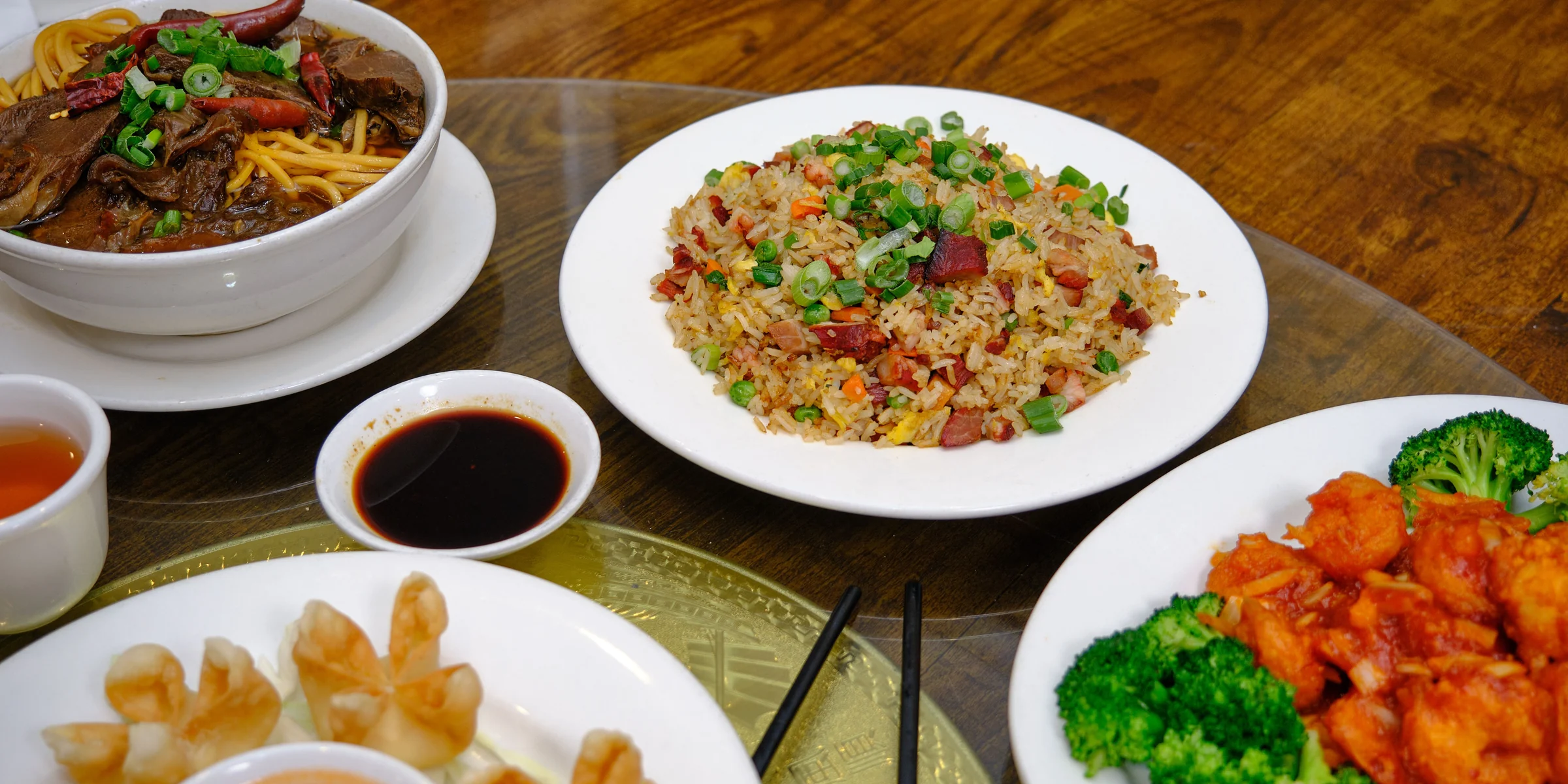
Regional Cuisines
Staples & Food Forms
Food Culture
How Chinese Food Works
Eating in China
What does “Chinese food” mean?
The phrase “Chinese food” can refer to food traditions within China, cuisines associated with Chinese communities abroad, or dishes adapted to ingredients and customers in another country. The intended meaning should be clear rather than treating these categories as interchangeable.
Cuisine inside China
Within China, culinary traditions include provincial and subregional styles, city-level food identities, ethnic and religious food traditions, home cooking, restaurant and banquet cooking, street and snack traditions, and contemporary innovation. These layers often overlap in the same city.
A national umbrella term
A national label is useful for orientation, but regional names are normally more informative. Sichuan, Cantonese, Shandong, Huaiyang, Yunnan, Xinjiang and Beijing food traditions differ substantially in ingredients, techniques, staples and flavour.
Traditional and contemporary food
“Traditional” does not mean unchanged. Ingredients and techniques travel; restaurants adapt; domestic cooking changes with equipment, work patterns and food supply. New dishes can still belong to Chinese culinary culture. Useful distinctions include historical, contemporary, regional, household, restaurant, diaspora and adapted forms — not a binary of “traditional” versus “modern fake” food.
Chinese Hot Pot
Regional styles, broths, ingredients and how to eat huǒguō
Meat, vegetables, tofu and regional trays
Clear, mala, beef-tallow and split pots
Ordering, cooking and shared-table etiquette
Mala broth systems and regional variation
Copper-pot mutton and northern clear broth
Regional cuisines of China
Regional cuisine in China may be organised by province, city, river basin, climate zone, staple crop, ethnic community or culinary lineage. The familiar Eight Great Cuisines classification is widely used, but it is not an exhaustive map of Chinese food. Official and educational materials often use the eight-cuisine framework for Shandong, Sichuan, Guangdong, Fujian, Jiangsu, Zhejiang, Hunan and Anhui traditions, while also recognising substantial internal subdivisions and additional regional cuisines. Treat the classification as an orientation framework, not a fixed scientific taxonomy.
| Culinary tradition | Chinese | Broad association | Useful starting characteristics | Required qualification |
|---|---|---|---|---|
| Shandong | 鲁菜 / 魯菜 | Shandong and northern banquet traditions | Soups, seafood, wheat foods and controlled heat | Contains multiple subregional styles |
| Sichuan | 川菜 | Sichuan | Layered flavour systems, chilli, Sichuan pepper and varied techniques | Not every Sichuan dish is intensely spicy |
| Cantonese | 粤菜 / 粵菜 | Guangdong | Fresh ingredients, roasting, steaming, soups and dim sum traditions | Guangdong contains distinct local traditions |
| Fujian | 闽菜 / 閩菜 | Fujian | Coastal and mountain ingredients, soups and seafood | Fuzhou, southern Fujian and other styles differ |
| Jiangsu | 苏菜 / 蘇菜 | Jiangsu | Refined cutting, braising, stewing and regionally varied styles | Huaiyang is one important component, not the whole province |
| Zhejiang | 浙菜 | Zhejiang | Seafood, vegetables and styles associated with Hangzhou, Ningbo and Shaoxing | Avoid reducing it to “light and delicate” only |
| Hunan | 湘菜 | Hunan | Chilli, smoked and preserved foods, sour and savoury flavours | Different from Sichuan cuisine |
| Anhui | 徽菜 | Anhui, particularly historical Huizhou traditions | Mountain ingredients, braising and stewing | “Hui cuisine” does not describe every Anhui dish identically |
The Eight Great Cuisines
The table above summarises the commonly cited eight culinary traditions. Chinese labels use simplified and, where relevant, traditional forms. These are useful starting points for reading menus and travel writing — not sealed borders or exclusive authenticity claims.
Important traditions outside the eight-cuisine model
The absence of a cuisine from the “Eight Great” list does not mean it is minor, recent or culturally unimportant. Beijing, Shanghai and Jiangnan, Yunnan, Guizhou, Xinjiang and Uyghur food traditions, Shaanxi, Shanxi, Henan, Hainan, Chaozhou / Chaoshan, Hakka, Tibetan food traditions, Inner Mongolian food traditions, and Korean Chinese food traditions are examples of important culinary environments that sit outside or across that eight-name framework. Ethnic-minority cuisines should not be compressed into one residual category.
Why regional boundaries remain imperfect
- Trade routes, migration and urbanisation move ingredients and cooks.
- Imperial, institutional and restaurant networks spread techniques.
- Interprovincial movement and changing food supply blur neat borders.
- Shared techniques appear in multiple regions under different names.
- Regional cuisine labels describe patterns, not sealed culinary borders.
Eight-cuisine orientation map (framework, not a complete map)
North / northeast association
- Shandong — 鲁菜
Central / Yangtze associations
- Anhui — 徽菜 · Jiangsu — 苏菜 · Zhejiang — 浙菜 · Hunan — 湘菜 · Sichuan — 川菜
Southeast / coastal associations
- Fujian — 闽菜 · Guangdong — 粤菜
Outside this eight-name frame (examples, not exhaustive)
- Beijing · Shanghai / Jiangnan · Yunnan · Guizhou · Xinjiang · Shaanxi · Shanxi · Henan · Hainan · Chaoshan · Hakka · Tibetan · Inner Mongolian · Korean Chinese
Staple foods, ingredients and geography
Staple-food patterns help explain Chinese culinary geography, but they should be described as tendencies rather than absolute divisions. Wheat and other grain-based foods have traditionally been especially prominent in many northern areas, while rice has traditionally been especially prominent in much of southern China. Academic research supports a broad northern wheat and southern rice pattern, while also showing substantial national and regional variation.
Rice-based foods
Steamed rice, congee, rice noodles, glutinous-rice foods, rice cakes and other regional rice products are central in many southern and southeastern meal patterns. Not every southern meal contains steamed rice, and rice foods also appear outside the south.
Other grains and starches
Millet, sorghum, corn, buckwheat, barley, potatoes, sweet potatoes, beans and pulses matter in many regional and historical diets. A rice-versus-wheat comparison alone is too narrow.
Geography and ingredients
Coast and inland settings, river and lake systems, mountain environments, tropical and temperate climates, seasonal preservation, livestock traditions, and local plants, fungi and herbs all shape what cooks can prepare. Climate alone did not create each cuisine; trade, migration and technique matter as well.
Staple-food spectrum (simplified historical pattern)
- More wheat- and millet-based traditions ← northern and northwestern patterns
- Mixed grain and rice traditions ← central and transitional regions
- More rice-based traditions ← southern and southeastern patterns
Chinese cooking techniques
Chinese culinary identity comes from technique as well as ingredients. Knife work, heat control, preparation order, texture and the treatment of sauces may matter as much as the named cooking method.
| Technique | Chinese term | General description | Important qualification |
|---|---|---|---|
| Stir-frying | 炒, chǎo | Rapid cooking in a heated pan or wok | Heat, batch size and ingredient order vary |
| Steaming | 蒸, zhēng | Cooking with steam | Used for fish, buns, dumplings, eggs and other foods |
| Boiling | 煮, zhǔ | Cooking in water or broth | Includes noodles, dumplings and many soups |
| Braising | 烧 / 燒, shāo | Cooking with liquid and seasoning after initial preparation | Covers multiple regional techniques |
| Red braising | 红烧 / 紅燒, hóngshāo | Soy- and seasoning-based braising associated with a reddish-brown finish | Recipes vary substantially |
| Stewing | 炖 / 燉, dùn | Longer, gentler cooking in liquid | Distinct traditions use different vessels and broths |
| Roasting | 烤, kǎo | Dry-heat cooking | Includes street, oven and specialist roasting traditions |
| Deep-frying | 炸, zhá | Cooking in hot oil | Often one stage in a multi-step dish |
| Pan-frying | 煎, jiān | Cooking against a heated surface with limited oil | Different from deep-frying |
| Smoking or curing | 熏 / 醃, xūn / yān | Preservation and flavour development | Methods vary by region |
Knife work and preparation
Uniform cutting, surface area, texture, cooking speed, bone and whole-fish preparation, and minced, sliced, shredded or diced forms shape how heat and seasoning act on food.
Heat control
High heat is important for some techniques, not all Chinese cooking. Slow simmering and steaming are equally significant. “Wok hei” belongs to particular Cantonese cooking contexts and should not be used as a universal measure of Chinese food quality.
Multi-stage cooking
One dish may combine blanching, frying, braising, steaming and final sauce reduction. Chinese cooking is not universally fast.
Cooking-technique matrix (orientation)
- Quick / higher heat — Stir-frying (炒) · Pan-frying (煎) · Deep-frying (炸) · some roasting (烤)
- Quick / moist — Boiling noodles or dumplings (煮) · quick steaming (蒸)
- Slower / moist — Braising (烧) · red braising (红烧) · stewing (炖) · longer steaming
- Preservation / flavour development — Smoking or curing (熏 / 醃)
How a Chinese meal is structured
A common meal pattern combines a staple food with one or more accompanying dishes. In group dining, several dishes may be shared, but meal structure varies between households, restaurants, regions, formal banquets and individual dining.
Staples and dishes
主食, zhǔshí, refers to staple foods. 菜, cài, refers to prepared dishes. Not every meal follows restaurant ordering conventions, and individual noodle or dumpling meals may blur the distinction.
Shared dining
Shared dishes are common in group dining. Individual bowls and small plates may be used; serving chopsticks may be provided; some meals and foods are individually portioned. Formal banquet order differs from an ordinary home meal.
Ordering for a group
Ask about dietary restrictions first. Choose a balance of vegetable, protein and staple foods; consider cooking methods and textures; avoid ordering several near-identical dishes unknowingly; confirm portion sizes; order additional dishes only when needed. Informal “diners plus one dish” rules are conventions in some restaurants, not universal laws.
Chopsticks and table conduct
Do not leave chopsticks standing vertically in a bowl. Do not use personal chopsticks to move food when serving utensils are provided. Observe the host or table before assuming formal rules. Ask rather than pretending to understand unfamiliar dishes.
Common meal-structure pattern
- Staple food — rice, noodles, buns or another grain food
- + Shared or individual dishes — vegetables, meat, fish, tofu, eggs or cold dishes
- + Optional soup, condiments, tea or fruit — depending on region and occasion
Festival, seasonal and symbolic foods
Food may connect family gatherings, agricultural seasons, ritual observance and popular symbolism. Associations vary by region and household, and festival foods are also commonly eaten outside their best-known festival.
| Occasion | Food commonly associated | Qualification |
|---|---|---|
| Spring Festival | Jiaozi in many northern traditions; niangao in multiple regions; fish and other reunion dishes | Practices vary substantially by region and household |
| Lantern Festival | Yuanxiao or tangyuan | Names, preparation and fillings vary |
| Dragon Boat Festival | Zongzi | Regional sweet and savoury forms differ |
| Mid-Autumn Festival | Mooncakes | Regional styles and fillings differ |
| Qingming | Qingtuan in parts of eastern and southern China | Not a universal national food |
| Winter Solstice | Dumplings or tangyuan in different regional traditions | Associations vary |
Spring Festival dumpling context
UNESCO nomination status
As of September 2026, the Chinese cuisine nomination remains part of UNESCO's 2026 evaluation cycle for the Representative List of the Intangible Cultural Heritage of Humanity. It is a pending nomination, not an inscription, and should not be treated as World Heritage or as already inscribed. Source: ich.unesco.org.
Chinese dishes and food categories to recognise
The following foods are useful reference points because they illustrate different regions, staples and cooking traditions. They are examples, not a definitive national menu or ranking.
| Dish | Chinese | Broad regional association | What it demonstrates |
|---|---|---|---|
| Jiaozi | 饺子 / 餃子 | Widespread; strong northern associations | Wheat wrapper, filled parcel, staple or shared dish |
| Baozi | 包子 | Widespread | Steamed filled bun as staple or snack |
| Mantou | 馒头 / 饅頭 | Many northern meal patterns | Plain steamed bun as staple |
| Peking duck | 北京烤鸭 / 北京烤鴨 | Beijing | Specialist roasting and banquet service |
| Char siu | 叉烧 / 叉燒 | Cantonese / Guangdong | Cantonese roasting and barbecue traditions |
| Red-braised pork | 红烧肉 / 紅燒肉 | Multiple regions | Red-braising technique and soy-based seasoning |
| Mapo tofu | 麻婆豆腐 | Sichuan | Tofu, chilli and Sichuan pepper in a sauce tradition |
| Kung pao chicken | 宫保鸡丁 / 宮保雞丁 | Sichuan associations | One Sichuan-associated dish, not the whole cuisine |
| Xinjiang lamb skewers | 羊肉串 | Xinjiang / Uyghur and related grill traditions | Central Asian–influenced roasting and spice profiles |
| West Lake vinegar fish | 西湖醋鱼 / 西湖醋魚 | Hangzhou / Zhejiang | Freshwater fish and Jiangnan sweet-sour finishing |
| Instant-boiled mutton | 涮羊肉 | Beijing | Communal hotpot-style dipping in clear broth |
| Zongzi | 粽子 | Multiple regions | Glutinous-rice festival and seasonal food |
Wheat foods and dumplings
- Jiaozi, baozi, mantou, noodles and bing or flatbreads.
- Chinese dumplings and jiaozi explained
Rice and rice-based foods
Steamed rice, congee, rice noodles, glutinous-rice preparations, zongzi and rice cakes illustrate rice as staple, snack or festival food.
Meat, poultry, fish, tofu and communal dishes
Meat and poultry examples such as Peking duck, char siu, red-braised pork, twice-cooked pork, kung pao chicken and Xinjiang lamb skewers belong to different culinary contexts. Fish and seafood traditions include steamed fish, West Lake vinegar fish, Cantonese poached seafood and Fujian soup traditions. Tofu, vegetables and cold dishes — including mapo tofu, home-style tofu, cold cucumber dishes, seasonal greens and pickled vegetables — show that Chinese cuisine is not inherently meat-heavy. Soups, hotpots and communal dishes include Sichuan or Chongqing hotpot, Beijing instant-boiled mutton, Cantonese soups and regional noodle soups.
Dish-category orientation
- Grain and staple foods
- Dumplings and buns
- Vegetables and tofu
- Meat and poultry
- Fish and seafood
- Soups and hotpots
- Preserved and fermented foods
- Festival foods
Chinese food in China and overseas
Chinese communities have adapted food traditions to new ingredients, labour conditions, customer expectations and local histories. Chinese American, British Chinese, Peruvian Chinese, Indian Chinese and other diaspora cuisines are legitimate culinary traditions, but they should not be treated as identical to contemporary regional cuisines within China.
Adaptation is not simply inauthenticity
Migration changes available ingredients. Restaurant businesses respond to local customers. Dishes can acquire new names and forms. Some overseas dishes have no exact equivalent in China. Some regional dishes became internationally familiar through migration patterns. Difference does not automatically mean inferiority or deception. The relevant question is which culinary tradition a dish belongs to.
Why visitors may be surprised in China
Menus are often organised by ingredient or cooking style. Familiar takeaway dishes may be absent. Sweetness, chilli, oil and portion expectations vary. Rice may not automatically accompany northern wheat-based meals. One restaurant often specialises in one regional or product category.
How to explore Chinese food in China
A useful food plan begins with the city or region being visited. Beijing, Chengdu, Guangzhou, Xi’an, Shanghai, Hangzhou, Kunming and Kashgar represent different food environments and should not be approached with one national checklist.
Start with a region, not a generic list
Match dishes and meal formats to the destination’s regional and local traditions rather than collecting “must-eat China” items from a single list.
Combine dish types
Balance a staple-food experience, a vegetable or tofu dish, a local protein or speciality, a snack or breakfast, a shared or communal meal, and a market, class or guided context where appropriate. There is no required number of meals.
Ask precise questions
Ask what region a dish is associated with; whether it is normally shared; whether it contains pork, shellfish, egg, dairy or peanuts; whether heat comes mainly from chilli, peppercorn or another seasoning; whether rice is included or ordered separately; whether it is a main meal, staple, snack or dessert; and whether it is seasonal.
Dietary requirements
Dietary labels do not always map cleanly across languages and kitchens. Confirm ingredients and preparation rather than relying only on the English dish name. Vegetarian, vegan, halal, gluten, shellfish, peanuts and tree nuts, sesame and soy all need explicit confirmation. Cross-contact cannot be guaranteed away from specialised kitchens. This is not medical advice.
Food activities in Beijing
Compare food tours, cooking classes and hosted meals in Beijing. What to expect from a Beijing dumpling-making class.
- Chinese dumplings and jiaozi explained
- Compare Beijing food experiences
- What to expect from dumpling making in Beijing
- Dumpling making for kids and families
- Compare Beijing cultural activities
- See the hosted hutong and dumpling experience
- Beijing Food Guide: dishes and local cuisine
- Chinese tea types, culture and brewing
- Traditional Chinese medicine theory and treatments
- Sichuan cuisine guide
- Cantonese cuisine and dim sum
- Chinese noodles guide
- Famous dishes orientation
- Xi'an Food Guide: noodles, street snacks and Muslim Quarter
- Chinese alcohol & wine: baijiu, huangjiu, rice wine
Chinese food FAQ
- Chinese food is a broad category containing many regional, local, ethnic, household and contemporary culinary traditions. It cannot be represented accurately by one flavour, ingredient or menu.
- The commonly cited Eight Great Cuisines are Shandong, Sichuan, Cantonese, Fujian, Jiangsu, Zhejiang, Hunan and Anhui. The framework is useful for orientation but does not include every important Chinese culinary tradition.
- No. Chilli and other pungent seasonings are important in several regional cuisines, but many Chinese dishes are mild, savoury, sweet, sour, aromatic or focused on the natural flavour and texture of the ingredients.
- No. Rice has traditionally been especially prominent in much of southern China, while wheat-based foods such as noodles, breads, buns and dumplings have traditionally been especially prominent in many northern areas. Modern diets and regional patterns are more varied than this simple division.
- The terms are often interchangeable in English. “Chinese cuisine” may sound more formal, while “Chinese food” may refer broadly to dishes, meals and culinary traditions.
- Common techniques include stir-frying, steaming, boiling, braising, stewing, roasting, pan-frying, deep-frying, smoking and curing. Different regions use these techniques in different ways.
- Shared dishes are common in group and family dining, but meals may also contain individually portioned noodles, rice bowls, dumplings, snacks or set meals. The format depends on region, venue and occasion.
- Start with foods associated with the destination rather than one national checklist. Try a local staple, vegetable or tofu dish, regional speciality, snack or breakfast, and one meal that shows how dishes are shared or served in context.
- It may be. Overseas Chinese cuisines developed through migration, local ingredients and customer demand. They are related to food traditions from China but may contain dishes and formats that developed primarily in diaspora communities.
- A broad historical pattern associates more wheat- and millet-based staple foods with many northern areas and more rice-based traditions with much of the south. Flavour, ingredients and cooking methods vary at a much finer regional level, so the north–south distinction is only a starting point.