
| Technique | Chinese (pinyin) | What it does | Traveler note |
|---|---|---|---|
| Stir-frying | 炒 (chǎo) | Rapid cooking in hot oil with constant movement | Batch size and heat vary; not all Chinese food is “quick wok” |
| Quick stir-fry / burst stir-fry | 爆 (bào) | Very high heat, short time | Often for tender meat and vegetables |
| Dry stir-fry | 干煸 (gānbiān) | Stir-fry with little liquid until edges crisp | Sichuan examples—see Sichuan Cuisine |
| Steaming | 蒸 (zhēng) | Cook with steam heat | Fish, buns, dumplings, eggs—Cantonese strength |
| Boiling / parboiling | 煮 (zhǔ) | Cook in water or broth | Noodles, dumplings, blanching before other steps |
| Braising / red braising | 烧 / 红烧 (shāo / hóngshāo) | Simmer with seasoned liquid after searing | Soy–sugar “red” colour in hóngshāo |
| Stewing | 炖 / 燉 (dùn) | Gentle long cook in liquid | Soups, braised meats, hotpot-adjacent pots |
| Roasting / baking | 烤 (kǎo) | Dry heat | Peking duck, char siu, oven breads |
| Deep-frying | 炸 (zhá) | Submerge in hot oil | Often one stage before saucing |
| Pan-frying | 煎 (jiān) | Cook on flat surface with limited oil | Potstickers, egg pancakes |
| Smoking / curing | 熏 / 腌 (xūn / yān) | Smoke or salt/pickle for flavour and preservation | Hunan, Sichuan and northern preserved meats |
| Pickling | 泡 / 酸菜 (pickle traditions) | Ferment or brine vegetables | Hotpot and noodle soup accents |
| Poaching | 白灼 (báizhuó) | Gentle boil in plain or lightly seasoned water | Cantonese seafood—minimal sauce at table |
| Double-cook | 回锅 (huíguō) | Boil or steam first, then stir-fry | Twice-cooked pork is the famous example |
Technique names on menus are not guarantees of one fixed method—restaurants adapt equipment, gas pressure and portion size.
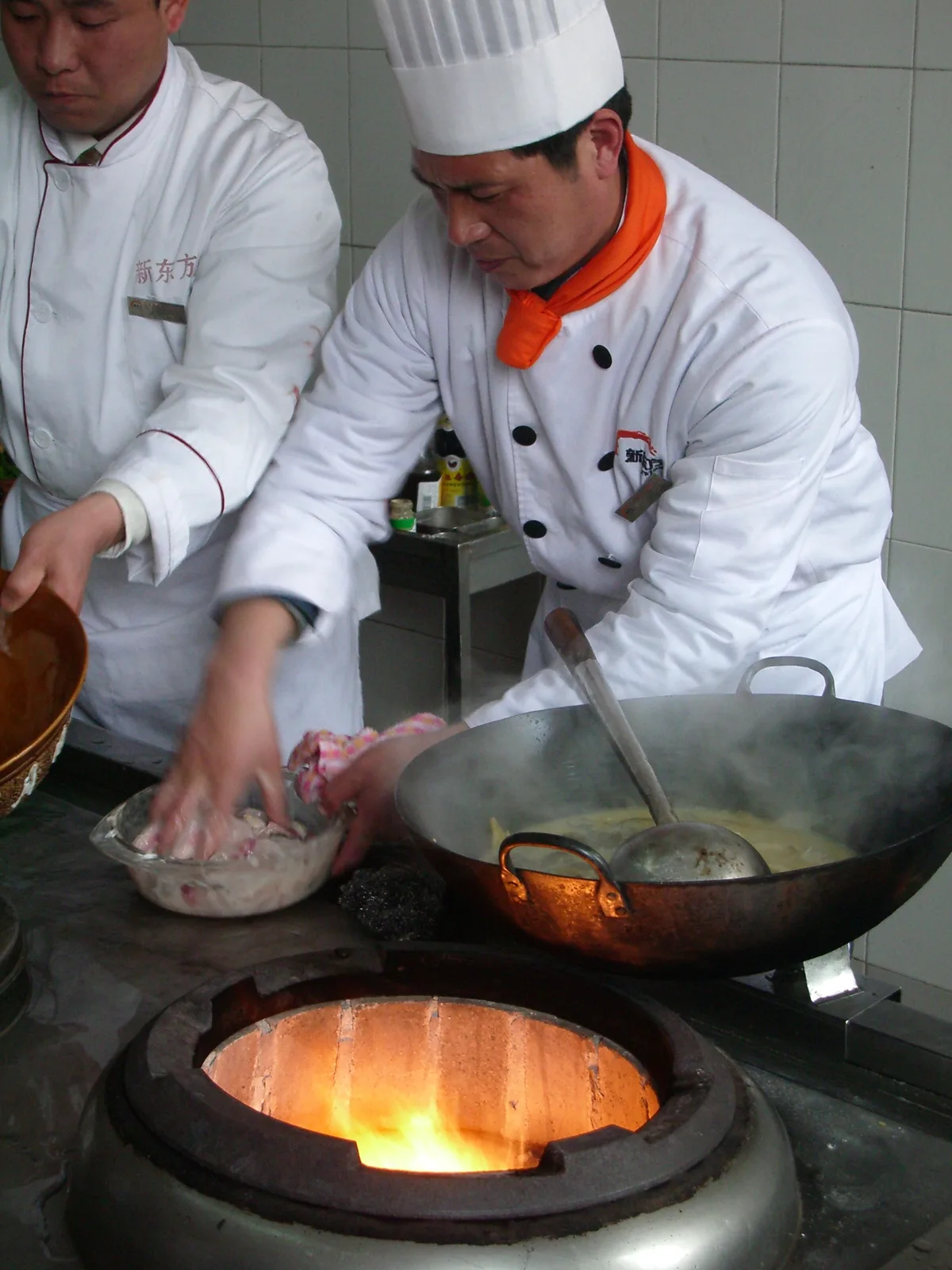
*Ingredients are tossed rapidly over high heat during wok cooking.*
Why Technique Matters as Much as Ingredients
Chinese culinary identity combines 刀工 (dāogōng, knife work), 火候 (huǒhòu, heat control) and 调味 (tiáowèi, seasoning timing). Two restaurants can use the same soy sauce and chicken but produce different kung pao because of cut size, wok heat, when vinegar enters the pan and how long peanuts stay crisp.
Travelers benefit from technique vocabulary when:
- Choosing between steamed versus fried versions of a similar ingredient.
- Understanding why hotpot is a meal format built on boiling at the table.
- Reading banquet menus where braised prestige dishes sit beside quick stir-fries.
Stir-Frying and Wok Heat
Stir-frying (炒) is rapid cooking in a curved pan with oil and aromatics. Variants include dry stir-fry (干煸) with minimal liquid and burst stir-fry (爆) at very high heat.
Wok hei (镬气)—breath of the wok—is discussed in Cantonese roasting and stir-fry contexts as a desirable smoky aroma from high heat. It is not a universal quality metric for all Chinese food; steamed fish and slow braises intentionally avoid it.
Home and restaurant kitchens may use flat-bottom woks, induction, or deep pots where gas flame woks are unavailable—technique adapts to equipment.
Steaming
Steaming (蒸) preserves moisture and delicate flavour—whole fish, dim sum dumplings, baozi and egg custards. Cantonese kitchens especially treat steaming as a primary technique, not a diet alternative.
Travel tip: steamed dishes may arrive plain, with soy and oil added at the table—taste before salting.
Boiling, Blanching and Noodle Cookery
Boiling (煮) covers noodle shops, dumpling pots and soup bases. Many multi-step dishes blanch meat or vegetables before stir-frying or saucing to control odour and texture.
Lanzhou beef noodles, hotpot and breakfast congee all sit in boiling logic—see Chinese Noodles.
Braising, Red Braising and Stewing
Braising (烧) and red braising (红烧) simmer ingredients in seasoned liquid after initial browning. Red-braised pork belly (红烧肉) appears across regions with different sweetness and soy profiles.
Stewing (炖) implies longer, gentler cooking—old fire soups (老火汤) in Cantonese families, clay-pot dishes in Jiangnan. One meal may include both a quick stir-fry and a slow stew.
Roasting and Barbecue
Roasting (烤) includes Peking duck, Cantonese siu mei (烧味) roast meats and oven breads. Open flame, hanging oven and closed oven each produce different skin texture.
Regional depth: Cantonese Cuisine · Beijing Peking duck.
Frying: Deep and Shallow
Deep-frying (炸) creates crisp shells—sweet-sour pork, fried tofu, youtiao. Pan-frying (煎) uses less oil for potstickers and egg pancakes. Many dishes fry briefly then sauced in a separate step.
Smoking, Pickling and Preservation
Smoking (熏) and pickling (腌 / 泡) build flavour and shelf life—Hunan smoked meats, Sichuan pickled mustard greens (酸菜), northern preserved vegetables. Preserved ingredients often appear inside hotpot broths and noodle soups, not only as sides.
Ingredient context: Ingredients, Sauces & Flavours.
Multi-Stage Cooking
One dish commonly chains techniques:
- Marinate protein.
- Blanch or deep-fry.
- Stir-fry aromatics and paste.
- Braise or reduce sauce.
Twice-cooked pork (回锅肉) literally returns to the wok after initial boiling. Travelers should not assume Chinese cooking is always fast—banquet prep can be slow even when final stir-fry is quick.
Knife Work and Texture
Uniform slices, julienne vegetables and cross-hatched cucumber are functional—not decorative. Cut shape controls how fast ingredients cook and how sauce clings.
Texture targets include 脆 (crisp), 嫩 (tender), 爽 (refreshing bite) and 滑 (silky)—menus sometimes encode texture in dish names.
Heat Control Spectrum
| Speed | Moist | Examples |
|---|---|---|
| Fast | Dry-ish | Stir-fry, dry-fry, roast |
| Fast | Wet | Boiled noodles, quick poach |
| Slow | Wet | Braise, stew, soup |
| Slow | Dry-ish | Smoke, cure, dehydrate |
Axes overlap by recipe—technique labels describe tendencies.
How Techniques Map to Regional Cuisines
| Region guide | Techniques often highlighted |
|---|---|
| Sichuan Cuisine | Dry-fry, pickle, smoke, hotpot boil |
| Cantonese Cuisine | Steam, poach, roast, slow soup |
| Shandong Cuisine | Quick stir-fry, deep-fry, broth clarity |
| Hunan Cuisine | Smoke, steam with chilli, stir-fry |
| Jiangsu / Zhejiang | Braise, slow reduction, fine knife work |
The Chinese Food hub compares regional frameworks; Famous Chinese Dishes shows technique through named plates.
Communal Techniques: Hotpot and Instant-Boil
Hotpot (火锅) and instant-boiled mutton (涮羊肉) delegate final cooking to diners at the table—broth technique and dipping-sauce design matter as much as raw ingredients.
Beijing copper-pot mutton: Beijing hotpot. Sichuan chilli hotpot: Sichuan Cuisine.
Clay Pots, Steamers and Equipment
Technique names imply equipment:
- Clay pot (沙锅 / 煲) for gentle stewing and rice casseroles.
- Bamboo steamers stacked for dim sum service.
- Hanging ovens for Peking duck and siu mei roasts.
- Copper hotpot for Beijing mutton—conductivity and presentation matter.
Restaurants may substitute modern equivalents; the technique label on the menu still signals intended texture and sauce concentration.
Banquet vs Home vs Street
The same technique produces different dishes by context:
| Context | Technique emphasis |
|---|---|
| Banquet | Slow braise, whole fish steam, spectacle roast |
| Home | Quick stir-fry, one-pot stew, leftover refry |
| Street | Deep-fry, griddle pan-fry, boil-to-order noodles |
| Canteen | Steam trays, large-batch stir-fry |
Travelers eating mostly in restaurants experience restaurant-weight oil and salt—home cooking is often lighter.
Reading Menus by Technique
Menus organised by ingredient (beef, tofu, vegetables) still encode technique in Chinese names:
- 干煸 (gān biān)—dry-fry.
- 红烧 (hóng shāo)—red braise.
- 清炒 (qīng chǎo)—light stir-fry.
- 白切 (bái qiē)—plain boil/slice, dip sauce.
- 口水 (kǒu shuǐ)—“mouthwatering” chilli oil cold dish.
Learning a dozen technique characters helps more than memorising every dish name in English translation apps.
Travel Learning: Classes and Markets
Food-focused itineraries sometimes include cooking classes or market walks—useful for seeing how techniques chain in real time (knife work → wok heat → sauce reduction). Beijing experience formats: Beijing food experiences. Technique vocabulary from this page makes those sessions easier to follow without expecting one demo to represent all of China.
Compare technique emphasis across regions on the Chinese Food hub before assuming one cooking class defines “how Chinese people cook.”
What This Page Does Not Cover
This is not a recipe book or equipment buying guide. DragonTrail does not rank wok brands or promise that home induction reproduces restaurant wok hei. For sauce and pantry vocabulary, see Ingredients, Sauces & Flavours.
FAQ
What is the most common Chinese cooking technique?
Stir-frying is widely used, but steaming, boiling and braising are equally central—region and dish type decide.
What does red braising mean?
红烧 (hóngshāo) usually means soy–sugar braising that colours meat reddish-brown—recipes vary by region and household.
Is all Chinese food cooked in a wok?
No. Steaming baskets, soup pots, clay vessels and ovens are standard—many meals never touch a wok.
What is twice-cooked pork?
回锅肉—pork boiled or steamed, then sliced and stir-fried with leek and bean paste; a Sichuan home-style classic.
What is wok hei?
A desirable smoky aroma from high-heat stir-fry in Cantonese contexts—not a universal standard for judging all Chinese food.
How does hotpot relate to “cooking technique”?
Hotpot is communal boiling at the table—broth building and dip sauces are kitchen techniques even if diners cook the final minute.
Where can I see techniques on a plate?
Famous Chinese Dishes links named dishes to regions; regional guides explain local emphasis.
Continue with Chinese Food
- Chinese Food guide
- Famous Chinese Dishes
- Ingredients, Sauces & Flavours
- Chinese Noodles
- Dining Etiquette in China
Regional cuisine guides
- Sichuan Cuisine
- Cantonese Cuisine
- Hunan Cuisine
- Shandong Cuisine
Experience food in Beijing
Sources & Review
- UNESCO — Chinese cuisine nomination (2026 evaluation cycle)
- Chinese culinary education materials on Eight Great Cuisines technique framing
- Fuchsia Dunlop, *Every Grain of Rice* and *Land of Plenty* — technique in home and Sichuan contexts
- Chinese characters verified
- Author: DragonTrail editorial
- Last reviewed: August 2026