
Sichuan hot pot is a regional tradition rather than one fixed dish: diners cook meat, offal, tofu, vegetables and other ingredients in a shared broth, often built around chilli and Sichuan pepper. Chengdu is a major center of Sichuan hot pot, while neighboring Chongqing has a closely related but distinct hot pot tradition. Broth strength, oil level and ingredient range vary widely by restaurant.
| Item | Answer |
|---|---|
| Chinese | 四川火锅 (Sìchuān huǒguō) |
| Core flavor system | Mala (麻辣)—chilli heat plus Sichuan-pepper numbing |
| Key cities | Chengdu; closely related neighboring Chongqing tradition |
| Broth base | Usually chilli oil and/or beef tallow, though mild broths exist |
| Typical format | Shared pot, à la carte ingredients, self-serve dipping sauce |
| Related pages | Mala Hot Pot, Chengdu vs Chongqing |
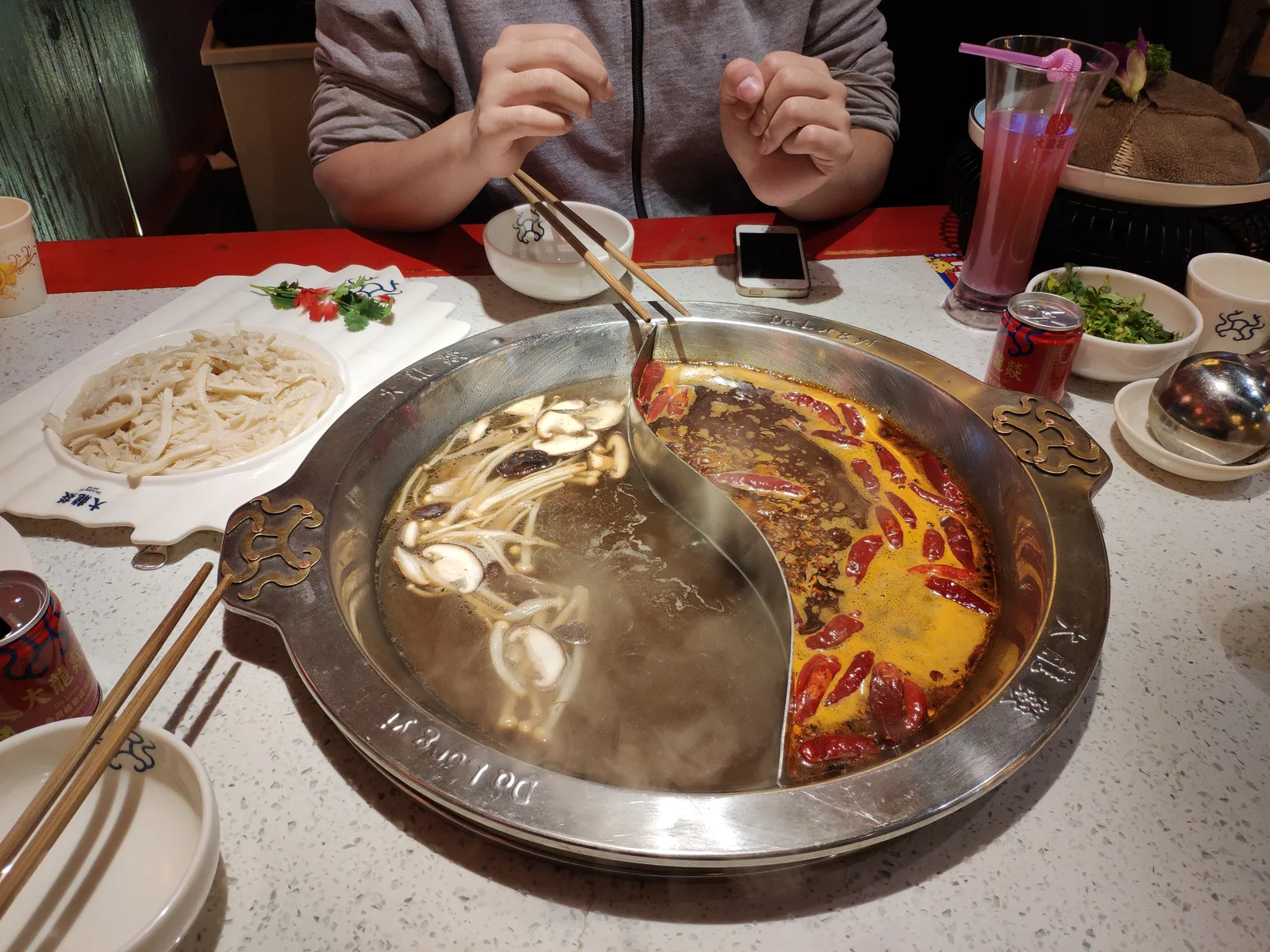
*A yuanyang hotpot lets diners cook ingredients in both spicy and mild broths.*
Sichuan Hot Pot as a Regional Umbrella
"Sichuan hot pot" is best understood as an umbrella term for a shared style of cooking practiced across Sichuan Province and, closely related, in neighboring Chongqing—rather than a single standardized recipe served identically everywhere. The style shares a core pantry (chilli, doubanjiang, Sichuan pepper, beef tallow or vegetable oil) and a core format (shared pot, self-cooked ingredients, sauce bar), but broth intensity, offal use and ingredient range differ meaningfully between a neighborhood shop and a large specialist chain, and between cities within the region. Travelers should treat any single restaurant's version as one example of the style, not the definitive one.
Mala: The Defining Flavor System
The flavor most associated with Sichuan hot pot is mala (麻辣)—chilli heat (辣, là) combined with the numbing, tingling sensation of Sichuan pepper (麻, má). Mala is a flavor profile applied across many Sichuan dishes, not a synonym for Sichuan food generally, and not every Sichuan hot pot broth is aggressively spicy—restaurants commonly offer clear, tomato or mushroom broths alongside a mala option. See Mala Hot Pot for a full breakdown of the two sensations and how mala differs from related dishes such as malatang.
Sichuan Cuisine's Wider Pantry
Hot pot draws on the same core ingredients as Sichuan cuisine more broadly: doubanjiang (fermented broad bean paste), dried chillies, Sichuan pepper, garlic, ginger and scallion. Diners who try Sichuan hot pot are tasting one application of a pantry that also produces stir-fries, cold dishes, noodle dishes and snacks throughout the province. Understanding hot pot as part of this wider system helps explain why the same numbing-spicy flavor shows up well beyond the hot pot table.
Chengdu and Chongqing: The Two Reference Cities
Chengdu and Chongqing are the two cities travelers most associate with Sichuan-style hot pot, and their versions overlap heavily—chilli oil, beef tallow, Sichuan pepper and shared-pot dining are common to both. General tendencies exist (Chongqing is often described as heavier and more offal-forward on average; Chengdu is often described as a touch milder), but these are tendencies, not fixed rules, and individual restaurants in either city can run in either direction. See Chengdu Hot Pot and Chongqing Hot Pot for city-specific guides, and Chengdu vs Chongqing Hot Pot for a direct side-by-side comparison.
Broth Options Within Sichuan-Style Hot Pot
| Broth style | What it is | Spicy? |
|---|---|---|
| Chilli-oil / beef-tallow (红汤, mala) | The classic base—chilli, Sichuan pepper, tallow or vegetable oil | Yes, adjustable intensity |
| Clear broth (清汤) | Bone or vegetable stock without chilli | No |
| Tomato or mushroom broth | Milder alternatives many restaurants also offer | No |
| Split pot (鸳鸯锅, yuānyāng guō) | Two broths divided in one pot | One side only |
Restaurants vary in how oily or intense their base runs even within the same broth category—see Hot Pot Broths & Soup Bases for the full national picture.
Typical Ingredients
Sichuan-style hot pot menus tend to run wider than Beijing-style menus, commonly including offal alongside standard meats and vegetables:
- Meat—thin-sliced beef, lamb and pork.
- Offal (optional)—beef tripe (毛肚), duck blood (鸭血), duck intestine (鸭肠).
- Tofu and soy—fresh tofu, frozen tofu, tofu skin.
- Vegetables—lotus root, potato, enoki and other mushrooms, leafy greens.
- Starches—wide flour noodles, sweet potato noodles, instant noodles.
Offal is a well-known part of the tradition but is ordered à la carte—travelers who prefer to skip it can build a complete meal from meat, tofu and vegetables. See Hot Pot Ingredients for the full national ingredient breakdown.
Dipping Sauce
Sichuan-style hot pot is commonly eaten with a sesame-oil-based dip (油碟, yóudié), mixed with garlic, cilantro and scallion at a self-serve sauce bar. The oil serves a practical function—cooling ingredients fresh out of hot broth and softening the chilli hit—separate from any dry spice mix (蘸料) some diners add on top.
Ordering Spice Level
Common phrases for adjusting spice apply consistently across Sichuan-style restaurants:
- Bù là (不辣)—not spicy.
- Wēi là (微辣)—mild.
- Zhōng là (中辣)—medium.
- Tè là (特辣)—very spicy.
Staff can usually calibrate a broth's chilli level on request, but "mild" is not standardized—a "not spicy" order can still carry background chilli-oil aroma unless a fully clear broth is chosen. Heat-sensitive first-timers should default to a clear broth or a split pot rather than assuming a "medium" request will feel genuinely mild.
Dietary Notes
Sichuan-style broths, including clear options, are typically made with meat or bone stock unless a restaurant explicitly states otherwise—do not assume any broth is vegetarian without asking. Beef tallow and animal fat are common base ingredients in mala broth specifically. See Vegetarian & Vegan Hot Pot and Halal Hot Pot for what to confirm before ordering.
Common Misconceptions
- "Sichuan hot pot is always extremely spicy." Mild broths are commonly available alongside mala options.
- "Chengdu and Chongqing hot pot are identical." They overlap heavily but differ in typical intensity and offal emphasis—see the Chengdu vs Chongqing comparison.
- "Every Sichuan-style hot pot restaurant serves the same broth." Oil level, chilli intensity and ingredient range vary restaurant to restaurant, even within the same city.
FAQ
What is Sichuan hot pot?
Sichuan hot pot is a regional hot pot tradition from Sichuan Province, most often built on a chilli-and-Sichuan-pepper mala broth, in which diners cook raw ingredients themselves in a shared pot and dip cooked food in a self-mixed sauce.
Is Sichuan hot pot the same as Chongqing hot pot?
They overlap heavily and share the same core pantry, but restaurants and general tendencies differ—Chongqing is often described as heavier and more offal-forward, Chengdu as slightly milder on average. See Chengdu vs Chongqing Hot Pot.
Is all Sichuan hot pot spicy?
No. Most Sichuan-style restaurants also offer clear, tomato or mushroom broths, and split (yuānyāng) pots let a table order both a mild and a spicy side at once.
What is mala and how does it relate to Sichuan hot pot?
Mala (麻辣) is the numbing-plus-spicy flavor system most associated with Sichuan hot pot, combining Sichuan pepper's numbing sensation with chilli heat. See Mala Hot Pot for the full breakdown.
What ingredients are common in Sichuan hot pot?
Thin-sliced meat, offal such as tripe and duck blood, tofu and soy products, mushrooms, leafy and root vegetables, and noodles. See Hot Pot Ingredients.
Do I have to eat offal at a Sichuan hot pot restaurant?
No. Offal is ordered à la carte and is optional—a complete meal can be built from meat, tofu and vegetables alone.
Can I get a mild Sichuan-style hot pot?
Yes—ask for a clear broth, request 微辣 (mildly spicy), or order a split pot with one non-spicy side.
Continue with Chinese Hot Pot
- Chinese Hot Pot guide
- Mala Hot Pot
- Chengdu vs Chongqing Hot Pot
- Hot Pot Broths & Soup Bases
- Sichuan Cuisine
City hot pot guides
Sources & Review
- Chinese Culinary Association — Eight Great Cuisines educational framework (Sichuan cuisine context)
- Fuchsia Dunlop, *Land of Plenty* — Sichuan pantry and hot pot background
- Chinese characters verified
- Author: DragonTrail editorial
- Last reviewed: August 2026