
These representative Chinese dishes are useful reference points because travelers encounter them on menus, in regional food writing and in overseas Chinese restaurants. They are not a ranked “best of China” list: names, recipes and serving styles vary by region, and the same English label may describe different versions in Chengdu, Guangzhou or San Francisco. Use this guide to recognise dishes, connect them to their regional context and decide what to try.
| Dish | Chinese | Region | What it is | Traveler note |
|---|---|---|---|---|
| Peking duck | 北京烤鸭 | Beijing | Roast duck with crisp skin, carved tableside; pancakes, scallion, sweet bean sauce | City speciality—see Beijing food; not a national everyday dish |
| Jiaozi / dumplings | 饺子 | North & nationwide | Wheat wrappers filled with meat or vegetables; boiled, steamed or pan-fried | Strong northern association; Chinese Dumplings |
| Baozi | 包子 | Nationwide | Steamed filled buns; savoury or sweet | Breakfast and snack staple; fillings vary |
| Mantou | 馒头 | North | Plain steamed wheat bun | Staple, not a “side bread” in the Western sense |
| Char siu | 叉烧 | Cantonese / Guangdong | Barbecued marinated pork | Gateway Cantonese roast; Cantonese Cuisine |
| Dim sum (assorted) | 点心 | Cantonese | Small plates for tea meal—dumplings, buns, rolls | Brunch culture; Dim Sum |
| Mapo tofu | 麻婆豆腐 | Sichuan | Tofu in spicy bean sauce with minced meat, chilli, Sichuan pepper | Iconic but not every Sichuan dish is this hot; Sichuan Cuisine |
| Kung pao chicken | 宫保鸡丁 | Sichuan associations | Stir-fried chicken, peanuts, dried chilli | Diaspora versions often milder and sweeter |
| Twice-cooked pork | 回锅肉 | Sichuan | Boiled then stir-fried pork with leek and bean paste | Home-style classic; good heat calibration dish |
| Sichuan hotpot | 四川火锅 | Sichuan / Chongqing | Communal pot; diners cook ingredients in broth | Split spicy/mild broth common; time-consuming meal |
| Red-braised pork | 红烧肉 | Multiple regions | Soy–sugar braised pork belly | “Hong shao” technique; sweetness varies |
| Dongpo pork | 东坡肉 | Zhejiang / Jiangnan | Slow-braised pork belly, square-cut | Hangzhou banquet association; Zhejiang Cuisine |
| West Lake vinegar fish | 西湖醋鱼 | Zhejiang (Hangzhou) | Freshwater fish, sweet-sour glaze | Mild, sauced fish; ask about bone structure |
| Steamed fish | 清蒸鱼 | Cantonese / coastal | Whole fish steamed with ginger, scallion, soy | Freshness is the point; Cantonese Cuisine |
| Buddha jumps over the wall | 佛跳墙 | Fujian | Luxury soup with multiple sea and land ingredients | Banquet dish; not casual lunch |
| Fish fragrant eggplant | 鱼香茄子 | Sichuan | Eggplant in garlic–ginger–chilli sauce (often no fish) | “Fish-fragrant” flavour label, not seafood |
| General Tso's chicken | 左宗棠鸡 | US–Taiwan restaurant lineage | Fried chicken in sweet-spicy glaze | Often absent in mainland China; not a classic national dish |
| Lanzhou beef noodles | 兰州牛肉面 | Northwest / nationwide chains | Hand-pulled wheat noodles in clear beef broth | Halal shops common; see Halal & Muslim Food |
| Biangbiang noodles | biangbiang面 | Shaanxi | Wide belt-like hand-pulled noodles, chilli oil | Xi’an street and shop speciality; Shaanxi Cuisine |
| Instant-boiled mutton | 涮羊肉 | Beijing | Thin mutton slices swished in copper pot broth | Winter communal meal; Beijing food |
| Zongzi | 粽子 | Multiple regions | Glutinous rice parcels, often bamboo-leaf wrapped | Dragon Boat Festival association; sweet/savoury varies |
| Yangzhou fried rice | 扬州炒饭 | Jiangsu | Fried rice with varied proteins and vegetables | “Yangzhou” implies refined dice; not generic takeaway |
| Crossing-the-bridge noodles | 过桥米线 | Yunnan | Hot broth with separately added rice noodles and toppings | DIY assembly; Yunnan Cuisine |
| Lamb skewers | 羊肉串 | Xinjiang / Northwest | Cumin-spiced grilled lamb on skewers | Night-market staple; Xinjiang & Northwest Food |
| Big plate chicken | 大盘鸡 | Xinjiang | Chicken and potato stew, often with belt noodles | Sharing dish; Central Asian influence |
| Shandong braised sea cucumber | 葱烧海参 | Shandong | Sea cucumber braised with scallion | Banquet prestige ingredient; Shandong Cuisine |
| Hunan steamed fish head with chilli | 剁椒鱼头 | Hunan | Fish head steamed with chopped salted chilli | Fresh chilli emphasis; Hunan Cuisine |
| Anhui stinky tofu | 臭豆腐 | Anhui / street food widespread | Fermented tofu, deep-fried | Strong aroma; street contexts vary in hygiene |
This table is not a ranking. It mixes banquet dishes, home cooking, street food and diaspora-famous names so travelers can decode menus—not so DragonTrail can crown a single “national dish.”
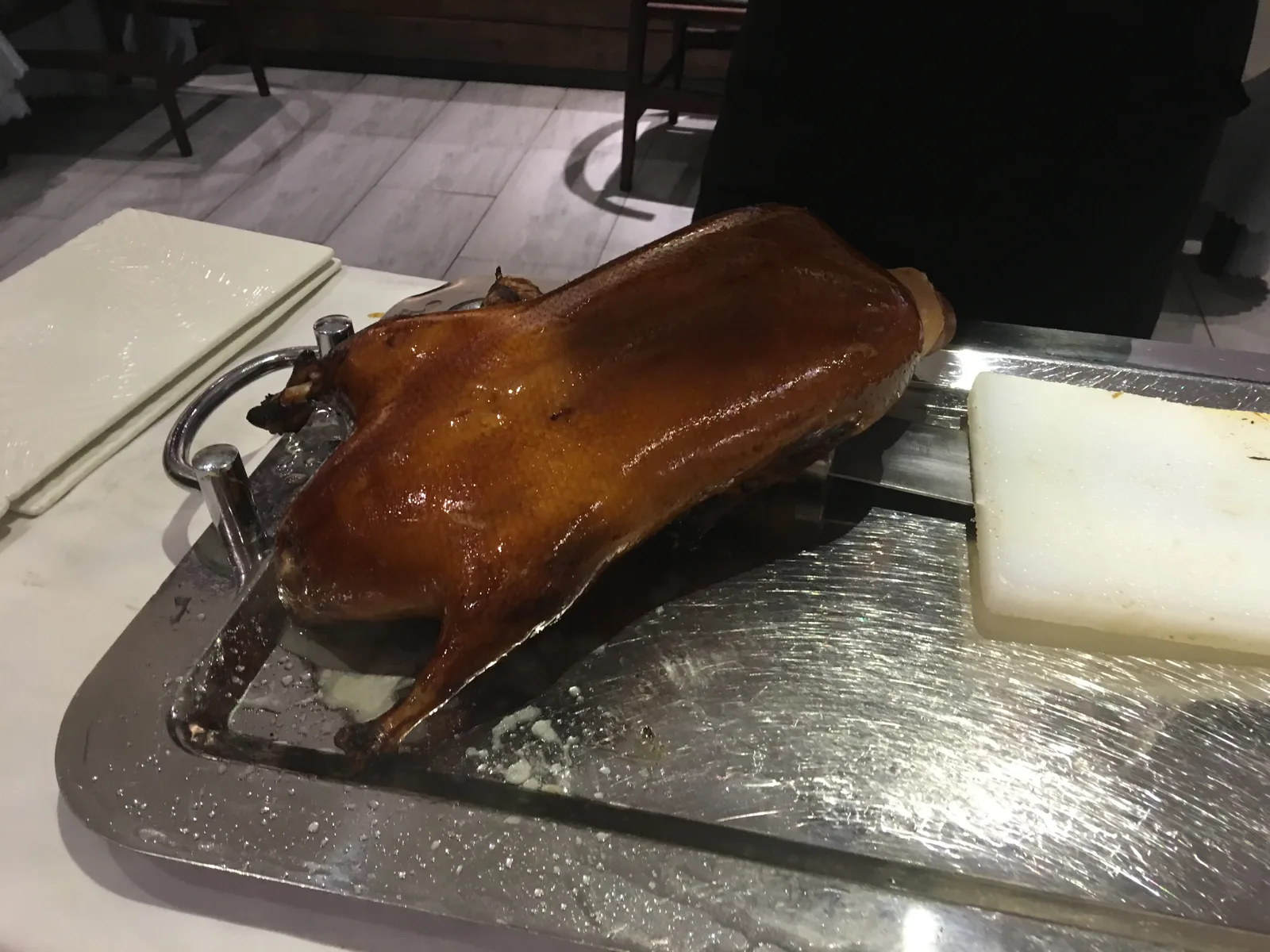
*Peking duck (北京烤鸭) plated for service—an iconic Beijing restaurant dish illustrating roast technique and banquet presentation. DragonTrail editorial image.*
How to Use This List
Three questions help more than memorising names:
- Which region or city am I in? Order what that place is known for—Peking duck in Beijing, dim sum in Guangzhou, rice noodles in Kunming—not a national greatest-hits reel.
- Is this dish local, regional or diaspora-famous? General Tso's chicken and some sweet-and-sour formats are primarily overseas menu items.
- What technique or meal format does it show? Hotpot is communal; dim sum is tea-meal small plates; jiaozi show wheat-staple culture.
For regional depth, use the Eight Great Cuisines child guides and major traditions outside that frame on the Chinese Food hub.
Wheat Staples: Dumplings, Buns and Noodles
Northern and northwestern meal patterns historically centre wheat—jiaozi, baozi, mantou, hand-pulled noodles and flatbreads. These are often staple foods, not side dishes.
- Jiaozi appear at family gatherings and Spring Festival tables in many northern traditions—Chinese Dumplings.
- Baozi and mantou anchor breakfast and canteen meals nationwide with regional filling styles.
- Lanzhou beef noodles and biangbiang illustrate noodle-shop culture—overlap with Chinese Noodles and Chinese Breakfast.
Rice, South and Coast
Southern and southeastern patterns more often centre steamed rice with shared dishes, plus rice noodles, congee and glutinous-rice festival foods.
- Crossing-the-bridge noodles show Yunnan rice-noodle assembly—Yunnan Cuisine.
- Steamed whole fish and Cantonese roast meats illustrate fresh-ingredient coastal logic—Cantonese Cuisine.
- Zongzi and mooncakes connect food to calendar festivals—Festival & New Year Foods.
Sichuan and Hunan: Heat, Numbing and Smoke
Sichuan (川菜) and Hunan (湘菜) are both chilli-associated but not interchangeable. Sichuan often layers Sichuan pepper (花椒, huājiāo) numbing with fermented pastes; Hunan more often emphasises fresh chilli, smoking and sour notes.
Representative Sichuan entries: mapo tofu, kung pao chicken, twice-cooked pork, fish fragrant eggplant, hotpot. Hunan example: steamed fish head with chopped chilli. Deep dives: Sichuan Cuisine · Hunan Cuisine.
Cantonese and Fujian: Coast, Roast and Soup
Cantonese cooking (粤菜) prioritises ingredient freshness, steaming, roasting and long-simmered soups—char siu, dim sum, steamed fish. Fujian (闽菜) is soup- and seafood-forward with mountain ingredients inland—Buddha jumps over the wall is a banquet illustration, not everyday lunch.
Child guides: Cantonese Cuisine · Fujian Cuisine · Dim Sum.
Jiangsu, Zhejiang and Anhui: Jiangnan Refinement
Jiangsu (苏菜) and Zhejiang (浙菜) include Huaiyang knife work, sweet-sour freshwater fish and refined braising—Yangzhou fried rice, West Lake vinegar fish, Dongpo pork. Anhui (徽菜) draws on mountain vegetables, bamboo and preserved ingredients—stinky tofu appears widely as street food but has strong Anhui associations.
Guides: Jiangsu Cuisine · Zhejiang Cuisine · Anhui Cuisine.
Shandong and Northern Banquet Traditions
Shandong (鲁菜) influences northern banquet cooking—seafood, clear broths, quick high-heat stir-fries and prestige ingredients such as braised sea cucumber. Beijing absorbs Shandong technique while maintaining its own roast-duck and hotpot identities—Beijing food · Shandong Cuisine.
Xinjiang, Northwest and Halal Contexts
Lamb skewers, big plate chicken and Lanzhou beef noodles illustrate northwest and Central Asian–influenced tables—cumin, wheat noodles and lamb where pork dominates elsewhere. Many noodle shops are Hui Muslim (清真) operated; halal claims still require venue-by-venue confirmation—Xinjiang & Northwest Food · Halal & Muslim Food in China.
Diaspora vs Mainland Menu Names
Overseas Chinese restaurants adapted dishes to local ingredients and customer expectations. Travelers should expect:
- Different sweetness, oil and portion sizes than remembered takeaway.
- Missing diaspora icons—General Tso's chicken is not standard mainland fare.
- Regional restaurant focus—one shop may specialise in one province’s food rather than a pan-China buffet.
- Menu organisation by ingredient—a Sichuan restaurant may group by “home-style,” “dry-fry,” and “cold dishes” rather than English appetizer–main–dessert flow.
Sweet-and-sour pork and chow-mein-style noodles illustrate export-menu evolution—in mainland China you may find related dishes under different names (糖醋里脊, 炒面) with sharper vinegar or less ketchup sweetness. Treat diaspora familiarity as a starting vocabulary, not a checklist mainland kitchens must match.
The question is not “authentic or fake” but which culinary tradition a dish belongs to—mainland regional, diaspora, or modern fusion.
Ordering Strategy for Visitors
| If you want… | Start with… | Why |
|---|---|---|
| Local identity | One city/regional speciality | Food travel follows geography |
| Shared-table experience | Dim sum or hotpot | Shows meal format, not only flavour |
| Mild introduction | Steamed fish, Dongpo pork, clear broth noodles | Calibrates sauce expectations |
| Heat exploration | One Sichuan or Hunan classic alongside a non-spicy dish | Avoid ordering only chilli-forward plates |
| Street context | Jianbing, skewers, noodle shop | Overlap with Street Food |
Technique and sauce vocabulary help decode menus—Chinese Cooking Techniques · Ingredients, Sauces & Flavours.
Soups, Hotpots and Communal Formats
Some “dishes” are really meal formats:
- Hotpot (火锅)—raw ingredients cooked at the table; Sichuan chilli broth versus Beijing clear mutton pot tell different stories.
- Cantonese soup sequence—slow soups may arrive before mains; the soup is a course, not a side.
- Crossing-the-bridge noodles—broth and toppings assembled at the table; timing keeps rice noodles from overcooking.
When a menu lists only famous stir-fries, ask whether the restaurant also serves whole fish steamed, soup, or roast meats—those categories reveal technique breadth beyond export-menu names.
Festival and Calendar Foods
Several table entries double as calendar foods—zongzi for Dragon Boat Festival, mooncakes for Mid-Autumn (sold well beyond festival weeks in shops). Festival context explains sweetness, gift packaging and why certain foods appear seasonally on every street corner—see Festival & New Year Foods.
Dietary Overlap
Famous dishes intersect dietary guides:
- Vegetarian: tofu classics may still contain pork or stock—Vegetarian & Vegan Food in China.
- Halal: lamb noodles and skewers often appear in qīngzhēn contexts—Halal & Muslim Food in China.
Do not infer diet compliance from an English dish name alone.
FAQ
Is there one national dish of China?
No universally agreed single national dish. Peking duck is strongly associated with Beijing; dumplings are widespread; regional specialities matter more than one symbol.
How were these dishes selected?
The selection includes banquet dishes, home cooking, street food and dishes familiar from overseas Chinese restaurants. It is an introduction to different food traditions, not a ranking or a complete list.
Is General Tso's chicken authentic Chinese food?
It is primarily a diaspora restaurant dish with debated origins—not a standard mainland classic.
What is the difference between dim sum and dumplings?
Dim sum is Cantonese small-plate tea meal culture. Jiaozi/dumplings are a broader wheat-parcel tradition—see Dim Sum and Chinese Dumplings.
Is mapo tofu always vegetarian?
Traditional recipes often include minced pork; vegetarian versions exist—confirm ingredients.
Which dishes should I try in Beijing?
Peking duck, instant-boiled mutton hotpot and northern wheat staples (jiaozi, noodles) fit the city—start from Beijing food.
How do famous dishes relate to the Eight Great Cuisines?
The eight-cuisine framework (鲁川粤闽苏浙湘徽) organises regional traditions on the Chinese Food hub—each child cuisine guide goes deeper than this dish list.
Continue with Chinese Food
- Chinese Food guide
- Chinese Cooking Techniques
- Ingredients, Sauces & Flavours
- Chinese Noodles
- Dining Etiquette in China
Regional cuisine guides
- Sichuan Cuisine
- Cantonese Cuisine
- Hunan Cuisine
- Shandong Cuisine
- Fujian Cuisine
- Jiangsu Cuisine
- Zhejiang Cuisine
- Anhui Cuisine
- Yunnan Cuisine
- Shaanxi Cuisine
- Xinjiang & Northwest Food
Experience food in Beijing
Sources & Review
- UNESCO — Chinese cuisine nomination (2026 evaluation cycle; pending inscription)
- UNESCO — China state page
- Talhelm et al., *Science* (2014) — staple geography context only
- Eight Great Cuisines educational framing in Chinese culinary literature
- Chinese characters verified
- Author: DragonTrail editorial
- Last reviewed: August 2026