
Traditional Chinese Medicine (TCM, 中医, zhōngyī) is both a living medical tradition in modern China and a cultural system travelers encounter in hospitals, pharmacies, museums, parks, wellness centers and everyday language. It includes classical frameworks such as yin–yang, five phases, qi and meridians, alongside practices including acupuncture, herbal medicine, tuina, cupping, moxibustion, tai chi and qigong.
For travelers, the most important distinction is between licensed medical care, non-medical TCM wellness services, and cultural or educational experiences. They do not have the same scope, regulation, evidence or risk. TCM is also not one unchanged ancient system or a single treatment: its institutions and practices have developed over centuries, and modern evidence varies substantially by modality and condition.
This guide maps those differences, explains the main concepts and practices, links to current evidence and safety information, and shows how visitors can explore TCM culture in Beijing without treating a travel guide as personal medical advice.
TCM at a Glance
| Item | Answer |
|---|---|
| Chinese term | 中医 (zhōngyī) — Traditional Chinese Medicine |
| Core classical frameworks | Yin–yang (阴阳); five phases/elements (五行); qi (气); meridians (经络) and acupoints (穴位) |
| Common modalities | Acupuncture, tuina, cupping, gua sha, moxibustion, herbal medicine, dietary therapy, tai chi/qigong |
| Diagnostic traditions (observation) | Inquiry, inspection, listening/smelling, palpation—including tongue and pulse observation in classical teaching |
| Medical vs non-medical wellness | Licensed clinical TCM (中医医疗) vs non-medical health-preservation services (中医养生保健服务) — different regulation and permitted scope |
| What this guide is not | Disease treatment advice, detox/weight-loss promises, dosage or formula guidance, or a substitute for your doctor |
| Beijing entry points | Museums, heritage pharmacies, cultural experiences, tai chi settings, wellness massage—see TCM in Beijing |
| Related DragonTrail clusters | Chinese Food (dietary culture); Chinese Tea (everyday beverage culture, not medicine) |
What "Traditional Chinese Medicine" Means
In English, "TCM" often collapses into one word: acupuncture. In China, 中医 is simultaneously a classical explanatory framework for health and balance, a set of professional traditions taught in universities and hospitals, and a cultural layer visible in museums, pharmacies, parks, and marketing. The same visitor may encounter a university hospital acupuncture department, a heritage brand pharmacy selling prepared products, and a hotel "wellness" menu using TCM vocabulary—all under overlapping but not identical rules.
DragonTrail treats TCM here as travel education: how the system is organized, what travelers might see, and how to distinguish cultural experience from clinical care. We do not tell you what is wrong with your body, what herb to take, or whether TCM can treat a named disease.
Classical Frameworks
Before modalities, TCM teaching organizes experience through shared vocabulary:
| Framework | Traveler-level summary | Child guide |
|---|---|---|
| Yin–yang | Complementary paired qualities (e.g. rest/activity, cold/warmth) used to describe balance—not a physics claim | Yin, Yang & Five Elements |
| Five phases (五行) | Five correlated categories (wood, fire, earth, metal, water) linking seasons, colors, organs in classical theory | Yin, Yang & Five Elements |
| Qi & meridians | Qi as vitality/process language; meridians as classical pathways; acupoints as named locations on those maps | Qi, Meridians & Acupoints |
| Pattern differentiation (辨证) | Classical method of grouping signs into patterns for professional reasoning—not self-diagnosis | Diagnosis: Tongue & Pulse |
These frameworks are traditional theory. Modern biomedical anatomy, physiology, and clinical trials use different methods. See TCM vs Western Medicine and Evidence & Safety.
Major Modalities
| Modality | What travelers usually see | Guide |
|---|---|---|
| Acupuncture | Fine needles at acupoints in licensed medical settings | Acupuncture |
| Tuina (推拿) | Manual therapy—pressing, kneading, joint techniques | Tuina Massage |
| Cupping (拔罐) | Suction cups leaving temporary circular marks | Cupping |
| Gua sha (刮痧) | Smooth-edged scraping with temporary skin marking | Gua Sha |
| Moxibustion (艾灸) | Heat from burning mugwort near points or regions | Moxibustion |
| Herbal medicine (中药) | Decoctions, powders, pills; pharmacy culture | Chinese Herbal Medicine |
| Dietary therapy (食疗) | Food-as-balance in classical teaching—not a weight-loss program | Food & Diet Therapy |
| Tai chi / qigong (太极/气功) | Slow movement and breath practices in parks and classes | Tai Chi & Qigong |
How TCM Developed
Documented medical texts, imperial pharmacy institutions, and regional schools accumulated from Han-era classics through Tang–Song systematization, Ming–Qing pharmacy and case-record literature, and modern university/hospital integration. Famous names in museum displays include Sun Simiao (孙思邈) and Li Shizhen (李时珍), author of the *Bencao Gangmu* (*Compendium of Materia Medica*).
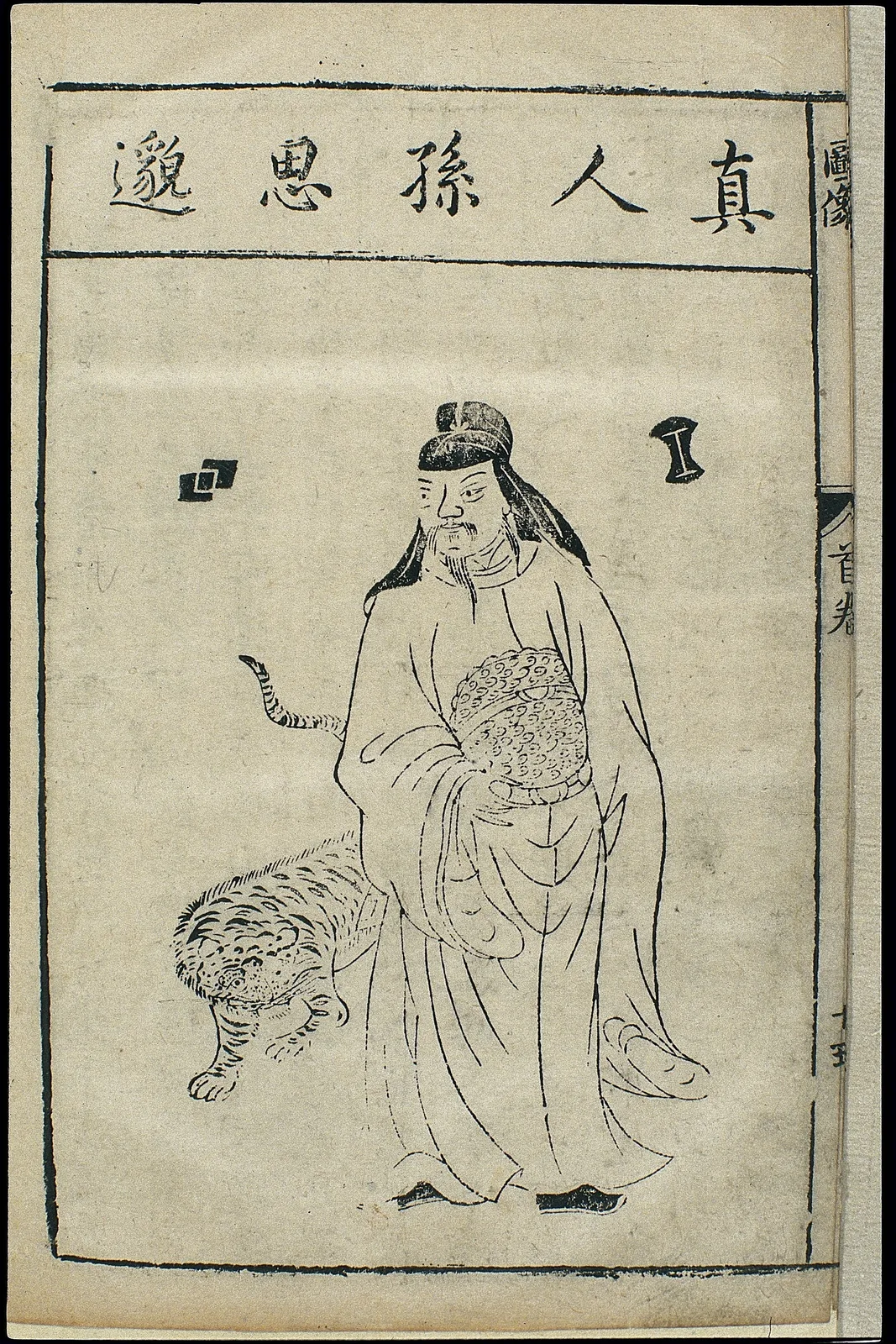
*Sun Simiao (孙思邈, Tang dynasty) in medical tradition—often cited in museum displays on Chinese medicine history. Wellcome Collection. Cropped/resized for web; non-generative.*
Full chronology: History of Traditional Chinese Medicine.
Medical Care, Wellness, and What Visitors Should Expect
China regulates TCM medical services (diagnosis and treatment by qualified practitioners in licensed settings) separately from non-medical TCM wellness / health-preservation services (中医养生保健服务).
Under the National Administration of Traditional Chinese Medicine (NATCM) *中医养生保健服务规范(试行)* (2023), non-medical TCM wellness providers are not permitted to conduct medical diagnosis or treatment. That includes acupuncture (针刺), certain higher-risk moxibustion techniques, prescribing medicines, and other invasive or diagnostic activities listed in the norm. A foot-massage shop using meridian vocabulary is therefore not equivalent to a hospital TCM department, and needle acupuncture does not belong in ordinary non-medical wellness scope.
For travelers:
- Cultural/educational experiences — museums, guided introductions, tai chi classes, heritage pharmacy visits.
- Non-medical wellness services — massage and related health-preservation packages within permitted non-medical scope; not a substitute for medical care.
- Clinical care — if you are ill or on medication, use licensed facilities and coordinate with your existing doctors; see TCM Medical Care for Foreigners for logistics only.
DragonTrail does not publish cure, detox, or weight-loss claims for TCM products or experiences.
Evidence, Safety, and Honest Limits
Research findings vary by intervention and condition. Some modalities have modern literature with condition-specific results; classical theory remains an interpretive framework, not laboratory anatomy. Herbal products can interact with prescription drugs; cupping and gua sha can leave visible skin marks and carry hygiene-related risks; moxibustion involves heat and smoke.
See Evidence & Safety for how to read claims—and what to avoid in tourist traps.
TCM and Chinese Food Culture
Classical dietary teaching discusses food properties in TCM vocabulary (e.g. "warm" or "cool" nature in theory—not thermometer temperature). That sits alongside—but is not the same as—Chinese regional cuisine as travelers eat it daily. For meal culture, see Chinese Food; for TCM dietary theory without diet plans, see Food & Diet Therapy. Chinese Tea is beverage culture; occasional historical texts mention tea in health contexts, but tea tourism is not medical advice.
How to Experience TCM in China
| Format | What it is | Best for |
|---|---|---|
| Museum / pharmacy heritage | Objects, texts, brand history | Context before any treatment |
| Cultural introduction experience | Seated explanation, sometimes light wellness demo | First-time learners |
| Tai chi / qigong class | Movement in park or studio | Active travelers; not medical treatment |
| Wellness tuina / spa package | Massage-oriented non-medical wellness—verify scope | Relaxation after sightseeing |
| Hospital/clinic TCM | Licensed care when you are already seeking treatment | Existing medical need—not tourism default |
Beijing is the practical hub for many short-stay visitors: TCM in Beijing, TCM Museums, Tongrentang, Imperial Medicine (Forbidden City context).
Common Misconceptions
- "TCM is one unified ancient science." It is a family of traditions, modern institutions, and commercial branding—see History.
- "Meridians are visible vessels like arteries." They are classical map language; modern anatomy textbooks describe different structures—see Qi & Meridians.
- "A tongue photo online can diagnose me." Tongue observation is a professional skill in context—not self-diagnosis—see Diagnosis.
- "Wellness cupping at a hotel equals hospital acupuncture." Credentialing, sterility, and legal scope differ—see Cupping and TCM in Beijing.
- "Herbal detox for weight loss." Avoid tourist marketing that promises cures; DragonTrail does not endorse disease-treatment claims.
Explore Traditional Chinese Medicine in More Detail
Foundations
- History of TCM
- Yin, Yang & Five Elements
- Qi, Meridians & Acupoints
- Diagnosis: Tongue & Pulse
- TCM vs Western Medicine
Major Practices
- Acupuncture
- Tuina Massage
- Cupping
- Gua Sha
- Moxibustion
- Chinese Herbal Medicine
- Food & Diet Therapy
- Tai Chi & Qigong
Evidence & Safety
Experience TCM in Beijing
- TCM in Beijing
- TCM Museums in Beijing
- Tongrentang in Beijing
- Imperial Medicine & the Forbidden City
- TCM Massage & Wellness in Beijing
FAQ
What is Traditional Chinese Medicine in simple terms?
A historical Chinese framework for understanding health and balance, plus professional traditions (acupuncture, herbal pharmacy, tuina, and others) taught and regulated in modern China. It is not one uniform cure-all system.
Can this guide tell me what TCM treatment I need?
No. DragonTrail explains concepts and travel context only—not personal diagnosis, formulas, or dosage.
Is TCM the same as wellness spa services in China?
Not always. Licensed medical TCM and non-medical wellness services (中医养生保健服务) fall under different rules. Non-medical providers are not permitted to diagnose or treat illness, and acupuncture is outside ordinary non-medical wellness scope.
What should I read before trying acupuncture or herbs on a trip?
Start with Evidence & Safety, TCM vs Western Medicine, and TCM Medical Care for Foreigners if you already have a medical condition or take prescription drugs.
Where can I learn about TCM without receiving treatment?
Museums, heritage pharmacies such as Tongrentang, and cultural introductions—see TCM in Beijing.
How does TCM relate to Chinese food?
Shared cultural history, but restaurant meals are not automatic "TCM therapy." See Food & Diet Therapy and Chinese Food.
Are cupping marks dangerous?
Cupping commonly leaves temporary marks, but adverse effects can include persistent discoloration, burns, scars, and infection when hygiene or technique is poor—see Cupping.
Experience TCM Culture in Beijing
Compare a seated Traditional Chinese Medicine cultural experience, a Temple of Heaven tai chi class, or tuina wellness massage. For imperial pharmacy context, see the Royal Medicine TCM cultural tour.
Continue Exploring
Sources & Review
- WHO — International Classification of Diseases (ICD-11) — traditional medicine chapter is a classification/reporting framework; it does not establish scientific validity or treatment efficacy
- National Administration of Traditional Chinese Medicine — 中医养生保健服务规范(试行) (2023) — non-medical wellness scope and prohibited diagnostic/treatment activities
- NCCIH — Traditional Chinese Medicine: What You Need To Know
- Sun Simiao and Li Shizhen — standard historical references in museum interpretive panels
- Chinese characters verified against standard reference forms
- Author: Chuan Shi
- Last reviewed: September 2026