
Xinjiang and northwest Chinese food covers diverse culinary traditions across Xinjiang and neighboring northwest regions, shaped by Uyghur, Hui, Kazakh, Tibetan, Han and other communities, as well as pastoral life and long-distance trade. Uyghur cuisine is one important tradition within Xinjiang; it is not a synonym for all Xinjiang food. This guide helps travelers understand those differences, the region's major staples and flavors, and how Muslim food traditions fit into the wider food landscape.
| Item | Detail |
|---|---|
| Geographic scope | Xinjiang; links to Gansu, Ningxia, Qinghai, Shaanxi northwest patterns |
| Major traditions | Uyghur, Hui Muslim Chinese, Kazakh pastoral, Han northwest urban |
| Staples | Wheat noodles, flatbreads (nang/馕), mutton, cumin, onions, peppers |
| Signature methods | Grilling, roasting, hand-pulled noodles, big-plate stir-fries |
| Famous examples | Lamb skewers, polo/pilaf, laghman noodles, dapanji |
| Critical qualification | Dietary rules vary by community—never assume all Xinjiang food is halal |
What "Northwest Food" Means on This Page
Northwest China spans desert basins, grasslands and mountain corridors along the historical Silk Road. Food here reflects wheat culture, mutton and beef, dairy in pastoral zones, and spice profiles (cumin, pepper, chilli) that differ from coastal Cantonese Cuisine or Sichuan Cuisine defaults.
Xinjiang alone contains multiple communities:
| Tradition | Notes for travelers |
|---|---|
| Uyghur | Central Asian–influenced breads, rice pilaf (polo), laghman noodles, grilled meats |
| Hui | Chinese Muslim communities with noodle and lamb traditions; halal where certified |
| Kazakh / pastoral | Dairy, horse meat in specific contexts, kettle cooking |
| Han urban | Northwest cities mix local and national Chinese restaurant formats |
Compressing these into one label—"Xinjiang food"—erases internal diversity. DragonTrail names Uyghur when describing Uyghur dishes, and northwest when comparing broader regional patterns.
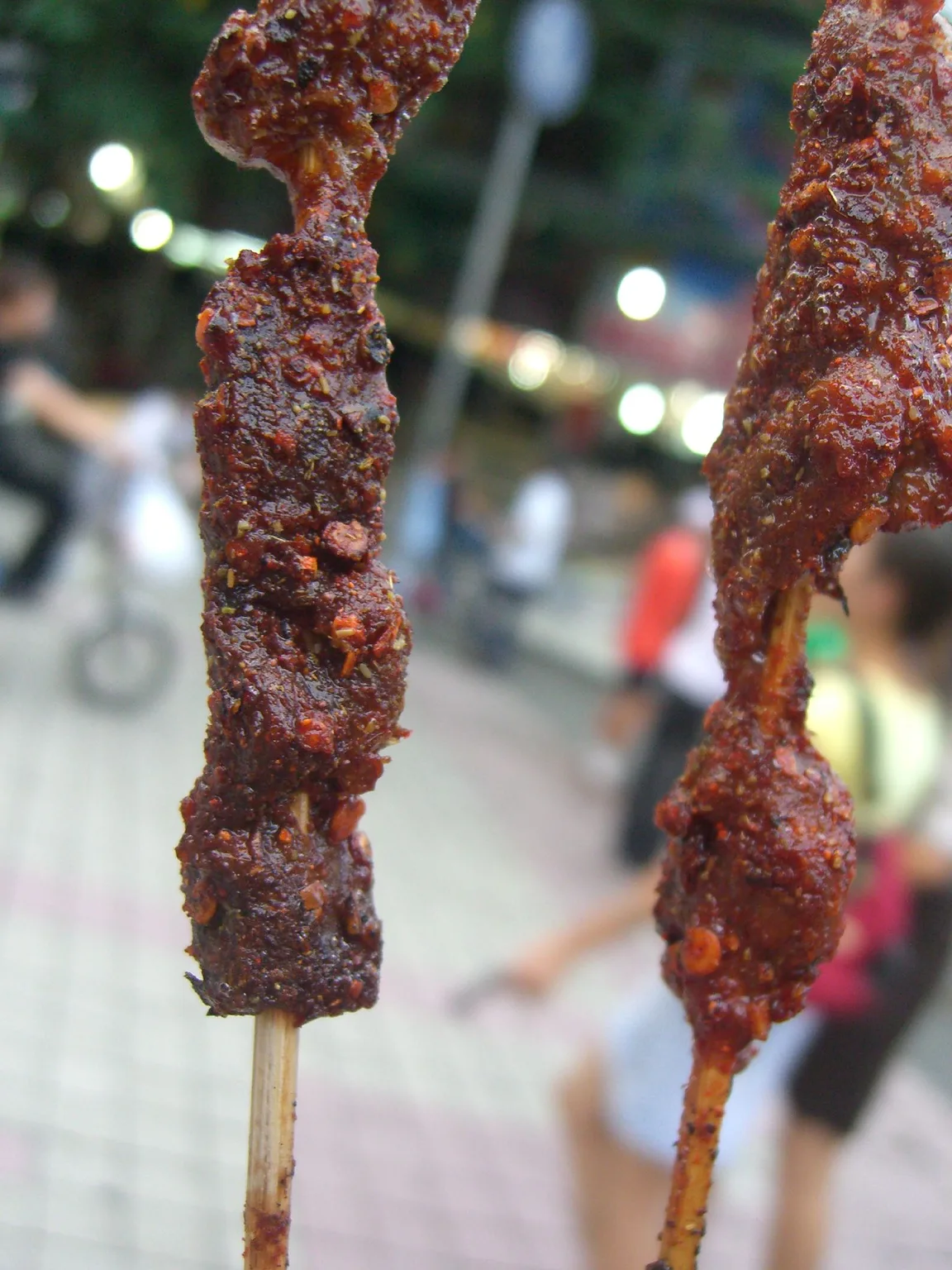
*Lamb skewers (羊肉串) — widely associated with northwest grill culture; seasoning and halal status depend on vendor and community. DragonTrail editorial image.*
Uyghur Cuisine: Distinct Tradition
Uyghur food draws on Turkic and Central Asian bread, rice and noodle formats alongside local agriculture and trade-spice palettes. Common traveler-facing examples:
| Dish | Names | Description |
|---|---|---|
| Nang / naan | 馕 | Wheat flatbread baked in tandoor-like ovens |
| Polo / pilaf | 抓饭 / polo | Rice cooked with carrot, onion, mutton |
| Laghman | 拉条子 | Hand-pulled noodles with stir-fried topping |
| Kebabs | 烤肉 / kawap | Skewered lamb or chicken, often cumin-heavy |
| Samsa | 烤包子 | Baked stuffed pockets |
| Dapanji | 大盘鸡 | "Big plate chicken" — shared stew with noodles (also popular beyond Uyghur-only venues) |
Uyghur meals may be halal when prepared by Muslim vendors following Islamic dietary law—but halal is a preparation standard, not an automatic property of every dish labeled "Xinjiang." Always confirm with the specific restaurant or stall.
Other Northwest Traditions (Beyond Uyghur)
| Region / community | Food notes |
|---|---|
| Lanzhou (Gansu) | Hand-pulled beef noodles (兰州拉面) — Hui-associated halal noodle shops nationwide |
| Ningxia | Hui Muslim cuisine; lamb, wheat, clear broth noodles |
| Shaanxi (Xi'an) | Biangbiang noodles, roujiamo "burgers," yangrou paomo bread-soup |
| Qinghai | Tibetan and multi-ethnic highland influences; yak butter tea adjacent to meal culture |
| Inner Mongolian | Distinct pastoral tradition—often treated separately from Xinjiang |
These share wheat prominence and mutton/beef centrality but are not interchangeable. Chinese Dumplings and northern jiaozi appear in Han northwest cities alongside Central Asian breads.
Flavours and Spices
Northwest grill and noodle shops often lead with cumin (孜然), chilli flake, Sichuan pepper occasionally, onion and garlic, and salt. Unlike Hunan Cuisine pickle-sour axis or Cantonese light-steam default, northwest street food can be aromatic and meat-forward.
See Chinese Ingredients for wheat flour types, lamb cuts and spice vocabulary.
Halal Food and Muslim Communities
Do not write or believe: "Xinjiang food is halal." That statement is incorrect as a universal rule.
| Fact | Why it matters |
|---|---|
| Multiple ethnic and religious communities live in Xinjiang | Uyghur Muslim, Hui Muslim, Han, Kazakh, others—each with different dietary practices |
| Halal (清真) requires specific slaughter and kitchen rules | Some restaurants display halal certification; many generic "Xinjiang" stalls may not |
| Beijing and other cities host Hui halal (清真) restaurants separate from Uyghur grill chains | See Halal & Muslim Food in China |
| Alcohol may appear in some venues | Not compatible with halal expectations—ask |
For travelers with religious dietary requirements, use certified halal signage, ask staff directly, and prefer established Hui or Uyghur Muslim-run venues rather than assuming regional branding.
Cooking Techniques
| Technique | Examples |
|---|---|
| Tandoor / oven baking | Nang bread |
| Open grill / skewers | Lamb kawap |
| Hand-pulled noodles | Laghman, Lanzhou lamian |
| Stew in wide pan | Dapanji |
| Rice pilaf cooking | Polo — oil, carrot, meat layered with rice |
Technique overview: Chinese Cooking Techniques. Northwest noodle pulling is a performance skill in many shop-front kitchens.
Where Travelers Encounter Northwest Food
- Urumqi, Kashgar, Turpan — Uyghur markets, bread lanes, night grills.
- Xi'an — Tang-dynasty capital heritage plus modern Muslim quarter food streets.
- Beijing — "Xinjiang restaurant" chains and Lanzhou lamian shops; verify halal signage if required.
- International cities — lamb skewers and "big plate chicken" spread via diaspora entrepreneurs; authenticity and sourcing vary.
Beijing's copper-pot mutton (Beijing hot pot) is another northern mutton tradition—Han capital lineage, not Uyghur polo.
Silk Road Exchange and Staple Geography
Historical Silk Road corridors moved wheat milling, cumin, sesame, walnut and grape culture between Central Asia and northwest China. Uyghur nang ovens and polo rice pans resemble Central Asian formats more closely than Cantonese dim sum steamers. At the same time, Lanzhou lamian shops nationwide show how Hui Muslim noodle craft became a pan-China fast-food format—often halal, but branded separately from Uyghur grill houses.
Wheat dominance here aligns with broad north–south staple patterns described on the Chinese Food hub—rice appears in polo and some urban meals, but noodles and bread anchor many northwest daily diets.
Reading Menus and Vendor Signs
Useful terms on northwest menus:
| Term | Meaning |
|---|---|
| 清真 (qīngzhēn) | Halal-certified or halal-intent kitchen—verify signage |
| 羊肉串 | Lamb skewers |
| 馕 | Nang bread |
| 拉条子 | Laghman hand-pulled noodles |
| 大盘鸡 | Big-plate chicken stew |
| 抓饭 | Polo / pilaf rice |
English "Xinjiang restaurant" may serve Han-style big-plate chicken without halal slaughter. Muslim travelers should prioritize visible 清真 certification and staff confirmation—not regional branding alone.
Practical Notes for Diners
- Halal needs: Look for 清真 certification and confirm cross-contamination policies; do not rely on English "Xinjiang" branding alone.
- Sharing: Dapanji and polo are communal—order for the table.
- Bread etiquette: Nang is often torn by hand; ask before wasting—breads are staple, not side garnish.
- Spice level: Cumin and chilli vary; milder orders may still be aromatic.
- Travel context: Xinjiang destinations involve normal travel planning (itinerary, documentation, local guidance). This food guide does not replace government travel advice.
Meal manners—tea, seating, payment: Chinese Dining Etiquette.
FAQ
Is all Xinjiang food Uyghur food?
No. Xinjiang includes Uyghur, Hui, Kazakh, Han and other food traditions. Name the specific tradition when possible.
Is Xinjiang food always halal?
No. Some Uyghur and Hui venues serve halal food; others do not. Halal requires verified preparation—see Halal & Muslim Food in China.
What are lamb skewers called in Chinese?
Often 羊肉串 (yángròu chuàn)—associated with northwest grill culture; halal status depends on the vendor.
What is laghman?
Laghman (拉条子) is hand-pulled noodle with a stir-fried meat-and-vegetable topping—common in Uyghur and broader Xinjiang restaurant menus.
What is the difference between polo and ordinary fried rice?
Polo (抓饭) is a Central Asian–style pilaf cooked with mutton, carrot and onion—oil-rich and communal—not the same as Cantonese fried rice.
How does northwest food differ from Sichuan or Hunan?
Northwest emphasizes wheat breads, mutton, cumin and Central Asian formats. Sichuan and Hunan are chilli-centric rice-bowl cuisines in the eight-cuisine framework—different pantries and meal structures.
Is Lanzhou beef noodle a Xinjiang dish?
It originates from Lanzhou, Gansu, strongly linked to Hui Muslim noodle culture—northwest, but not uniquely Uyghur.
Where does this topic sit in the Chinese Food guide?
Under regional traditions outside the simple eight-cuisine list on Chinese Food, with links to ingredients and halal food.
Continue with Chinese Food
- Chinese Food guide
- Halal & Muslim Food in China
- Chinese Ingredients
- Chinese Cooking Techniques
- Chinese Dining Etiquette
Related regional guides
Sources & Review
- UNESCO — Silk Roads: the Routes Network of Chang'an-Tianshan Corridor — historical trade context for northwest food exchange
- Xinjiang Uyghur Autonomous Region government cultural heritage publications on local culinary traditions
- China Islamic Association — halal certification context (institutional, not restaurant directory)
- Rachel Harris, academic work on Uyghur culture and Central Asian foodways (peer-reviewed)
- E.N. Anderson, *The Food of China* — northwest and Muslim Chinese chapters
- Chinese characters verified
- Author: DragonTrail editorial
- Last reviewed: August 2026