
| Item | Answer |
|---|---|
| Format | Shared pot; diners cook their own food at the table |
| First step | Choose the broth (清汤 clear, mala, split/yuānyāng, etc.) |
| Cooking approach | Cook in batches, not all ingredients at once |
| Safety priority | Cook raw meat and seafood fully before eating |
| Key vocabulary | 微辣 (mildly spicy), 鸳鸯锅 (split pot), 清汤 (clear broth) |
| Related pages | Broths & Soup Bases, Ingredients |
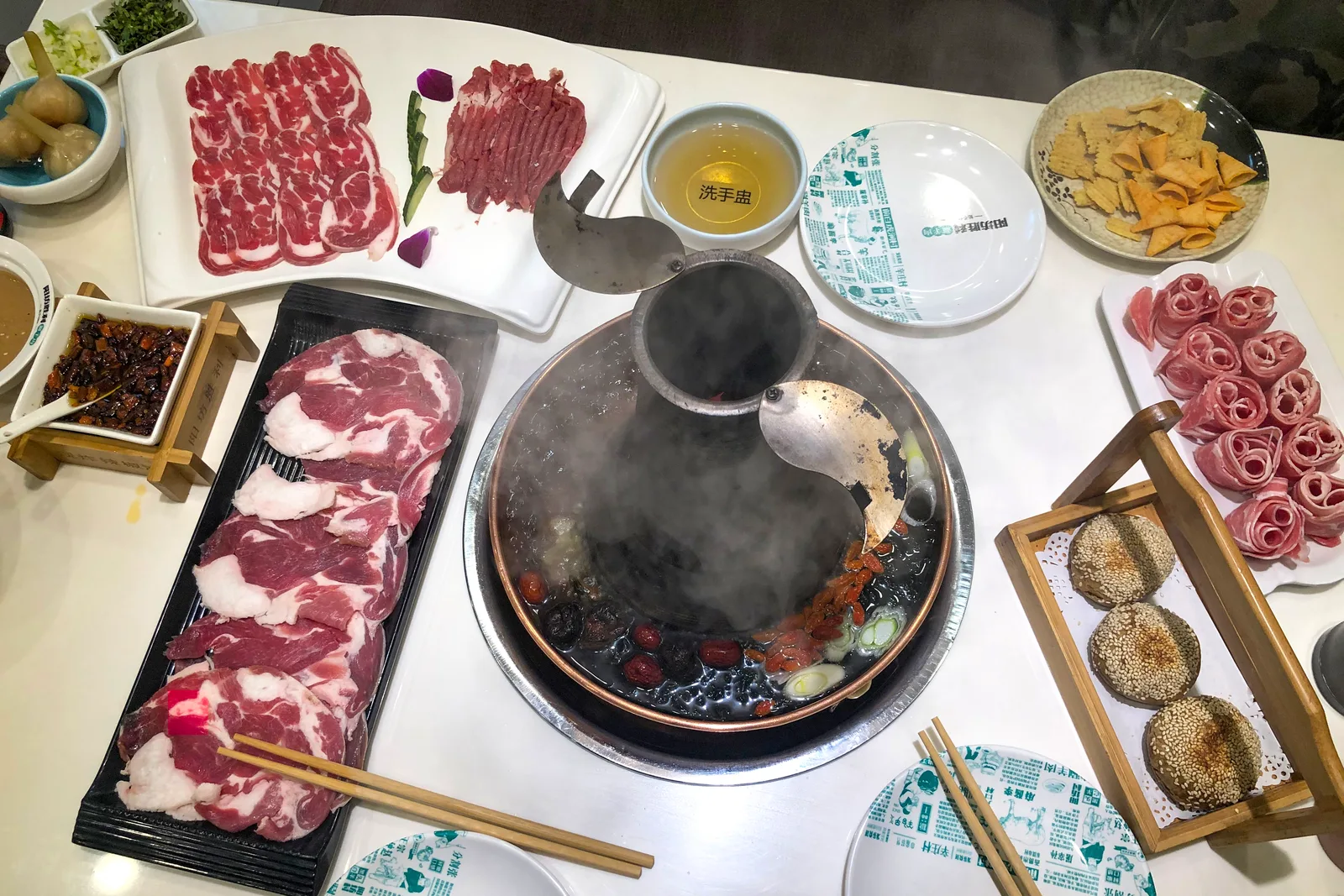
*Thinly sliced meat cooks quickly in a traditional copper chimney hotpot.*
Step 1: Choose the Broth
Decide on a broth before ordering ingredients, since it shapes the rest of the meal. A 清汤 (qīngtāng, clear broth) suits diners who want a mild introduction, while a mala broth suits those who want the classic spicy-numbing flavor. If the table has mixed preferences, ask for a 鸳鸯锅 / 鴛鴦鍋 (yuānyāng guō, split pot), which divides the pot into a spicy side and a mild side so everyone can share one meal. See Hot Pot Broths & Soup Bases for the full range of options.
Step 2: Choose or Mix a Dipping Sauce
Most hot pot restaurants offer a sauce bar or a fixed sauce menu. Beijing-style hot pot typically pairs with a sesame-based sauce (麻酱), often mixed with a little fermented tofu, chive flowers or chilli oil to taste. Sichuan and Chongqing-style restaurants commonly offer a sesame-oil-and-garlic dip (油碟), which many diners use specifically to cool the mouth between bites of a spicy broth. There is no single required sauce—sample a small amount before committing to a full bowl, since combinations can be intense.
Step 3: Order a Balanced Ingredient Set
Order a mix of meat, seafood, tofu, vegetables and one or two starches rather than filling the table with a single category. A practical starter order for two to three people is one or two meat plates, one tofu or soy item, two to three vegetable plates and one noodle or starch item, adjusting as the meal continues. See Hot Pot Ingredients for what each category typically includes.
Step 4: Start With Ingredients That Suit the Broth and Meal
Add root vegetables, tougher items and things that need longer cooking earlier, since they take more time to soften. Save delicate items such as leafy greens and thin-sliced meat for slightly later, since they cook within seconds and can overcook or disintegrate if added too early in a hard-boiling pot.
Step 5: Cook Safely
Cook raw meat, seafood and offal fully before eating. Hot pot broth generally simmers hard enough to cook thin-sliced items quickly, but exact timing depends on the ingredient's thickness, the broth's temperature and how many items are in the pot at once. Use your own judgment and the venue's guidance rather than a fixed universal timer, and if in doubt, leave an item in a little longer rather than pulling it out early. This page does not provide medical advice; if you have specific food-safety concerns, ask restaurant staff directly.
Step 6: Use Serving Utensils Where Provided
Many restaurants provide a separate strainer spoon, ladle or serving chopsticks (公筷) for retrieving cooked food from the shared pot, distinct from the chopsticks you eat with. Using serving utensils where available reduces cross-contact between raw and cooked food and is increasingly standard practice at hot pot restaurants.
Step 7: Eat in Batches Instead of Dumping Everything In at Once
Adding too many ingredients to the pot at the same time cools the broth, makes it hard to track what is cooked and what is still raw, and can lead to overcrowding that traps items at the bottom. Add a moderate batch, retrieve items as they finish, and then add the next batch rather than filling the pot to the brim in one go.
Step 8: Adjust Spice and Sauce
If a mala broth feels too intense, thin your dipping sauce with more sesame oil, ask for extra plain broth or water on the side, or switch to cooking mostly on the mild side of a split pot. Asking for a 微辣 (wēilà, mildly spicy) broth reduces intensity from the start, though how mild that actually tastes is subjective and varies by kitchen—do not assume 微辣 will feel mild to every palate.
Step 9: Finish With Noodles or Vegetables Only if Desired
Once the main round of meat, seafood and vegetables is finished, many diners add noodles or extra leafy greens to the remaining broth as a final course, since the liquid has picked up flavor from everything cooked in it. This step is optional—finishing with starch is a common habit, not a required part of the meal.
Shared-Table Etiquette
Hot pot is inherently communal: everyone shares one pot (or one side of a split pot) and often a shared sauce station. Avoid double-dipping cooked food back into a communal sauce bowl with chopsticks that have touched your mouth—use a spoon to portion sauce onto your own plate where hygiene-conscious service is offered. Take turns retrieving food rather than crowding the pot, and be mindful that raw meat and cooked, ready-to-eat food should not touch the same serving plate.
Useful Vocabulary
- 微辣 (wēilà)—mildly spicy. A common menu option, though spice tolerance is subjective and this label varies by restaurant.
- 鸳鸯锅 / 鴛鴦鍋 (yuānyāng guō)—split or dual-flavor pot, dividing one pot into a spicy side and a mild side.
- 清汤 / 清湯 (qīngtāng)—clear or mild broth, commonly used for Beijing-style hot pot and as the mild option in split pots.
Common Mistakes
- Filling the pot with everything at once. This cools the broth and makes it hard to track cooking times.
- Assuming 微辣 will taste mild. "Mild" is calibrated by the kitchen, not by a fixed standard—order cautiously if you are unsure of your spice tolerance.
- Skipping the sauce bar. The dipping sauce meaningfully changes the flavor of the meal, especially with a mild broth.
- Not using serving utensils. Where provided, use a separate spoon or serving chopsticks to retrieve cooked food rather than your personal chopsticks.
FAQ
What is the correct order to eat hot pot in China?
There is no single required order, but a practical sequence is: choose the broth, mix a dipping sauce, order a balanced ingredient set, cook longer items first and delicate items later, eat in batches, and finish with noodles or vegetables if desired.
How long should I cook meat in hot pot?
Cooking time depends on the ingredient's thickness and the broth's temperature. Thin-sliced meat generally cooks within seconds to a couple of minutes, but always cook fully rather than following a fixed universal timer, and follow the venue's guidance if unsure.
What does 微辣 mean on a hot pot menu?
微辣 (wēilà) means "mildly spicy." It is a common way to order a lower-intensity broth, though how mild it tastes still varies by restaurant and by individual spice tolerance.
What is a 鸳鸯锅 split pot?
A 鸳鸯锅 (yuānyāng guō) is a hot pot divided into two sections by a metal partition, typically pairing a spicy broth with a mild or clear broth so a table can order both at once.
Do I need to use separate chopsticks for raw and cooked food?
Where a restaurant provides serving utensils or public chopsticks (公筷), use them to place raw food into the pot and retrieve cooked food, then eat with your personal chopsticks. This reduces cross-contact between raw and ready-to-eat food.
Is it normal for a hot pot meal to take a long time?
Yes. Hot pot is paced by the table rather than the kitchen, and meals commonly run well over an hour as diners add and retrieve ingredients in batches.
What if the broth is too spicy for me?
Thin your dipping sauce with more sesame oil, ask for extra plain broth, cook mainly on the mild side of a split pot, or order a milder broth from the start—see Hot Pot Broths & Soup Bases for mild options.
Continue with Chinese Hot Pot
City hot pot guide
Sources & Review
- Beijing municipal traveler/food source on local dining traditions
- Chinese characters verified
- Author: DragonTrail editorial
- Last reviewed: August 2026