
- Shared table cooking
- Broth · ingredients · dipping sauce
- Regional styles across China
Start with regional hotpot styles or jump straight to how to eat hot pot.
| Item | Answer |
|---|---|
| Chinese | 火锅 / 火鍋 |
| Pinyin | huǒguō |
| Basic format | Shared simmering pot at the table; diners cook their own ingredients |
| Shared vs individual | Usually a shared pot for the whole table; single-pot and split (yuānyāng) formats both exist |
| Spicy or not? | Not inherently—clear northern broths are common alongside mala broths |
| Major traveler-facing styles | Beijing shuàn yángròu, Sichuan/Chengdu mala, Chongqing beef-tallow |
| Typical components | Broth, raw ingredients, dipping sauce |
| Key misconception | Chinese hot pot is not one standardized dish |
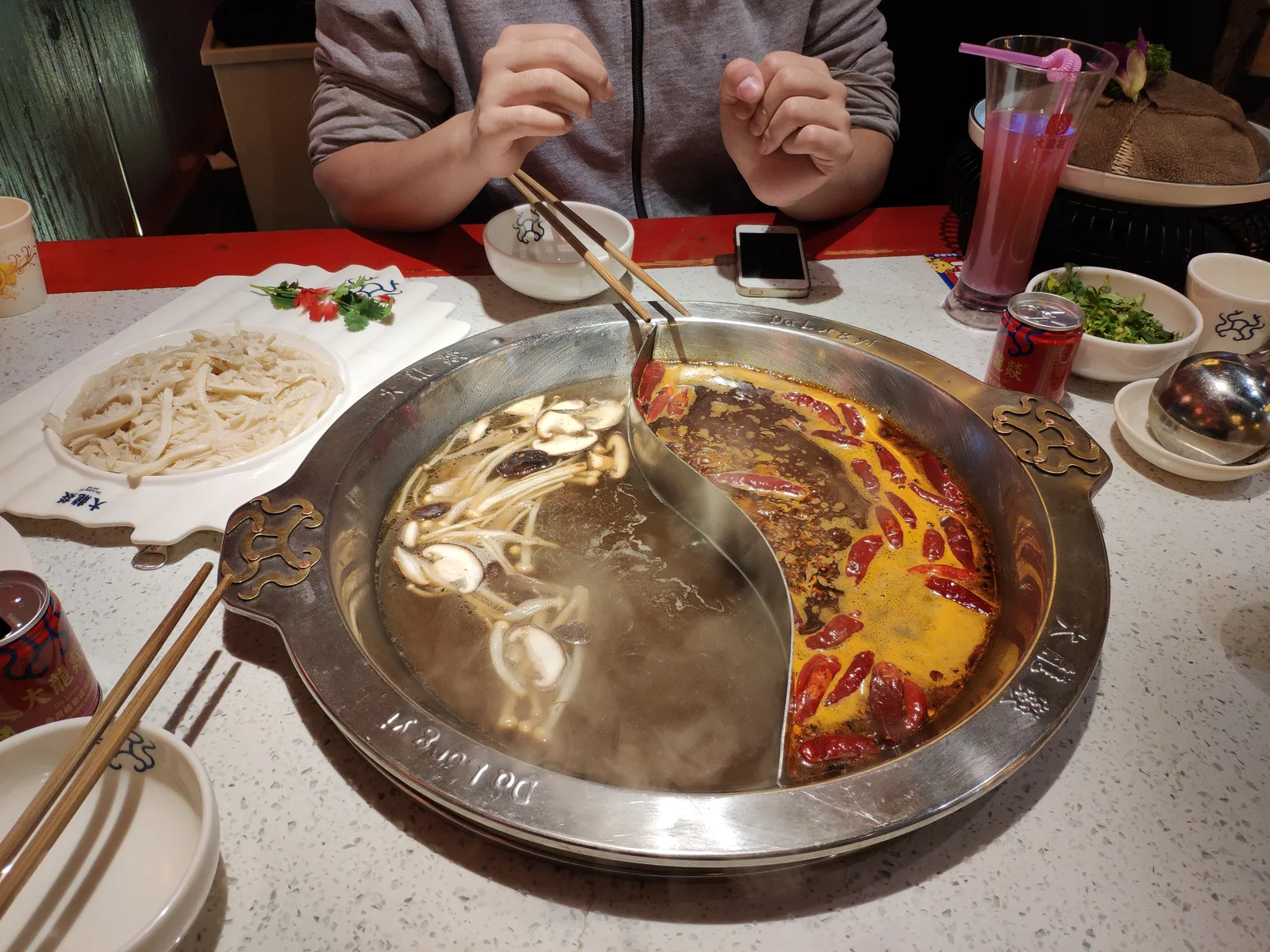
*A yuanyang hotpot lets diners cook ingredients in both spicy and mild broths.*
What Is Chinese Hot Pot?
Chinese hot pot is a meal format, not a single recipe. A pot of simmering broth sits at the center of the table—on a portable burner, induction plate or built-in stove—and diners add thinly sliced meat, seafood, vegetables, tofu and noodles in batches, retrieving each piece once it is cooked and dipping it in a sauce they mix themselves.
This basic structure repeats across China, but the broth, ingredients and sauces vary by region, restaurant and household. A home hot pot in a northern city can look and taste very different from a restaurant hot pot in Chengdu or Chongqing. Both a family gathering around a modest pot and a specialist restaurant chain serving dozens of ingredient trays are legitimately "hot pot"—the format flexes, and that variation is the point, not an exception to a fixed standard.
Hot pot restaurants range from simple neighborhood shops with a handful of ingredient trays to large multi-floor chains with self-serve sauce bars and dozens of broth options. Household hot pot—especially around colder months and festival gatherings—remains common and is often simpler than a restaurant version: one broth, a modest ingredient spread and a shared sauce bowl for the table.
How a Hot Pot Meal Works
Hot pot is paced by the table, not by the kitchen—there is no fixed course order, and a meal can run for well over an hour as diners keep adding and retrieving ingredients. Most hot pot meals follow the same general sequence, even though the specific choices differ by region:
- Choose the broth—clear, mild, mala or a split (yuānyāng) pot with two flavors side by side.
- Choose or mix a dipping sauce—sesame paste, sesame oil with garlic, or a house sauce bar.
- Order the ingredients—meat, seafood, vegetables, tofu and starches, usually from a menu or self-serve fridge.
- Cook ingredients in batches—thin slices cook in seconds; root vegetables and tougher items take longer.
- Eat as items are ready—hot pot is a rolling meal, not a single plated course.
- Add starch or finishing items such as noodles or leafy greens toward the end if you want them.
Cooking times depend on the ingredient, its thickness and how hard the broth is simmering. For raw meat and seafood, cook fully before eating and follow the venue's guidance rather than a fixed universal timer.
Main Components
Every hot pot meal combines three building blocks, each large enough to deserve its own guide:
- Hot Pot Broths & Soup Bases—the simmering liquid that defines much of the flavor and spice level.
- Hot Pot Ingredients—the meat, seafood, vegetables, tofu and starches you cook in it.
- How to Eat Hot Pot—ordering, cooking, sauce-mixing and shared-table etiquette.
Major Regional Styles
Hot pot varies enough by region that "Chinese hot pot" is really a family of related traditions rather than one dish. This table is an orientation, not a complete inventory:
| Style | Broad association | Broth focus | Typical traveler takeaway |
|---|---|---|---|
| Beijing shuàn yángròu | Beijing/northern | Clear/mild | Lamb + sesame dipping sauce |
| Sichuan | Sichuan | Varied, often mala | Layered chilli + Sichuan pepper systems |
| Chengdu | Chengdu/Sichuan | City-level hotpot landscape | Traveler city context |
| Chongqing | Chongqing | Strongly associated with beef-tallow spicy broth | Robust chilli/pepper profile and classic hotpot ingredients |
Do not reduce every Sichuan-area hot pot to one formula—broth intensity, oil content and ingredient lists differ restaurant to restaurant even within the same city. For a deeper regional read, see Sichuan Hot Pot and the Chengdu vs Chongqing comparison.
What Is Mala?
Mala (麻辣, málà) is a flavor profile that combines numbing Sichuan pepper (麻, má) with chilli heat (辣, là). It is closely associated with Sichuan and Chongqing hot pot, but mala is a flavor system, not a synonym for all Chinese hot pot—plenty of hot pot in China is clear, mild or only lightly spiced. See Mala Hot Pot for a full breakdown of the two sensations and how mala differs from related mala-flavored dishes.
Hot Pot vs Malatang vs Mala Xiang Guo
These three terms are often confused because they share vocabulary and a spicy-broth family resemblance, but they are different formats:
| Dish | Format | How it is cooked | Typically served as |
|---|---|---|---|
| Mala hot pot (麻辣火锅) | Shared simmering pot at the table | Diners cook raw ingredients themselves in the broth | Communal meal, usually for two or more people |
| Malatang (麻辣烫) | Ingredients or skewers chosen at a counter | Kitchen boils your selection in spicy broth before serving | Often single-serving; common as street food or fast-casual |
| Mala xiang guo (麻辣香锅) | Ingredients chosen at a counter, no broth | Stir-fried/tossed in spicy oil in a wok—"dry" | Single-serving stir-fry, no soup |
Mala hot pot is a communal, self-cooked meal; malatang and mala xiang guo are usually solo, kitchen-cooked orders. See Mala Hot Pot for the full comparison.
Where DragonTrail Travelers Will Encounter Hot Pot
- Beijing—a distinct local copper-pot mutton tradition built around clear broth and thin lamb slices (Beijing Hot Pot).
- Chengdu—a major Sichuan hotpot destination with a dense restaurant scene spanning street-corner shops to specialist chains (Chengdu Hot Pot).
- Chongqing—a city-defining hotpot tradition built around beef-tallow broth, chilli and Sichuan pepper (Chongqing Hot Pot).
- Shanghai—many hotpot styles are available, from Sichuan/Chongqing-style to milder tomato and mushroom options; this is a city-choice guide, not a claim of one dominant local tradition (Chinese Hot Pot).
- Zhangjiajie—look for Sanxiaguo, a separate Tujia local-food entity cooked as a stewed pot rather than a self-cooked communal broth, not simply "Zhangjiajie Sichuan hotpot" (Zhangjiajie Sanxiaguo).
- Xi'an—hot pot is not a defining local dish here; Xi'an's food identity centers on Muslim Quarter and wheat-based specialties rather than a standalone hotpot tradition, so DragonTrail does not publish a separate Xi'an hotpot guide at this time.
Dietary Considerations
Vegetable ingredients and mild-looking broths do not automatically make a hot pot meal vegetarian, halal or allergen-safe. Broths, dipping sauces and shared pots all need to be checked individually:
- Halal Hot Pot and the broader Halal & Muslim Food in China guide.
- Vegetarian & Vegan Hot Pot and the broader Vegetarian & Vegan Food in China guide.
Common Misconceptions
- "Chinese hot pot is one dish." It is a meal format with many regional broths, ingredient sets and serving styles.
- "Hot pot is always spicy." Clear and mild broths are common, especially in Beijing-style hot pot.
- "Mala hot pot, malatang and mala xiang guo are the same thing." They share a flavor family but differ in format and how the ingredients are served.
- "Chengdu and Chongqing hot pot are identical." They overlap but are distinct traditions—see the Chengdu vs Chongqing comparison.
FAQ
What is Chinese hot pot?
Chinese hot pot (火锅, huǒguō) is a shared meal in which diners cook raw ingredients themselves in a simmering pot of broth at the table, then dip the cooked food in a personal sauce. It is a meal format with many regional variations rather than one fixed recipe.
Is Chinese hot pot always spicy?
No. Spice level depends on the broth chosen. Beijing-style shuàn yángròu typically uses a clear, mild broth, while many Sichuan and Chongqing hot pots use a mala (numbing-spicy) broth. Split (yuānyāng) pots let a table order both a mild and a spicy broth at once.
What is huoguo?
Huoguo is the pinyin romanization of 火锅, the Chinese term for hot pot. "Huoguo" and "hot pot" refer to the same meal format.
What do you put in Chinese hot pot?
Common ingredients include thinly sliced meat, seafood, fish balls, tofu and soy products, mushrooms, leafy vegetables, root vegetables and noodles. Availability depends on the restaurant and region—see Hot Pot Ingredients for a full breakdown.
What is the difference between Sichuan and Beijing hot pot?
Beijing hot pot centers on shuàn yángròu—thin-sliced mutton cooked in a clear or mild broth and eaten with a sesame-based dipping sauce. Sichuan hot pot more often uses a mala broth with chilli and Sichuan pepper and a wider ingredient range including offal and fish balls. They are different regional traditions, not variations of the same broth.
Is mala hot pot the same as malatang?
No. Mala hot pot is a shared, self-cooked meal at a communal pot. Malatang is usually a single-serving dish where you choose ingredients or skewers at a counter and the kitchen cooks them for you in spicy broth before serving.
Can vegetarians eat hot pot in China?
Sometimes, with checks. Many broths—including tomato, mushroom and some "clear" bases—may still contain meat stock or animal fat, and dipping sauces can contain non-vegetarian ingredients. See Vegetarian & Vegan Hot Pot for what to confirm before ordering.
Is halal hot pot available in China?
Yes, particularly in cities with Hui Muslim communities, such as Beijing's Niujie area. Halal status is not automatic just because a restaurant serves lamb—broth, cooking fat, sauces and shared utensils all need to be confirmed. See Halal Hot Pot.
Continue with Chinese Hot Pot
- Hot Pot Ingredients
- Hot Pot Broths & Soup Bases
- How to Eat Hot Pot
- Mala Hot Pot
- Sichuan Hot Pot
- Chengdu vs Chongqing Hot Pot
Dietary guides
City hot pot guides
Related guides
Sources & Review
- Beijing municipal traveler/food source on local dining traditions
- TravelChinaGuide — Chengdu and Sichuan regional dining context
- Chinese characters verified
- Author: DragonTrail editorial
- Last reviewed: August 2026