
| Item | Detail |
|---|---|
| Chinese | 点心 (diǎnxīn) — "touch the heart" (light bites) |
| Culinary home | Cantonese / Guangdong; widely copied in Hong Kong and diaspora |
| Meal timing | Morning through early afternoon; evening dim sum exists in some cities |
| Service styles | Cart service, checklist ordering, or hybrid |
| Companion drink | Tea (often pu-erh, chrysanthemum, jasmine or blend) |
| Distinct from | Northern jiaozi culture — see Chinese Dumplings |
| Etiquette | Tea pouring, sharing, chopstick norms — Dining Etiquette |
What Dim Sum Is
Dim sum began as tea-house snacks along Guangdong travel and trade routes and evolved into a weekend family institution: many tables, rotating carts or tick-sheet menus, and continuous tea refills. Dishes are small portions meant for sharing—order many types, take a few pieces each, and pace the meal over conversation.
English speakers sometimes use "dim sum" for any Chinese small bite. In China, the term most precisely labels Cantonese-origin tea snacks. Shanghainese xiaolongbao, northern jiaozi and Sichuan small plates belong to other traditions even when they appear on a bilingual "dim sum" menu overseas.
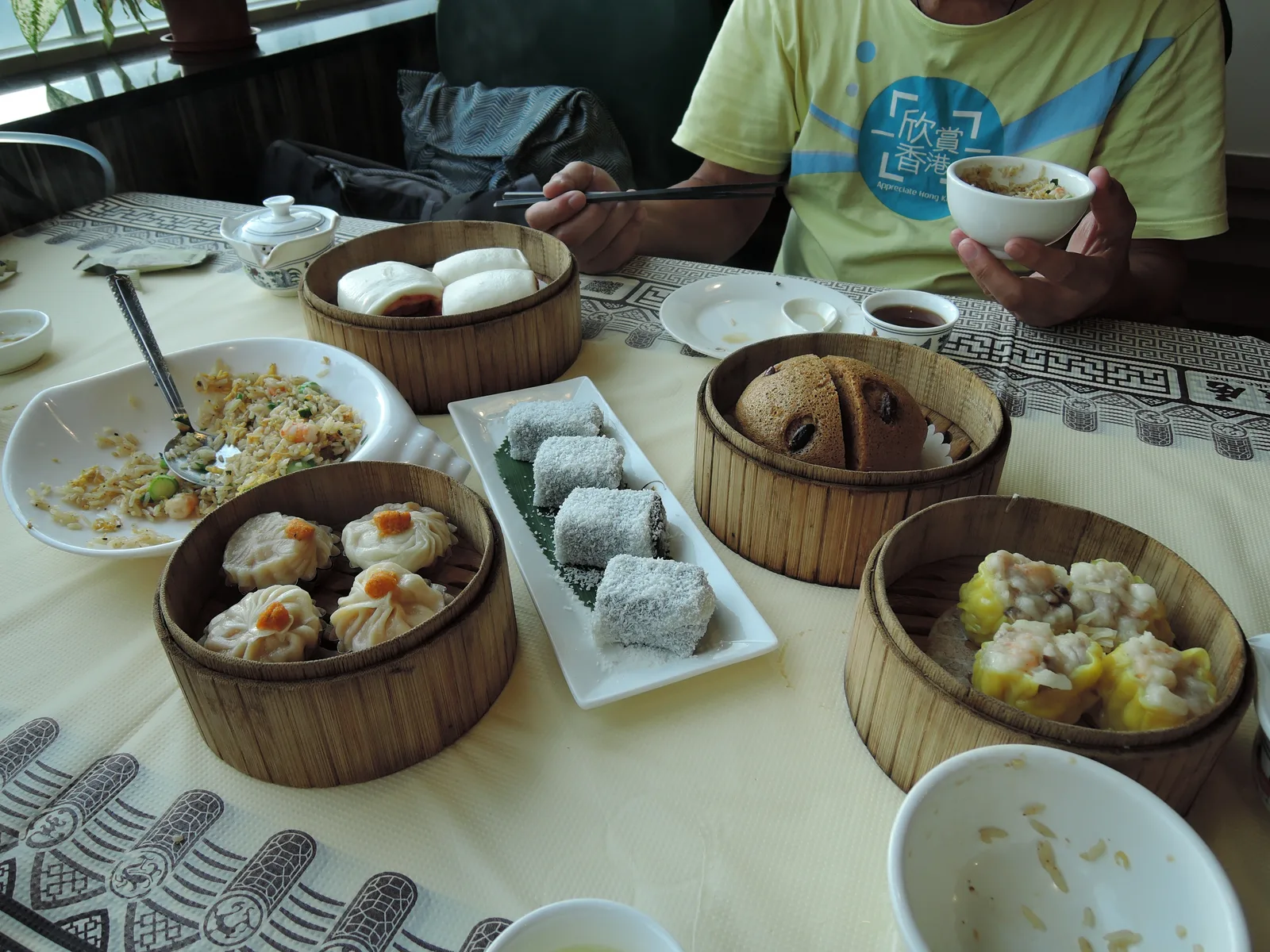
*Dim sum spread — steamed, baked and fried small plates typical of Cantonese tea service. DragonTrail editorial image.*
How Dim Sum Differs from Chinese Dumplings
| Dim sum | Jiaozi / Chinese dumplings | |
|---|---|---|
| Parent cuisine | Cantonese tea meal | Nationwide; strong northern wheat culture |
| Typical wrapper | Har gow crystal, siu mai open-top, bao steamed/baked | Wheat dough folded parcels |
| Meal context | Many dishes + tea | Staple dish, festival food, home cooking |
| DragonTrail guide | This page | Chinese Dumplings |
Har gow (shrimp dumplings) and siu mai are dim sum icons, but dim sum also includes non-dumpling items: chicken feet, turnip cake, egg tarts and congee. For wrapper types, fillings and homemade jiaozi, use the dumplings hub—not this page.
Core Categories on a Dim Sum Menu
| Category | Chinese | Examples |
|---|---|---|
| Steamed | 蒸 | Har gow 虾饺, siu mai 烧卖, cheung fun 肠粉 |
| Baked / roasted | 烘 / 焗 | Char siu bao 叉烧包, egg tarts 蛋挞 |
| Fried | 炸 | Spring rolls, taro puffs, sesame balls |
| Braised / stewed | 焖 / 炖 | Chicken feet in black bean, tripe |
| Congee & rice | 粥 / 饭 | Preserved egg congee, lotus-leaf rice |
| Vegetables | 菜 | Gai lan with oyster sauce, steamed greens |
Menus vary by shop prestige, region and chef lineage. Shunde and Hong Kong styles differ in portion size, sweetness and lard use.
Famous Dim Sum Dishes Travelers Should Recognise
| Dish | Chinese | Recognition cue |
|---|---|---|
| Har gow | 虾饺 | Translucent shrimp dumpling |
| Siu mai | 烧卖 | Open-topped pork/shrimp dumpling |
| Char siu bao | 叉烧包 | Steamed or baked barbecue-pork bun |
| Cheung fun | 肠粉 | Steamed rice-noodle rolls with filling |
| Lo mai gai | 糯米鸡 | Sticky rice in lotus leaf |
| Feng zhao | 凤爪 | Braised chicken feet |
| Turnip cake | 萝卜糕 | Pan-fried radish cake, Lunar New Year link |
| Egg tart | 蛋挞 | Cantonese bakery crossover |
These illustrate Cantonese Cuisine technique—steaming precision, roast-meat fillings and rice-starches—not a mandatory checklist for every visit.
Tea Service and Dining Etiquette
Dim sum without tea is incomplete in traditional settings. Common practice:
- Rinse cups with hot water from the pot (table ritual varies).
- Pour for others before yourself when refilling.
- Tap the table lightly to thank someone for pouring—folk etiquette in many Cantonese halls.
- Share dishes centrally; use serving chopsticks or clean ends if provided.
Full norms—seating, bill payment, chopstick taboos: Chinese Dining Etiquette. Tea culture overlaps the Chinese Tea cluster but dim sum halls rarely teach gongfu ceremony.
Service Styles: Carts vs Checklists
| Style | What happens | Traveler tip |
|---|---|---|
| Cart service | Steamer carts circulate; pick plates as they pass | Peak hours mean fast carts—decide quickly |
| Checklist / order card | Tick boxes; kitchen steams to order | Better for dietary questions item-by-item |
| Hybrid | Carts plus specials board | Ask what's freshest |
Cart service feels theatrical but can sell out of popular items early. Checklist shops may wait longer for first baskets—normal for made-to-order steaming.
Ingredients and Techniques Behind Dim Sum
Dim sum quality hinges on dough handling, stock depth and wok timing:
- Har gow wrappers require wheat starch elasticity—translucent when correct, rubbery when overworked.
- Siu mai tops stay open; filling binds shrimp and pork with fat for juiciness.
- Cheung fun uses rice-slurry steamed into sheets, then rolled—see Chinese Ingredients for rice flour vs wheat distinctions.
- Steaming dominates; see Chinese Cooking Techniques.
Roast meats for bao fillings connect to siu mei shops—same char siu lineage as Cantonese Cuisine roast windows.
Where to Eat Dim Sum as a Traveler
- Guangzhou and Hong Kong — largest traditional scene; book weekend tables early.
- Shenzhen and Macau — mix of classic and modern dim sum lounges.
- Beijing and Shanghai — Cantonese chains and hotel restaurants; verify whether kitchen is Cantonese-trained.
- Diaspora Chinatowns — often cart or checklist formats; sweetness and portion size may differ from Guangdong.
Beijing food experiences sometimes include dumpling making—jiaozi workshops, not full dim sum service. Compare formats on Beijing food experiences.
Practical Tips
- Arrive early (before 10:30) on weekends for full selection and shorter queues.
- Start with steamed classics, add fried items mid-meal to manage fullness.
- Dietary restrictions: Shrimp and pork dominate; vegetarian dim sum exists at Buddhist or specialist shops—confirm stock and lard use.
- Pricing: Per-basket or per-piece; tea charge per head (茶位费) is common—check the cover line on the bill.
- Leftovers: Some regions pack leftover baskets; not universal.
Modern Dim Sum and Fusion Formats
Contemporary Guangzhou and Hong Kong venues offer luxury dim sum with truffles, seafood upgrades and tasting menus—still small-plate logic but higher price tiers. Mainland hotel buffets label "dim sum" for mixed steamers that include non-Cantonese items; authenticity varies.
Abroad, frozen har gow and delivery dim sum trade ritual for convenience. Travelers seeking cart culture and tea pacing should prioritize traditional halls in Guangdong or established Cantonese diaspora institutions rather than generic pan-Asian brunch buffets labeled "dim sum."
FAQ
Is dim sum the same as dumplings?
No. Dim sum is Cantonese small-plate tea meal culture. Dumplings (jiaozi) are a broader wheat-parcel tradition. Overlap exists (har gow, siu mai) but the meal formats differ. See Chinese Dumplings.
When is dim sum served?
Traditionally late morning through lunch. Some urban restaurants offer all-day or evening dim sum; Hong Kong and Guangzhou vary by shop.
What tea goes with dim sum?
Pu-erh, chrysanthemum–pu-erh blend, jasmine or house blends are common—designed to cut richness between baskets.
What is yum cha?
Yum cha (饮茶) means "drink tea" in Cantonese and colloquially refers to the dim sum meal—not tea alone.
Do I need to speak Cantonese to order?
Large cities provide Mandarin and English menus; pointing at carts or tick sheets works. Ask about pork lard or shrimp in mixed fillings if you have allergies.
Is dim sum vegetarian?
Standard menus are heavily pork and seafood. Vegetarian Buddhist dim sum exists in some cities—seek specialist venues rather than assuming every basket is meat-free.
How does dim sum relate to Cantonese cuisine?
Dim sum is a flagship meal format within Cantonese Cuisine—not the whole cuisine.
What etiquette should I know?
Pour tea for others, share dishes centrally, and avoid sticking chopsticks upright in rice. Details: Chinese Dining Etiquette.
Continue with Chinese Food
- Chinese Food guide
- Cantonese Cuisine
- Chinese Dumplings
- Chinese Dining Etiquette
- Chinese Cooking Techniques
Experience food in Beijing
Sources & Review
- Hong Kong Tourism Board — yum cha / dim sum cultural overview (institutional, non-recipe)
- Guangzhou municipal cultural tourism publications on Cantonese tea-house heritage
- E.N. Anderson, *The Food of China* — academic survey of regional meal formats
- Chinese Culinary Association — dim sum as Cantonese culinary subtradition in eight-cuisine education materials
- UNESCO — China intangible cultural heritage state page
- Chinese characters verified
- Author: DragonTrail editorial
- Last reviewed: August 2026