
| Format | Chinese examples | Common regions | Traveler note |
|---|---|---|---|
| Congee / rice porridge | 粥 (zhōu), 皮蛋瘦肉粥 | South; nationwide chains | Mild; toppings vary |
| Steamed buns | 包子 (bāozi), 馒头 (mántou) | North; nationwide | Sweet or savory fillings |
| Fried dough sticks | 油条 (yóutiáo) | Widespread | Often with soy milk |
| Soy milk | 豆浆 (dòujiāng) | Widespread | Sweet or savory |
| Rice noodles | 米线, 肠粉 | South, southwest | Shop counter service |
| Pancakes / bing | 煎饼果子, 手抓饼 | North; street stalls | Portable |
| Dim sum | 点心 | Cantonese regions; diaspora | Sit-down; tea service |
| Hot soup | 胡辣汤, 羊肉汤 | Henan, northwest | Hearty; spicy variants |
This page sits in the Chinese Food cluster alongside noodles, street food and dining etiquette.
Why There Is No Single "Chinese Breakfast"
Geography and staple crops shape morning food. Wheat belts favor buns, flatbreads, dough sticks and noodle soups. Rice regions favor congee, rice rolls and rice-noodle bowls. Pastoral and northwestern areas add lamb soup and heavier breads. Urban migration means Shanghai commuters may buy jianbing while Guangzhou office workers queue for cheung fun—both "Chinese breakfast," neither universal.
Work rhythm matters as much as region: factory shifts, school gates, airport hotels and tourist districts each produce different peak-hour food. A luxury hotel buffet is a valid breakfast experience but not representative of neighborhood shop culture.
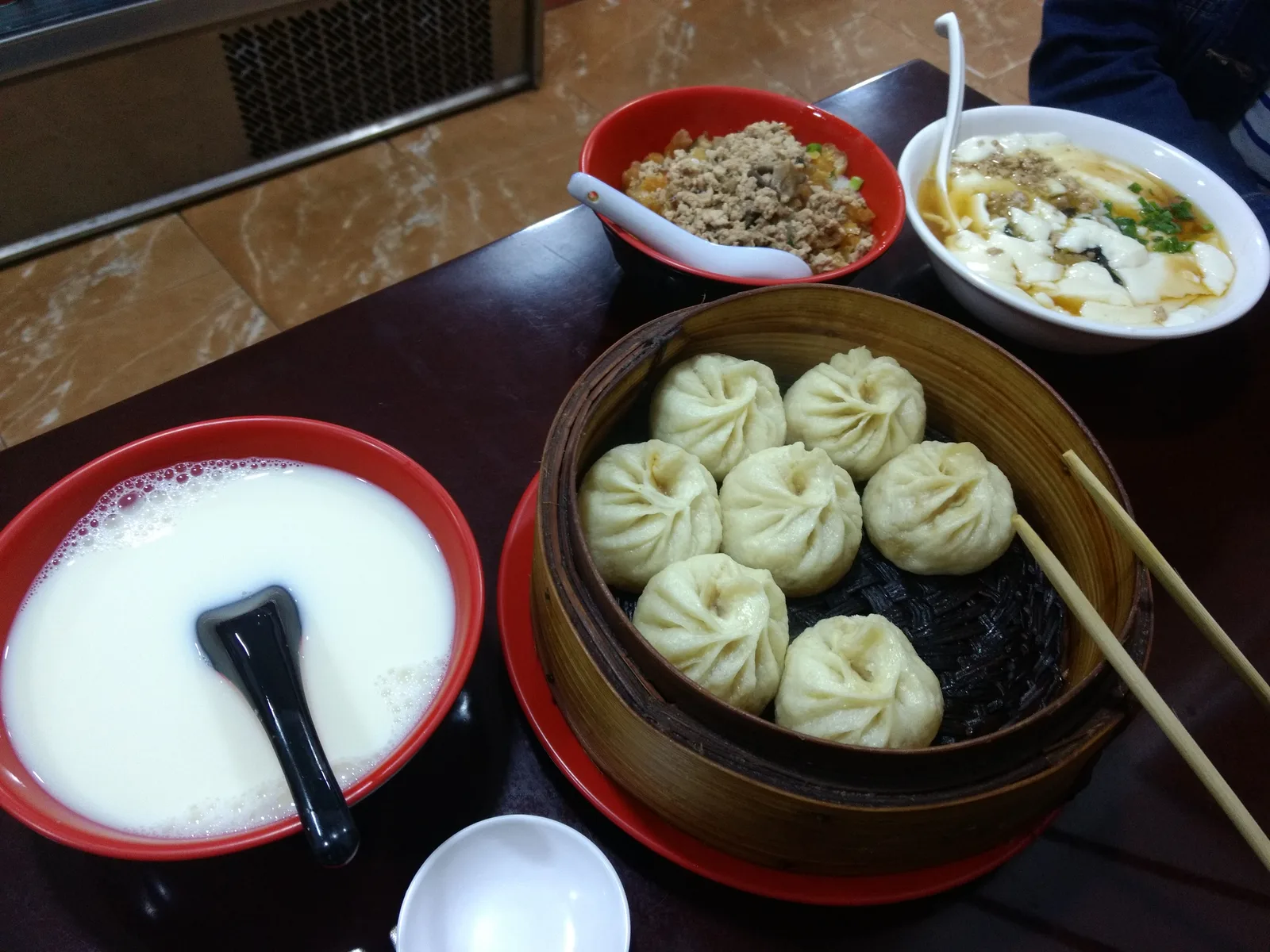
*Typical composed breakfast spread—actual items vary by city and household. DragonTrail media library.*
Northern Wheat Breakfast
Youtiao (fried dough sticks) dipped in sweet or savory soy milk is a classic northern pairing—crisp, hot and inexpensive. Baozi (steamed stuffed buns) and mantou (plain steamed buns) fill canteen steamers by dawn. Jianbing (煎饼果子)—crisp crepe with egg, cracker, sauce and greens—is Beijing and Tianjin street-breakfast iconography, often eaten while walking.
Doujiang shops may sell youtiao, sesame flatbread and tea eggs in combination—pay at counter, eat standing or at small tables.
Southern Rice and Congee Breakfast
Congee (粥) ranges from plain rice porridge with pickles to elaborate century egg and pork (皮蛋瘦肉粥) versions in Cantonese chains. Congee is comfort food, late-night food and morning food depending on context.
Cheung fun (肠粉)—steamed rice rolls with shrimp or beef—anchors Guangdong morning teahouse culture. Rice noodle soup (米线) appears in Yunnan and Guangxi breakfast shops with quick topping choices.
Dim Sum as Morning Meal
Cantonese yum cha (饮茶)—tea plus dim sum—is a sit-down social breakfast or brunch, not a five-minute counter transaction. Har gow, siu mai, char siu bao and turnip cake appear on rolling carts or order cards. Timing extends toward midday on weekends.
Travelers in Hong Kong, Guangzhou or Shenzhen encounter dim sum as regional breakfast culture; it is not standard in every Chinese city at 7 a.m.
Street-Stall and Market Breakfast
Many breakfasts are street food in practice: jianbing griddles, soy-milk carts, steamers on sidewalk, Muslim bread ovens. Hygiene and crowd density vary—busy shop turnover is a practical quality signal. Overlap: Chinese Street Food.
Ethnic and Regional Variation
Hui Muslim morning shops may sell beef or lamb soup, flatbread and tea without pork products—related cluster page: Halal & Muslim Food in China.
Xinjiang breakfasts can include tea, bread and noodle soup reflecting Central Asian habits—see Xinjiang & Northwest Food.
Tibetan areas feature butter tea and tsampa—distinct from Han breakfast patterns; mention as regional context only when traveling there.
Hotel, Airport and Train Breakfast
International hotels in Beijing, Shanghai and Guangzhou offer fusion buffets—congee, noodles, pastry, eggs—useful for jet lag but culturally mixed. High-speed rail stations sell packaged buns and cup noodles; not culinary highlights but logistics reality.
For intentional local breakfast, leave the hotel district once or book a guided Beijing food experience that includes morning market context—see Beijing food.
Breakfast vs Lunch Timing
Shops often close by mid-morning when lunch prep begins. Arrive before 9:30 for peak northern street breakfast; dim sum teahouses run longer. "Breakfast" dishes sometimes reappear as snacks—jianbing at noon is normal in busy districts.
Practical Tips for Travelers
- Carry small cash or mobile pay—some elderly-run stalls prefer local apps; tourist areas increasingly accept cards at chains.
- Point and choose when language is limited—steamers display buns visually.
- Allergies: peanut and sesame appear in sauces; wheat is everywhere in north; specify 不要花生 if needed.
- Spice at breakfast—Henan hulatang (胡辣汤) is peppery; southern congee is usually mild.
- Photography—ask before filming vendors at close range.
How Breakfast Connects to Other Staples
Morning wheat formats link to Chinese noodles (soup noodles at breakfast) and Chinese Dumplings (morning dumpling shops in some cities). Festival foods rarely dominate weekday breakfast—see Chinese New Year foods for seasonal contrast.
Canteen and Chain Breakfast
Office canteens (单位食堂) and school gates repeat predictable steam-tray formats—baozi, congee, fried dough—priced for volume. Nationwide chains (e.g. soy-milk and baozi franchises) standardize northern-adjacent menus in cities where local tradition might otherwise favor rice. Chains help travelers when language is limited; they are not the only authentic layer.
Beverage Pairings Beyond Soy Milk
Doujiang (soy milk) dominates northern pairing logic, but mian tang (面汤, noodle cooking water), millet porridge (小米粥) and tea (especially with dim sum) anchor other regions. Suanmeitang (sour plum drink) appears as bottled accompaniment in some snack districts—not breakfast default but common in tourist food streets.
Weekend vs Weekday Rhythm
Weekday breakfast is fast—commute window, mobile pay, eat walking. Weekends allow dim sum queues, family congee, and market browsing. Tourists sleeping late may miss 6–9 a.m. peak; some northern doujiang shops close by 10 a.m. Dim sum halls bridge toward lunch on Saturday–Sunday.
Breakfast in Other Chinese Food Guides
Compare meal layers across the cluster: Chinese Street Food for griddle overlap, Chinese Noodles for soup-bowl mornings, Dining Etiquette for dim sum table manners, and Chinese Food hub for regional cuisine context.
Language Quick Reference
| English need | Chinese phrase |
|---|---|
| One soy milk, two youtiao | 一杯豆浆,两根油条 |
| No egg (jianbing) | 不要鸡蛋 |
| Not spicy | 不要辣 |
| Takeaway | 打包 |
| How much? | 多少钱? |
Phrasebook helps; pointing at steamers remains valid strategy in busy shops.
Allergies and Diet at Breakfast
Peanut and sesame hide in jianbing sauce and doujiang blends. Wheat dominates northern counters. Egg is default in many bing. State needs clearly; hotel breakfast buffets offer safer fallback for complex allergies but weaker local context.
International visitors sometimes assume hotel buffet equals local breakfast—use buffets for convenience, then seek one neighborhood shop experience for texture comparison with this guide's regional examples.
FAQ
What do Chinese people eat for breakfast?
It depends on region and city—northern soy milk and youtiao, southern congee and rice rolls, Cantonese dim sum, northwestern lamb soup and many local variants. There is no single national breakfast.
Is dim sum only for breakfast?
Dim sum is associated with morning and brunch yum cha in Cantonese culture but can extend toward lunch, especially on weekends.
Can I find Western breakfast in China?
Hotels and cafés in major cities serve Western items; neighborhood local breakfast remains Chinese-format in most districts.
Is street breakfast safe to eat?
Busy shops with high turnover are a practical heuristic; travelers with sensitive stomachs may start with steamed items and bottled drinks.
What is jianbing?
A northern-style savory crepe, often with egg, cracker, sauce and greens—popular Beijing-Tianjin street breakfast.
Do Chinese eat rice for breakfast?
Yes in much of the south—congee and rice-noodle bowls are common morning formats.
Where to try breakfast in Beijing?
Hutong and side-street jianbing and doujiang shops near residential areas; hotel buffets for convenience—see Beijing food.
How does breakfast relate to dining etiquette?
Shared table manners at dim sum follow broader meal customs—see Dining Etiquette in China.
Continue with Chinese Food
- Chinese Food guide
- Chinese Noodles
- Chinese Street Food
- Festival & New Year Foods
- Dining Etiquette in China
City & regional guides
Sources & Review
- Regional breakfast ethnography — provincial culinary museum summaries
- UNESCO and intangible heritage — regional food customs where inscribed
- Chinese characters verified
- Author: DragonTrail editorial
- Last reviewed: August 2026