
| Item | Answer |
|---|---|
| Chinese term | 锅底 (guōdǐ), commonly translated "soup base" |
| Major families | Clear/mild, mala, beef-tallow, tomato, mushroom, herbal, split (yuānyāng) |
| Spicy by default? | No—clear and mild broths are common |
| House-made vs packaged | Both exist; restaurants may use house-made stock, packaged base, or a combination |
| Vegetarian caution | Do not assume "vegetarian" unless the broth ingredients are confirmed |
| Related pages | Hot Pot Ingredients, How to Eat |
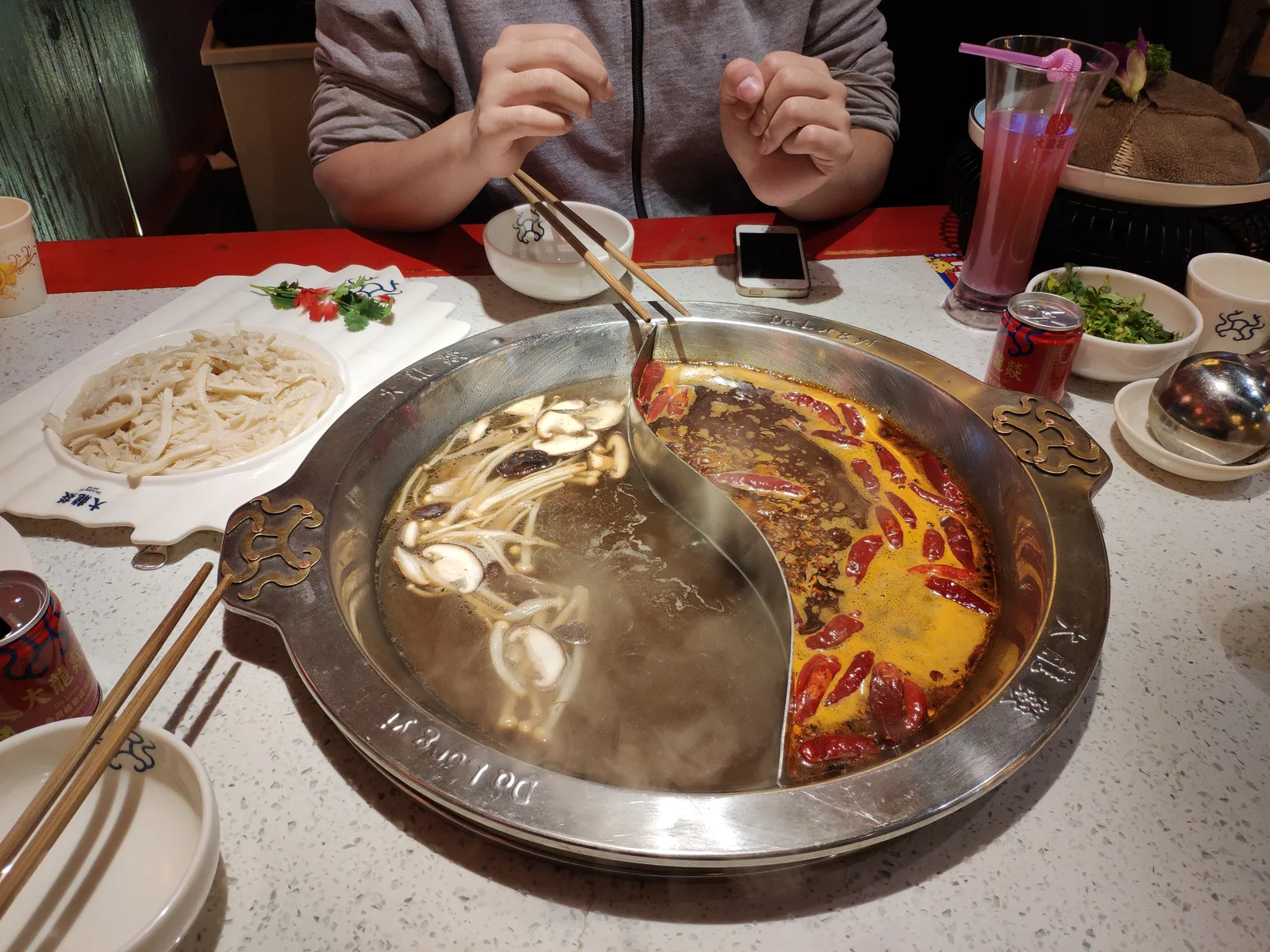
*A yuanyang hotpot lets diners cook ingredients in both spicy and mild broths.*
Pot Base, Broth and Soup Base: What Travelers Actually Mean
Chinese menus most often use 锅底 (guōdǐ), literally "pot base," for the liquid a hot pot restaurant serves you at the start of the meal. In everyday English travel usage, this gets translated interchangeably as "broth," "soup base" or "hot pot base." All three English terms usually refer to the same thing: the simmering liquid in the pot, before you add your own ingredients.
Some restaurants make their base from scratch with bones, aromatics and spices simmered for hours; others use a packaged base—a concentrated paste or block that is diluted with water or stock at the table. Packaged bases are common, including for well-known regional flavors such as mala, and are not automatically a lower-quality choice—many packaged bases are produced by established regional brands. If the base's exact preparation matters to you (for dietary or halal reasons, for example), ask the restaurant directly rather than assuming from the menu description alone.
Clear Northern-Style Broth
Clear broth (清汤, qīngtāng) is a mild, usually lightly seasoned stock associated with Beijing-style shuàn yángròu (instant-boiled mutton) hot pot. It is typically made with water, ginger, scallion and sometimes goji berries or dates, letting the flavor of thin-sliced lamb and a sesame-based dipping sauce carry the meal rather than a heavily seasoned liquid. Clear broth is a useful choice for travelers who want a milder introduction to hot pot, or who are dining with people who do not want spice. See Beijing Hot Pot for the fuller regional picture.
Sichuan Mala Broth
Mala broth (麻辣锅底) combines chilli for heat with Sichuan pepper (花椒, huājiāo) for a numbing sensation, usually built on an oil base with dried chillies, doubanjiang (fermented broad bean paste) and aromatics simmering together. Intensity varies enormously by restaurant—some Sichuan-style broths are only lightly spiced, while others are aggressively hot. Ordering a "mild" (微辣, wēilà) version reduces intensity but does not guarantee the broth will feel mild to every traveler, since spice tolerance is subjective and kitchens calibrate "mild" differently. See Mala Hot Pot for a full breakdown of the flavor system.
Chongqing Beef-Tallow Broth
Chongqing-style hot pot is strongly associated with a broth built on beef tallow (牛油) rather than a purely vegetable-oil base, combined with a heavy layering of dried chillies and Sichuan pepper. The tallow gives the broth body and a distinctive richness, and it is one of the clearest technical differences travelers can look for between a Chongqing-style broth and a lighter Sichuan-style mala broth elsewhere. Not every Chongqing restaurant uses an identical ratio of tallow to oil, chilli or pepper—treat this as a regional tendency, not a fixed formula. See Chongqing Hot Pot for city-specific detail.
Tomato Broth
Tomato broth (番茄锅底) is a widely available mild option, built on tomato, sometimes with additional vegetables or a light stock. It reads as familiar to many international travelers and is a common "safe" choice for mixed groups that include people who do not want spice. Do not assume tomato broth is meat-free by default—some versions are built on a meat or bone stock base with tomato added for flavor and color, so confirm directly if a vegetarian meal matters.
Mushroom Broth
Mushroom broth (菌菇锅底) uses a mix of mushrooms—often several varieties together—simmered into a savory, umami-forward liquid. It is another commonly offered mild option and is sometimes marketed as a lighter or more "health-focused" choice on restaurant menus. As with tomato broth, mushroom broth is not automatically vegetarian; some versions include chicken or bone stock alongside the mushrooms for depth of flavor.
Herbal and Other Mild Styles
Some restaurants, particularly in southern China, offer herbal or medicinal-style broths built with ingredients such as goji berries, dates, ginseng slices or other traditional additions, aimed at a warming or tonic quality alongside mild flavor. These broths are less standardized than the major styles above and vary considerably by restaurant—treat any specific health claims about a "tonic" broth with caution rather than as established medical fact.
Yuānyāng / Split Pot
The yuānyāng guō (鸳鸯锅 / 鴛鴦鍋), or split pot, divides a single pot into two sections—commonly a spicy mala side and a mild or clear side—using a metal divider shaped like a yin-yang symbol. This format lets one table order two broths at once without needing two separate pots, and it is one of the most practical solutions for mixed groups where some diners want spice and others do not.
Broth Comparison Table
| Broth style | Typical flavor | Usually spicy? | Animal-fat/stock risk | Best for | Regional association |
|---|---|---|---|---|---|
| Clear/mild (清汤) | Light, aromatic | No | Low, but may use chicken/bone stock | First-timers, mild-spice groups | Beijing/northern |
| Sichuan mala | Numbing-spicy, oily | Yes, variable intensity | Often uses animal fat/oil blend | Travelers wanting the classic Sichuan flavor | Sichuan |
| Chongqing beef-tallow | Rich, very spicy | Yes, typically intense | High—built on beef tallow | Travelers seeking the strongest regional style | Chongqing |
| Tomato | Tangy, mild | No | Varies—confirm stock base | Mixed groups, spice-averse diners | Nationwide |
| Mushroom | Savory, mild | No | Varies—confirm stock base | Diners wanting umami without spice | Nationwide |
| Herbal/mild tonic | Mild, aromatic | No | Varies by restaurant | Diners seeking a lighter option | Mostly southern China |
| Yuānyāng (split) | Two flavors in one pot | One side only | Depends on which sides are chosen | Mixed spice-tolerance groups | Nationwide |
Choosing a Broth as a First-Timer
A practical approach for a first hot pot meal is to order a split (yuānyāng) pot if it is available, pairing a mild broth—clear, tomato or mushroom—with a spicy option on the other side. This lets everyone at the table sample both without committing the whole meal to one intensity level. If a split pot is not offered, choosing a single mild broth and adding chilli oil to your personal dipping sauce gives more individual control over spice than starting with a fully mala pot.
Dietary and Vegetarian Notes
No broth on this page should be assumed vegetarian, vegan or halal without confirmation. Clear, tomato and mushroom broths are often mistaken for automatically meat-free options, but many restaurants build even these lighter broths on chicken or bone stock for flavor. Mala and beef-tallow broths commonly use animal fat as a base ingredient. Shared pots also mean any broth can pick up flavor and particles from meat and seafood cooked in it by other diners. See Vegetarian & Vegan Hot Pot and Halal Hot Pot for what specifically to ask before ordering.
FAQ
What is a hot pot soup base?
A hot pot soup base—锅底 (guōdǐ) in Chinese—is the simmering liquid in the pot that diners cook their ingredients in. It can be house-made from scratch or prepared from a packaged base diluted at the table.
What is the difference between clear broth and mala broth?
Clear broth (清汤) is a mild, lightly seasoned stock associated with Beijing-style hot pot. Mala broth combines chilli heat with the numbing sensation of Sichuan pepper and is associated with Sichuan and Chongqing hot pot.
Is Chongqing hot pot broth the same as Sichuan mala broth?
They are closely related but not identical. Chongqing broth is strongly associated with beef tallow as a base fat, giving it a richer, heavier character, while Sichuan mala broths outside Chongqing more often use a lighter oil base.
Is tomato hot pot broth vegetarian?
Not automatically. Some tomato broths are built on a meat or bone stock with tomato added for flavor, so confirm directly with the restaurant if a vegetarian meal is important.
What is a yuanyang pot?
A yuānyāng guō (鸳鸯锅) is a split pot divided into two sections, usually a spicy side and a mild side, letting one table order two broths at once.
Can I ask for a milder hot pot broth?
Yes—asking for 微辣 (wēilà, mildly spicy) or a clear/tomato/mushroom broth reduces spice intensity, though "mild" is calibrated differently by each kitchen and may still feel spicy to some travelers.
Are all hot pot broths spicy?
No. Clear, tomato, mushroom and herbal broths are common mild options available at most hot pot restaurants alongside spicier mala and beef-tallow styles.
Continue with Chinese Hot Pot
Regional hot pot guides
Sources & Review
- TravelChinaGuide — Chengdu and Sichuan regional dining context
- Chinese characters verified
- Author: DragonTrail editorial
- Last reviewed: August 2026