
| Item | Detail |
|---|---|
| Chinese | 湘菜 (Xiāngcài) |
| Core region | Hunan Province; Xiang River basin cities |
| Signature sensations | Fresh/dried chilli, smoke, sour notes, fermented black beans |
| Common techniques | Stir-frying, steaming, smoking, braising, stewing |
| Staples | Rice dominant; noodles and wheat snacks in cities |
| Famous examples | Steamed fish head with chilli, Chairman Mao's red-braised pork, smoked meats |
| Important qualification | Not identical to Sichuan despite shared "spicy Chinese" stereotype |
What Hunan Cuisine Is
Hunan cooking developed in a humid subtropical interior with strong agricultural and river-trade networks. Chilli entered everyday cooking deeply—fresh, pickled and dried—partly for preservation and flavour, not only for spectacle. Smoking and curing pork, fish and poultry remain visible in markets and home pantries, especially in western Hunan mountain communities.
Changsha, the provincial capital, anchors urban restaurant culture; Xiangxi (western Hunan) and Hengyang areas maintain distinct ingredient access and festival foods. "Hunan" on a menu describes a pattern, not one uniform spice dial.
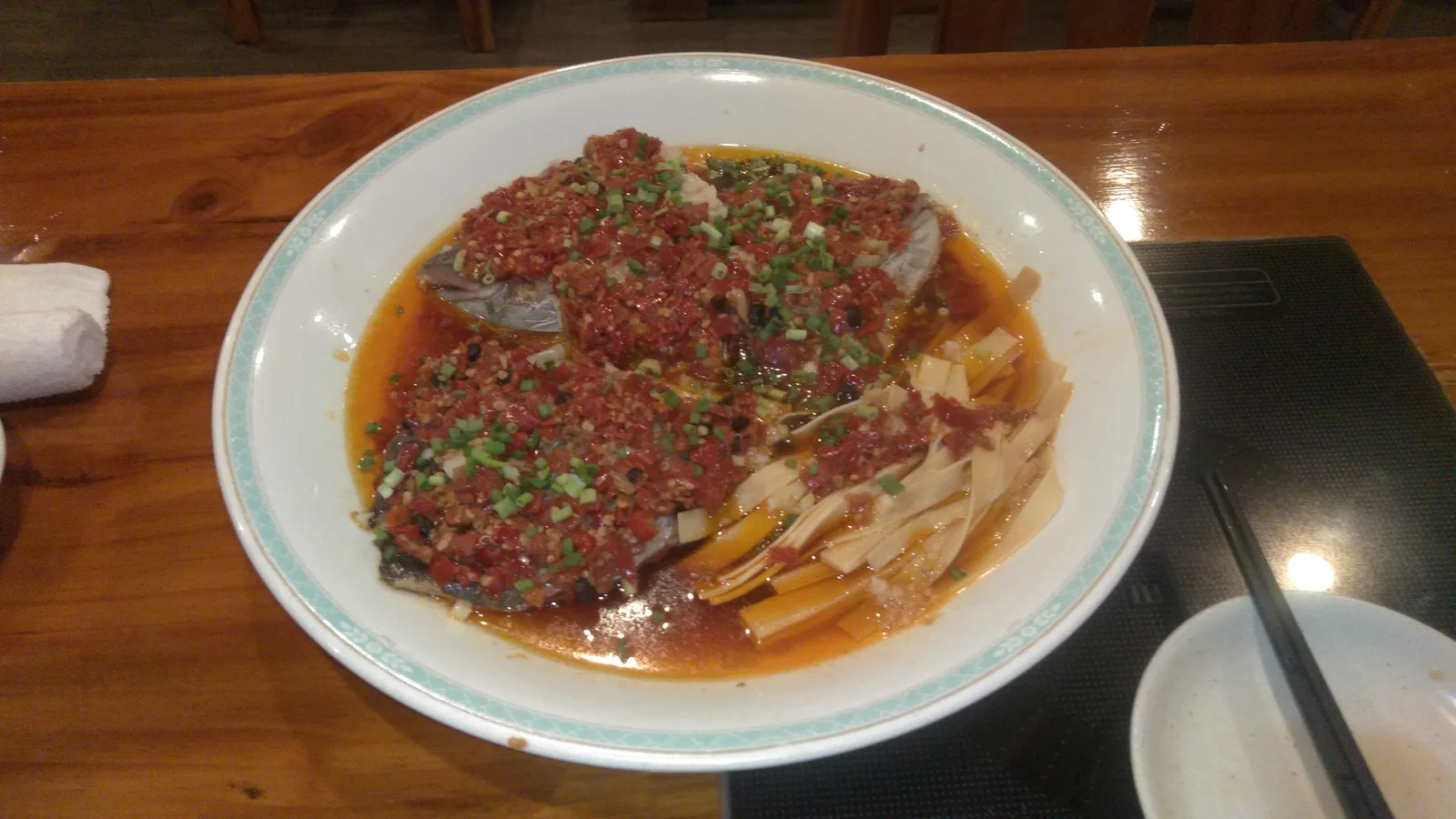
*Steamed fish head with chopped chillies (剁椒鱼头) — Hunan presentation using fermented chilli paste. DragonTrail editorial image.*
Flavour Profile: Xiāng Là vs Málà
| Hunan (湘菜) | Sichuan (川菜) | |
|---|---|---|
| Primary heat | Fresh, pickled, dried chilli | Chilli plus Sichuan pepper numbing |
| Smoke | Prominent in many dishes | Present but different pantry emphasis |
| Sour notes | Pickled chilli, black vinegar accents | Sweet-sour in some classics, less pickle-forward |
| Fermented pastes | Duo jiao (剁椒), fermented black beans | Doubanjiang central |
| English stereotype | "Very spicy" | "Numbing spicy" |
Hunan heat is often described as direct and bright; Sichuan heat frequently layers numbing huājiāo. Both provinces eat non-spicy dishes—do not assume every table is fiery.
Key Ingredients
| Ingredient | Hunan role |
|---|---|
| Fresh red and green chilli | Stir-fries, steamed toppings |
| Duo jiao (剁椒) | Fermented chopped chilli for fish heads and stir-fries |
| Smoked pork / bacon (腊味) | Stir-fries, rice dishes, festival meals |
| Fermented black beans | Steamed and stir-fried meats |
| Pickled vegetables | Sour crunch in stir-fries and soups |
| Ginger, garlic, scallion | Base aromatics |
| Rice | Staple for shared meals |
Ingredient context across regions: Chinese Ingredients.
Signature Dishes Travelers Recognise
| Dish | Chinese | What it shows |
|---|---|---|
| Steamed fish head with chopped chillies | 剁椒鱼头 | Duo jiao, communal steaming |
| Chairman Mao's red-braised pork | 毛氏红烧肉 | Sweet-savoury braised pork belly |
| Steamed cured meat | 腊味合蒸 | Smoke and preservation culture |
| Stir-fried pork with chilli | 农家小炒肉 | Everyday chilli pork |
| Changsha stinky tofu | 臭豆腐 | Fermented street snack tradition |
| Dry pot cauliflower | 干锅花菜 | Dry-pot technique with chilli |
| Hunan rice noodles | 湖南米粉 | Breakfast and snack wheat/rice noodle culture |
Fish head dishes are banquet and casual staples—portions are large; order for groups. Stinky tofu is street food with strong aroma; not every visitor enjoys it, but it illustrates fermentation culture.
Cooking Techniques
| Technique | Chinese | Hunan example |
|---|---|---|
| Steaming | 蒸 | Fish head with duo jiao |
| Stir-frying | 炒 | Chilli pork, smoked bacon with peppers |
| Smoking / curing | 熏 / 腊 | Cured meats for steaming or frying |
| Braising | 烧 / 红烧 | Red-braised pork belly |
| Dry pot | 干锅 | Less soupy than hotpot; wok-tossed aromatics |
| Pickling | 腌 | Chillies and vegetables for sour heat |
Dry-pot service resembles Sichuan Cuisine dry-fry culture but often skips huājiāo. Broader technique map: Chinese Cooking Techniques.
Hunan vs Sichuan vs Cantonese
| Cuisine | Heat style | Smoke | Broth / soup role |
|---|---|---|---|
| Hunan | Chilli-forward, pickled sour | Strong | Hearty soups, less tea-house dim sum |
| Sichuan | Málà, fermented bean pastes | Moderate | Hotpot culture central |
| Cantonese | Mild default | Roast meats, not pickle-smoke axis | Slow soups, dim sum |
All three appear in eight-cuisine education on the Chinese Food hub. Beijing visitors may encounter Hunan chains alongside Sichuan—read menus for duo jiao and smoked meat cues.
Where Travelers Encounter Hunan Food
- Changsha — night markets, stinky tofu streets, fish-head restaurants.
- Major Chinese cities — Hunan provincial restaurants for business banquets and chilli-focused dining.
- International menus — fewer dedicated Hunan shops than Sichuan abroad; dishes may appear under generic "Hunan spicy" labels.
Hunan is also a tea-producing province (Junshan Yinzhen yellow tea among famous names)—meal culture and tea culture intersect but remain separate clusters. See Chinese Tea for tea-specific travel.
Preservation, Pickling and the Hunan Pantry
Hunan humidity encouraged pickling and smoking as flavor and storage strategies—not merely spice for its own sake. Duo jiao (fermented chopped chilli) and zha cai (pressed mustard tuber) appear in home kitchens and industrial jars alike. Cured pork and fish (腊味) peak around Lunar New Year when steamed platters combine multiple smoked items.
This preservation axis distinguishes Hunan from Cantonese fresh-steam default and from Sichuan pickle-plus-huājiāo combinations. Travelers tasting steamed cured meat (腊味合蒸) encounter smoke and salt before chilli intensity.
Historical and Cultural Context
Hunan's interior position and Xiang River trade linked it to rice surplus regions and mountain communities. Twentieth-century political associations—Mao Zedong's Hunan origins, migration of Hunan cooks to national capitals—boosted dishes like red-braised pork on nationwide menus. That fame is cultural marketing as much as ancient lineage; Changsha street food tells a different story from banquet Mao-style pork.
Today Hunan restaurant chains export standardized chilli levels to malls across China. Independent kitchens still adjust smoke, pickle age and fresh chilli variety—reasons two "Hunan spicy" tables in one city can taste unlike each other.
Pairing Hunan Meals with Other Guides
Visitors building a multi-province food itinerary often contrast one Hunan chilli dinner with a milder Cantonese steam meal or a Sichuan hotpot night—three different chilli logics. For wheat snacks overlapping northwest noodles, see Chinese Dumplings and Xinjiang & Northwest Food; Hunan remains a rice-and-chilli interior tradition first. Check Chinese Ingredients for chilli and pickle vocabulary used on menus.
Practical Notes for Diners
- Spice calibration: Specify *wēi là* (微辣, mild) or *bù là* (不辣) if needed; fermented chilli toppings add heat you cannot stir away.
- Smoked meats: Salty and rich—balance with rice and greens.
- Fish head meals: Often one head serves 2–4 people; confirm size and price.
- Dietary needs: Vegetarian dishes exist but cross-contamination with pork stock is common. Halal Hunan-style restaurants are not typical—see Halal & Muslim Food in China for how religious dietary traditions differ by region and community.
- Sharing: Family-style plates with rice; Chinese Dining Etiquette applies.
Hunan dry-pot and chilli cooking differ from Sichuan hot pot—see Chinese Hot Pot and Zhangjiajie Sanxiaguo for related communal and local-food formats.
FAQ
Is Hunan food spicier than Sichuan food?
Not universally. Hunan often emphasizes fresh chilli and smoke without Sichuan pepper numbing. Personal tolerance and specific dishes matter more than province rankings.
What is duo jiao?
Duo jiao (剁椒) is fermented chopped red chilli used as a topping and seasoning—key to steamed fish head and many stir-fries.
What is the difference between Hunan and Sichuan cuisine?
Hunan: chilli, smoke, pickles, sour notes. Sichuan: doubanjiang, huājiāo numbing, málà layers. Both are Eight Great Cuisines.
Is Chairman Mao's red-braised pork a Hunan dish?
It is widely marketed as a Hunan-associated braised pork belly dish named after Mao Zedong's Hunan origins—restaurant recipes vary in sweetness and spice.
What is Hunan stinky tofu?
Fermented tofu deep-fried or braised—strong aroma, soft interior. A Changsha street-food icon, not representative of every Hunan meal.
Does Hunan cuisine use Sichuan pepper?
Sometimes, but it is not the defining numbing backbone the way it is in Sichuan. Do not expect málà as default.
Where should I read about dim sum or Cantonese food?
Dim Sum and Cantonese Cuisine cover southern tea-meal traditions—different from Hunan's chilli-smoke axis.
How does Hunan fit the Chinese Food guide?
As one of the Eight Great Cuisines on Chinese Food, with links to ingredients and cooking techniques.
Are Hunan and Sichuan hotpot the same?
No. Hunan dry-pot and chilli-forward stir-fries differ from Sichuan málà hotpot broth culture. Both provinces offer communal meals, but broth, spice and pantry defaults diverge.
Continue with Chinese Food
Related guides
- Chinese Dining Etiquette
- Chinese Tea — Hunan tea regions
Sources & Review
- Hunan Provincial Museum and cultural bureau published materials on Xiang culinary heritage
- E.N. Anderson, *The Food of China* — regional comparison chapters
- Fuchsia Dunlop, *Revolutionary Chinese Cookbook* — Hunan-focused practitioner scholarship (recipe context, historical framing)
- Chinese Culinary Association — Eight Great Cuisines educational framework
- UNESCO — China intangible cultural heritage state page
- Chinese characters verified
- Author: DragonTrail editorial
- Last reviewed: August 2026