
Chinese sculpture develops in four broad phases: Neolithic and Bronze Age foundations dominated by pottery and ritual bronze rather than figural statues, the Qin and Han invention of monumental figural sculpture, several Buddhist-driven centuries in which religious icon-carving becomes the dominant genre, and a final imperial-to-modern phase centered on funerary sculpture, palace ornament and 20th-century public monuments.
A useful broad chronology runs through those phases; periods overlap, regional traditions diverge, and the linked guides below add more depth without treating the four phases as the only possible scholarly periodization.
| Period | Approximate date | What happens |
|---|---|---|
| Neolithic | before c. 2000 BCE | Painted pottery and small carved figures; no monumental sculpture yet |
| Shang & Zhou | c. 1600–256 BCE | Bronze casting reaches an extraordinary level, almost entirely for ritual vessels; Sanxingdui bronzes are a striking exception |
| Qin | 221–206 BCE | The terracotta army establishes large-scale, individualized figural sculpture in fired clay |
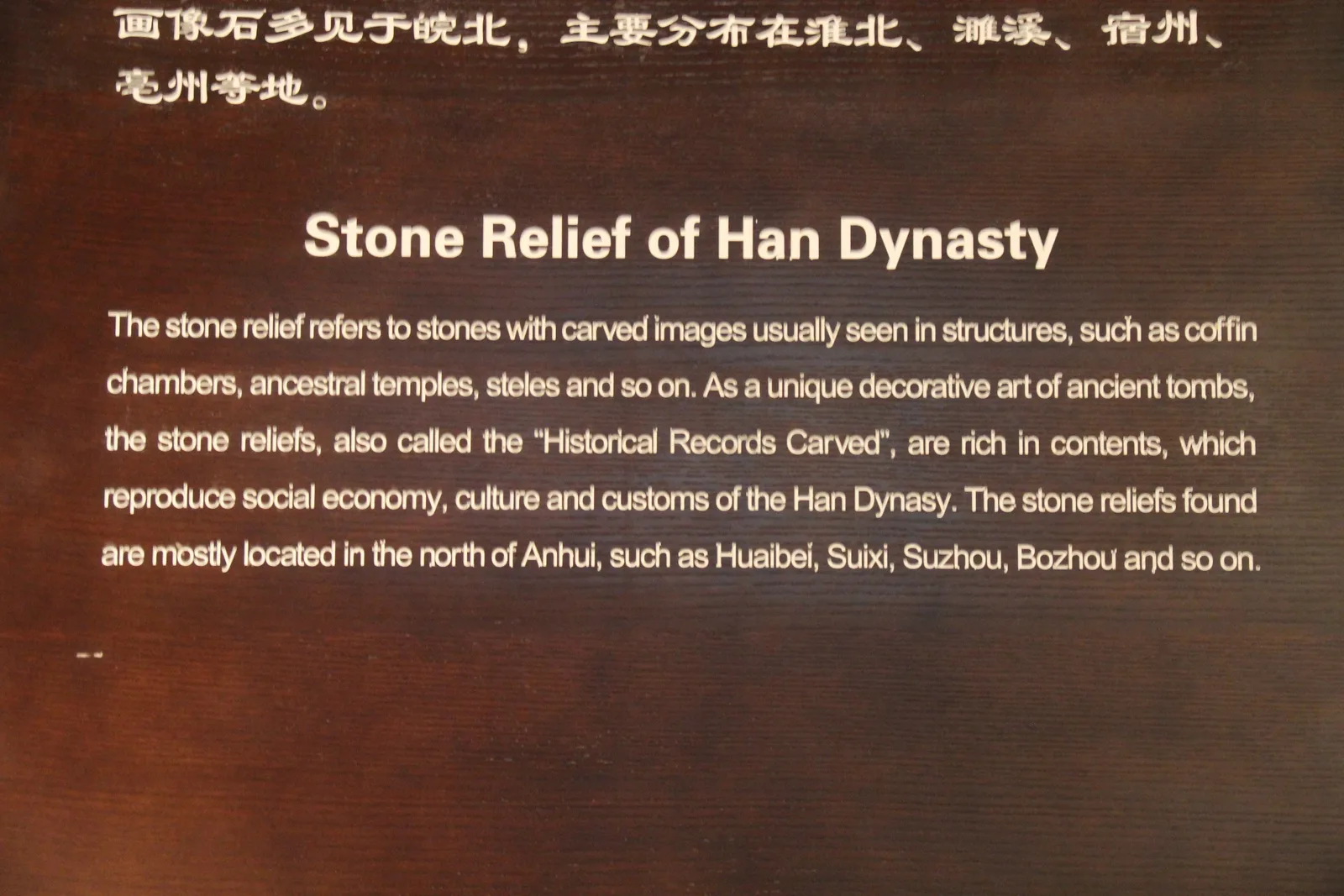
| Han | 206 BCE–220 CE | Stone-relief tomb shrines, pottery tomb figures, and the Eastern Han bronze horse known as the Flying Horse of Gansu |
| Six Dynasties–Northern Wei | 220–589 | Buddhism arrives; the first great cave temples (Yungang, early Longmen) are carved |
| Sui–Tang | 581–907 | Buddhist sculpture reaches its technical and stylistic peak; sancai tomb figures flourish |
| Song–Yuan | 960–1368 | Large polychrome wood Buddhist figures; Dazu rock carvings continue Buddhist cave art in Sichuan |
| Ming–Qing | 1368–1911 | Imperial funerary sculpture (Ming Tombs Sacred Way), palace bronze animals, continued religious and decorative carving |
| Modern–contemporary | 1912–present | Academic bronze training, public monuments, and contemporary studio sculptors |
Before Figural Sculpture: Neolithic and Bronze Age China
China's earliest three-dimensional art is pottery and small carved figures rather than monumental sculpture. Neolithic communities across different regions modeled pottery vessels and occasional figures for ritual and daily use, and worked jade into small ceremonial and ornamental objects—jade carving developed its own long tradition, covered separately on the Chinese Jade Carvings guide.
The Shang and Zhou dynasties (c. 1600–256 BCE) then push bronze casting to a technical level that has few parallels anywhere in the ancient world, but the overwhelming majority of that effort went into ritual vessels—ding tripods, zun wine vessels, gui food containers—used in ritual and ancestral ceremonies, not into free-standing statues of people or animals. The single most famous Shang bronze, the Houmuwu ding excavated at Anyang and now in the National Museum of China, weighs over 800 kilograms and is a ritual vessel, not a sculpture in the figural sense. A genuine exception exists at Sanxingdui in Sichuan, where excavations from 1986 onward uncovered large free-standing bronze human figures and masks unlike anything from the contemporary Shang heartland—evidence that figural bronze sculpture existed in ancient China, just not as the mainstream product of the best-known bronze workshops. The Chinese Bronze Sculpture guide works through this ritual-vessel-versus-sculpture distinction in more detail.
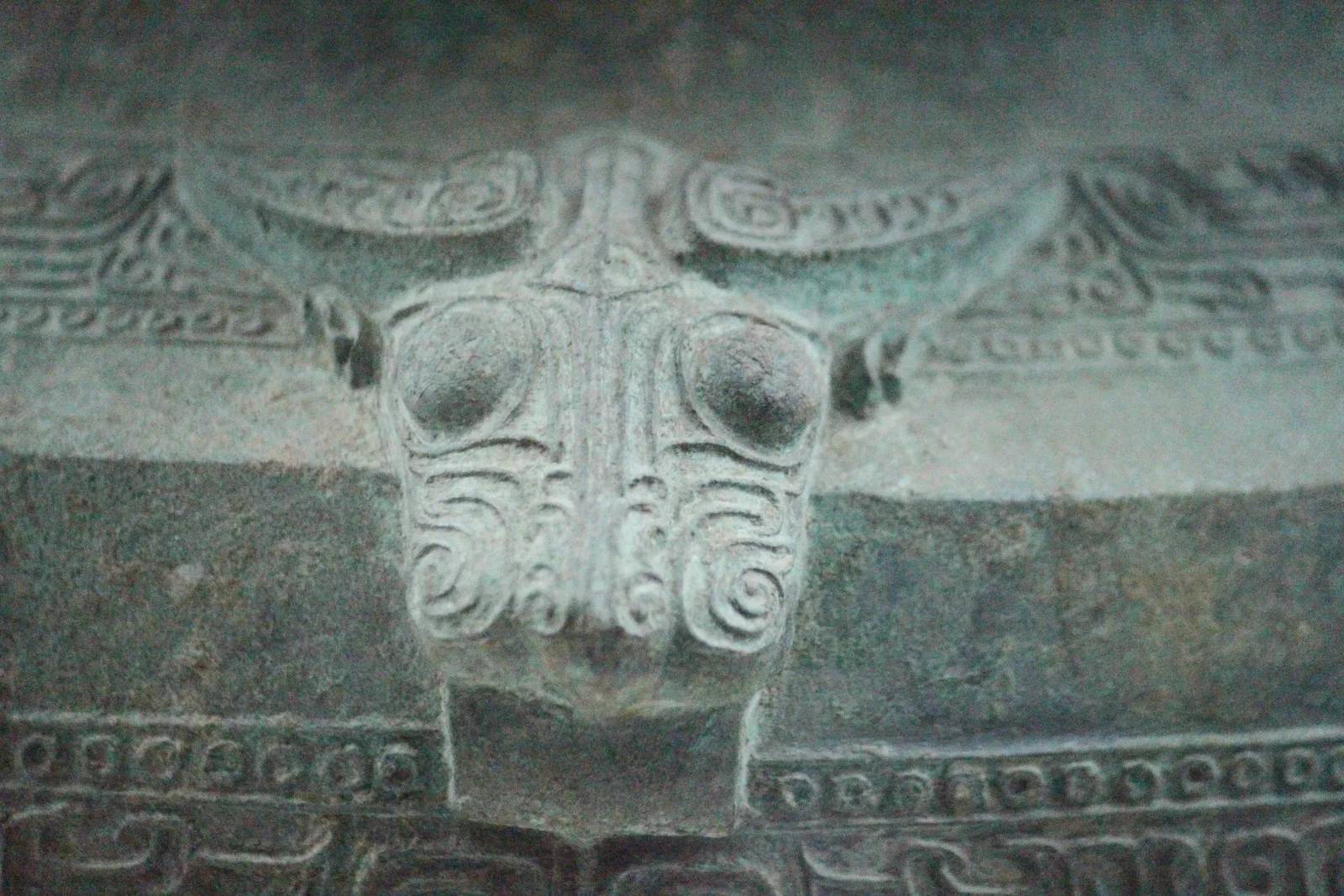
*Shang dynasty bronze zun, a ritual wine vessel rather than a figural sculpture—representative of what most surviving ancient Chinese bronzes actually are.*
Qin and Han: Monumental Figural Sculpture Arrives
The Qin dynasty (221–206 BCE) is short but decisive for the history of Chinese sculpture. China's first emperor, Qin Shi Huang, commissioned an underground army of thousands of individually finished, life-size terracotta soldiers, officers, horses and chariots to guard his tomb near what is now Xi'an. Discovered by farmers digging a well in 1974 and excavated since, the Terracotta Army remains the clearest single argument that ancient China produced monumental figural sculpture on a scale comparable to anything in the ancient Mediterranean world—it was simply built underground, for the dead, rather than displayed in a public forum for the living.
Han sculpture (206 BCE–220 CE) continues and diversifies the funerary tradition. Stone-relief tomb shrines, of which the Wu family shrines in Shandong are the best-documented example, carved narrative and mythological scenes in low relief on the walls of above-ground family shrine buildings. Smaller pottery tomb figures—houses, animals, servants, entertainers—became a standard part of Han burial practice, a tradition that expands dramatically under the Tang. Han metalworkers also cast the sculpture now known as the Flying Horse of Gansu: a bronze galloping horse, one hoof balanced on a bird mid-flight, unearthed in 1969 from a tomb at Leitai near Wuwei and now in the Gansu Provincial Museum. Both the Han stone reliefs and the Han bronze horse are covered on the Tomb & Funerary Sculpture guide and the Chinese Horse Sculpture guide.
The Buddhist Centuries
Buddhism reached China by the 1st century CE and, over the following several hundred years, made religious icon-carving the dominant sculptural genre in the country. The Northern Wei dynasty, ruling from Datong and then Luoyang, sponsored the first great cave-temple projects: the Yungang Grottoes near Datong, begun under the monk Tanyao in the mid-5th century, and the Longmen Grottoes near Luoyang, begun after the Northern Wei court moved there in 493. Sui and Tang sculptors continued and expanded both traditions—Longmen's colossal Vairocana Buddha at the Fengxian Temple, completed in 675 under Emperor Gaozong with major sponsorship from Empress Wu Zetian, stands over 17 meters tall and is often treated as the high point of Tang Buddhist stone carving.
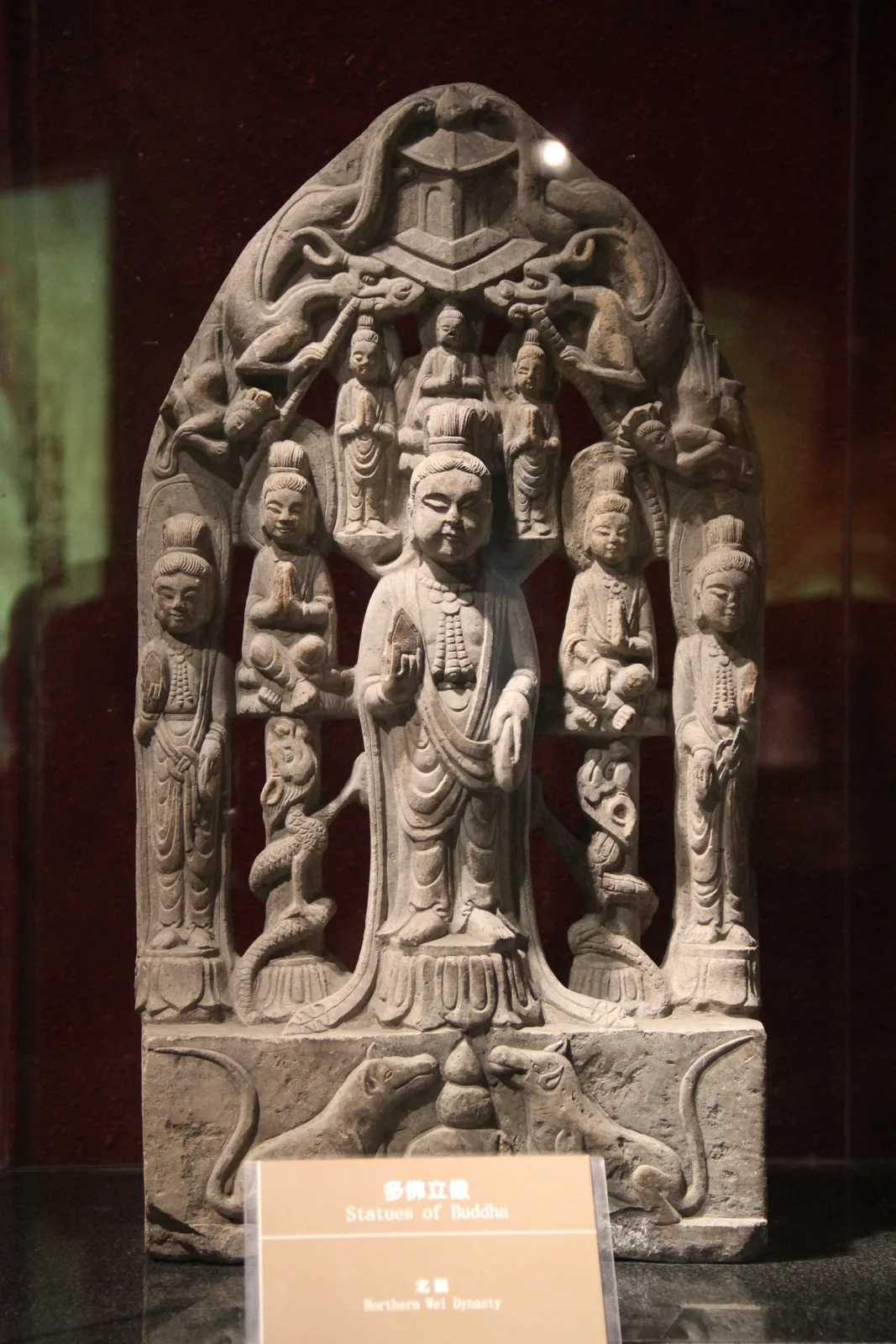
*Northern Wei-style stone Buddha, representative of the cave-temple sculpture carved at Yungang and early Longmen in the 5th and 6th centuries.*
Portable Buddhist sculpture developed alongside the monumental cave-temple tradition: small gilt bronze Buddhas and bodhisattvas, often inscribed with donor names and dates, circulated widely and are now held across major museum collections worldwide. Wood carving produced large polychrome Buddhist figures—especially Guanyin, the bodhisattva of compassion, whose "water-moon" seated pose became one of the most recognizable images in Chinese religious art from the Song dynasty onward. Buddhist cave art continued even after its northern heartland declined, moving into Sichuan, where the Dazu rock carvings near Chongqing were carved mainly between the 9th and 13th centuries and are notable for combining Buddhist, Taoist and Confucian imagery at the same sites. The Buddhist Sculpture guide and Chinese Wood Sculpture guide cover this material in full.
Tang Tomb Sculpture: A Parallel Secular Tradition
Alongside religious carving, Tang China also produced an enormous body of secular tomb sculpture: painted and lead-glazed ("sancai") pottery figures of warriors, officials, camels and especially horses, made to accompany the dead. Tang horse figures, sometimes shown with riders, are now held in museum collections from Beijing to the Metropolitan Museum of Art in New York to the Museum of Far Eastern Antiquities in Stockholm. This tradition is covered in depth on the Clay & Pottery Sculpture guide and the Chinese Horse Sculpture guide.
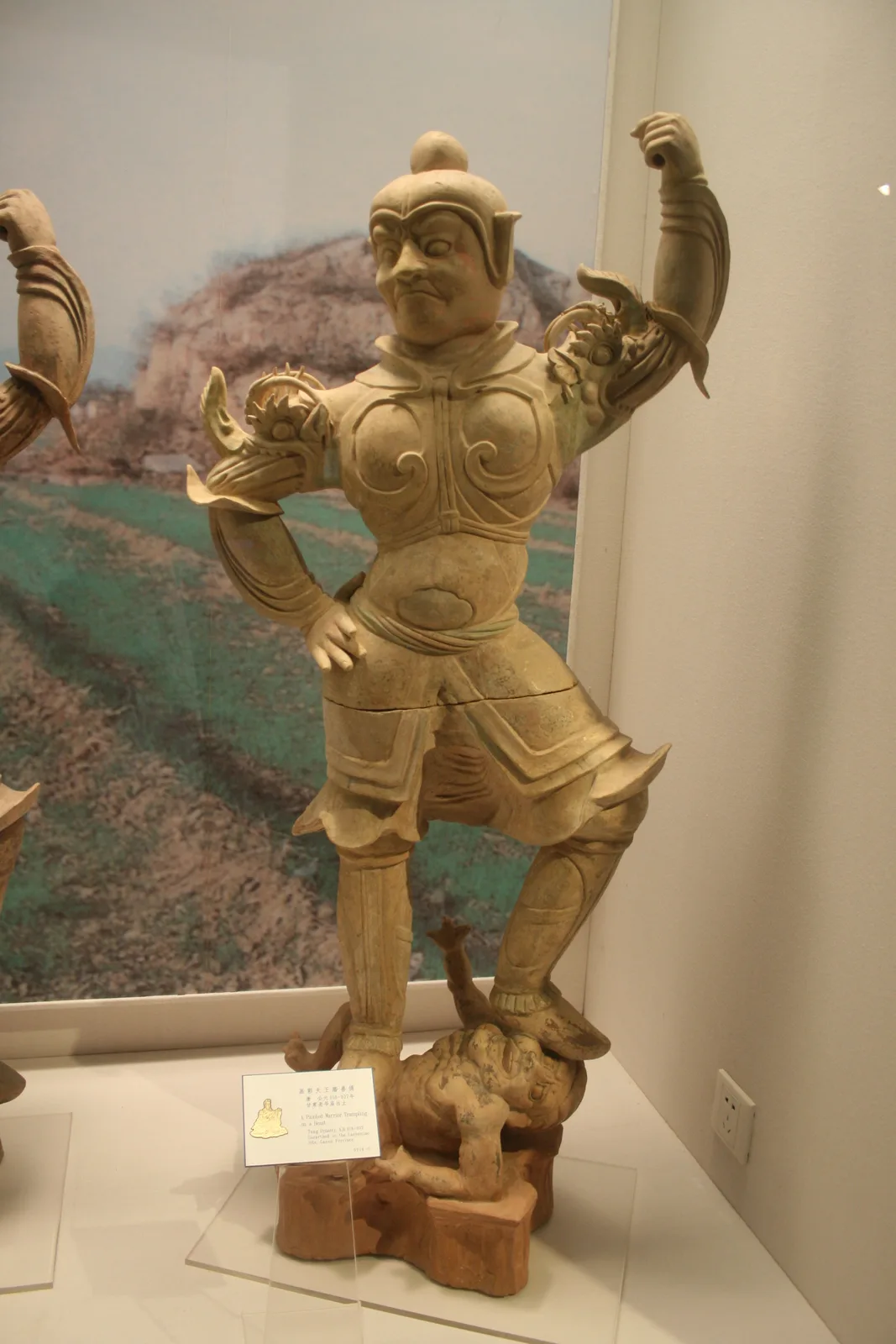
*Tang dynasty painted pottery warrior figure, part of the secular tomb-sculpture tradition that ran alongside Tang Buddhist carving.*
Imperial and Funerary Sculpture: Ming and Qing
By the Ming and Qing dynasties, the most visible new sculpture in China is imperial and funerary rather than primarily religious. The Ming Tombs north of Beijing preserve a Sacred Way lined with 24 stone animals—lions, mythical xiezhi, camels, elephants, qilin and horses—each species carved in both standing and kneeling pairs, along with stone officials, leading toward the imperial burial mounds. Inside Beijing, the Forbidden City accumulated gilded bronze dragons, bronze lions, and large carved stone dragon reliefs on its ceremonial staircases, all made to project imperial authority through repeated, standardized imagery rather than individual artistic invention. The Chinese Dragon Sculpture guide and Chinese Guardian Lions guide cover these palace traditions, and the Tomb & Funerary Sculpture guide covers the Ming Tombs Sacred Way specifically.
Modern and Contemporary Sculpture
Chinese sculpture's most recent chapter is comparatively short. Sculptors trained in early 20th-century academic traditions—often influenced by European bronze and plaster technique—began producing portrait busts and public monuments in a more Western figural style than the earlier religious and funerary traditions. A major and highly visible result is the Monument to the People's Heroes in Tiananmen Square, completed in 1958: a nearly 38-meter granite and marble obelisk whose base carries ten large marble bas-relief panels depicting a century of Chinese revolutionary history, created by a team of sculptors led by Liu Kaiqu. Contemporary sculptors such as Wu Weishan, known for bronze portrait works of cultural figures including the painter Qi Baishi, continue a figural tradition that now sits in dialogue with international sculpture rather than in isolation from it. See the Modern & Contemporary Chinese Sculpture guide for more.
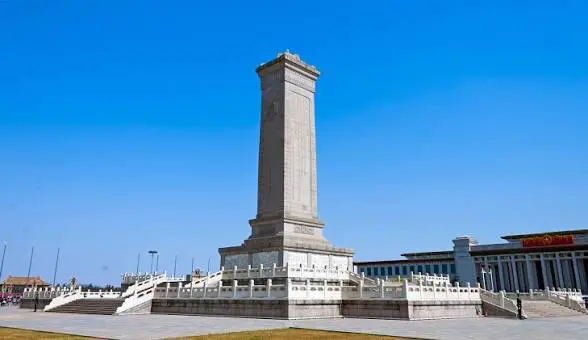
*Monument to the People's Heroes, Tiananmen Square, Beijing, completed 1958. Its marble bas-reliefs form a major public sculpture ensemble in modern China.*
See This History in Beijing
Much of this chronology can be traced through a single Beijing itinerary: Bronze Age ritual vessels and the National Museum's Ancient Chinese Buddhist Sculpture display at the National Museum of China, imperial bronze and stone sculpture at the Forbidden City, and garden sculpture at the Summer Palace. For the Qin dynasty starting point of this whole story, a separate trip to Xi'an and the Terracotta Warriors tour is necessary—see Where to See Chinese Sculpture in Beijing for full routing advice.
FAQ
What is a useful broad chronology of Chinese sculpture history?
A useful broad chronology runs from Neolithic and Bronze Age foundations (pottery and ritual bronze, not yet monumental figural statues), through Qin–Han monumental funerary sculpture, the Buddhist centuries when religious icon-carving was especially prominent, and the Ming–Qing-to-contemporary period of imperial, funerary and modern public sculpture. These phases overlap and are not the only scholarly way to periodize the material.
When did Buddhism start influencing Chinese sculpture?
Buddhism reached China by around the 1st century CE, but its major impact on sculpture becomes visible from the 5th century onward, with the Northern Wei dynasty's cave-temple projects at Yungang and Longmen.
Were ancient Chinese bronzes mostly statues?
No. Most Shang and Zhou bronzes are ritual vessels made for ritual and ancestral ceremonies, not free-standing figural sculpture. The Sanxingdui bronzes from Sichuan are a notable exception; see the Bronze Sculpture guide.
What is the single most important turning point in Chinese sculpture history?
Most historians point to two: the Qin terracotta army, which established monumental figural sculpture, and the arrival of Buddhism a few centuries later, which made religious icon-carving the dominant genre for nearly a thousand years.
Is the Terracotta Army the oldest Chinese sculpture?
No. It is the oldest widely known example of monumental figural sculpture, but Neolithic pottery figures and Shang–Zhou bronze work are considerably older; they simply are not figural statues in the same sense.
Where can I trace this chronology in person?
Beijing covers most of it: the National Museum of China for Bronze Age ritual vessels and Buddhist sculpture, the Forbidden City for imperial bronze and stone, and the Summer Palace for garden sculpture. The Qin starting point requires a separate Xi'an trip; see Where to See Chinese Sculpture in Beijing.
Continue with Chinese Sculpture
Sources & Further Reading
- UNESCO World Heritage Centre — Yungang Grottoes
- UNESCO World Heritage Centre — Dazu Rock Carvings
- National Museum of China — Houmuwu ding and Ancient Chinese Buddhist Sculpture exhibition
- UNESCO World Heritage Centre — Longmen Grottoes (Fengxian Temple Vairocana completed 675 CE)