
Chinese guardian lions—sometimes called "Foo dogs" in English, though they are lions, not dogs—are paired stone or bronze sculptures placed at the entrances of palaces, temples, tombs and, historically, government and wealthy private buildings. They are one of the most widely reproduced sculptural motifs from China, and one of the most misunderstood: the animal is not native to China, the male-with-ball and female-with-cub pairing is a common convention rather than an absolute rule, and the finest surviving examples are functional architectural guardians rather than free-standing art objects meant to be appreciated in isolation.
| Item | Answer |
|---|---|
| Common English nickname | "Foo dog" or "Fu dog" |
| What they actually are | Lions, not dogs |
| Are lions native to China? | No |
| Typical arrangement | Pairs flanking an entrance |
| Common gender convention | Male often shown with a ball/globe under one paw; female often shown with a cub — a widespread but not universal convention |
| Materials | Stone (most common) and gilded bronze (imperial contexts) |
| Best Beijing examples | Forbidden City gilded bronze lions; Summer Palace stone lions, including 544 on the Seventeen-Arch Bridge |
| Early dated example | Stone lions at the Han dynasty Wu family shrine site, Shandong |
Lions Are Not Native to China
The first fact worth knowing about Chinese guardian lions is that lions have never lived in China as a native species. The lion entered Chinese art and culture as an imported symbol, carried in through cultural and religious contact along trade and Buddhist transmission routes from regions of South and Central Asia where lions were part of the local environment and iconography. Once established, the lion took on a distinctly Chinese decorative and symbolic role as a guardian figure—protective, dignified, associated with strength and status—independent of any local familiarity with the actual animal. This is part of why stylized Chinese guardian lions can look quite different from naturalistic lions: they were carved from cultural memory and imported imagery rather than from direct observation.
"Foo Dog" Is a Nickname, Not a Fact
English-language sources, especially older ones, often call these sculptures "Foo dogs" or "Fu dogs." This is a Western nickname, not a Chinese term or a claim about the animal's actual identity—the sculptures represent lions. The nickname likely arose from a combination of the animal's somewhat stylized, curly-maned appearance in some regional styles and casual English description rather than from any genuine canine association in Chinese tradition. When precision matters—captioning a photo, describing a piece in a museum context—"guardian lion" or "stone lion" (shishi) is the more accurate term.
The Ball and Cub Convention
A widely repeated description of paired Chinese guardian lions says the male rests one paw on a ball or globe (representing supremacy over the world, or in some readings, control of the imperial court) while the female rests a paw on a cub (representing nurturing and the continuity of the imperial lineage). This convention appears frequently enough to be genuinely useful as a rule of thumb for reading a pair of lions at a glance, but it is a common convention, not an absolute law: regional workshops, individual dynasties, and specific commissions vary, and not every historical pair of guardian lions follows the ball-and-cub pattern precisely. Treat it as a helpful starting point for interpretation rather than a guarantee for every pair you encounter.
Guardian Lions in Beijing
Forbidden City gilded bronze lions
The Forbidden City's gilded bronze lions, positioned at key gates and courtyards along the palace's main ceremonial route, are the best-known imperial example of the guardian-lion tradition. Cast in bronze rather than carved in stone and finished with gilding, they signal the highest tier of imperial patronage—stone guardian lions were common at temples and official buildings, but gilded bronze was reserved for the most important palace contexts. These lions are outdoor sculpture and are viewable year-round regardless of which indoor galleries happen to be open on a given visit.
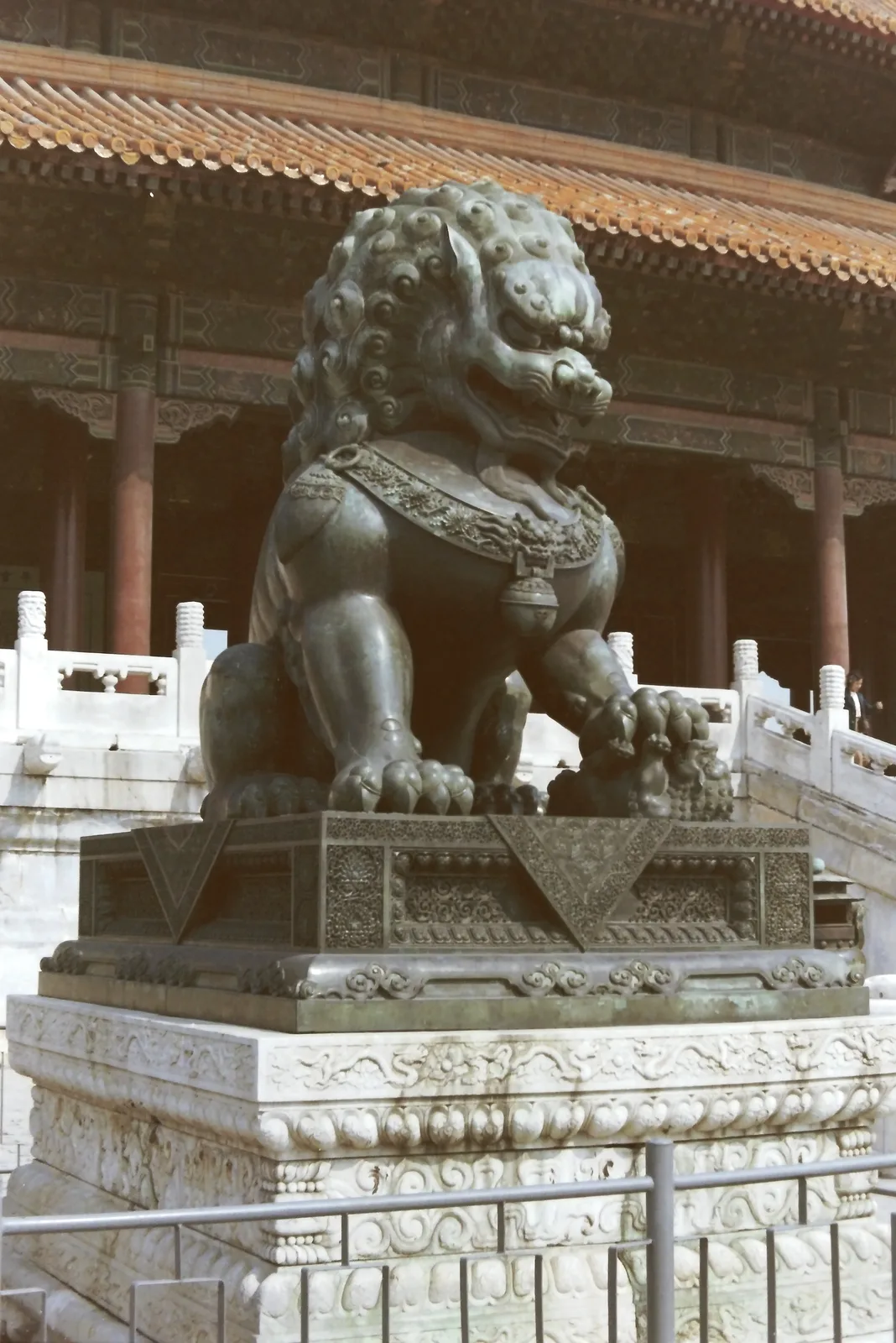
*Gilded bronze guardian lion at the Forbidden City, Beijing. Bronze lions like this mark the highest tier of imperial guardian-lion patronage, reserved for the most important palace contexts.*
Summer Palace stone lions
The Summer Palace holds one of the largest concentrations of carved stone lions anywhere in China: the balustrades of the 150-meter Seventeen-Arch Bridge, connecting the East Causeway of Kunming Lake to South Lake Island, carry 544 individually carved stone lions—no two identical—making it the largest lion count on any Chinese stone bridge. Built in 1750 under the Qianlong Emperor, the bridge and its lions are a popular stop for visitors, including families looking for an easy "spot the different lion" activity while crossing. A Summer Palace private tour is a practical way to see the bridge alongside the rest of the garden's sculpture and architecture.
An Early Dated Example: The Wu Family Shrine Lions
For travelers interested in how far back the guardian-lion tradition goes, a pair of stone lions preserved at the Wu family shrine site in Jiaxiang, Shandong—associated with a mid-2nd-century CE Han dynasty funerary shrine complex—is among the earliest confidently, historically dated stone lions in China. This is a specialist site rather than a standard Beijing-adjacent stop, but it establishes that the guardian-lion tradition was already well underway by the Han dynasty, centuries before the grand imperial bronze and stone lions most visitors encounter today.
FAQ
Are Chinese guardian lions actually dogs?
No. They represent lions. "Foo dog" or "Fu dog" is a Western nickname, not a claim from Chinese tradition that the animal is a dog.
Were lions ever native to China?
No. Lions have never been native to China; the guardian-lion motif entered Chinese art through cultural and religious contact along trade and Buddhist transmission routes, then developed into a distinctly Chinese decorative and symbolic tradition.
Does the male lion always hold a ball and the female always hold a cub?
This is a common convention—male with a ball or globe, female with a cub—but it is not an absolute rule followed by every historical pair. Treat it as a useful starting point for reading a pair of lions, not a guarantee.
What is the difference between the Forbidden City's lions and the Summer Palace's lions?
The Forbidden City's guardian lions are gilded bronze, reserved for the palace's most important ceremonial contexts. The Summer Palace's most famous lions are carved stone, including the 544 individually carved lions on the Seventeen-Arch Bridge balustrades.
How many stone lions are on the Summer Palace's Seventeen-Arch Bridge?
544, each individually carved and no two identical, making it the highest lion count on any Chinese stone bridge.
What is the earliest dated stone lion in China?
A pair of stone lions preserved at the Han dynasty Wu family shrine site in Jiaxiang, Shandong, associated with a mid-2nd-century CE funerary complex, is among the earliest confidently dated examples.
Continue with Chinese Sculpture
Plan a Visit
Sources & Further Reading
- Palace Museum — Imperial bronze and stone guardian lions in the Forbidden City
- UNESCO World Heritage Centre — Imperial Tombs of the Ming and Qing Dynasties (Sacred Way animal sculpture context)