
Most bronze objects a visitor sees in a Chinese museum's Bronze Age gallery are ritual vessels—not sculptures of people, animals or deities. That distinction is the single most useful thing to understand before looking at Chinese bronze work: ritual bronzes (ding, zun, gui and related forms) were made for ritual and ancestral ceremonies and are shaped like functional vessels even when heavily decorated, while free-standing bronze sculpture—figures and animals meant to stand on their own as an image—is a separate and, before the Buddhist period, much rarer category. This guide covers both strands and where each shows up for travelers.
| Item | Answer |
|---|---|
| Ritual bronze forms | Ding (tripod), zun (wine vessel), gui (food vessel), and related types |
| Ritual bronze purpose | Ritual and ancestral offerings, not portraiture or free-standing statues |
| Heaviest ritual bronze | Houmuwu ding, Shang dynasty, 832.84 kg, National Museum of China |
| Major exception (freestanding figural bronze) | Sanxingdui bronze standing figures and masks, Sichuan |
| Later freestanding bronze sculpture | Buddhist gilt-bronze icons, palace guardian lions and dragons, the Han "Flying Horse of Gansu" |
| Modern bronze sculpture | Portrait busts and public monuments, e.g. work by Wu Weishan |
Ritual Bronzes: China's Real Bronze Age Output
The Shang (c. 1600–1046 BCE) and Zhou (1046–256 BCE) dynasties developed bronze casting to an extraordinary technical level, using complex piece-mold casting to produce vessels with dense, intricate surface decoration. Almost all of that effort, however, went into ritual vessels rather than figural sculpture. Ding are tripod or four-legged vessels used to cook and present meat offerings; zun and you are wine vessels; gui hold grain offerings. These objects were commissioned by royal and noble households for ritual and ancestral ceremonies, often inscribed with dedications naming the ancestor being honored, and buried with their owners or handed down as lineage treasures.
The single most famous example is the Houmuwu ding (formerly known as the Simuwu ding), excavated at Anyang, Henan, in 1939 and now held at the National Museum of China. At 832.84 kilograms it is the heaviest surviving bronze vessel from anywhere in the ancient world, cast in one piece for the body and four legs with separately cast handles—an engineering feat that required well over a thousand kilograms of raw metal and a tightly organized workforce. It is, unambiguously, a ritual vessel: a rectangular cooking-and-offering form, not a statue of a person or animal.
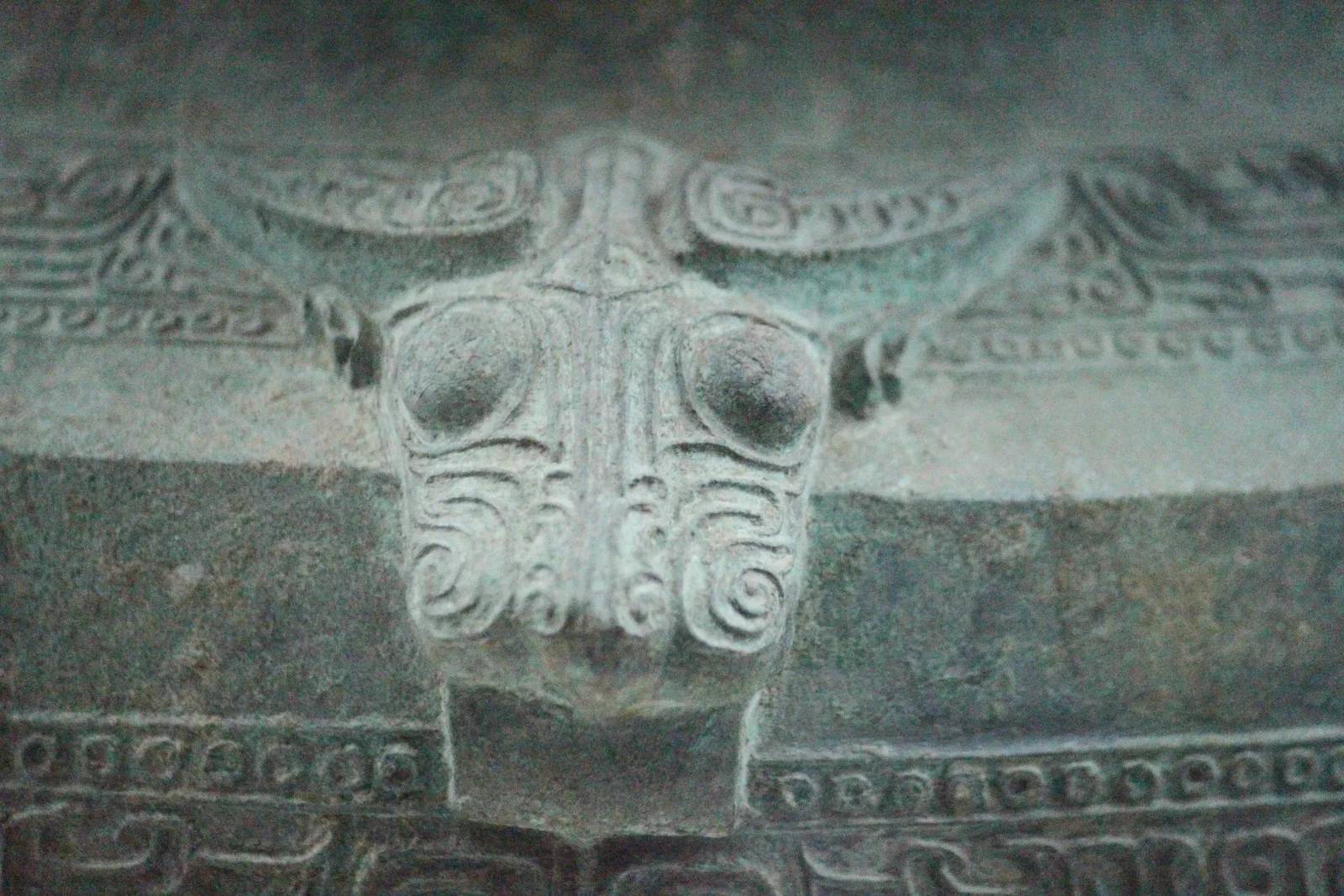
*Shang dynasty bronze zun, a wine vessel used in ritual and ancestral ceremonies. Objects like this, not figural statues, make up most of the surviving ancient Chinese bronze record.*
Understanding this distinction matters for two practical reasons. First, it explains why "ancient Chinese bronze sculpture" is a smaller and later category than visitors often assume—true figural bronze statues are mostly a Buddhist-era and later development, covered below. Second, it helps make sense of museum labeling: a Shang or Zhou gallery full of "bronzes" is usually a ritual-vessel gallery, and calling every object in it a "sculpture" blurs a distinction Chinese art history treats as important.
Sanxingdui: The Major Exception
The clearest counterexample to "ancient Chinese bronze equals ritual vessels" comes from Sanxingdui, an archaeological site near Guanghan in Sichuan associated with the ancient Shu culture, a Bronze Age civilization contemporary with the Shang dynasty but culturally distinct from it. Sacrificial pits discovered in 1986, and additional pits excavated from 2019 onward, contained large free-standing bronze human figures, bronze masks with sharply protruding eyes, and a bronze "tree" nearly four meters tall.
The best-known Sanxingdui bronze standing figure is roughly 1.68 meters tall on a 0.9-meter pedestal—about 2.6 meters total—and is generally considered the largest bronze human figure known from any Bronze Age culture anywhere in the world. Unlike Shang ritual vessels, these bronzes were cast as solid or thin-shelled forms meant to be displayed, mounted on poles, or possibly worn in ceremonies—closer to what most people mean by "sculpture" than any contemporary Shang object. Sanxingdui bronzes are held at the Sanxingdui Museum near Guanghan and are among the most striking objects in all of Chinese archaeology precisely because they don't fit the ritual-vessel pattern that otherwise defines the period.
Freestanding Bronze Sculpture After the Bronze Age
Outside the Sanxingdui exception, free-standing bronze figural sculpture becomes common in China only later, and largely for two purposes.
Religious icons. From the Northern Wei period onward, workshops cast small gilt-bronze Buddhas and bodhisattvas as portable devotional images, often inscribed with donor dedications. These are genuine free-standing figural sculpture, cast to represent a specific deity for veneration. See the Buddhist Sculpture guide for more.
Imperial guardian and decorative bronzes. Ming and Qing palaces used cast bronze for guardian lions, dragons, cranes, tortoises and other symbolic animals placed in courtyards—functional imperial decoration rather than ritual vessels or religious icons. The Forbidden City and Summer Palace both hold significant collections of this kind, covered on the Chinese Dragon Sculpture guide and Chinese Guardian Lions guide.
Han dynasty bronze casters also produced one especially famous free-standing figural bronze outside these two categories: the "Flying Horse of Gansu," a galloping horse balanced on one hoof atop a bird in flight, unearthed in 1969 near Wuwei, Gansu, and now held at the Gansu Provincial Museum. See the Chinese Horse Sculpture guide for that piece in full.
Modern Bronze Sculpture
Bronze remains a common material for modern Chinese public monuments and portrait sculpture, continuing a craft lineage that runs back to the Shang furnaces even though the purpose has changed—modern bronze sculpture often depicts specific historical and cultural figures rather than serving ritual or purely decorative functions. Contemporary sculptor Wu Weishan, known internationally for bronze portrait works of figures including the painter Qi Baishi and the philosopher Confucius, is a widely cited example. See the Modern & Contemporary Chinese Sculpture guide for more.
See Bronze Sculpture in Beijing
The National Museum of China holds the country's premier collection of Shang and Zhou ritual bronzes, including the Houmuwu ding, alongside its Buddhist sculpture galleries. The Forbidden City and Summer Palace are the places to see later imperial figural bronze—dragons, lions and other guardian animals—outdoors. Exterior bronze and stone sculpture is normally visible during opening hours, subject to temporary route and conservation restrictions. See Where to See Chinese Sculpture in Beijing for a full comparison and routing advice, or book a Forbidden City private tour to see the palace's bronze animals in context.
FAQ
Are ancient Chinese bronzes usually sculptures?
No. Most surviving Shang and Zhou bronzes are ritual vessels—ding, zun, gui and related forms—made for ritual and ancestral ceremonies, not free-standing figural sculpture.
What is the heaviest ancient Chinese bronze?
The Houmuwu ding, a Shang dynasty ritual vessel excavated at Anyang in 1939 and now at the National Museum of China, weighs 832.84 kilograms and is the heaviest bronze vessel known from the ancient world. It is a ritual vessel, not a statue.
What are the Sanxingdui bronzes?
Large free-standing bronze human figures and masks excavated from sacrificial pits at the Sanxingdui site in Sichuan, associated with the ancient Shu culture. They are a rare example of true figural bronze sculpture from a period otherwise dominated by ritual vessels, and the largest known figure is about 2.6 meters tall including its pedestal.
When did China start making freestanding bronze statues regularly?
Mainly from the Northern Wei period onward, when workshops began casting portable gilt-bronze Buddhist icons, and later in imperial palace contexts for guardian lions, dragons and other symbolic animals.
Is the Flying Horse of Gansu a ritual bronze?
No. It is a free-standing figural bronze sculpture—a galloping horse balanced on a bird in flight—rather than a vessel form, making it unusual among Han-era bronzes. See the Chinese Horse Sculpture guide.
Who is a well-known contemporary Chinese bronze sculptor?
Wu Weishan is widely cited internationally for bronze portrait sculptures of historical and cultural figures, including the painter Qi Baishi. See the Modern & Contemporary Chinese Sculpture guide.
Continue with Chinese Sculpture
Sources & Further Reading
- National Museum of China — Houmuwu ding
- Sanxingdui Museum — Sanxingdui bronze figures and masks
- Gansu Provincial Museum — Flying Horse of Gansu (Bronze Running Horse / 铜奔马)