
The horse is one of the most consistently well-executed subjects in Chinese sculpture, spanning a famous Han dynasty bronze known as the Flying Horse of Gansu and a large body of Tang tomb pottery horses. Chinese historical sculpture did not develop monumental public equestrian statuary at the same scale as the European tradition—horses appear extensively in funerary and small-scale contexts rather than as civic public monuments—though modern Chinese public equestrian monuments do exist.
| Item | Answer |
|---|---|
| Most famous single work | Flying Horse of Gansu (Galloping Horse Treading on a Flying Swallow) |
| Its date and material | Eastern Han dynasty, cast bronze |
| Discovery | 1969, tomb at Leitai, near Wuwei, Gansu |
| Current location | Gansu Provincial Museum |
| Other role | China's official tourism emblem since 1983 |
| Tang tradition | Painted and lead-glazed ("sancai") pottery horses, often with riders, made as tomb goods |
| Chinese vs. Western tradition | Historical Chinese horse sculpture is mostly funerary and small-scale; modern public equestrian monuments exist but are a smaller genre |
The Flying Horse of Gansu
The single most celebrated horse sculpture in Chinese art is a small bronze known as the Flying Horse of Gansu, or the Galloping Horse Treading on a Flying Swallow. Cast during the Eastern Han period (roughly 25–220 CE), the bronze shows a horse at full gallop, head raised and neighing, with one hoof resting lightly on the back of a bird in flight—a composition that balances the entire weight of the sculpture on that single point of contact. At roughly 34.5 centimeters tall, it is a small object, but its dynamic pose and engineering are what make it a landmark of ancient Chinese bronze work rather than its size.
The piece was unearthed in 1969 from a tomb at Leitai, near Wuwei in Gansu Province, associated with a Han dynasty military general responsible for frontier defense. It is now held at the Gansu Provincial Museum in Lanzhou, and since 1983 its silhouette has served as China's official national tourism emblem—making it, quite possibly, the most reproduced image of any single Chinese sculpture. Some scholars have raised questions about aspects of the tomb's exact dating relative to its contents, but the bronze horse itself is consistently described in museum and scholarly literature as an Eastern Han work. This piece is also profiled on the 12 Famous Chinese Sculptures guide and discussed as an example of freestanding figural bronze on the Chinese Bronze Sculpture guide.
Tang Tomb Horses
Several centuries later, Tang dynasty China produced an entirely different kind of horse sculpture: pottery tomb figures, made in large numbers as mingqi (spirit goods) to accompany the dead. Tang tomb horses are usually shown standing or in a poised, alert stance rather than mid-gallop, sometimes saddled and equipped for riding, sometimes shown with a rider figure. Many are finished in the lead-glazed "sancai" style using green, amber and cream glazes, while others are painted rather than glazed.
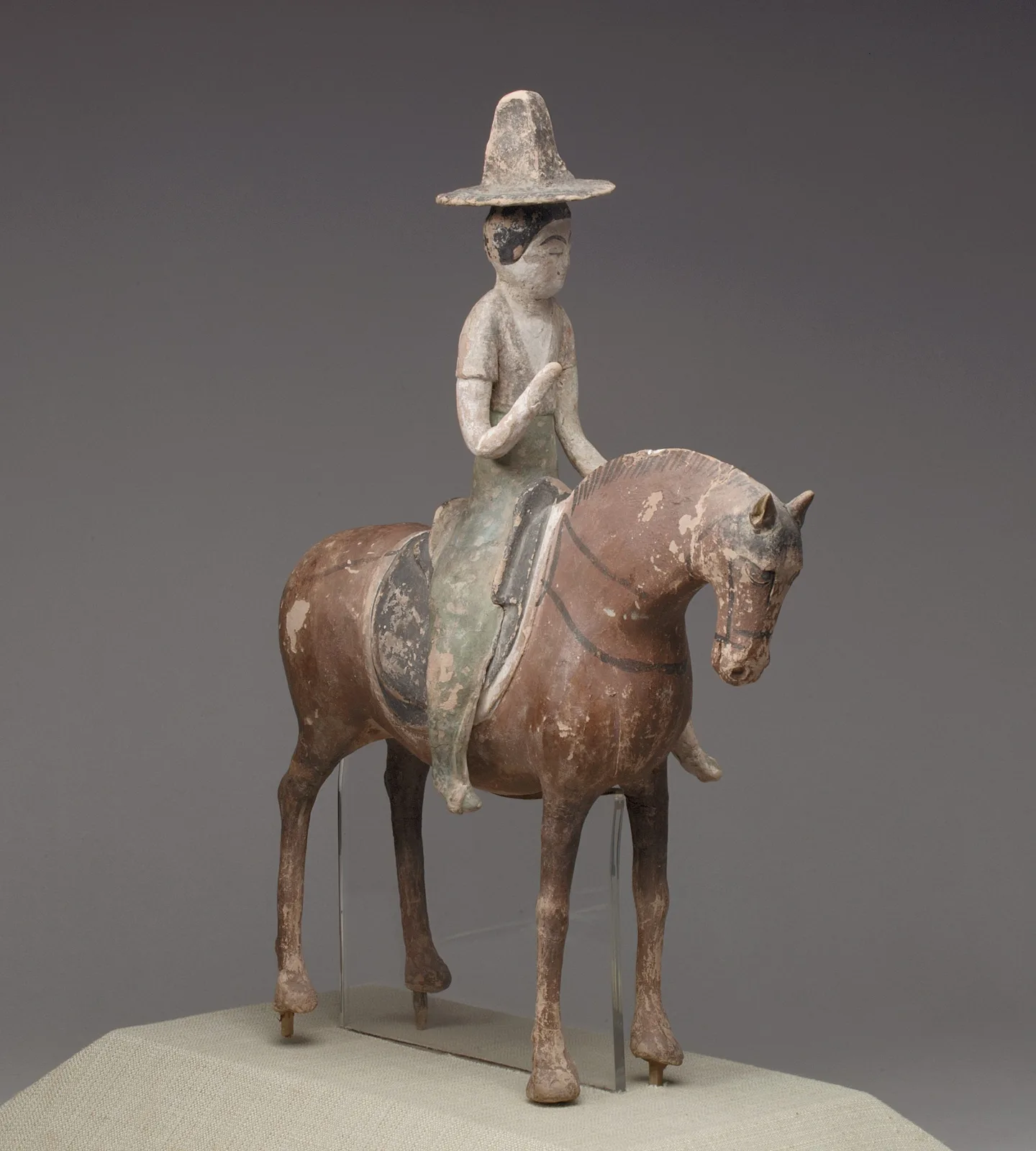
*Tang dynasty painted pottery horse and female rider figure. Horse-and-rider tomb figures like this are held in museum collections including The Metropolitan Museum of Art.*
Tang horse-and-rider figures are held in museum collections worldwide, from Beijing to New York's Metropolitan Museum of Art to the Museum of Far Eastern Antiquities in Stockholm, which holds significant early Chinese material collected during early 20th-century excavation and research work in China. Horses mattered enormously to Tang China both practically and symbolically—as cavalry animals central to frontier defense and as prestige goods obtained partly through trade along Silk Road routes—which helps explain why they receive such careful, individualized sculptural treatment in tomb assemblages compared with many other animal subjects.
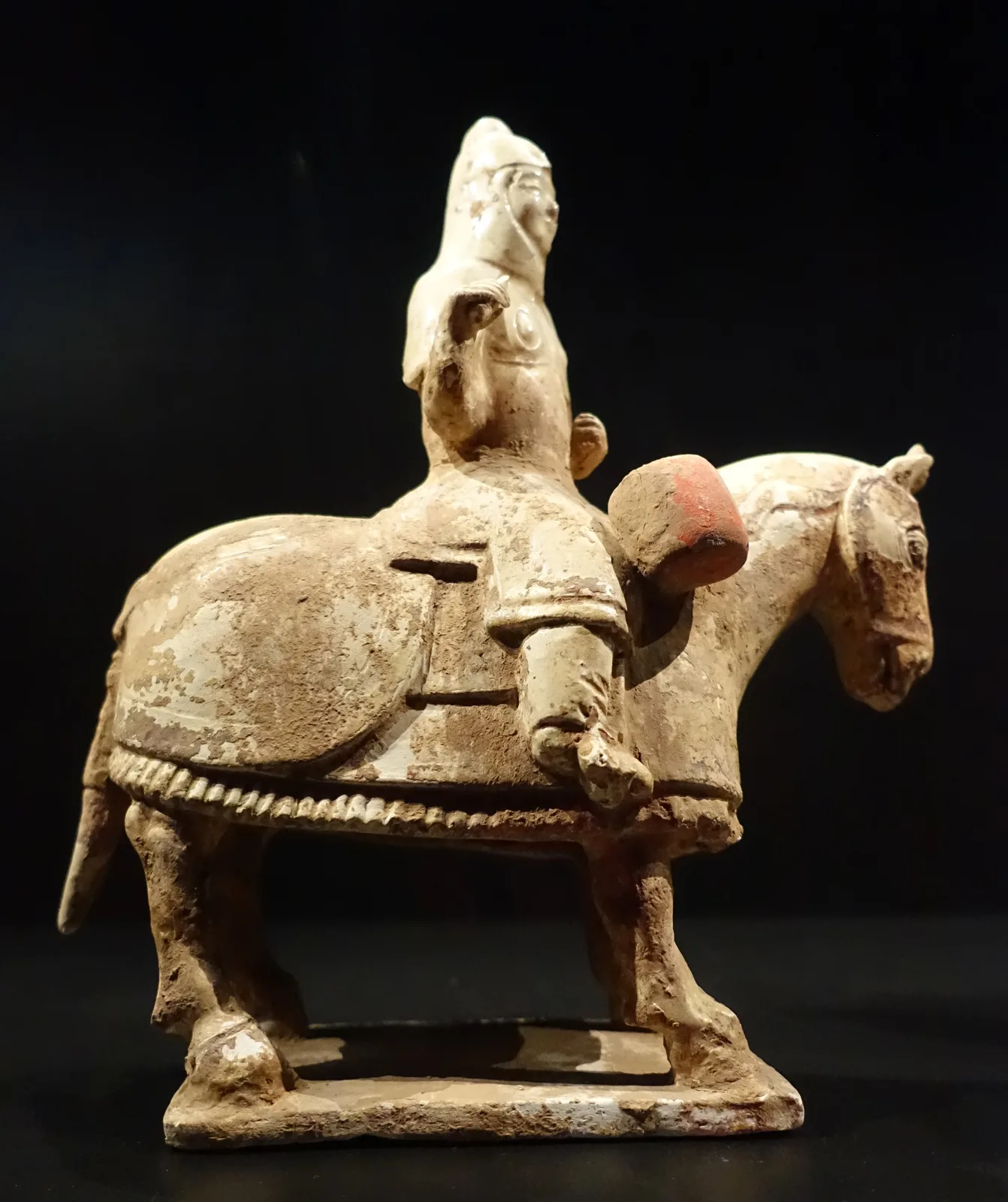
*Tang dynasty pottery horse and rider figure. Chinese museums abroad, including the Museum of Far Eastern Antiquities in Stockholm, hold significant Tang funerary pottery collections.*
The Qin Cavalry Horses
The Terracotta Army near Xi'an also includes large numbers of life-size terracotta cavalry and chariot horses alongside its soldier figures, made with the same individualized-finishing approach used for the human figures. These are covered on the Clay & Pottery Sculpture guide and the Tomb & Funerary Sculpture guide, since they belong as much to that funerary tradition as to a horse-specific one.
Why China Has No Real Equivalent of the European Equestrian Statue
Visitors familiar with European public sculpture sometimes look for a Chinese equivalent of the classical or Renaissance equestrian statue—an emperor or general mounted on horseback, cast in bronze and displayed in a public square as a civic monument. Chinese historical sculpture did not develop monumental public equestrian statuary at the same scale as the European tradition. Horses appear extensively in funerary contexts (tomb figures, spirit-way sculpture) or as small-scale bronze and pottery objects. Modern Chinese public equestrian monuments do exist, but they remain a comparatively smaller genre next to the funerary horse tradition that dominates the historical record. See the Modern & Contemporary Chinese Sculpture guide for that later material.
Where to See Horse Sculpture
The Flying Horse of Gansu is in Lanzhou, not Beijing or Xi'an, so seeing the original requires a separate trip; reproductions and its silhouette appear widely across Chinese tourism branding. Tang tomb horses appear in museum collections in Beijing, including the National Museum of China, and Qin cavalry horses are part of the Terracotta Army complex near Xi'an, reachable via the Xi'an Terracotta Warriors tour. See Where to See Chinese Sculpture in Beijing for Beijing-specific routing.
FAQ
What is the Flying Horse of Gansu?
An Eastern Han dynasty bronze sculpture of a galloping horse balanced on one hoof atop a bird in flight, unearthed in 1969 near Wuwei, Gansu, and now held at the Gansu Provincial Museum. It has served as China's official tourism emblem since 1983.
Is the Flying Horse of Gansu in Beijing?
No. It is at the Gansu Provincial Museum in Lanzhou, a separate trip from both Beijing and Xi'an.
What are Tang tomb horses made of?
Painted or lead-glazed ("sancai") pottery, made as mingqi (spirit goods) to accompany the dead. Many show a rider figure and were produced in large numbers for Tang burials.
Why doesn't China have famous public equestrian statues like Europe does?
Chinese horse sculpture developed mainly within funerary and small-scale bronze/pottery traditions rather than as monumental civic statues of rulers on horseback, so the genre of the classical public equestrian statue was never a major feature of Chinese sculptural history.
Are the Terracotta Army's horses the same tradition as the Flying Horse of Gansu?
They share the broader category of ancient Chinese horse sculpture but come from different traditions: the Terracotta Army's horses are life-size clay funerary figures from the Qin dynasty, while the Flying Horse of Gansu is a small Eastern Han bronze made for a different funerary context.
Where can I see Tang tomb horses in a museum?
Museum collections worldwide, including Beijing's National Museum of China, The Metropolitan Museum of Art in New York, and the Museum of Far Eastern Antiquities in Stockholm.
Continue with Chinese Sculpture
Plan a Visit
- Xi'an Terracotta Warriors tour
- Contact us to plan a wider itinerary
Sources & Further Reading
- Gansu Provincial Museum — Flying Horse of Gansu (Bronze Running Horse / 铜奔马)
- The Metropolitan Museum of Art — Tang dynasty pottery horses and riders