
The Chinese dragon is one of the most repeated motifs in Chinese sculpture, but it rarely appears as a single free-standing statue in the way a lion might. Instead it shows up across bronze incense burners and courtyard sculptures, carved stone relief panels on palace staircases, roof-ridge ornament, and architectural detail—often tied to imperial authority, water and rain, religious or cosmological imagery, or auspicious meaning, depending on context, rather than as an independent artwork. This guide covers where and how the dragon motif appears in Chinese sculpture, with a focus on the Forbidden City and Summer Palace, where most visitors will actually encounter it.
| Item | Answer |
|---|---|
| Symbolism | Imperial authority, yang energy, water and rain, good fortune |
| Common sculptural forms | Cast bronze courtyard sculptures and incense burners, carved stone relief panels, roof-ridge figures, architectural ornament |
| Best-known stone example | Large carved dragon relief slab, Forbidden City, behind the Hall of Preserving Harmony |
| Best-known bronze examples | Gilded bronze dragon sculptures in Forbidden City courtyards |
| "Nine sons of the dragon" | A folk convention describing nine dragon-like offspring with different traits, not a fixed classical canon |
| Where to see it | Forbidden City and Summer Palace, Beijing |
The Dragon as Symbol, Not Standalone Statue
In Western sculptural tradition, a dragon might appear as a single carved or cast figure meant to be read on its own. In Chinese sculpture, the dragon motif usually serves a larger decorative or architectural program: it appears on the sides of bronze incense burners, in relief along palace staircases, coiled around roof ridges, and carved into door panels and screens. The dragon in Chinese sculpture and architecture represents imperial authority (the emperor was traditionally described as the "true dragon," and dragon imagery was legally restricted to imperial use in certain forms and colors), yang energy in the yin-yang cosmological system, and control over water and rain—an association that made dragon imagery especially appropriate near drainage features, bridges and waterside architecture.
Dragons in Bronze
Cast bronze dragon sculptures appear as free-standing courtyard ornaments at major imperial sites, most visibly inside the Forbidden City, where gilded bronze dragons sit alongside gilded bronze lions, cranes and other symbolic animals in the palace's ceremonial courtyards. These bronze dragons are typically paired or arranged symmetrically, following the same left-right balance convention used for guardian lions, and are meant to be read as part of the palace's overall decorative program rather than as independent sculptural commissions.
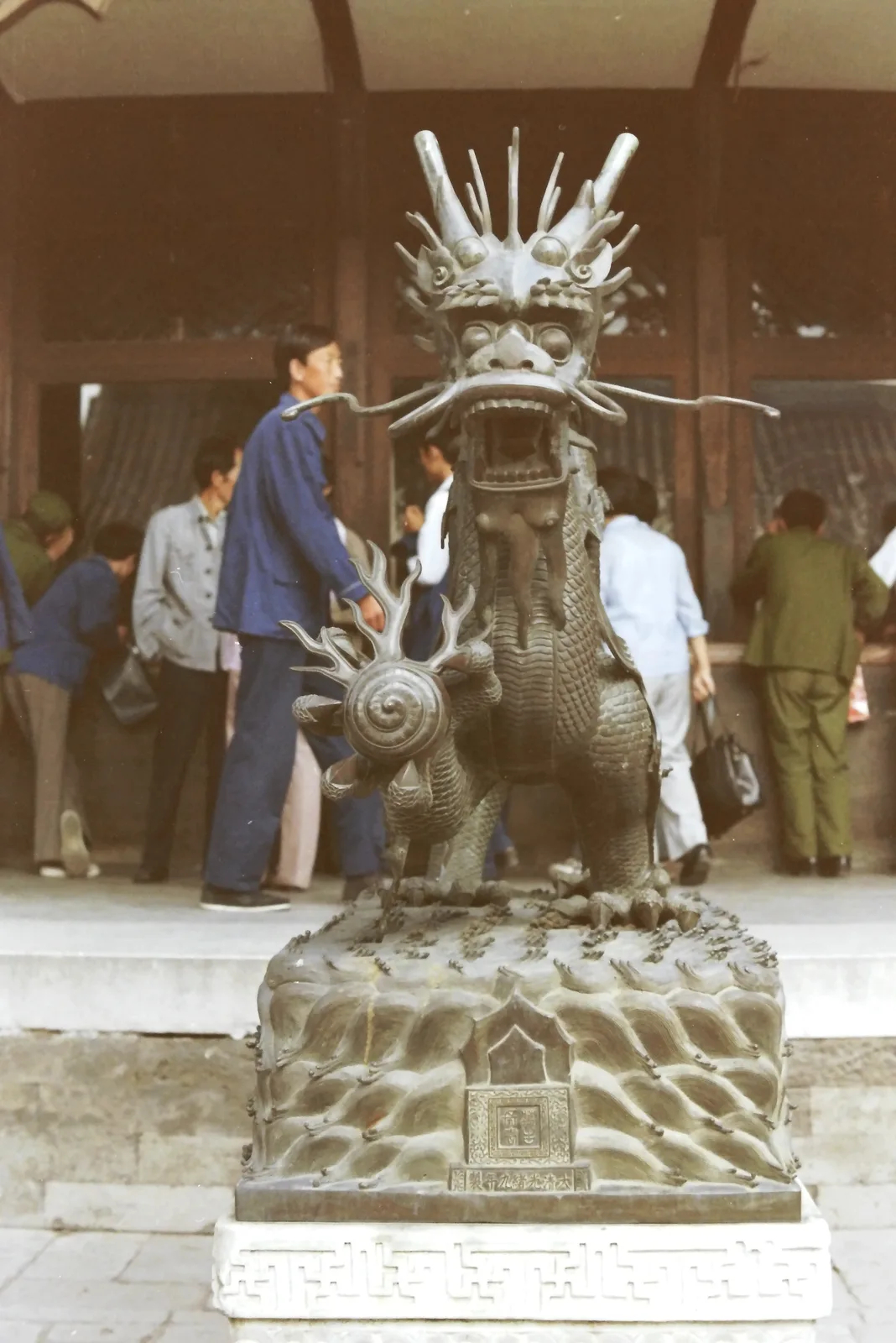
*Gilded bronze dragon in a Forbidden City courtyard, Beijing. Bronze dragon sculptures like this sit outdoors and are viewable year-round as part of the palace's exterior.*
Dragons in Stone Relief
The most technically impressive dragon sculpture most visitors will see is not a free-standing statue but a large carved stone relief panel: the marble dragon-and-cloud relief slab set into the central staircase behind the Hall of Preserving Harmony in the Forbidden City, carved from a single massive stone block and reserved historically for the emperor's palanquin to pass over rather than for anyone to walk on directly. Dragon-head water spouts, carved into the marble terraces surrounding the Forbidden City's main halls, are a smaller and more functional example of the same motif—decorative dragon heads that also served as drainage outlets during rain.
Nine-Dragon Screens and Roof-Ridge Dragons
Glazed-tile relief walls known as nine-dragon screens are another common form: freestanding decorative walls, faced with molded and glazed ceramic tile relief panels depicting nine dragons, placed at the entrance to certain palace and temple complexes as auspicious spirit screens. On rooftops, small dragon and mythical-animal figures line the ridges of major imperial halls, both as ornament and as a traditional marker of a building's rank—the more figures on a roof ridge, the higher the building's status in the traditional hierarchy.
The "Nine Sons of the Dragon": A Folk Convention
Chinese folklore describes the dragon as having nine sons, each a different mythical creature with its own personality and typical placement—one fond of carrying weight appears at the base of stone tablets, one fond of looking into the distance appears on bridge posts, and so on. This is a useful frame for reading some recurring animal-headed sculptural details around Chinese architecture, but it is a folk convention with regional and textual variation, not a single fixed classical canon that every scholar or craftsman followed identically. Treat it as a helpful pattern for noticing motifs, not as an absolute rule for identifying every carved creature you encounter.
Where to See Dragon Sculpture in Beijing
The Forbidden City is the essential stop: bronze courtyard dragons, the great marble dragon relief staircase behind the Hall of Preserving Harmony, and dragon-head drainage spouts on the palace terraces are all outdoor sculpture, viewable regardless of which indoor galleries are open on a given day. A Forbidden City private tour is a practical way to make sure you don't miss the relief staircase, which sits slightly off the main foot-traffic path.
The Summer Palace contributes dragon imagery in a garden setting, including painted dragon-boat motifs and decorative dragon carving on pavilions and bridges around Kunming Lake; a Summer Palace private tour pairs naturally with a Forbidden City day. See Where to See Chinese Sculpture in Beijing for a fuller comparison of both sites.
FAQ
Is the Chinese dragon usually a standalone statue?
Not usually. Dragon imagery in Chinese sculpture usually appears as part of a larger decorative or architectural program—bronze courtyard figures, carved stone relief, roof-ridge ornament, glazed-tile screens—rather than as an independent free-standing statue. Context matters: dragons can signal imperial authority, water and rain, religious or cosmological meaning, or auspicious decoration.
What does the dragon symbolize in Chinese sculpture?
Imperial authority, yang energy in the yin-yang system, and control over water and rain. Dragon imagery was historically restricted in certain forms and colors to imperial use.
Where is the most famous carved dragon relief in Beijing?
The large marble dragon-and-cloud relief slab set into the central staircase behind the Hall of Preserving Harmony in the Forbidden City, carved from a single stone block.
What is a nine-dragon screen?
A freestanding decorative wall faced with molded and glazed ceramic tile relief panels depicting nine dragons, placed as an auspicious spirit screen at the entrance to certain palace and temple complexes.
Are the "nine sons of the dragon" a fixed, official list?
No. It is a well-known folk convention describing nine dragon-like offspring with different traits and typical placements, useful for reading recurring architectural motifs, but it varies across sources rather than following one single fixed classical canon.
Where can I see dragon sculpture in Beijing?
The Forbidden City has the widest range—bronze courtyard dragons, the marble relief staircase, and dragon-head drainage spouts—all viewable outdoors. The Summer Palace adds dragon motifs in a garden and lakeside setting. See Where to See Chinese Sculpture in Beijing.
Continue with Chinese Sculpture
Plan a Visit
Sources & Further Reading
- Palace Museum — Forbidden City architecture and decorative sculpture
- Palace Museum — Imperial dragon sculpture and architectural ornament in the Forbidden City