
Chinese wood sculpture is best known for two very different scales of work: large polychrome Buddhist figures—especially seated Guanyin statues—made from the Song dynasty onward, and small, finely detailed boxwood carvings, a craft tradition centered on Putian in Fujian that continues today as recognized intangible cultural heritage. Wood is also far more vulnerable than stone or bronze to fire, humidity and insect damage, so fewer early Chinese wood sculptures survive relative to how common the material once was—most of what visitors see in museums today comes from later, better-preserved periods.
| Item | Answer |
|---|---|
| Most famous wood sculpture subject | Guanyin, the bodhisattva of compassion, especially in the seated "water-moon" pose |
| Period when large wood Guanyin figures became widespread | Song dynasty (960–1279) onward |
| Major surviving-craft region | Putian, Fujian Province |
| Common Putian materials | Boxwood, longan wood, sandalwood, camphor wood |
| Putian carving techniques | Round carving, fine detail carving, multi-layer openwork carving |
| Recognition | Putian wood carving is a China national-level intangible cultural heritage craft |
| Preservation risk | Fire, humidity and insects; fewer early wood sculptures survive than stone or bronze ones |
Why So Little Early Chinese Wood Sculpture Survives
Wood carving has been part of Chinese sculptural practice for as long as stone and bronze work, but far less of it survives from the earliest periods. Wood burns, rots in humid conditions, and is vulnerable to insect damage in a way that stone and metal are not, so what remains today skews heavily toward later dynasties, drier or better-maintained storage conditions, and objects that were valued highly enough to be actively conserved. This is worth keeping in mind when a museum gallery seems to jump straight from Tang stone Buddhas to Song and later wood figures—it usually is not that wood carving was absent earlier, but that earlier wood objects simply did not survive in comparable numbers.
Large Polychrome Buddhist Wood Sculpture
The most celebrated strand of Chinese wood sculpture is religious: large seated figures of Guanyin, the bodhisattva of compassion, carved in wood and finished with polychrome paint and gilding. The relaxed "water-moon" pose—Guanyin seated with one leg raised or crossed in an informal posture, rather than the strict frontal symmetry of many stone Buddhas—became especially popular from the Song dynasty onward and produced some of the most admired works in all of Chinese Buddhist art. These large wood Guanyin figures are now held across major museum collections worldwide and are frequently singled out as highlights of their respective Asian art galleries.
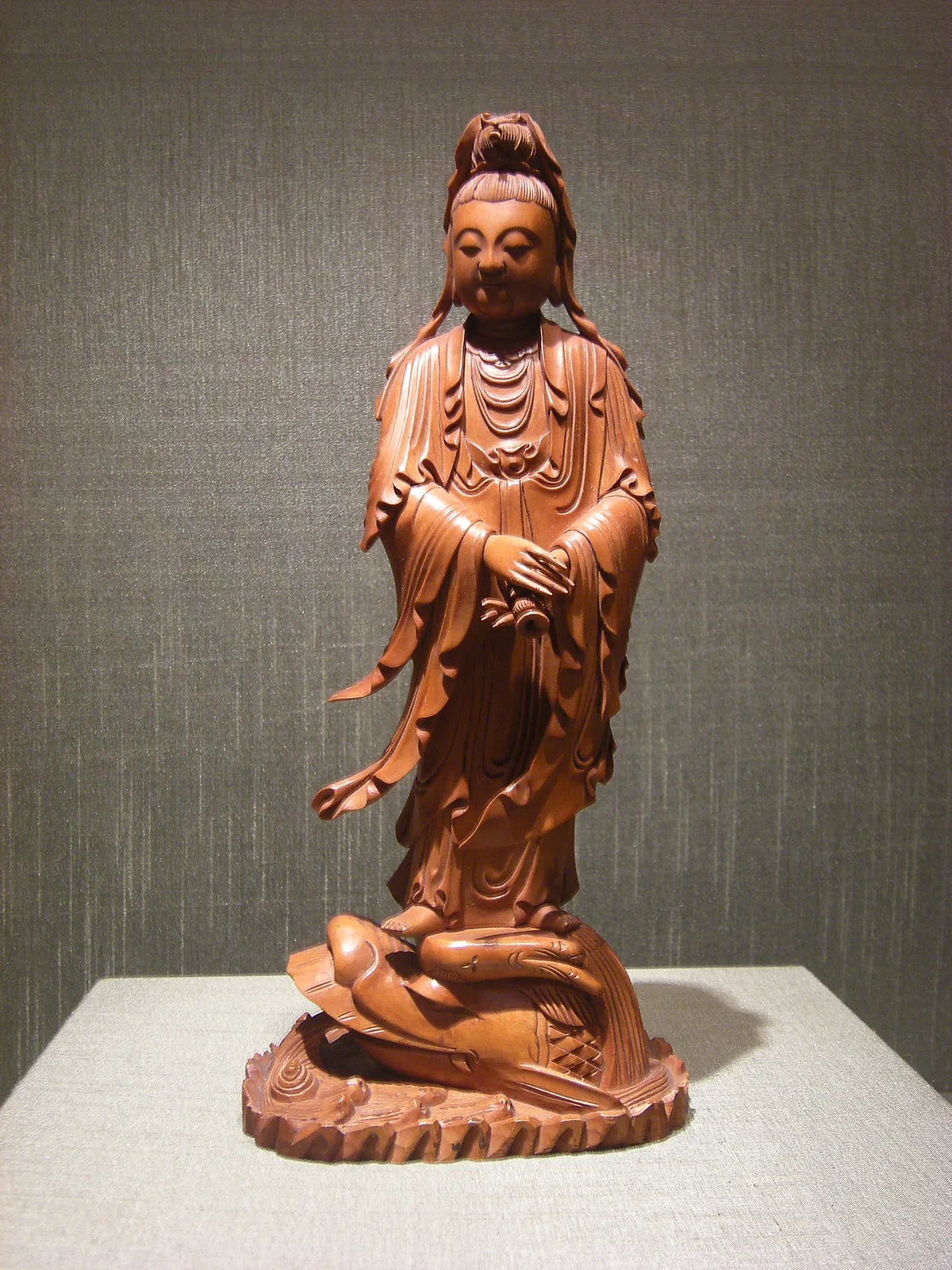
*Seated wooden representation of Guanyin, the bodhisattva of compassion.*
Wood carving also produced other Buddhist figures—arhats (lohan), guardian kings, and temple architectural sculpture such as carved beam ends and bracket sets—as part of the same devotional and architectural culture that produced stone cave temples. For the broader religious context, see the Buddhist Sculpture guide.
Putian Boxwood Carving: A Living Craft Tradition
While large polychrome Guanyin figures represent one end of Chinese wood sculpture, a very different and still-active tradition survives in Putian, Fujian Province. Putian wood carving traces its roots to the Tang dynasty, when local temples commissioned carved architectural decoration and Buddhist statues, and developed further through the Song, Ming and Qing dynasties into a recognized regional specialty. The craft uses several materials—longan wood, boxwood, sandalwood and rosewood—each associated with slightly different finished character, with boxwood particularly suited to fine, small-scale figure carving because of its tight, even grain.
Putian carvers are known for three signature techniques: round carving (fully three-dimensional figures, especially Buddhist statues), fine detail carving (precise facial features, drapery folds, and surface texture), and multi-layer openwork carving, in which multiple pierced layers create depth and complexity from a single block. Guanyin remains a central subject in this tradition today, alongside figures connected to Mazu, the sea goddess widely worshipped in Fujian and Taiwan, and secular subjects such as flowers, birds and figures from literature. Putian wood carving is recognized as a national-level intangible cultural heritage craft in China, meaning it is actively documented and supported as a living tradition rather than treated purely as historical practice.
Wood Carving and Chinese Architecture and Furniture
Wood sculpture overlaps closely with two adjacent crafts that fall outside this guide's scope. Architectural wood carving—dragon-head brackets, carved beams, decorative screens—is closely tied to traditional building practice and is covered on the Chinese Architecture guide. Fine furniture carving, a separate and highly developed craft in its own right, sits outside the Chinese Sculpture cluster entirely. This guide focuses specifically on wood as a sculptural medium for standalone figures rather than as architectural or furniture ornament.
Where to See Chinese Wood Sculpture
Large historic Buddhist wood sculpture appears in major museum collections around the world more often than in any single Beijing venue, so travelers hoping to see this material specifically should not assume a Beijing-only itinerary covers it well. In Beijing, the National Museum of China's Ancient Chinese Buddhist Sculpture display includes wood pieces alongside stone, bronze and clay examples—subject, as always, to the museum's current exhibition schedule. See Where to See Chinese Sculpture in Beijing for current routing advice across Beijing's museums.
FAQ
Why does so little ancient Chinese wood sculpture survive?
Wood is far more vulnerable than stone or bronze to fire, humidity and insect damage. Most surviving Chinese wood sculpture dates from later periods with better preservation conditions rather than reflecting when wood carving actually began.
What is the most famous subject in Chinese wood sculpture?
Guanyin, the bodhisattva of compassion, especially in the relaxed seated "water-moon" pose that became widespread from the Song dynasty onward. Large polychrome wood Guanyin figures are among the most admired works of Chinese Buddhist art.
What is Putian wood carving?
A wood carving tradition centered on Putian, Fujian Province, known for round carving, fine detail carving and multi-layer openwork carving, traditionally used for Buddhist statues and architectural decoration. It is recognized as a national-level intangible cultural heritage craft and remains an active practice today.
What is boxwood, and why is it used for carving?
Boxwood is a dense, fine-grained hardwood well suited to small-scale, highly detailed figure carving. It is one of several woods used in the Putian tradition, alongside longan wood, sandalwood and rosewood.
Is wood carving the same as furniture carving?
No, though the two crafts overlap in skill and sometimes in workshop tradition. This guide covers wood as a sculptural medium for standalone figures; furniture carving is a separate craft with its own techniques and history.
Where can I see Chinese wood sculpture in Beijing?
The National Museum of China's Ancient Chinese Buddhist Sculpture display includes wood figures alongside stone, bronze and clay examples, subject to the museum's current exhibition schedule. See Where to See Chinese Sculpture in Beijing for full routing advice.
Continue with Chinese Sculpture
Sources & Further Reading
- China Intangible Cultural Heritage — Putian wood carving (木雕·莆田木雕), national ICH listing
- The Metropolitan Museum of Art — Chinese Buddhist wood sculpture, including seated Guanyin figures