
Buddhist sculpture is one of the largest and longest-running traditions in Chinese sculpture, spanning cliff-face cave temples, portable gilt-bronze icons, painted clay figures and large polychrome wood statues from the early centuries of Buddhism in China onward. This guide covers the major cave-temple sites, the main materials Buddhist sculptors worked in, and where to see Buddhist sculpture in Beijing—with a clear caveat about gallery opening status that matters for trip planning.
| Item | Answer |
|---|---|
| Arrival of Buddhism in China | By roughly the 1st century CE |
| Major impact on sculpture begins | 5th century CE, under the Northern Wei dynasty |
| Major cave-temple sites | Yungang (Datong), Longmen (Luoyang), Mogao (Dunhuang), Maijishan (Tianshui), Dazu (Chongqing) |
| Tallest Longmen Buddha | Vairocana Buddha, Fengxian Temple, 17.14 meters, completed 675 CE |
| Beijing collection | National Museum of China, Gallery S13, Ancient Chinese Buddhist Sculpture exhibition (official page lists 236 objects), subject to current exhibition status |
| Palace Museum sculpture gallery | Currently listed as a temporary closure; check the current museum notice before visiting |
| Materials used | Stone, gilt bronze, wood, painted clay |
Buddhism's Arrival and Its Effect on Sculpture
Buddhism reached China by around the 1st century CE via Central Asian trade routes, but its transformative effect on Chinese sculpture becomes visible mainly from the 5th century, once ruling dynasties began state-sponsoring large-scale icon-carving projects. Before this, Chinese three-dimensional art had been dominated by ritual bronze vessels and, from the Qin dynasty on, funerary figures—see Ancient Chinese Sculpture for that earlier record. Buddhism introduced a new purpose for sculpture: creating an image of a deity or enlightened being as an object of veneration, at a scale and in a quantity that no earlier Chinese religious or funerary tradition had required.
The Great Cave Temples
Chinese Buddhist sculpture's most spectacular expression is a series of cliff-face cave-temple complexes, several carved over multiple dynasties and centuries.
Yungang Grottoes, Datong
The Yungang Grottoes, cut into a sandstone cliff near Datong in Shanxi Province, are where large-scale Chinese Buddhist cave sculpture effectively begins. Work started in the mid-5th century under the Northern Wei dynasty, initially through a project led by the monk Tanyao that produced five enormous cave-carved Buddhas—each said to represent a Northern Wei emperor. Carving continued for roughly a century, ultimately producing 252 major caves and niches and more than 51,000 statues across an 18,000-square-meter carved area. Yungang is a UNESCO World Heritage Site and is usually described as the starting point for a distinctly Chinese Buddhist sculptural style that blends South and Central Asian Buddhist art conventions with local material and taste.
Longmen Grottoes, Luoyang
After the Northern Wei court moved its capital to Luoyang in 493, cave-carving activity shifted south to the limestone cliffs along the Yi River, producing the Longmen Grottoes. Carving continued intermittently for roughly 400 years through several dynasties, with the largest share of work completed under the Tang. Longmen today holds an estimated 2,345 caves and niches and close to 100,000 Buddhist statues and reliefs. Its single most famous work is the Vairocana Buddha in the Fengxian Temple cave: a seated Buddha 17.14 meters tall, with a 4-meter head and 1.9-meter ears, completed in 675 under Emperor Gaozong with major financial sponsorship from Empress Wu Zetian. Popular tradition holds that the Buddha's features were modeled after Wu Zetian herself, though modern scholarship treats that claim with more caution than older guidebooks do. Longmen is also a UNESCO World Heritage Site.
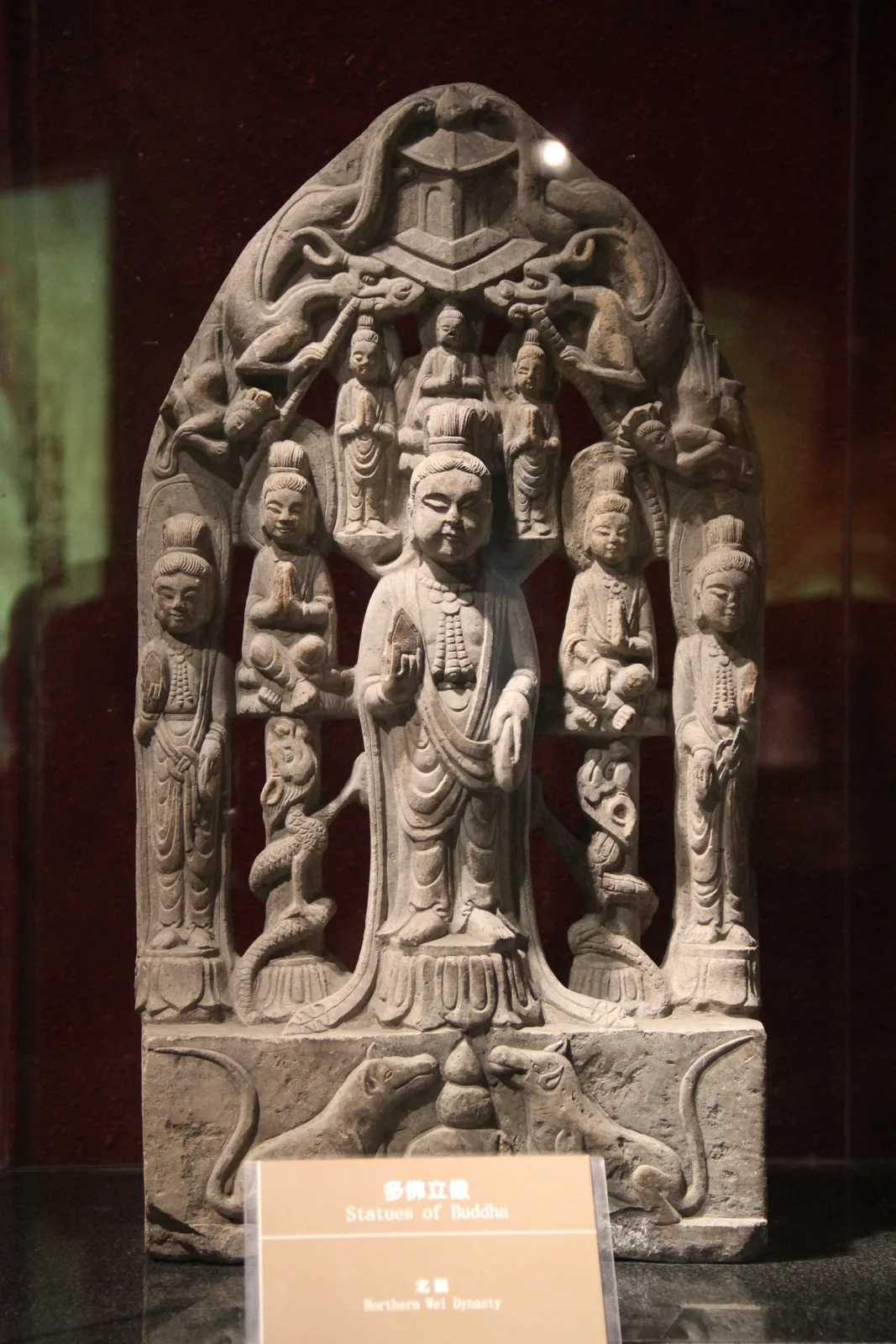
*Northern Wei-style stone Buddha figure, representative of the cave-temple sculpture carved at Yungang and early Longmen in the 5th and 6th centuries.*
Mogao Caves and Maijishan Grottoes
Two further sites round out what is often called China's "four great grotto complexes." The Mogao Caves near Dunhuang, Gansu, are famous above all for wall painting, but they also contain extensive painted clay sculpture—clay rather than carved stone was the practical local material. The Maijishan Grottoes near Tianshui, also in Gansu, are similarly known for painted clay figures set into a dramatic natural rock formation. Both sites underline that Chinese Buddhist sculpture is not a single-material tradition: stone dominates where good carving stone exists, clay dominates where it does not.
Dazu Rock Carvings, Chongqing
Buddhist cave art continued well after its northern heartland declined, moving into Sichuan and the area around modern Chongqing. The Dazu Rock Carvings, a set of five major clusters carved mainly between the 9th and 13th centuries, are unusual for combining Buddhist, Taoist and Confucian imagery within the same complex of sites—clear evidence of the religious blending common in later Chinese popular practice. The largest cluster, Baodingshan, was carved under the direction of the Southern Song Buddhist master Zhao Zhifeng over roughly seventy years and contains close to 10,000 figures. Dazu is a UNESCO World Heritage Site and is often treated as the last major peak of large-scale Buddhist rock carving in China.
Portable Buddhist Sculpture: Gilt Bronze and Wood
Not all Chinese Buddhist sculpture is carved into a mountainside. From the same Northern Wei period onward, workshops cast small gilt-bronze Buddhas and bodhisattvas—often only a few centimeters to a few tens of centimeters tall—that could be commissioned by individual donors, inscribed with dedications, and kept in household shrines or temples rather than fixed to a cliff face. These portable images now form an important part of major museum collections worldwide.
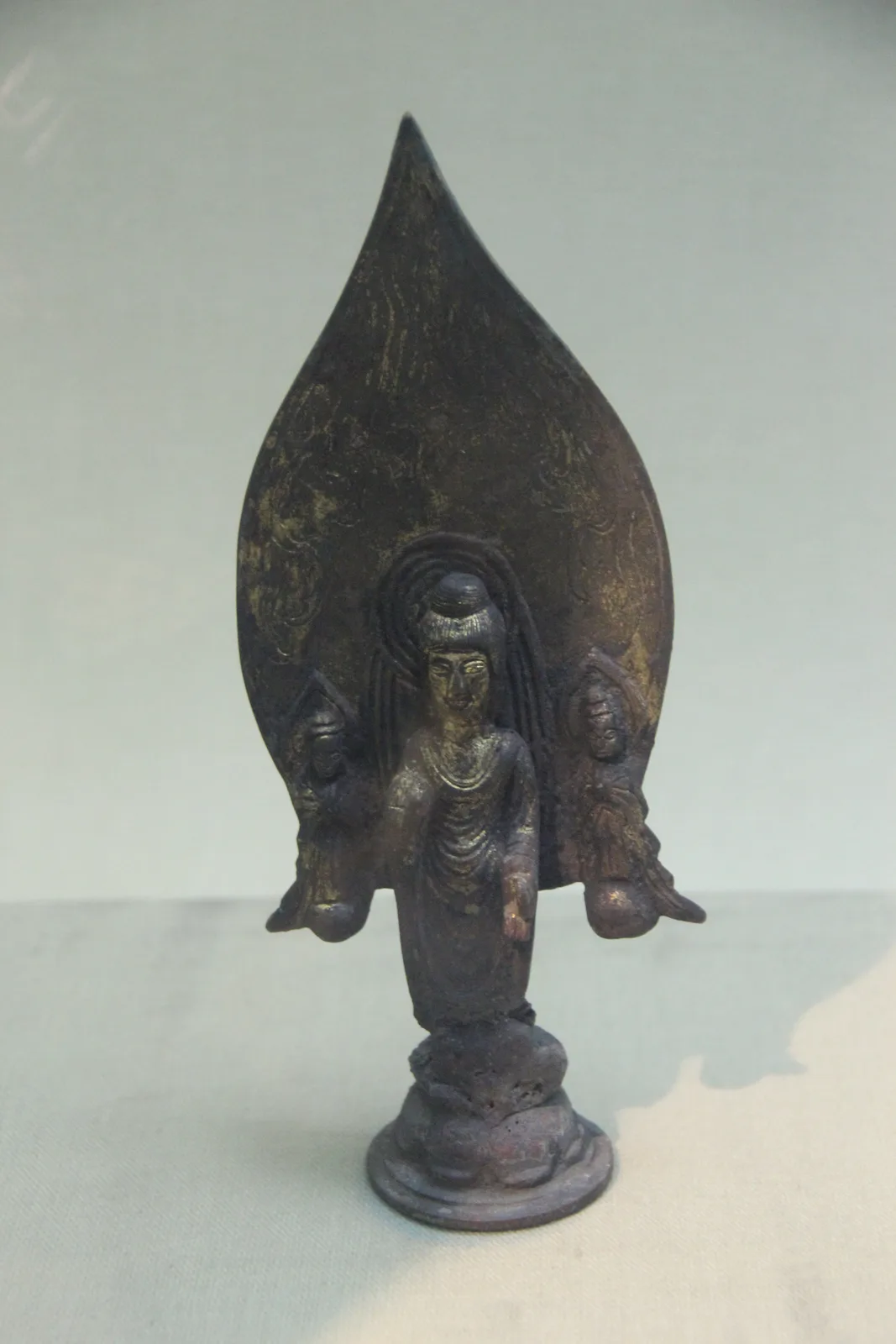
*Northern Wei-style gilt bronze Buddha figure, representative of the small portable devotional images produced alongside monumental cave sculpture.*
Wood carving produced a different scale of portable Buddhist sculpture: large seated figures of Guanyin, the bodhisattva of compassion, especially in the relaxed "water-moon" pose that became widespread from the Song dynasty onward. These large polychrome wood Guanyin figures are now held in major museum collections around the world and remain some of the most admired examples of Chinese Buddhist wood carving. See the Chinese Wood Sculpture guide for more on this tradition, including the smaller boxwood carving craft that continues in Fujian today.
Buddhist Sculpture in Beijing
Two Beijing institutions hold the most important Buddhist sculpture collections for visitors, and both carry a status caveat worth understanding before you plan around them.
The National Museum of China, on the east side of Tiananmen Square, presents its permanent Ancient Chinese Buddhist Sculpture exhibition in Gallery S13. The current official exhibition page lists 236 objects spanning the 5th century through the Ming dynasty, drawing on styles from Yungang, the Tianlong Mountain grottoes, and other sites across China—more than 200 works in the reinstalled display. As with any museum exhibition, exact contents and access are subject to the museum's current schedule—check current opening information before your visit.
The Palace Museum's Sculpture Gallery, inside the Forbidden City, holds imperial and religious sculpture in a dedicated indoor space. As of this guide's most recent update, the gallery is listed as a temporary closure on the Palace Museum's official site; when the gallery is open, it is a valuable addition to a Forbidden City visit, but its status is subject to change and a standard Forbidden City ticket does not automatically include it. Check the current museum notice before building an itinerary around it, and see Where to See Chinese Sculpture in Beijing for how to route around whichever galleries happen to be accessible on your visit date. A Forbidden City private tour can help adapt the day's route to current gallery status.
FAQ
When did Buddhism start influencing Chinese sculpture?
Buddhism reached China by around the 1st century CE, but its major impact on sculpture is usually dated from the 5th century, when the Northern Wei dynasty began sponsoring large cave-temple projects at Yungang and later Longmen.
What are the four great Buddhist grotto complexes in China?
Yungang (near Datong), Longmen (near Luoyang), Mogao (near Dunhuang) and Maijishan (near Tianshui) are commonly grouped together as China's four major Buddhist grotto sites, though Dazu near Chongqing is also a major later complex.
How tall is the biggest Buddha at Longmen?
The Vairocana Buddha in the Fengxian Temple cave at Longmen is 17.14 meters tall, with a 4-meter head, and was completed in 675 CE.
Is the Palace Museum Sculpture Gallery open right now?
As of this guide's most recent update, the gallery is listed as a temporary closure on the Palace Museum's official site. Check the current museum notice before planning a visit around it; exterior bronze and stone sculpture is normally visible during Palace Museum opening hours, subject to temporary route and conservation restrictions.
Does the National Museum of China's Buddhist sculpture exhibition always look the same?
The National Museum's permanent Ancient Chinese Buddhist Sculpture exhibition in Gallery S13 presents more than 200 works; the current official exhibition page lists 236 objects. Like any museum exhibition, exact contents and accessibility are subject to the museum's current schedule—confirm before visiting.
What materials did Chinese Buddhist sculptors use?
Mainly stone (for cave-temple carving), gilt bronze (for small portable icons), wood (for large seated Guanyin figures and other devotional statues), and painted clay (especially at Mogao and Maijishan, where local stone was less suited to fine carving).
Is the Dazu Rock Carvings site purely Buddhist?
No. Dazu is unusual for combining Buddhist, Taoist and Confucian imagery within the same complex of carved sites, reflecting the religious blending common in later Chinese popular religion.
Continue with Chinese Sculpture
- Chinese Sculpture guide
- History of Chinese Sculpture
- Chinese Wood Sculpture
- Where to See Chinese Sculpture in Beijing
Sources & Further Reading
- UNESCO World Heritage Centre — Yungang Grottoes
- UNESCO World Heritage Centre — Dazu Rock Carvings
- UNESCO World Heritage Centre — Longmen Grottoes (Fengxian Temple Vairocana completed 675 CE; height 17.14 m)
- National Museum of China — Ancient Chinese Buddhist Sculpture exhibition (Gallery S13; 236 objects)