
Tomb and funerary sculpture is one of the most extensive traditions in Chinese sculpture, ranging from stone-relief shrine walls and monumental spirit-way animals to large numbers of pottery figures made for burials. Many tomb assemblages reflect beliefs that the deceased continued to require protection, status, attendants or material provision after death, although burial beliefs and practices changed substantially by period and region. This guide covers Han stone reliefs, the Qin terracotta army as tomb guardian sculpture, mingqi tomb figurines, and the Ming Tombs Sacred Way—and points travelers to Xi'an as a practical viewing path for the Terracotta Army.
| Item | Answer |
|---|---|
| Core purpose | Guard, serve or accompany the deceased in the afterlife |
| Major traditions covered here | Han stone-relief shrines; Qin terracotta army; Han–Tang mingqi figurines; Ming Tombs Sacred Way |
| Best-documented Han reliefs | Wu family shrines, Jiaxiang, Shandong |
| Pivotal funerary sculpture | Qin terracotta army, c. 8,000 estimated figures |
| Ming Tombs Sacred Way animals | 24 stone animals (6 species, standing and kneeling pairs) plus 12 stone human figures |
| Primary commercial/viewing path | Xi'an, for the Terracotta Army |
Why Chinese Tombs Were Filled with Sculpture
Many elite tombs were furnished with guardian figures to protect the deceased, servant and animal figures to serve their needs, and, for the most powerful burials, entire processional avenues of stone officials and animals leading to the burial site itself. Those assemblages often reflect beliefs that the dead continued to require protection, status, attendants or material provision—though burial beliefs and practices changed substantially by period and region. That shared funerary purpose connects sculpture across very different materials and scales—from a small painted pottery servant figure to a monumental stone elephant on an imperial Sacred Way—more than any single stylistic thread does.
Han Stone-Relief Tomb Shrines
Wealthy Han dynasty (206 BCE–220 CE) families built above-ground shrine structures near family tombs and decorated their interior walls with narrative and mythological scenes carved in low relief—a technique using flat, incised outlines rather than deeply carved three-dimensional forms. The best-documented example is the Wu family shrine complex in Jiaxiang County, Shandong, built around the mid-2nd century CE and largely rediscovered in the 18th century by the Qing scholar Huang Yi. Its reliefs depict Confucian moral exemplars, legendary rulers, historical episodes, and mythological scenes such as archers shooting down suns from the sky—a visual encyclopedia of the values and stories a Han elite family wanted associated with its ancestors. A pair of stone lions preserved at the same site is among the earliest confidently dated stone lions in China, connecting Han funerary sculpture directly to the guardian-lion tradition covered on the Chinese Guardian Lions guide.
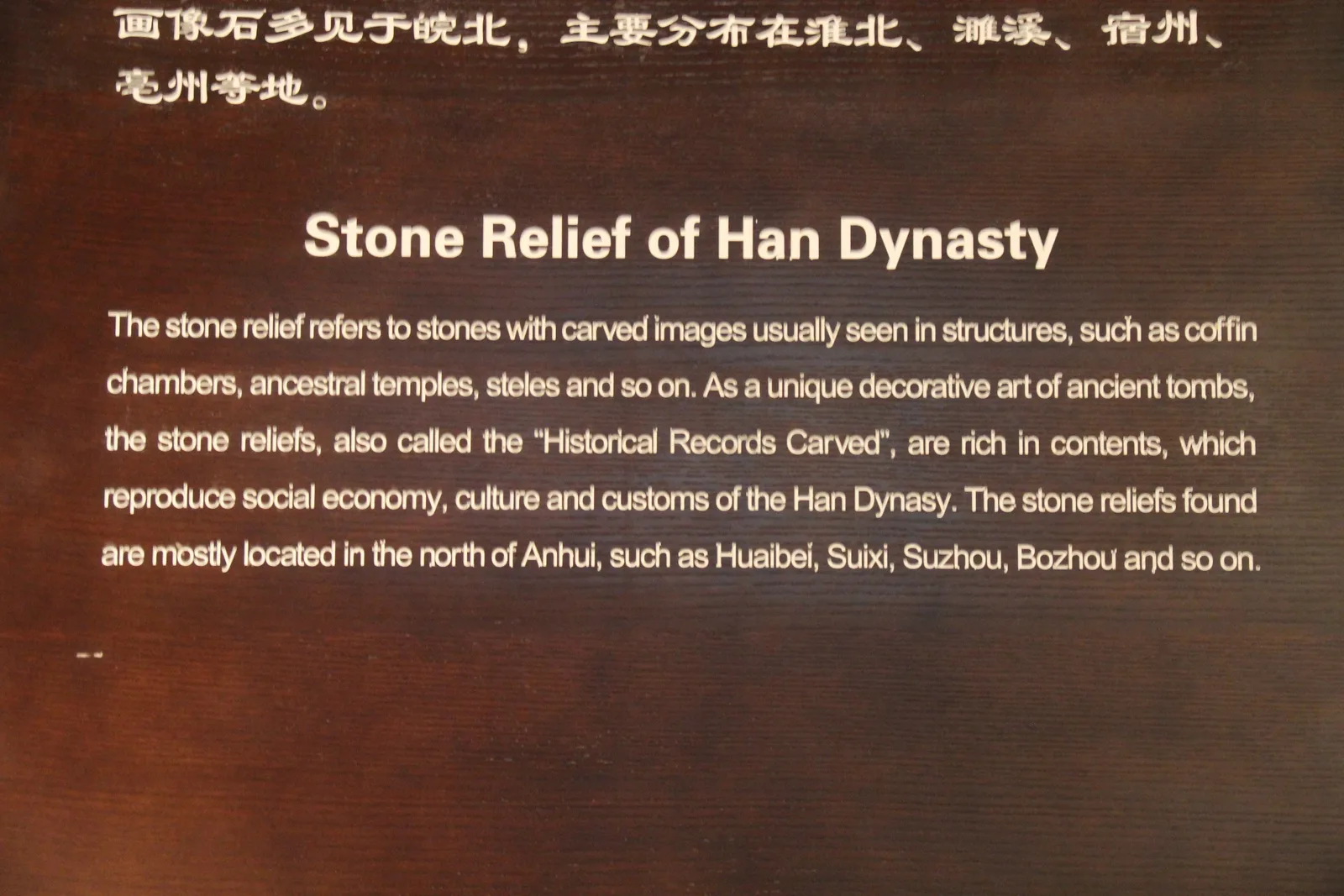
*Han dynasty stone relief, representative of the narrative and mythological carving found in family tomb shrines such as the Wu family shrine complex in Shandong.*
The Qin Terracotta Army as Tomb Guardian Sculpture
The Qin terracotta army, buried near the tomb of China's first emperor outside modern Xi'an, is the most extreme example of funerary sculpture built to guard the dead: an entire underground army of an estimated 8,000 individually finished soldiers, officers, cavalry horses and chariots, discovered by farmers digging a well in 1974. Unlike the small mingqi figures discussed below, these are life-size, and unlike the abstract animal guardians of the later Ming Tombs Sacred Way, they are explicitly military—soldiers meant to protect the emperor in the afterlife exactly as an army would have protected him in life.
Rank is expressed sculpturally as well as symbolically: officer figures such as generals are taller, more elaborately armored, and finished with greater individual detail than ordinary infantry figures, mirroring the military hierarchy the figures were meant to represent.
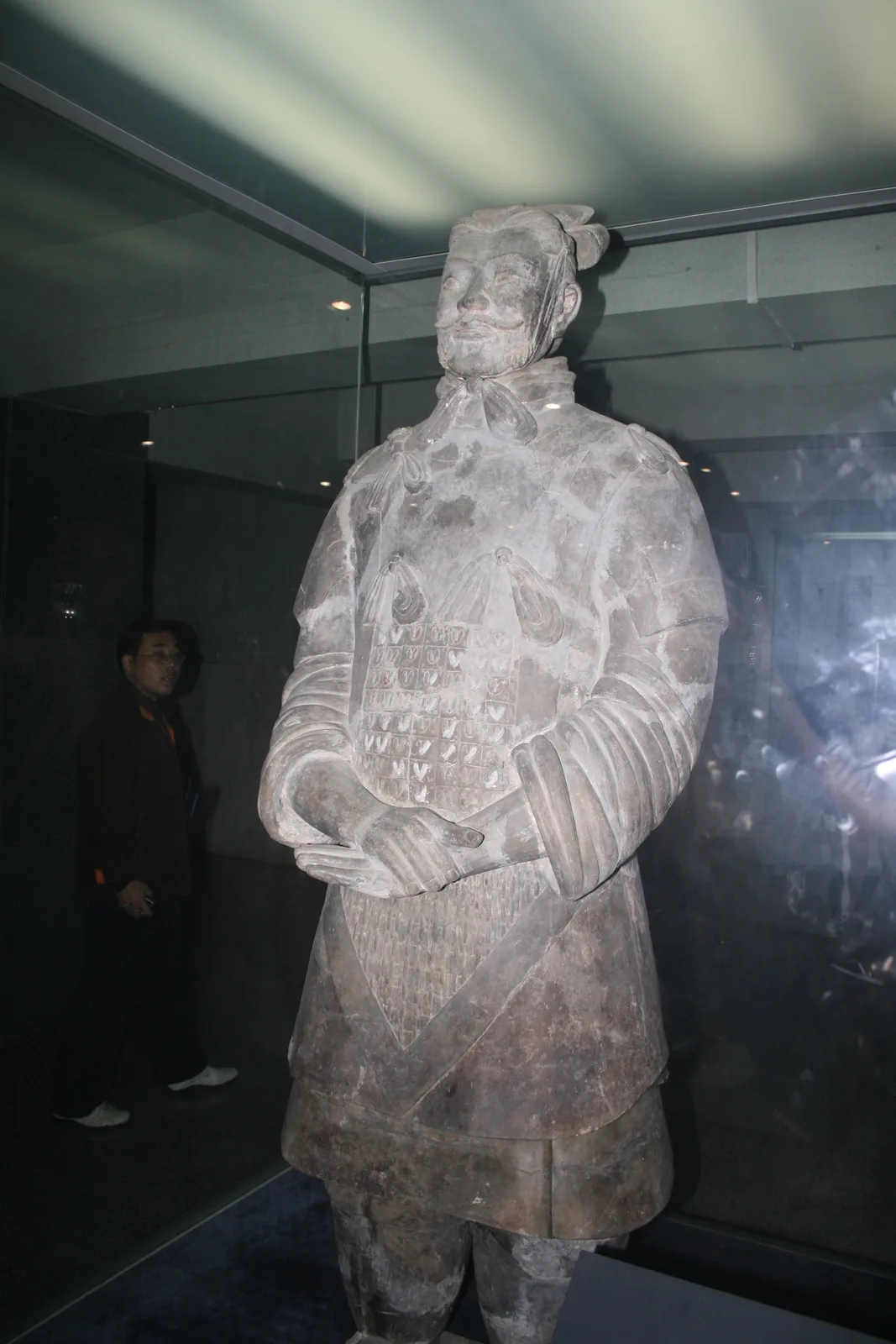
*Qin dynasty terracotta general figure. Higher-ranking officer figures within the Terracotta Army were made taller and more elaborately armored than ordinary soldiers, expressing military hierarchy through sculptural detail.*
The Terracotta Army is covered from a material and production perspective on the Clay & Pottery Sculpture guide and profiled as a landmark work on the 12 Famous Chinese Sculptures guide; this page treats it specifically as an instance of tomb guardian sculpture within the wider funerary tradition.
Mingqi: Serving the Dead at Smaller Scale
Most Chinese funerary sculpture was never made at Terracotta Army scale. From the Han dynasty through the Tang, most tombs—including those of officials and wealthy commoners, not just emperors—were furnished with mingqi: small pottery figures of model houses, granaries, farm animals, servants, musicians, dancers, camels and horses, made to serve the deceased's needs and reflect their household in the afterlife. Tang mingqi reach a particularly refined and varied form, often finished in lead-glazed "sancai" ware or painted directly onto unglazed earthenware, and are covered in more depth on the Clay & Pottery Sculpture guide and the Chinese Horse Sculpture guide for the horse-specific material within this broader mingqi tradition.
The Ming Tombs Sacred Way
The clearest surviving example of a full imperial funerary processional avenue is the Sacred Way (Shendao) leading to the Ming Tombs, north of central Beijing. The avenue is lined with 24 large stone animal sculptures, representing six species—lion, xiezhi (a mythical horned creature associated with justice), camel, elephant, qilin, and horse—each species carved in two standing and two kneeling pairs, for a total of 12 animals on each side of the road. Twelve stone human figures, including military officers, civil officials and meritorious officials, continue the same processional arrangement. According to tradition, the standing and kneeling pairs represent alternating watch and rest, with the guardians said to change shifts at midnight.
Each animal on the Sacred Way carries specific symbolism: lions for strength and imperial authority, camels and elephants for the vastness of territory under imperial control, qilin as an auspicious mythical creature, xiezhi as an incorruptible judge of right and wrong, and horses as an indispensable royal mount. Unlike the Qin terracotta army, which was buried underground and unseen until modern excavation, the Ming Tombs Sacred Way was always meant to be visible—a ceremonial approach walked by the living as part of imperial ritual, not a hidden guard for the dead alone.
Xi'an: The Primary Path for This Category
For most travelers, the Terracotta Army is both the most famous and the most commercially central piece of this entire category, and it requires a dedicated trip to Xi'an, roughly 1,100 kilometers from Beijing, rather than a Beijing day excursion. DragonTrail's Xi'an Terracotta Warriors tour is built specifically around this site and the wider Qin Shi Huang Mausoleum complex. The Ming Tombs Sacred Way, by contrast, is a Beijing-area half-day trip in its own right; see Where to See Chinese Sculpture in Beijing for how to fit it into a wider Beijing itinerary without treating it as a quick add-on to a Forbidden City morning.
FAQ
Why do Chinese tombs contain so much sculpture?
Traditional Chinese burial practice treated the afterlife as a continuation of earthly status and household life, so tombs were furnished with guardian figures, servant and animal figures, and, for the most powerful figures, entire processional avenues of stone officials and animals.
What are the Wu family shrines?
A Han dynasty (mid-2nd century CE) family shrine complex in Jiaxiang County, Shandong, known for extensive narrative and mythological stone-relief carving on its interior walls, and for a pair of stone lions among the earliest confidently dated in China.
Is the Terracotta Army considered tomb sculpture?
Yes. It was built specifically to guard the tomb of China's first emperor in the afterlife, making it the largest and most elaborate example of tomb guardian sculpture in Chinese history.
What is mingqi?
Mingqi are spirit or tomb figurines—model houses, animals, servants, musicians and similar figures—made to serve and accompany the deceased. They were a standard part of Han and Tang burial practice at a much smaller scale than the Terracotta Army.
How many stone animals line the Ming Tombs Sacred Way?
24 stone animals, representing six species (lion, xiezhi, camel, elephant, qilin and horse), each carved in standing and kneeling pairs, plus 12 stone human figures.
Can I visit the Terracotta Army and the Ming Tombs on the same trip?
They are not near each other. The Terracotta Army is near Xi'an, roughly 1,100 kilometers from Beijing, while the Ming Tombs are a Beijing-area half-day trip. Plan them as separate legs of an itinerary; see the Xi'an Terracotta Warriors tour for the Xi'an side.
Continue with Chinese Sculpture
- Chinese Sculpture guide
- Ancient Chinese Sculpture
- Clay & Pottery Sculpture
- 12 Famous Chinese Sculptures
Plan a Visit
- Xi'an Terracotta Warriors tour
- Contact us to plan a wider itinerary
Sources & Further Reading
- UNESCO World Heritage Centre — Mausoleum of the First Qin Emperor (Terracotta Army context)
- UNESCO World Heritage Centre — Mausoleum of the First Qin Emperor