
Peking duck (北京烤鸭 — Běijīng kǎoyā), also called Beijing roast duck, is Beijing's signature roast-duck dish. It is known for crisp skin, tender meat, tableside carving and thin pancakes served with sweet bean sauce, scallion and cucumber. For first-time visitors, choosing the restaurant matters mainly because Beijing has both traditional and modern styles, ranging from historic roast-duck houses to contemporary fine dining. This page is a practical Beijing food guide for eating the dish in the city, not a recipe and not a history of Chinese food as a whole.
Quick Answer
- Best all-round choice for most visitors: Siji Minfu (四季民福).
- Best for history and the closed-oven tradition: Bianyifang (便宜坊).
- Best premium option: Da Dong (大董).
- Famous but not currently recommended by DragonTrail: Quanjude (全聚德).
- A famous roast-duck restaurant generally requires roughly ¥150–200 per person at mainstream establishments, while premium restaurants can be ¥300–500+ per person once additional dishes are ordered.
- A whole duck is normally shared rather than ordered individually.
- Prices vary by branch and menu. Treat the figures below as approximate, current indicative prices for planning, not guarantees.
2026 menu snapshots — useful as reference points, not permanent prices — put Siji Minfu's signature duck around ¥259 and Da Dong's signature duck around ¥398. Quanjude remains historically important, but DragonTrail does not currently recommend it as the best food-quality or value option.
What Is Peking Duck?
Peking duck is Beijing roast duck rather than simply any Chinese roast duck. Many Chinese restaurants roast duck. What distinguishes Peking duck is the preparation of the skin, the roasting method, the carving and the way it is served.
The duck is traditionally carved at the table. Crispy skin is a central part of the dish, not simply a by-product of roasting. Diners are meant to notice the contrast between the brittle, lacquered skin and the tender meat underneath.
It is normally accompanied by thin wheat pancakes, sweet bean sauce, scallion and cucumber. Some restaurants serve pieces of especially crisp skin separately with sugar before the pancake course, so the texture can be tasted on its own.
Peking duck belongs to Beijing's restaurant culture rather than to home cooking. The Beijing food tradition includes many other dishes — noodles, mutton hotpot, snacks — but roast duck is the dish most visitors recognise first. Beijing duck is the same dish under a shorter English name; both point to this carved, pancake-wrapped roast duck, not to a generic poultry plate.
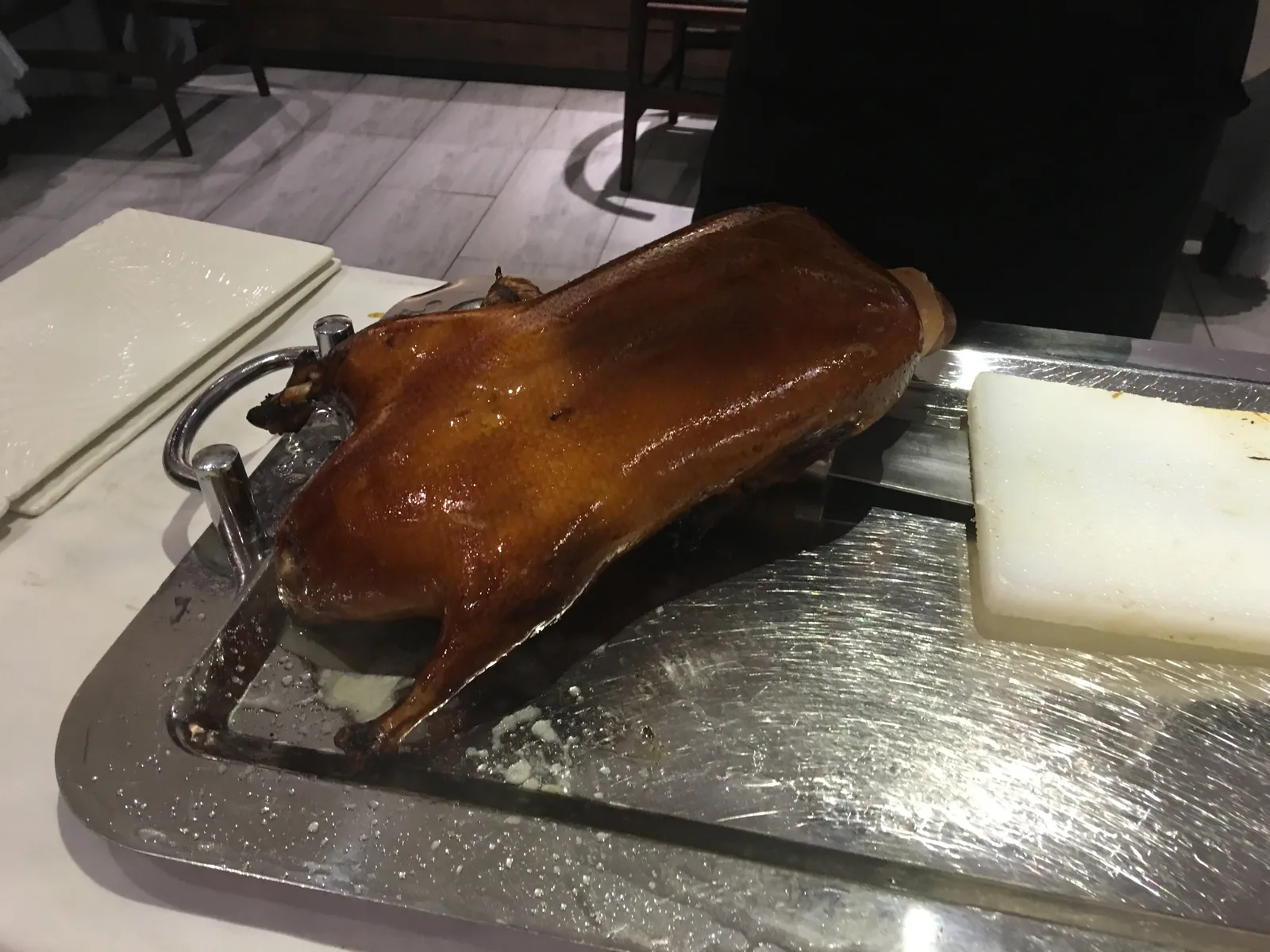
*Peking duck is traditionally roasted until the skin becomes crisp and glossy before being carved for diners. Photo: Bjoertvedt / CC BY-SA 4.0 via Wikimedia Commons.*

Hung-Oven vs Closed-Oven Peking Duck
Beijing has two major traditional roasting systems. Beijing government sources describe them as the city's two main traditional Peking-duck styles. Neither method is objectively superior; they produce different textures and belong to different restaurant lineages.
Hanging oven (挂炉). The oven has an open front. Ducks hang inside over fruitwood and an open flame. This hanging-oven roast-duck technique is historically associated with Quanjude, which was founded in 1864. Quanjude's historical importance for the hanging-oven method is separate from DragonTrail's current dining recommendation. The technique is recognised as national intangible cultural heritage.
Bianyifang — 焖炉 / closed oven. The oven is preheated and then closed. The duck cooks primarily through retained and radiant heat rather than a direct open flame. Bianyifang traces its history to 1416 and is the closed-oven lineage DragonTrail recommends when history and technique matter most. Its closed-oven technique is also recognised as national intangible cultural heritage.
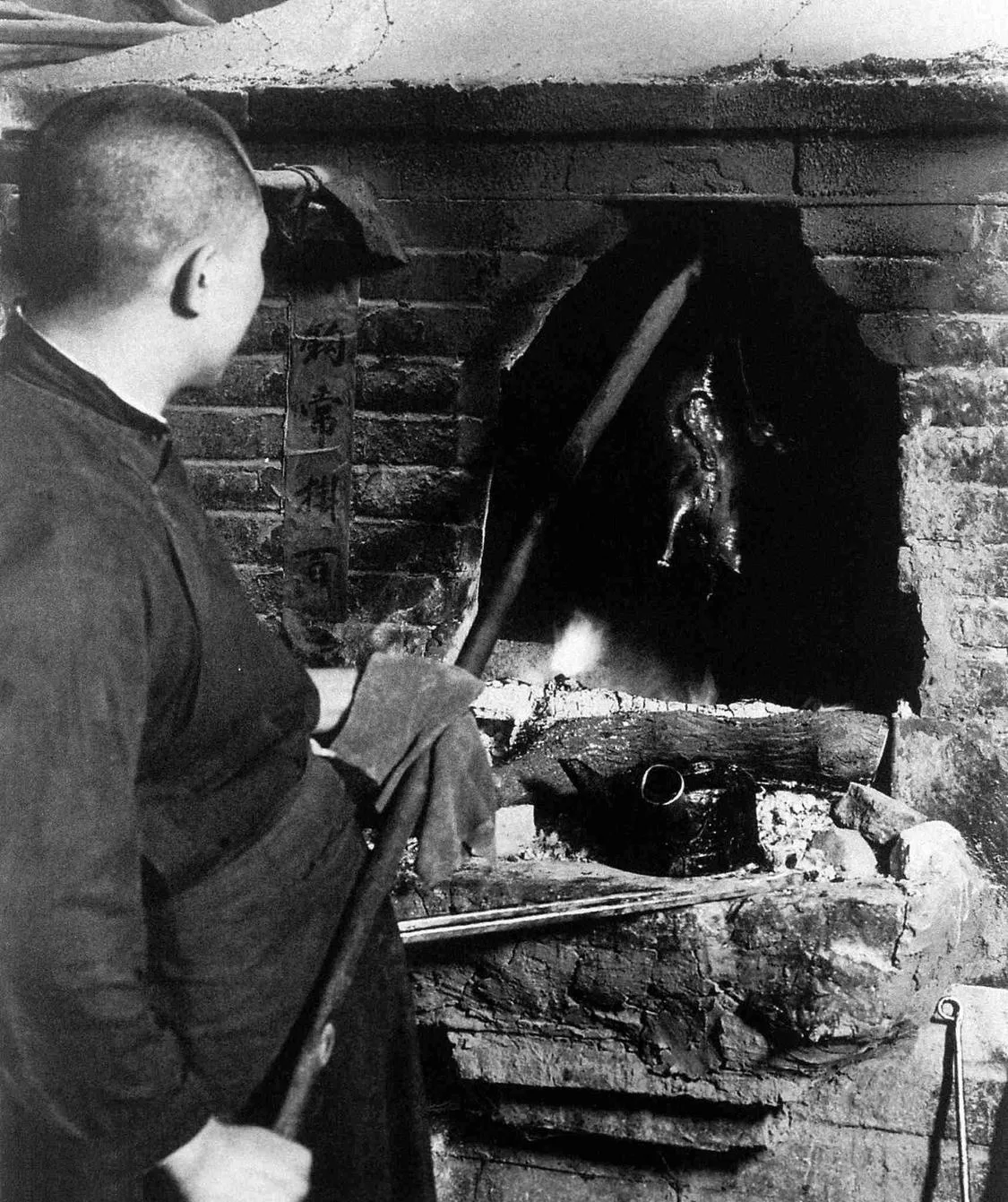
*Peking ducks roasting in a hanging oven, the open-flame method associated with Beijing roast duck.*
A visitor comparing the two is tasting two recognised Beijing traditions, not choosing a single “correct” roast.
Where should you eat Peking duck in Beijing?
Beijing has many famous roast duck restaurants, but they do not offer the same kind of experience. DragonTrail's current recommendation for most visitors is Siji Minfu. For a more historical experience, choose Bianyifang. For a polished premium meal, choose Da Dong.
Best all-round choice: Siji Minfu
Siji Minfu is our first choice for most visitors who want well-prepared Peking duck without turning the meal into a luxury occasion. The duck is generally crisp, balanced and less heavy than the versions served at some older tourist-facing brands. It also offers a broad menu of familiar Beijing dishes, making it a practical choice for couples, families and first-time visitors.
Its popularity is the main drawback. Busy branches can have long queues, particularly around normal dinner hours. Branch quality and waiting times can vary, so the most famous location is not automatically the best choice for every itinerary.
Best for history: Bianyifang
Bianyifang is the better choice if the history and cooking tradition matter most to you. Founded during the Ming dynasty, it is one of Beijing's oldest roast duck restaurant brands and is associated with the closed-oven, or menlu, method.
This produces a different experience from the open-flame hanging-oven style used by many other Beijing duck restaurants. Choose Bianyifang to compare techniques or to place the meal within the longer history of Peking duck, rather than simply to follow the most famous modern restaurant name.
Best premium option: Da Dong
Da Dong is the premium choice. Its roast duck is known for particularly crisp skin and a lighter presentation, while the dining room, plating and wider menu are more refined. It works well for a special dinner, business meal or traveller who values the complete restaurant experience and is comfortable paying more.
What about Quanjude?
Quanjude remains the most internationally recognised Peking duck name, and its history is important. However, DragonTrail does not currently recommend it as the best place to eat roast duck in Beijing.
Our concern is the present dining experience rather than the brand's history. In our assessment, quality can be inconsistent, and the duck can feel heavier and oilier than the alternatives above. Visitors may also find that they are paying partly for the famous name rather than receiving the best meal at that price.
This is an editorial recommendation, not a claim that every Quanjude branch or every meal is the same. Visitors who specifically want to experience the historic brand may still choose it. For food quality and overall value, however, we would usually direct travellers to Siji Minfu, Bianyifang or Da Dong instead.
DragonTrail's quick recommendation
| What you want | Our recommendation | Main trade-off |
|---|---|---|
| Best choice for most visitors | Siji Minfu | Popular branches can have long queues |
| Historical restaurant and closed-oven tradition | Bianyifang | Chosen more for history and technique |
| Refined premium dinner | Da Dong | Higher price |
| Famous historic brand | Quanjude | Not our current recommendation for food quality or value |
Restaurant performance can vary by branch and date, so we treat these as practical categories rather than guarantees about an individual meal.
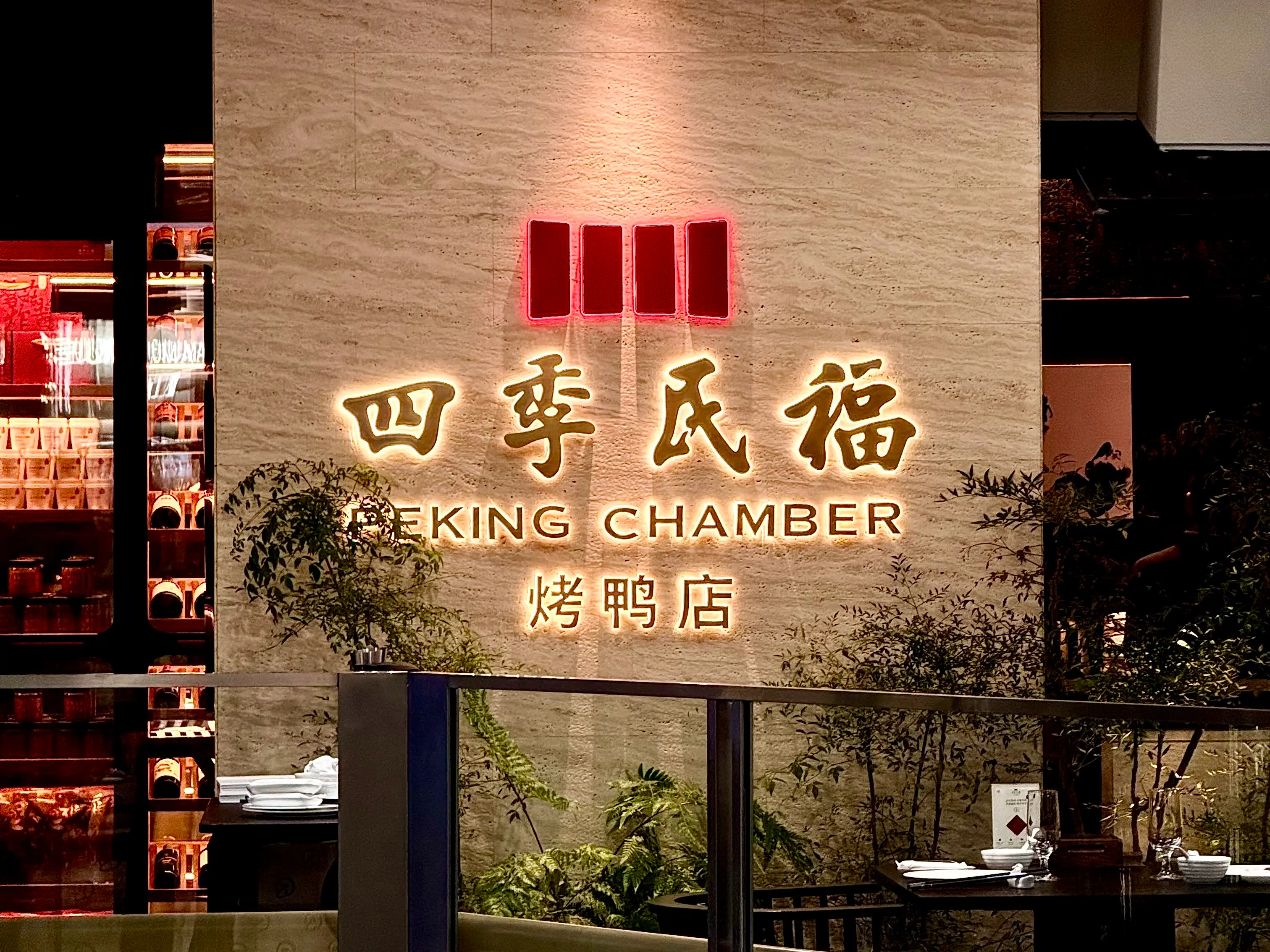
*Siji Minfu is DragonTrail's main recommendation for a good all-round Peking duck meal in Beijing.*
How Much Does Peking Duck Cost in Beijing?
For most travellers, it is more useful to budget for the whole meal than to compare the duck price alone. Pancakes, condiments, additional Beijing dishes, drinks, service and the restaurant level can materially change the final bill.
| Type of meal | Approximate budget |
|---|---|
| Casual/local roast-duck restaurant | ¥80–150 per person |
| Well-known mainstream restaurant | ¥150–220 per person |
| Premium roast-duck restaurant | ¥300–500+ per person |
| Signature whole duck at major brands | roughly ¥250–400 |
These are planning ranges, not fixed menu prices. Prices vary between branches and may change.
Two people do not need to order two ducks. A whole duck is commonly shared. A couple should normally order the duck plus a small number of side dishes rather than build a huge banquet.
Pancakes and condiments may be itemized separately at some restaurants, so the duck price on the menu is not always the full cost of the course. The remaining duck frame may sometimes be prepared as soup or another dish; ask when ordering.
Do not treat a 2026 snapshot such as ¥259, ¥268 or ¥398 as a guaranteed current price. Use those figures only to recognise the difference between a mainstream signature duck and a premium one.
How to Eat Peking Duck
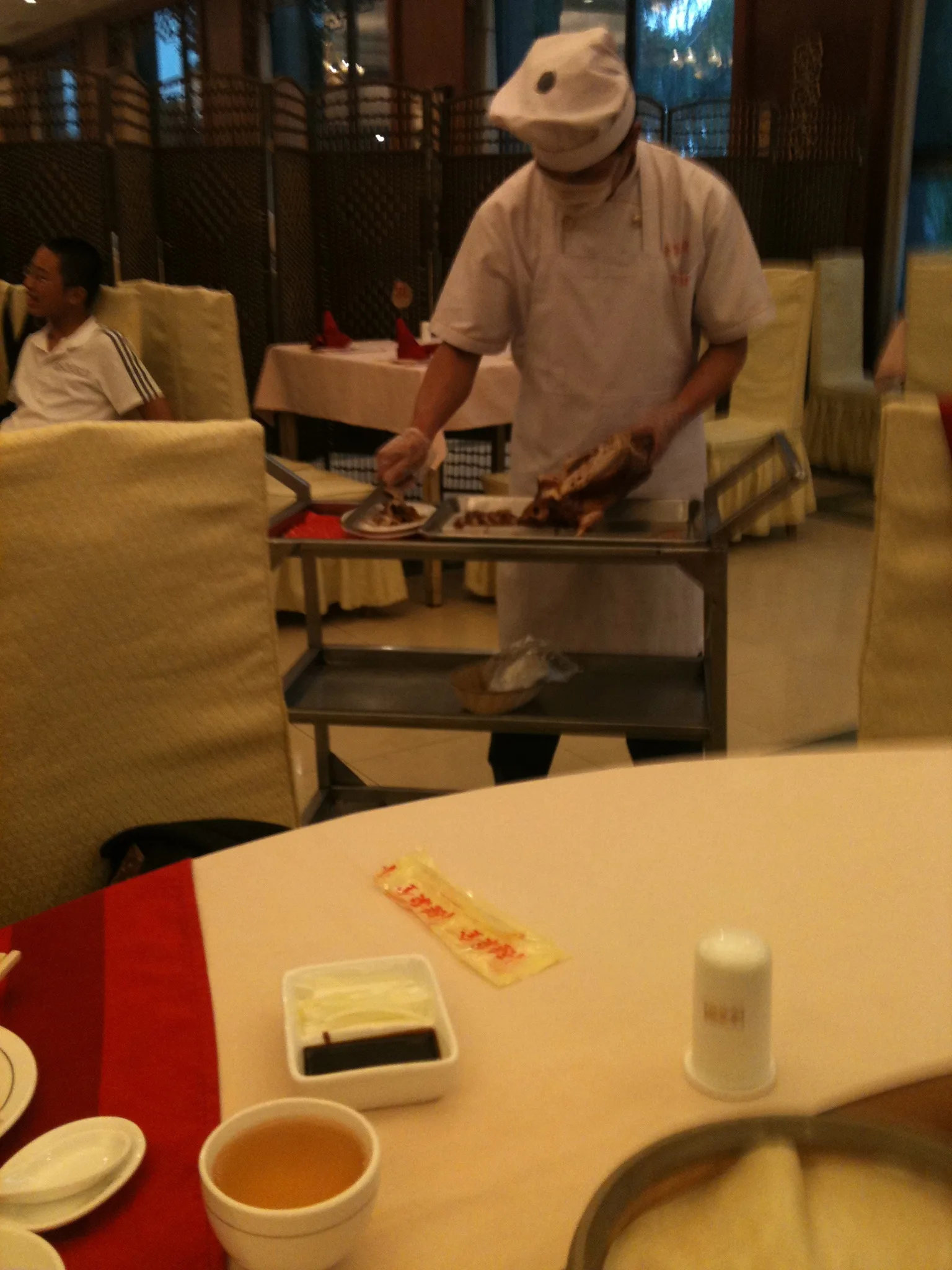
*Tableside carving is part of the traditional Peking duck dining experience. Photo: Pixor / CC BY-SA 3.0 via Wikimedia Commons.*

The sequence below is the usual table method. Restaurants vary the extras; the core combination stays the same.
Step 1: Try the crisp skin
Some restaurants first serve pieces with especially crisp skin. These may be eaten alone or dipped lightly in sugar so the texture and rendered fat can be tasted before adding sauce.
Step 2: Take a pancake
Lay one thin wheat pancake flat on your plate.
Step 3: Add sauce and vegetables
Add a small amount of sweet bean sauce, then scallion and cucumber. Do not overload the pancake.
The Beijing accompaniment is 甜面酱 — tiánmiànjiàng, sweet bean sauce. English-language menus sometimes loosely call it hoisin-style sauce, but sweet bean sauce is the more accurate Beijing term. Hoisin is a related condiment in overseas Chinese cooking; it is not the precise name for what is served with Peking duck in Beijing.
Step 4: Add the duck
Add one or two slices containing both crisp skin and meat.
Step 5: Fold and eat immediately
Fold the lower edge up, fold the sides inward and eat the wrap while the duck is still warm and the skin remains crisp.
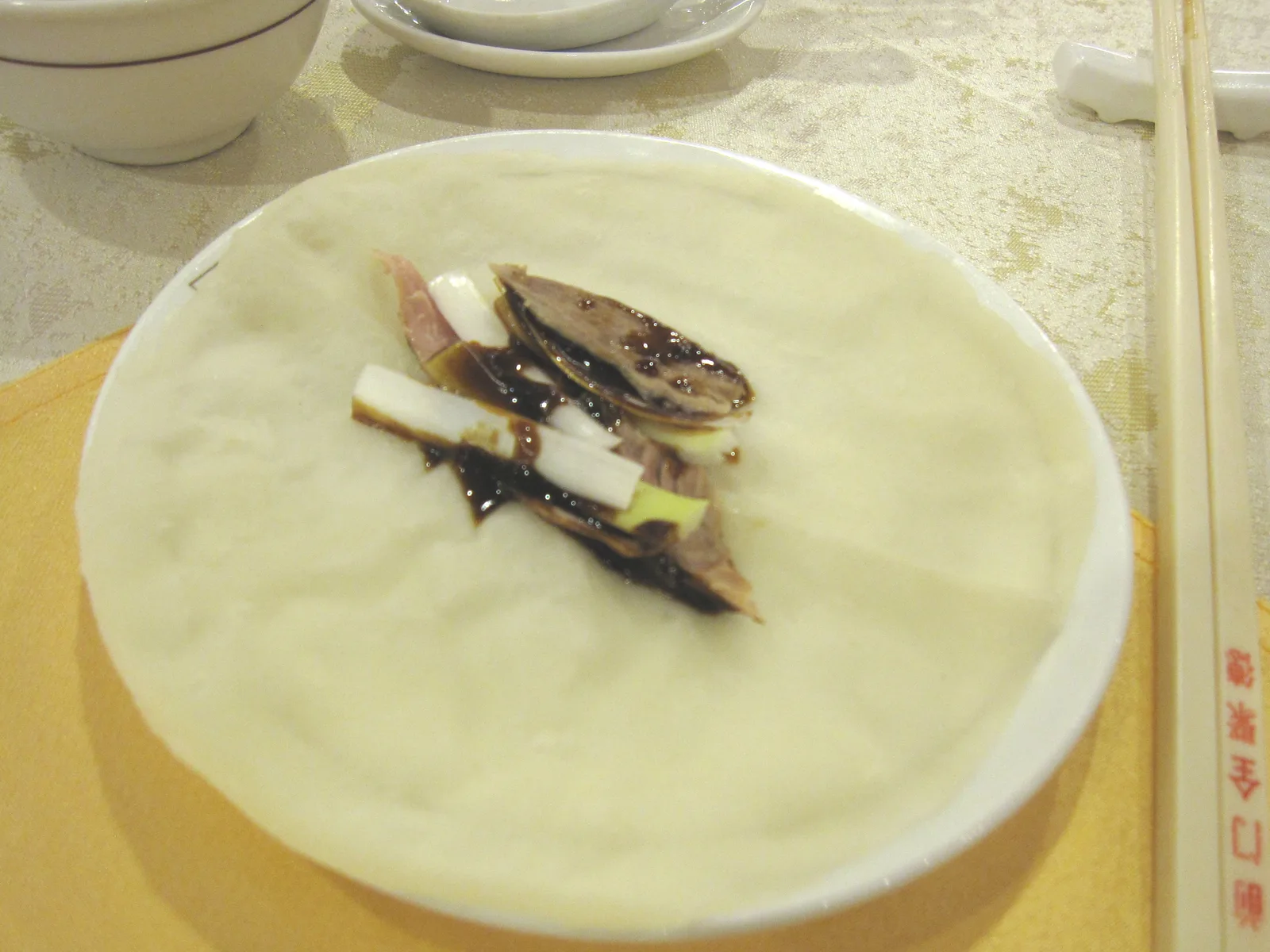
*A classic Peking duck wrap combines carved duck, sweet bean sauce, scallion and cucumber in a thin pancake. Photo: J. Patrick Fischer / CC BY-SA 3.0 via Wikimedia Commons.*

Some restaurants provide additional garlic, pickled vegetables, melon or other accompaniments. Variations are normal. There is no need for foreign visitors to imitate ceremonial rules rigidly. The essential combination is hot carved duck + pancake + sauce + fresh aromatics.
Official Beijing tourism material describes the classic combination of duck, sweet bean sauce, pancakes, scallion and cucumber.
Add Peking Duck to a Beijing Food or Hutong Experience
Peking duck works particularly well as the dinner component of a Beijing food or cultural day rather than as a standalone sightseeing stop. A common combination is the Forbidden City or Qianmen during the day, a walk through Beijing's historic neighbourhoods, and Peking duck for dinner.
Food and Hutong experience
If you want the dish inside a wider eating day, start with Explore Beijing food experiences and Explore Beijing's hutongs. A hosted neighbourhood meal such as the Hutong calligraphy and dumpling experience is a daytime counterpart — Chinese dumplings at lunch, roast duck at dinner is a balanced pairing, not a duplicate of the same meal.
The restaurant dinner is not automatically included in those experiences unless the specific product says so.
Custom private itinerary
If you want to combine sightseeing, a Hutong visit and a Peking duck dinner in one private Beijing itinerary, DragonTrail can help arrange the route around your hotel, attraction reservations and preferred restaurant. Get in touch.