
Traditional Chinese furniture is recognized less by a single decorative motif than by the relationship between its proportions, wooden framework, joinery, materials and surface treatment. Classical examples range from restrained huanghuali chairs and tables to richly carved or lacquered Qing court furniture. The most influential surviving design traditions are especially associated with the Ming (1368–1644) and Qing (1644–1912) dynasties. The most useful way to recognize traditional Chinese furniture is to read silhouette, proportion, structure, material and surface together.
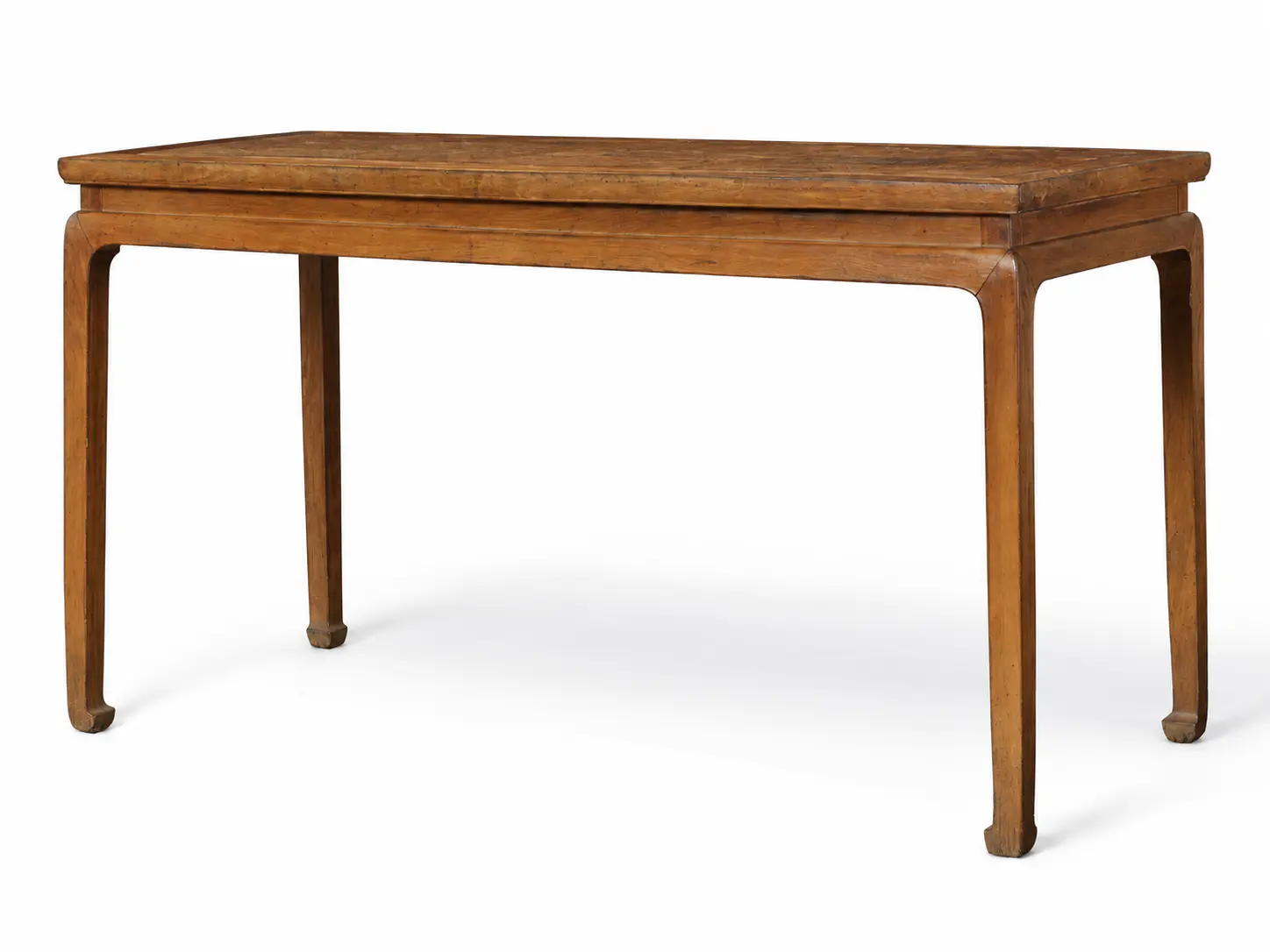
*Huanghuali painting table, late 16th–early 17th century, Ming dynasty. The Metropolitan Museum of Art, Public Domain.*
Traditional Chinese Furniture at a Glance
| Characteristic | What to look for |
|---|---|
| Structure | Clearly legible wooden frames and interlocking joints |
| Proportion | Balanced relationship between legs, rails, panels and open space |
| Silhouette | Strong chair backs, curved arms, straight or subtly splayed legs |
| Materials | Huanghuali, zitan, huali/hongmu, elm and other woods |
| Surface | Polished wood, lacquer, carved lacquer or inlay |
| Furniture forms | Chairs, tables, beds/couches, cabinets and screens |
| Decoration | From extremely restrained to highly elaborate |
| Classical periods | Especially Ming and Qing dynasties |
These cues help recognition; they are tendencies, not a checklist that every workshop followed.
The Design Language of Traditional Chinese Furniture
Structure Remains Visible
In many classical Chinese furniture forms, the framework is not hidden behind upholstery or cladding. An informed viewer can often identify legs, rails, stretchers, aprons, frames, panels, seat frames and back splats as separate but related members. Construction and composition reinforce one another: a rail that seats into a leg is both a joint and a line in the silhouette.
Classical Chinese furniture is renowned for sophisticated interlocking wooden joints, particularly mortise-and-tenon systems. Fine furniture often minimizes visible metal fastening, but construction methods varied and adhesives could also be used. The point for recognition is visual: members meet in ways that remain readable rather than disguised.
Proportion and Negative Space
Many classical hardwood forms treat open space as part of the design. The void between chair legs, the framed opening around a back splat, or the space beneath a table apron can feel as carefully judged as carved detail. Narrow structural members and restrained solid panels keep mass from swallowing the silhouette.
This is a craft observation, not a claim that every Chinese household designed rooms around abstract emptiness. Still, when a painting table or yokeback chair looks “light” for its size, the cause is usually proportion and negative space working with the frame—not missing ornament alone.
Line, Curve and Silhouette
Recognizable visual cues include gently curved crest rails, horseshoe-shaped arm rails, vertical back splats, straight or subtly splayed legs, recessed-leg tables, upturned table ends and frame-and-panel construction. The overall silhouette often lets an observer name a furniture family—yokeback chair, painting table, wardrobe—before examining surface decoration.
Silhouette reading is the first step in the recognition framework below. Decoration can confirm taste and workshop ambition, but line and proportion usually announce the type.
Major Traditional Chinese Furniture Styles
Ming Furniture Tradition
Many of the classical hardwood forms most strongly associated with Ming taste emphasize proportion, line and visible structure, although decorated and lacquered Ming furniture also existed. Structural clarity, balanced proportions, polished hardwood surfaces and elegant transitions between components appear repeatedly in museum presentations of Ming and late-Ming chairs and tables.
The Ming huanghuali painting table and related yokeback chairs show how engineering and appearance stay linked: apron, legs and stretchers remain part of the visual story. That reputation should not be read as “Ming furniture is always simple.” Ornament, beading and lacquer appear where workshops wanted emphasis; the enduring design lesson is clarity of frame rather than a ban on decoration.
Qing Furniture Tradition
Qing furniture ranges from restrained continuations of Ming-derived forms to highly elaborate imperial works. Ming-derived structural types remained important. Court furniture could become more massive; zitan became particularly prominent in elite imperial contexts; carving could grow denser; lacquer and precious-material inlay could become increasingly elaborate. Qianlong-period court furniture provides especially rich ornamental examples without representing every Qing household.
For a fuller Ming–Qing comparison, see Ming vs Qing furniture. For recognition, ask which material, workshop culture and decorative programme you are seeing—not only which dynasty label is attached.
Regional and Vernacular Furniture
Traditional furniture was made across China from local hardwoods, elm, softwoods, bamboo, lacquered timber and other available materials. Surviving museum collections disproportionately emphasize elite pieces, while ordinary households used a much broader material spectrum. Vernacular furniture is historically important even when it lacks rare tropical hardwoods or imperial workshop marks.
The Main Furniture Forms
Museum presentations—including the Palace Museum Furniture Gallery—commonly organize classical furniture into chairs, beds, tables, cabinets and screens. The summaries below support recognition, not a complete catalogue.
Chairs and Stools
Yokeback Chair
The yokeback armchair is among the most recognizable Chinese seating silhouettes: a tall central splat, a crest rail that projects beyond the uprights, and an upright posture that reads as architectural. The form is often compared visually to a yoke or official’s hat in collector language, but the practical recognition cue is the projecting crest and vertical splat.
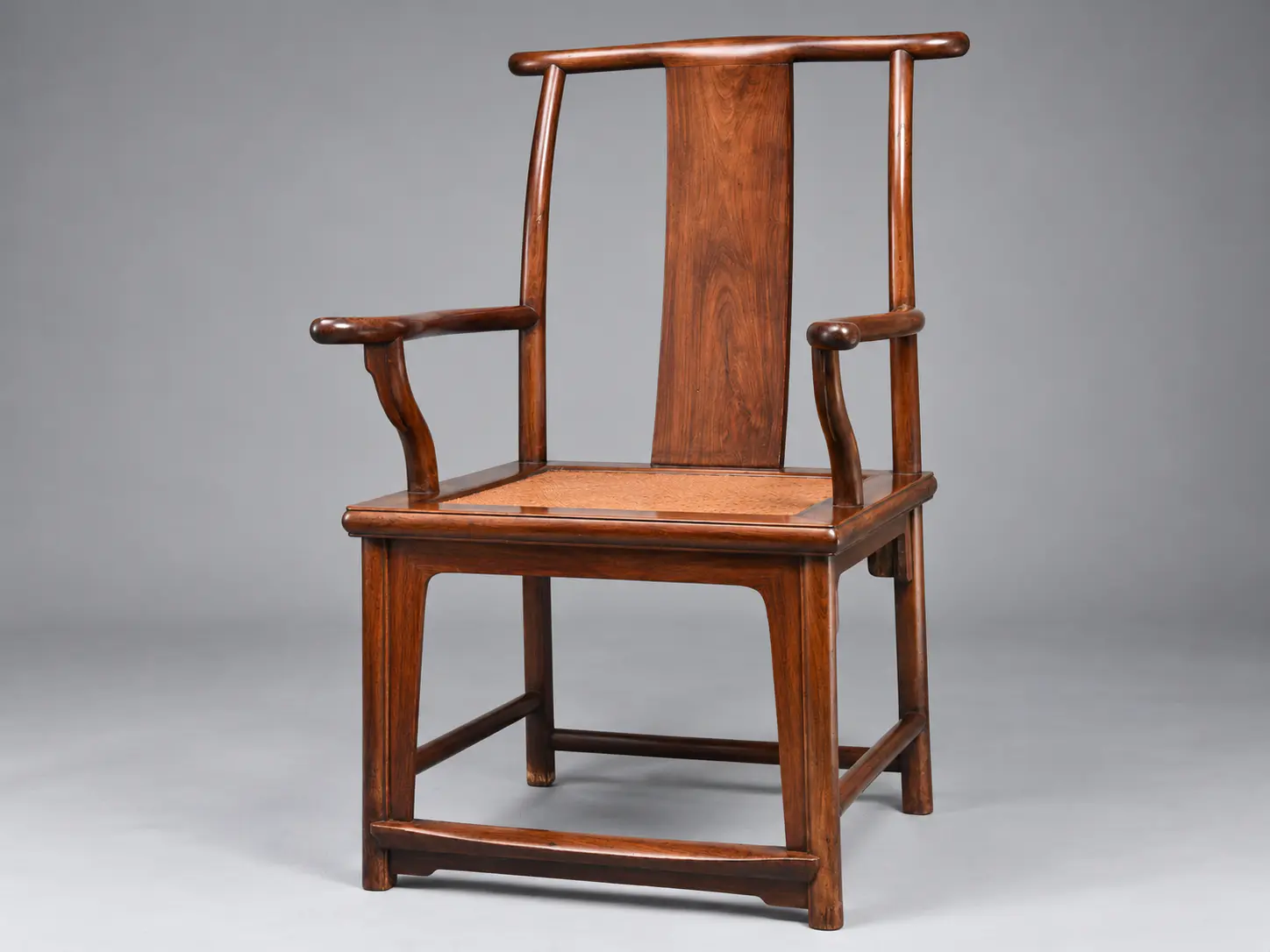
*Huanghuali yokeback armchair, 17th century, late Ming–early Qing period. The Metropolitan Museum of Art, Public Domain.*
Horseshoe-Back Armchair
The horseshoe-back armchair wraps back and arms in a continuous curved rail. That flowing transition is one of the clearest Chinese chair silhouettes and contrasts with the more rectilinear yokeback crest.
Folding Chairs and Stools
Folding chairs and stools expand seating for informal or portable use. Silhouette still matters—legs, stretchers and seat frame—but mass and ornament vary widely across periods and workshops.
Tables
“Chinese table” is not a single design. Painting tables, side tables, recessed-leg tables, altar or long tables and couch tables serve different room roles. Long painting tables especially show horizontal proportion, exposed frame, apron, legs and stretchers, often with a relatively thin visual profile compared with their width. Recessed-leg designs pull legs inward beneath the top, clarifying the overhang.
Beds and Couches
Platform-like couches, beds and low couch tables blur seating and sleeping. Railings, canopies and nearby low tables can turn a bed into a semi-enclosed room within a room. Recognition starts with platform height, rail profile and whether the piece reads as seating, sleeping or both.
Cabinets and Storage
Frame-and-panel wardrobes organize clothing, bedding and related goods. Rectangular doors, metal fittings and panel rhythm repay attention as carefully as chair silhouettes. Large paired cabinets are common in museum displays of elite hardwood furniture.
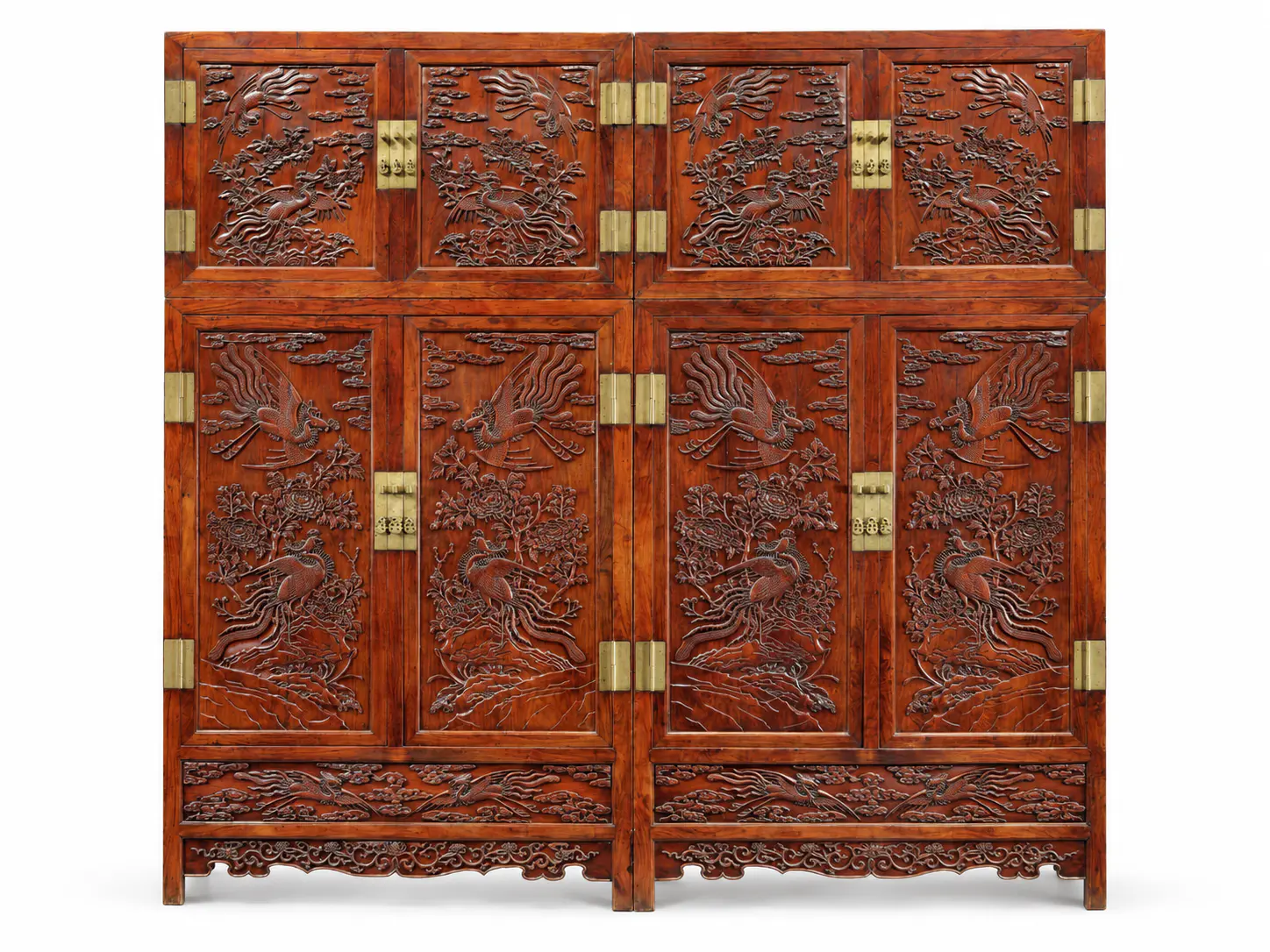
*Huanghuali wardrobe, 16th century, Ming dynasty. The Metropolitan Museum of Art, Public Domain.*
Screens
Folding screens, standing screens and table screens divide rooms, frame views and carry decorative surfaces. Screens are often where traditional furniture shifts from restrained timber framing into lacquer, painting, gold and inlay programmes.
Materials Shape the Furniture
Furniture style cannot be separated from material. Grain, colour, density and finish change how structure and ornament read.
Huanghuali
Huanghuali—botanically associated with *Dalbergia odorifera*—is strongly linked to important Ming and early Qing hardwood furniture. Warm brown to yellow-brown tones and pronounced grain suit elegant structural forms where polish keeps joinery visible. Recognition cues are covered here; for material identity and authenticity questions, see huanghuali, zitan and hongmu and Chinese antique furniture.
Zitan
Zitan is dense and dark—purple-brown to nearly black—and particularly associated with elite Qing furniture. It supports detailed carving and heavier visual mass while still allowing polished, structurally legible chairs.
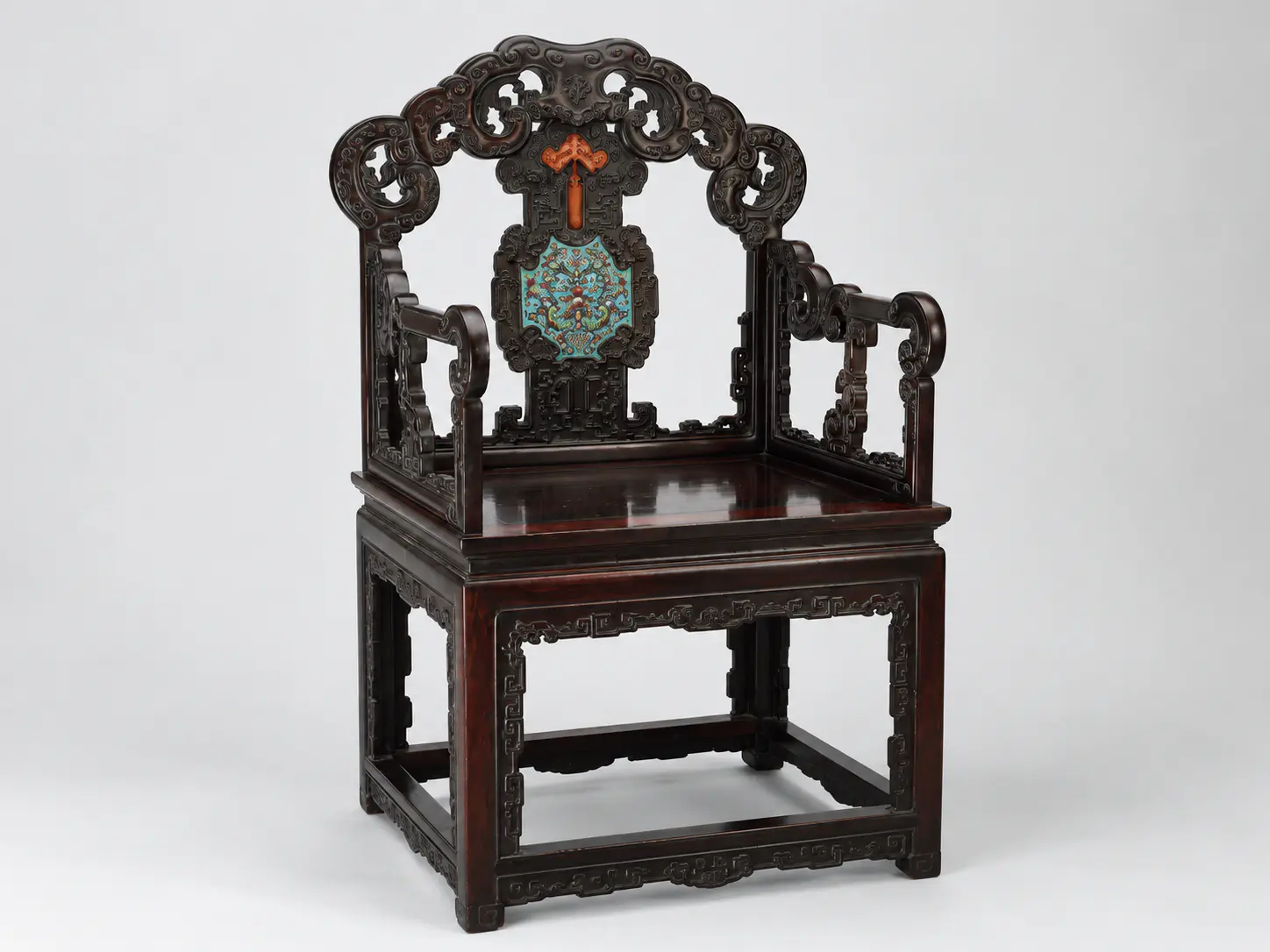
*Zitan armchair, 17th century, late Ming or early Qing. The Metropolitan Museum of Art, Public Domain.*
Elm and Other Woods
Not all traditional Chinese furniture was made from rare tropical hardwood. Elm and other locally available woods supplied ordinary domestic pieces for centuries. Vernacular material is not historically unimportant simply because collectors prize huanghuali and zitan.
Lacquer
Lacquer can completely transform the visual language: black or red lacquer, carved lacquer, painted lacquer and inlay can dominate reading even when the underlying carcass follows familiar joinery. Traditional Chinese furniture is not synonymous with exposed wood grain.
Decoration: From Restraint to Ornament
Search results often oversimplify Chinese furniture as either “minimal” or “ornate.” Design practice sits on a spectrum.
Structural Decoration
Decoration can arise from shaped aprons, carved brackets, curved rails, pierced elements and elegant joint transitions without covering the frame.
Carving
Carving may include floral motifs, dragons, geometric patterns, landscape scenes and symbolic imagery. Density and location—splat, apron, panel—matter as much as motif for recognition.
Inlay
Elite furniture historically used mother-of-pearl, jade, precious stones, metals and other luxury materials. Palace collections document extensive precious-material embellishment in imperial contexts. Where jade appears as a material culture topic, see also Chinese jade.
Lacquer Decoration
Carved red lacquer and multi-panel lacquer screens show that ornament can become the primary visual programme. Compare such surfaces with a polished huanghuali painting table to see how wide the traditional spectrum is.
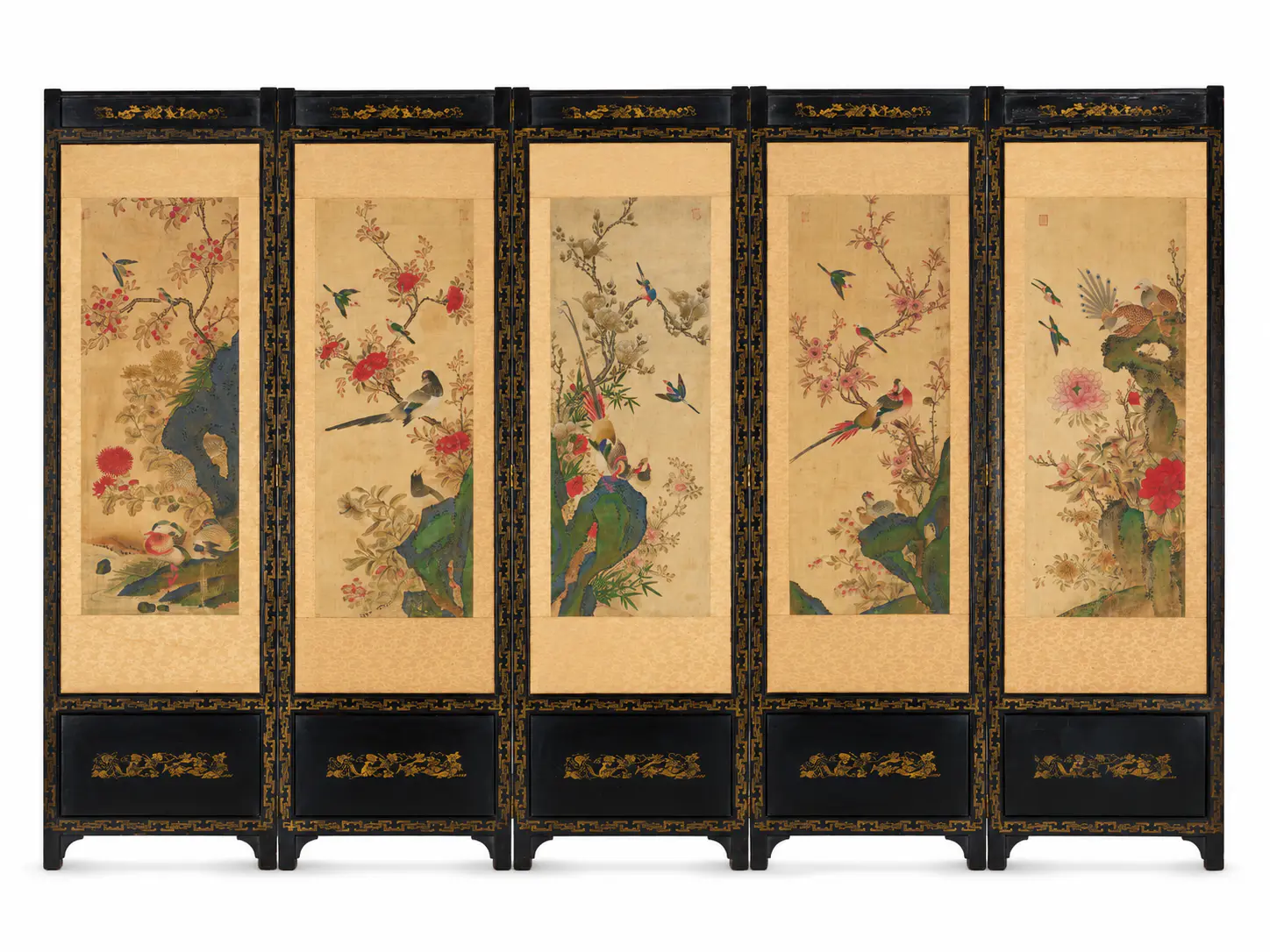
*A folding screen composed as five vertical bird-and-flower paintings.*
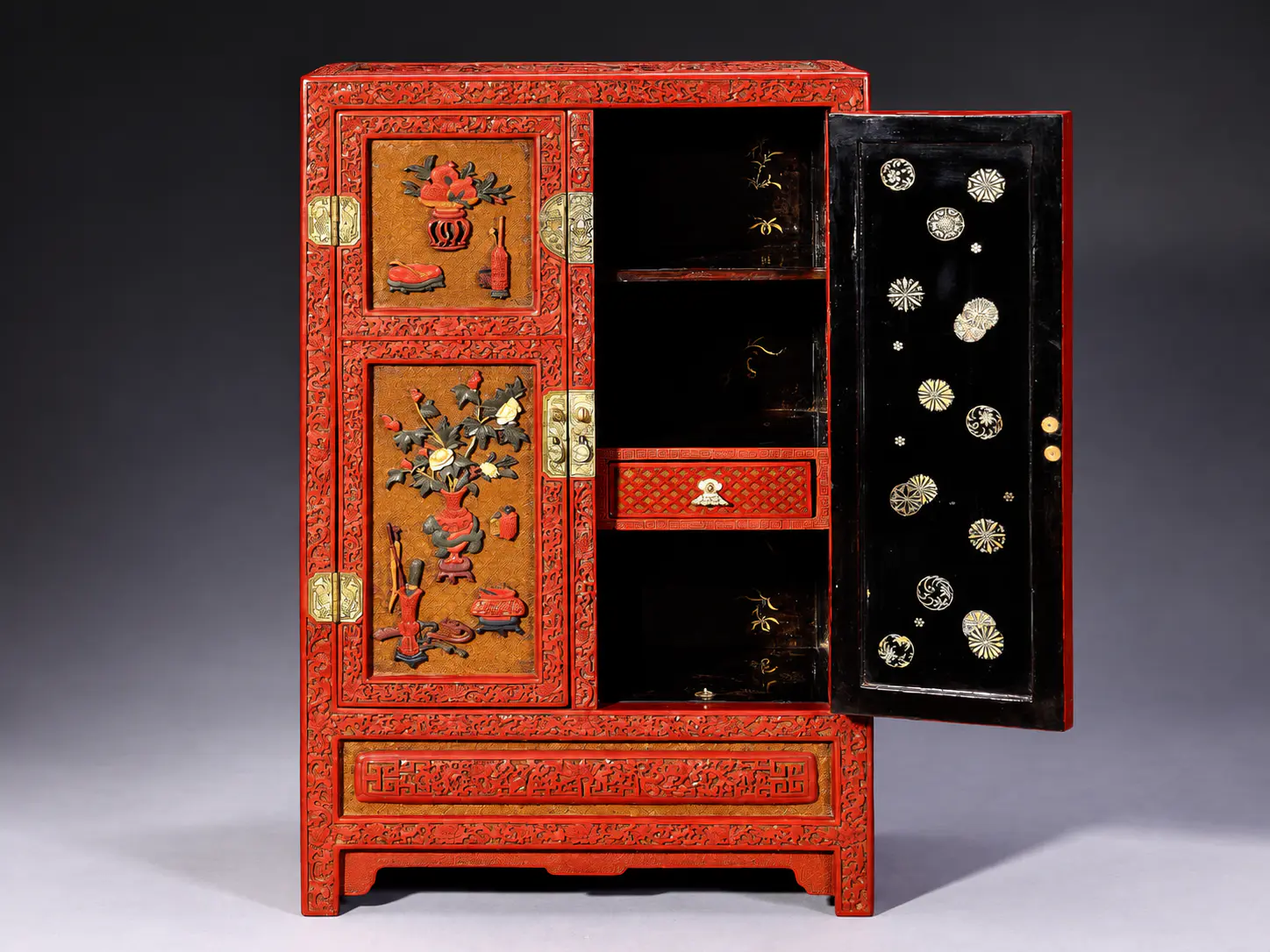
*Carved red lacquer cabinet with figures in a landscape, Qing dynasty, Qianlong period. The Metropolitan Museum of Art, Public Domain.*
How Furniture Worked Inside Traditional Chinese Rooms
Furniture placement could reinforce room function, symmetry, hierarchy, reception arrangements, study spaces, sleeping areas and ritual settings—without a single universal plan for every household. A pair of chairs flanking a table, a screen closing a view, or a painting table set for writing all depend on wall axes, doorways and courtyard light.
Reading furniture with traditional Chinese houses, house layout and design, siheyuan and Chinese architecture clarifies why forms feel incomplete when removed from their rooms.
How to Recognize Traditional Chinese Furniture
1. Look at the silhouette
Chair back, arms, table proportions and cabinet profile usually announce the family first.
2. Read the frame
Identify legs, rails, stretchers, aprons and panels. Ask whether structure remains visually legible.
3. Examine the material
Visible hardwood grain versus lacquered or inlaid surfaces changes how decoration and mass read.
4. Examine decoration
Note restrained shaping versus dense carving, lacquer programmes or inlay.
5. Consider period and context
Decoration alone cannot identify an object as Ming or Qing. Workshop culture, material and room type matter.
Style is not the same as date. Modern reproductions can accurately copy historical forms, so visual style alone cannot authenticate antique Chinese furniture. Traditional form, reproduction, vintage piece, antique and museum-period object are related but distinct categories.
Seeing traditional Chinese furniture in person makes its proportions, joinery, surface treatment and materials much easier to understand than photographs alone. Beijing’s Palace Museum Furniture Gallery and related craft museums remain useful places to practice recognition—see the Chinese furniture hub for collection context.
Traditional Chinese Furniture FAQ
What are the main characteristics of traditional Chinese furniture?
Look for legible wooden frames, balanced proportions, distinctive silhouettes (such as yokeback or horseshoe-back chairs), hardwood or lacquered surfaces, and forms including chairs, tables, beds, cabinets and screens. Decoration ranges from restrained shaping to elaborate carving and lacquer. Ming and Qing traditions are the best-documented classical reference points.
What is Chinese-style furniture?
“Chinese-style furniture” in modern markets may borrow historical silhouettes without using traditional joinery, period materials or antique status. Traditional Chinese furniture, as discussed here, refers to classical design language and construction—especially Ming- and Qing-associated forms—rather than any contemporary product labeled Chinese style.
What is the difference between Ming and Qing furniture?
Ming-associated hardwood taste often emphasizes proportion, line and visible structure; Qing traditions span continued Ming-derived forms and more elaborate imperial hardwood, lacquer, carving and inlay. These are tendencies, not absolute rules.
What wood is traditional Chinese furniture made from?
Elite classical collections highlight huanghuali, zitan and related hardwoods, while elm and other woods supplied much ordinary furniture. Lacquered timber and bamboo constructions also appear. Modern commercial “rosewood” labels do not map perfectly onto every historical term.
Why is huanghuali important in Chinese furniture?
Huanghuali—linked botanically to *Dalbergia odorifera*—is closely associated with refined Ming and early Qing hardwood chairs and tables where warm tone, grain and joinery remain visible. It is a design and collection reference class, not the only traditional material.
What is a Chinese yokeback chair?
A yokeback chair typically has a tall central splat and a crest rail that projects beyond the upright posts, creating an upright, architectural silhouette. It is one of the most recognizable classical Chinese seating forms.
Did traditional Chinese furniture use nails?
Classical Chinese furniture is renowned for interlocking wooden joinery, especially mortise-and-tenon systems. Fine furniture often minimizes visible metal fastening, but methods varied and adhesives could also be used. Avoid absolute “no nails or glue” claims.
Is all traditional Chinese furniture antique?
No. Traditional describes form and design language. Reproductions, later copies, vintage pieces and museum-period antiques can share silhouettes. Style alone does not prove age or authenticity.