
Traditional Chinese furniture includes a wide range of seating, tables, beds, storage furniture and screens. The Palace Museum groups its Ming and Qing furniture collection into five principal categories—chairs, beds, tables, cabinets and screens—but each group contains many specialized forms. A painting table, folding chair, canopy bed and wardrobe served different practical and social roles, while their proportions, materials and decoration changed across period and setting. For overall design language, see traditional Chinese furniture; for the parent overview, start with Chinese furniture.
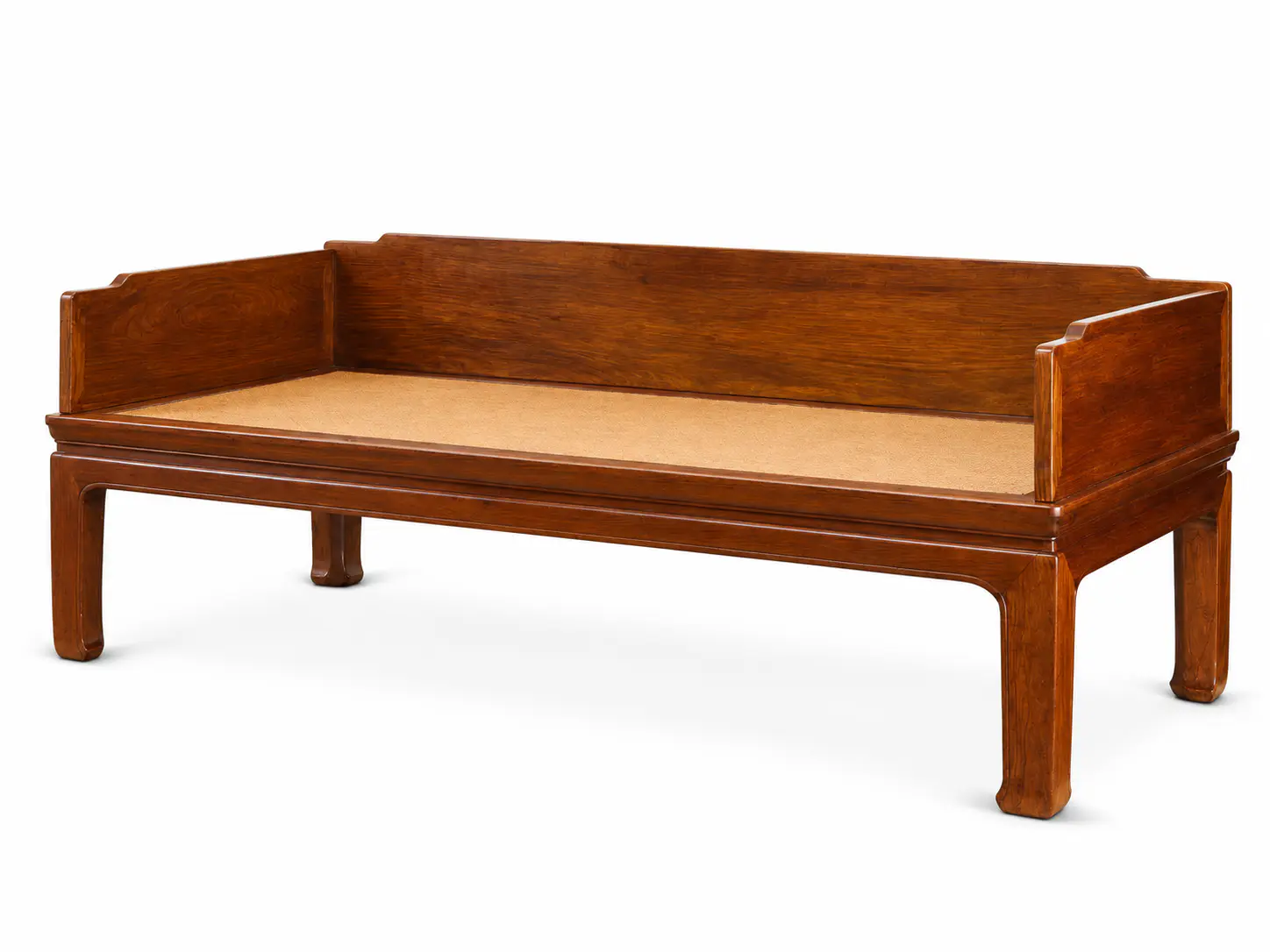
*A low wooden daybed combining a woven surface with raised rails on three sides.*
Traditional Chinese Furniture Types at a Glance
| Main family | Common forms | Primary function |
|---|---|---|
| Chairs & seating | Yokeback chairs, horseshoe-back chairs, folding chairs, stools | Sitting, reception, status |
| Tables | Painting tables, side tables, narrow tables, tea tables, couch tables | Writing, painting, eating, display, tea |
| Beds & couches | Canopy beds, couches, luohan-style couch beds | Sleeping, resting, sitting, receiving guests |
| Cabinets & storage | Wardrobes, square-corner cabinets, display cabinets, shelves | Clothing, bedding, objects, display |
| Screens | Folding screens, standing screens, table screens | Dividing space, display, decoration |
These categories describe function and form. The same furniture type can be made in different woods, finishes and historical styles.
The Palace Museum organizes its furniture collection into five main types. That institutional taxonomy is a clear high-level map—not a claim that there are exactly five kinds of Chinese furniture in every scholarly system. Each family contains multiple specialized forms.
Chairs and Seating
Seating is the first of the Palace Museum’s chair category, treated here as an umbrella for elevated sitting furniture. Stools belong with this family as related seating even when they lack backs. Higher seating became increasingly important over a long historical arc; the Shanghai Museum notes that higher seating rose in importance during the Northern and Southern Dynasties. This page stays with recognizable forms rather than a full history of sitting.
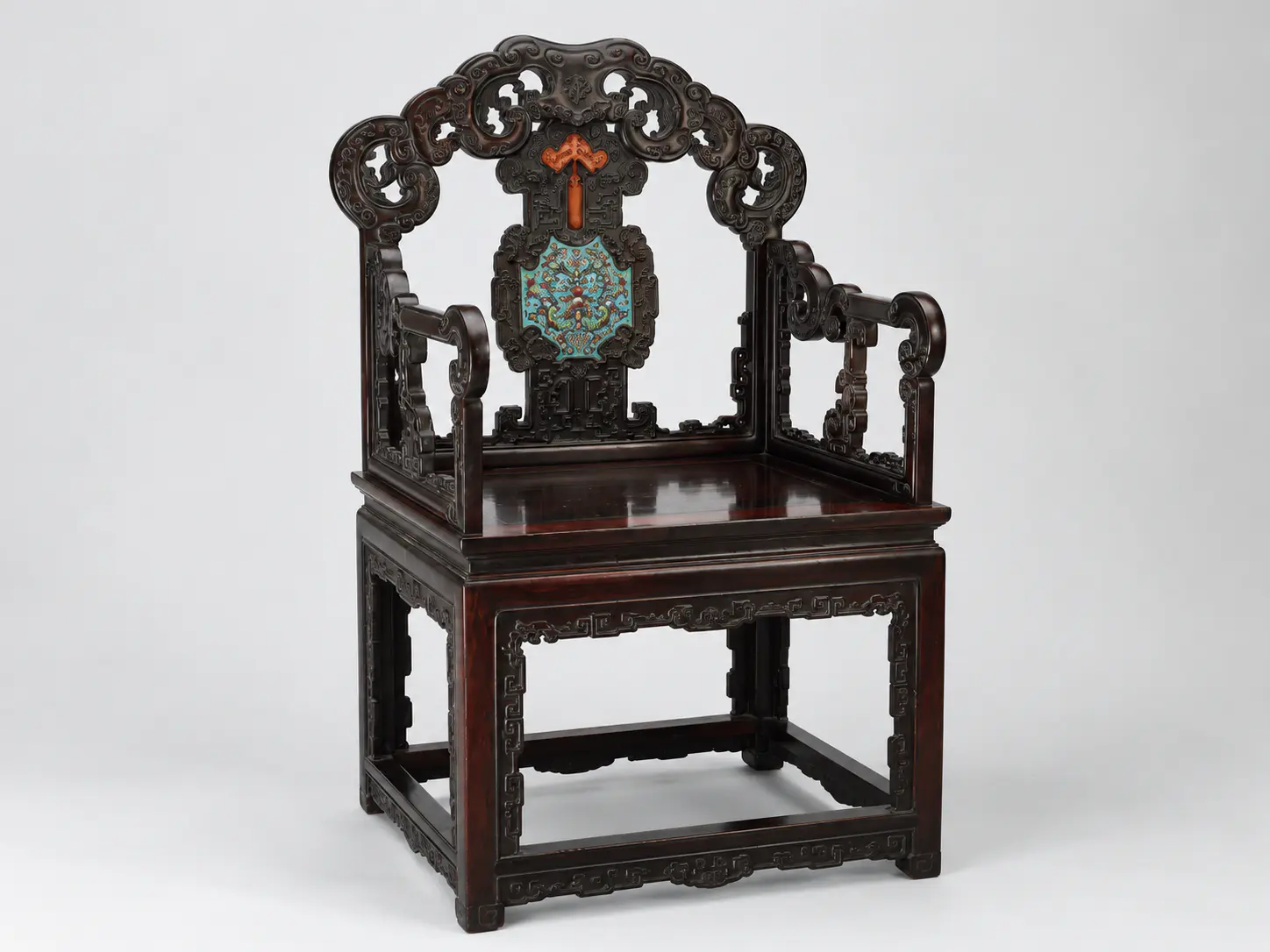
*Zitan armchair, 17th century, late Ming or early Qing period. The Metropolitan Museum of Art, Public Domain.*
Yokeback Chairs
A yokeback chair is typically recognized by a tall back, a central back splat, a projecting crest rail and a relatively upright posture within an exposed wooden frame. The English name refers to the shape of the upper rail, not to agricultural use. Surviving hardwood examples make the silhouette easy to read; construction details belong on the joinery page, and material names on huanghuali, zitan and hongmu.
Horseshoe-Back Armchairs
Horseshoe-back armchairs are among the most recognizable classical Chinese chair forms. A continuous curved back-and-arm rail creates a rounded transition from back to arms and a flowing silhouette. The form appears in fixed and folding versions. A curved back alone does not date a chair to the Ming dynasty; period and style are separate layers (see Ming vs Qing furniture).
Folding Chairs
Folding chairs are a distinctive subtype. Shanghai Museum documentation of a Ming huanghuali folding armchair with curved rest describes a crest rail assembled from multiple sections joined through mortise-and-tenon construction. Folding mattered for portability, flexible seating and, in some contexts, ceremonial or status display—the Shanghai Museum notes that some folding chairs were treated as status furniture and placed prominently in halls. Keep that social reading restrained and object-based.
Stools
Stools were not merely secondary chairs. Common characteristics include no back, a square or round seat, stretchers and a portable form.
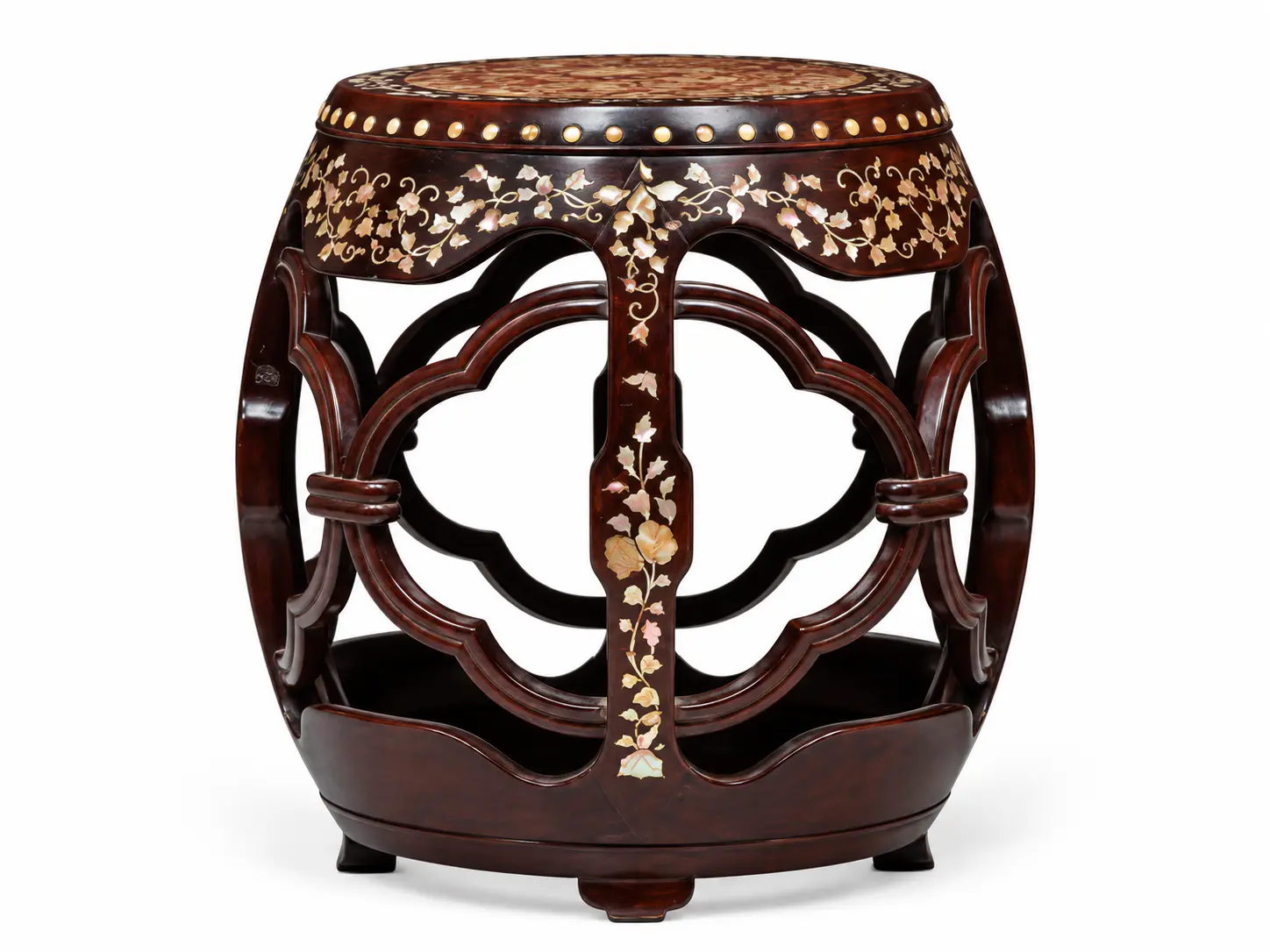
*Open geometric framing and pale floral inlay decorate this dark wooden stool.*
Tables
There is no single traditional “Chinese table.” Tables were shaped around different activities: painting and writing, wall placement and display, tea service, and low use on or with couches. Aprons, legs and stretchers recur across types; how those members lock together is explained on the joinery page.
Painting and Writing Tables
Painting and writing tables typically offer a broad work surface at a height suited to seated work, with a strong structural frame and enough depth for paper, brushes and scroll work. Shanghai Museum documentation of a Ming zitan painting table shows that these could be large work surfaces rather than small side tables. They belong naturally with calligraphy, painting and the scholar’s study.
Side Tables
Narrow side tables could stand against walls, beside chairs, in studies or in reception spaces. Their proportions and aprons vary; the functional idea is a supporting surface beside seating or along a wall rather than a primary writing desk.
Narrow and Long Tables
Long or narrow tables often appear against walls in halls for display or for decorative and ritual objects. A long shape alone does not prove ritual or altar use—function depends on setting and evidence, not silhouette alone.
Tea Tables
Tea tables served seating arrangements for tea and light objects. Modern low tea-table proportions do not apply universally; terminology and heights vary by collection and historical context.
Couch Tables / Kang Tables
Couch tables are a useful distinctive subtype. The Metropolitan Museum’s documented 17th-century huanghuali couch table is only about 12.4 cm high. The museum explains that it was positioned on a couch between two sitters and used for items such as teacups and reading material.
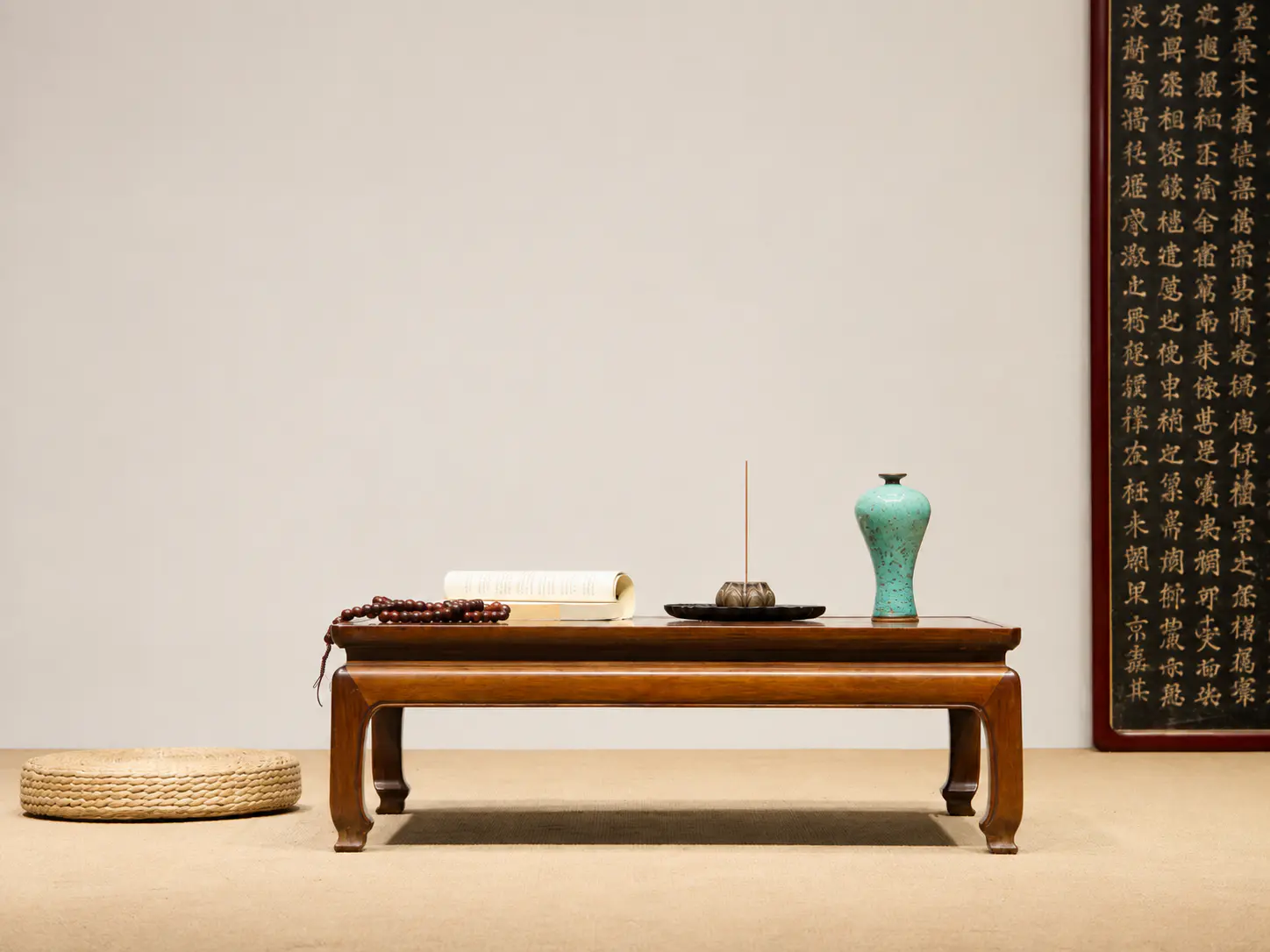
*A low table provides a restrained surface for incense, ceramics and writing-related objects.*
A couch table was designed at a much lower height than a full-sized painting or writing table. That height difference is one of the clearest ways to separate table types by function.
Beds, Couches and Daybeds
Traditional Chinese sleeping and reclining furniture ranges from enclosed canopy beds to open couches used for sitting and reclining. English labels vary across museum and collector traditions; identify the underlying form before treating names as fixed.
Canopy Beds
Shanghai Museum documentation of a Ming huanghuali six-post canopy bed with front railings describes posts supporting an upper framework or canopy and railings that create partial enclosure, giving the bed a room-like quality. Not every Chinese bed had a canopy. (This guide uses the museum’s published object facts; it does not reuse Shanghai Museum imagery without a verified open licence.)
Couches / Ta
The Met’s 17th-century huanghuali couch (Chinese title 榻牀) illustrates furniture that crosses the modern Western distinction between seat and bed. Users could sit with legs crossed or pendant; quilts and cushions could be added in colder weather. The hero image above is this form.
Luohan Beds / Couch Beds
A luohan bed (罗汉床 / *luohanchuang*) is a couch-bed form with railings or back panels but without the full overhead canopy and vertical posts of a canopy bed. Official Shanghai Museum material describes the luohan bed as having railings, lacking top frame and canopy posts, and usable for sitting or reclining—suitable for receiving guests or resting. It is best treated as a compact subtype within beds and couches rather than a wholly separate furniture family.
Kang and Low Furniture
A *kang* is historically connected with raised or heated platform traditions in northern China and should not automatically be equated with every Chinese bed. Catalogue references to the term deserve careful reading; the full kang heating-and-platform system is a broader architectural topic than this furniture taxonomy.
Cabinets, Wardrobes and Storage Furniture
The Palace Museum’s cabinet category is the umbrella for storage furniture: wardrobes, cabinets, display cabinets, shelves and specialized forms. Wardrobe and cabinet are related but not exact synonyms in English usage.
Wardrobes
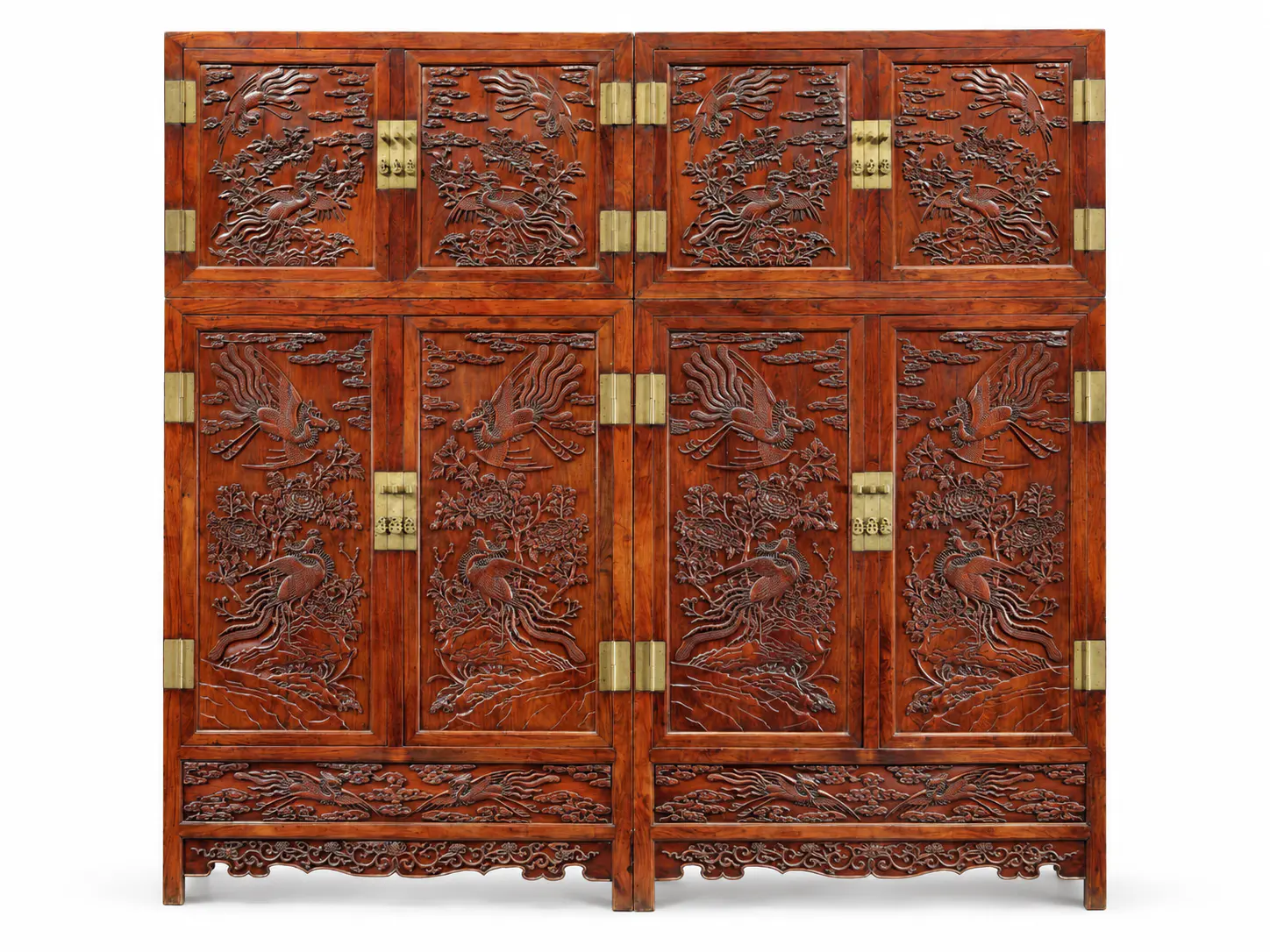
*Repeated carved panels and metal fittings organise the front of this multi-door cabinet.*
Square-Corner Cabinets
Square-corner cabinets present an upright rectangular body, vertical corners, framed doors and internal shelves or compartments. Shanghai Museum documentation includes a large Qing zitan square-corner cabinet with dragon decoration. Not all square-corner cabinets are Qing.
Round-Corner Cabinets
Round-corner cabinets are another recognized classical cabinet form. Top and side geometry differs from rigid square-corner cabinetry. Keep construction detail light unless a specific object record supports it.
Display Cabinets and Shelving
Shanghai Museum documentation of Qing display cabinetry can combine zitan, glass, opening doors, sliding doors and decorative carving. That shows furniture types continued to evolve and could absorb new materials and stylistic influences. Imported glass or Western influence does not represent all Qing cabinets—treat such pieces as documented late imperial examples.
Chests
Beyond the five major Palace Museum groupings, other functional storage forms such as chests also appear in Chinese material culture and museum collections. This page does not force chests into the five-type gallery taxonomy.
Screens
Screens function as furniture, spatial dividers, display surfaces and decorative objects at once. Chinese screens range from large folding room screens to small table screens.
Folding Screens
Folding screens use a hinged multi-panel format that can stand independently, reshape interior space and carry pictorial decoration across a large surface.
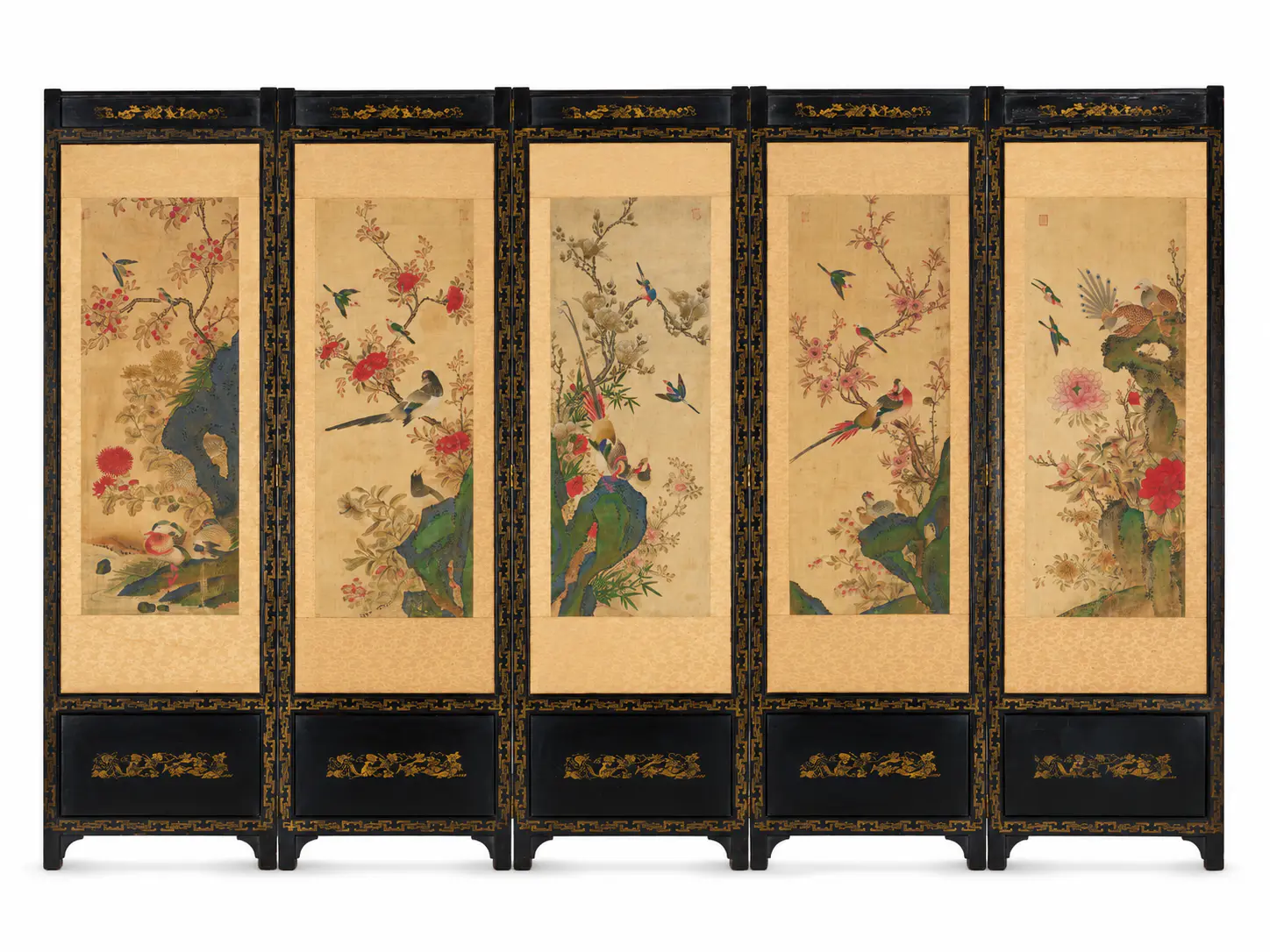
*Five-panel folding screen, 1676, Qing dynasty, Kangxi period; lacquer on wood, colors and gold. The Metropolitan Museum of Art, Public Domain. For surface techniques, see Chinese lacquer furniture.*
Standing Screens
Standing screens may be single-panel or framed screens set in stands. Roles include room division, visual focus, interior hierarchy and display. Not every standing screen was primarily a privacy screen; many had decorative or ceremonial roles.
Table Screens
Screens also exist at a much smaller scale. Table screens could stand on desks or tables, frame small works in jade, ivory, lacquer or other materials, and function as scholar’s objects rather than room dividers. Screen does not always mean a large folding room divider. The Met holds numerous Qianlong-period table screens in jade, lacquer, ivory and wood combinations.
Furniture Designed to Work Together
Furniture types were not isolated products. Common relationships include:
- Chair + side table — reception and social arrangements.
- Couch + couch table — the Met pair concept: a low table used on or with a couch.
- Table + stools — Shanghai Museum documents Qing carved-red-lacquer table-and-stool sets.
- Study furniture — Shanghai Museum reconstructed Ming/Qing study settings describe combinations including bed, cabinets, clothes racks, painting tables, bookshelves, chairs, stools and scholar’s objects.
Furniture type becomes meaningful inside a room system. For spatial context, see traditional Chinese houses, house layout and design and siheyuan.
Furniture Types by Room and Function
| Space / activity | Furniture commonly associated |
|---|---|
| Reception hall | Chairs, side tables, screens, long tables |
| Scholar’s study | Painting table, chair, stool, couch, couch table, cabinets |
| Sleeping space | Canopy bed, couch/bed, cabinets |
| Storage | Wardrobes, cabinets, chests |
| Display | Long tables, cabinets, screens, stands |
| Flexible seating | Stools, folding chairs |
Arrangements varied by period, region, household status, building type and room function. No single layout is universally Chinese.
How to Identify a Furniture Type
- Start with function — sitting, sleeping, working, storage, or dividing/displaying space?
- Look at height — low couch tables serve different contexts from full-height painting tables.
- Look at enclosure — back, arms, railings, canopy, doors or panels?
- Look at mobility — folding, portable, or a stable large object?
- Compare with museum examples — prefer documented institutional objects over dealer naming alone.
Furniture names can overlap between museums, collectors and translation traditions. Identify the underlying form and function before relying on an English label. Form alone does not establish age; see Chinese antique furniture.
Type Is Not the Same as Style, Material or Age
| Label layer | What it describes | Example |
|---|---|---|
| Furniture type / form | Object shape and use | Yokeback chair |
| Style / period description | Historical design tendency | Ming style |
| Material | Wood or finish | Huanghuali |
| Construction | How it is joined | Mortise-and-tenon |
| Age / market term | Chronology or collecting category | Antique |
One object can therefore be a late-Ming huanghuali yokeback armchair using mortise-and-tenon construction. Those terms describe different layers of the same piece—linking this taxonomy page to traditional styles, woods, joinery, Ming vs Qing and antique assessment.
Where to See Different Furniture Types
Seeing furniture types together in a museum makes their differences much clearer: the height of a painting table, scale of a wardrobe, enclosure of a canopy bed and spatial role of a folding screen are difficult to understand from isolated photographs.
Palace Museum Furniture Gallery
The Palace Museum Furniture Gallery is the primary Beijing connection for this taxonomy. The collection contains more than 6,200 pieces or sets of Ming and Qing furniture, organized into the five principal categories this page follows: chairs, beds, tables, cabinets and screens. Collections and gallery rotations differ—individual categories are not always on view. Check the Palace Museum’s current visitor information before your visit in case of temporary closures or gallery adjustments.
Shanghai Museum Ming and Qing Furniture Collection
The Shanghai Museum’s Ming and Qing furniture gallery documentation includes more than 100 pieces and examples such as folding chairs, yokeback chairs, canopy beds, painting tables, narrow tables, screens, cabinets and table-and-stool sets, plus reconstructed reception and study rooms that show furniture combinations. The Shanghai Museum officially announced that the gallery closed beginning April 13, 2026 for conservation and reinstallation, with reopening to be announced separately. Confirm current visitor information before planning a visit.
Types of Traditional Chinese Furniture FAQ
What are the main types of traditional Chinese furniture?
The Palace Museum groups its Ming and Qing furniture into five principal types: chairs, beds, tables, cabinets and screens. Each family contains many specialized forms.
What are traditional Chinese chairs called?
There is no single chair type. Common forms include yokeback chairs, horseshoe-back armchairs, folding chairs and other armchairs, with stools as related seating.
What is a yokeback chair?
A chair with a tall back, central splat and projecting crest rail whose upper rail shape gives the English name “yokeback.”
What is a traditional Chinese couch or daybed called?
English labels vary. Museums use terms such as couch or *ta* (榻牀) for open forms used for sitting and reclining; luohan beds are a related couch-bed subtype with railings but without a full canopy.
What is a luohan bed?
A couch-bed (*luohanchuang* 罗汉床) with railings or back panels, without the overhead canopy and posts of a canopy bed, used for sitting or reclining.
What is a Chinese canopy bed?
A bed whose posts support an upper framework or canopy, often with railings that create partial enclosure.
What types of Chinese tables are there?
Major functional types include painting and writing tables, side tables, narrow or long tables, tea tables and low couch tables.
What were traditional Chinese wardrobes used for?
In The Met’s documented Ming huanghuali wardrobe example, large freestanding wardrobes stored clothing, bedding and hats.
What is a Chinese folding screen?
A hinged multi-panel screen that can stand independently, divide or reshape space and carry pictorial decoration.
What is a table screen?
A small-scale screen for a desk or table, often framing decorative materials—distinct from large room-dividing folding screens.
Are furniture types different in the Ming and Qing dynasties?
Core forms overlap substantially across Ming and Qing. Styling, proportions, materials and decoration may change; see Ming vs Qing furniture.