
No single feature proves that Chinese furniture is antique. Age, material, construction, surface, repairs, provenance and comparison with documented examples need to be considered together. Specialists move from recognition → examination → evidence → attribution → authentication, building an opinion from converging clues rather than from one “tell.” Style alone does not establish age; old-looking surfaces can be reproduced; genuine furniture commonly contains restoration; and modern workshops can use traditional woods, forms and mortise-and-tenon joinery. This page explains how experts assess whether a piece may be genuinely old, and what a buyer should examine before accepting a claimed Ming or Qing attribution. For forms and design language, see traditional Chinese furniture; for the broader cluster overview, see the Chinese furniture hub.
Important: This guide can help you examine a piece and identify questions to ask. It cannot authenticate valuable furniture remotely. High-value purchases should be examined by an experienced specialist, conservator or qualified appraiser.
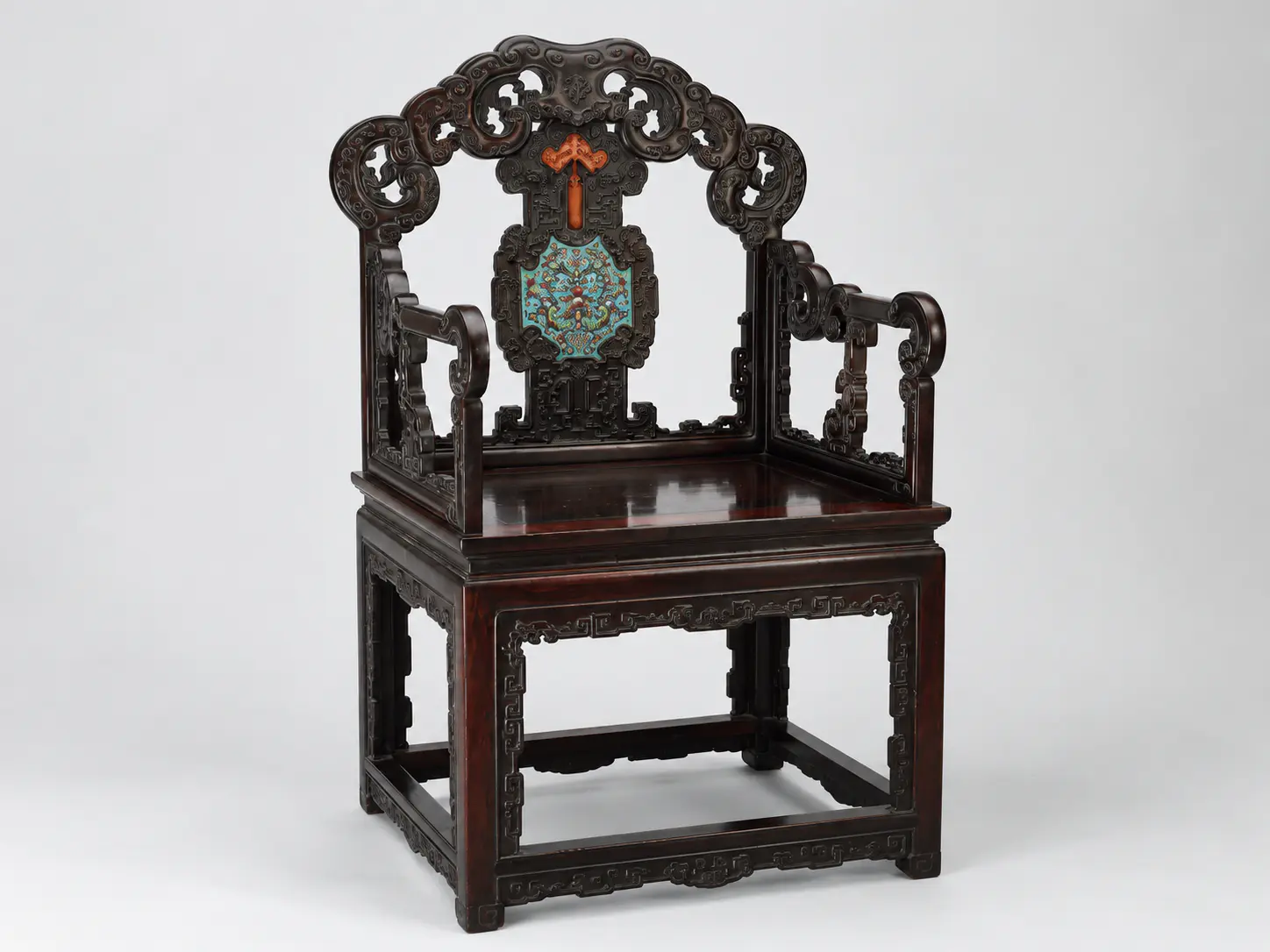
*An ornate Chinese armchair combining open carving with a colourful backrest panel.*
Antique Chinese Furniture at a Glance
| Evidence | What it can tell you | What it cannot prove alone |
|---|---|---|
| Form and proportion | Whether the object fits documented historical types | Actual age |
| Wood | Whether the claimed material is plausible | Dynasty/date |
| Joinery | Construction tradition and later alteration | Authenticity by itself |
| Surface and wear | Evidence of use, oxidation and handling | Genuine antiquity |
| Underside/interior | Repairs, replacement members, tool marks, untouched surfaces | Exact date |
| Hardware | Construction history and replacement clues | Age without context |
| Repairs | History of use and intervention | That the whole piece is later |
| Provenance | Ownership history and earlier documentation | Authenticity if records are weak |
| Published comparisons | Whether form/construction matches documented examples | Identity of the exact object |
Authenticity comes from convergence of evidence, not one test.
Authentication should consider form, construction, material, surface, condition, restoration, provenance and documented comparisons together.
Start With the Whole Object
Examination begins with the object as a whole. Specialist auction guidance for Chinese furniture collecting often stresses stepping back first: silhouette, profile, leg splay, arm movement and the planes of cabinet doors. Only after that overall reading does close inspection of joints, wood and underside make sense.
Form and Proportion
Ask whether the overall form corresponds to documented historical furniture; whether proportions are coherent; whether legs, rails, aprons and stretchers relate naturally; whether decoration integrates with construction; and whether one component looks inconsistent with the rest. An authentic old component inserted into a later reconstruction does not make the entire object period.
Correct historical style is necessary for a convincing attribution, but it is not sufficient evidence of age. Modern craftsmen can reproduce classical silhouettes accurately. The traditional Chinese furniture page covers recognition of those silhouettes; this page asks whether the object in front of you supports the age claim attached to that silhouette.
Compare Like With Like
Compare the object with documented museum examples of the same furniture form, not merely anything labeled “Ming furniture.” Yokeback chairs should be compared with documented yokeback chairs; recessed-leg tables with recessed-leg tables; round-corner cabinets with round-corner cabinets; horseshoe-back chairs with horseshoe-back chairs. Look at dimensions, proportions, leg profiles, apron form, rail placement, back splat, joinery logic, hardware and material. Museums with published object records are stronger comparison sources than unsourced dealer images.
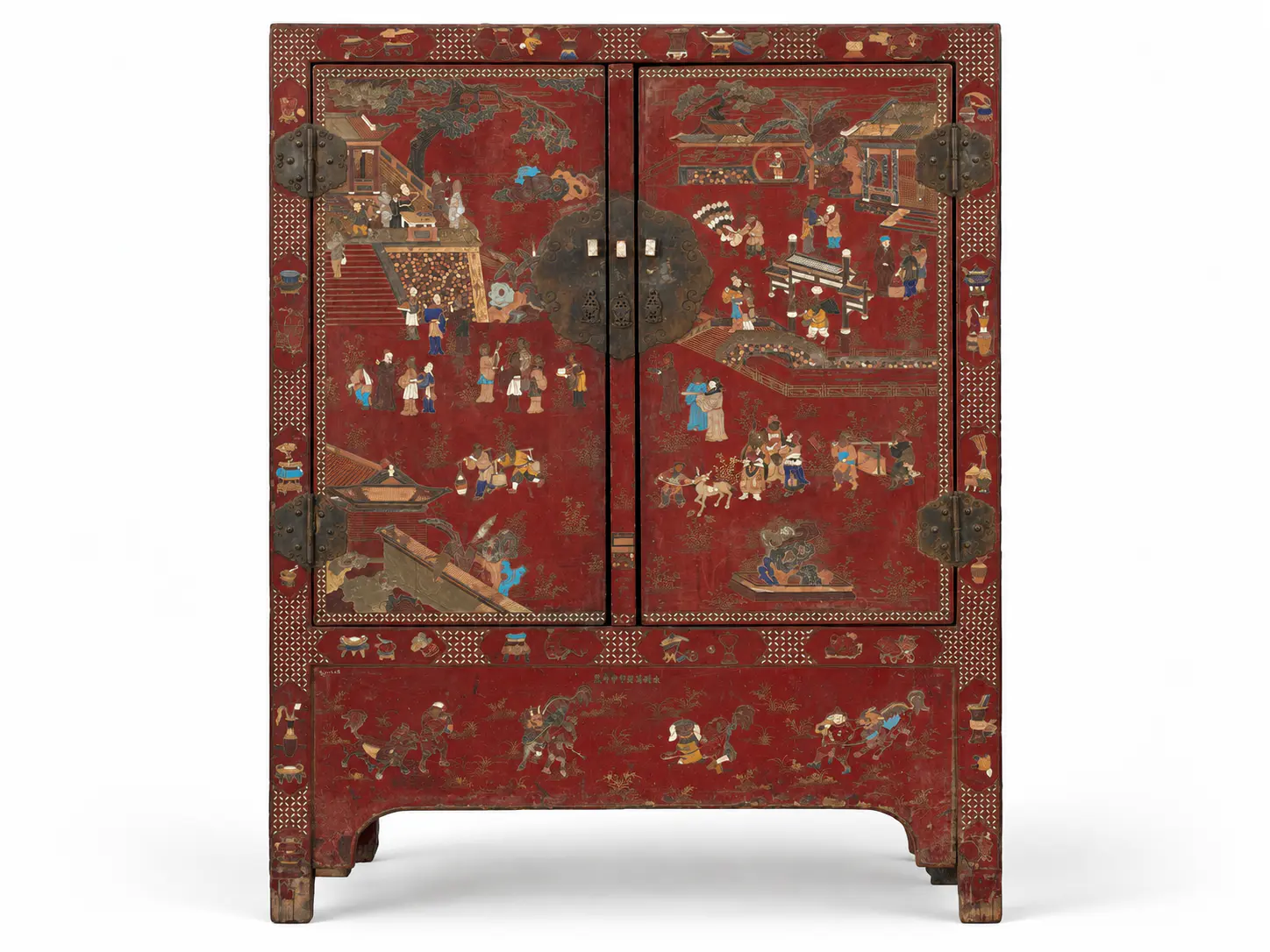
*Wardrobe, late 16th or early 17th century, Ming dynasty, with wood, mother-of-pearl and other inlay. The Metropolitan Museum of Art, Public Domain. Use documented examples of the same form when comparing construction and fittings.*
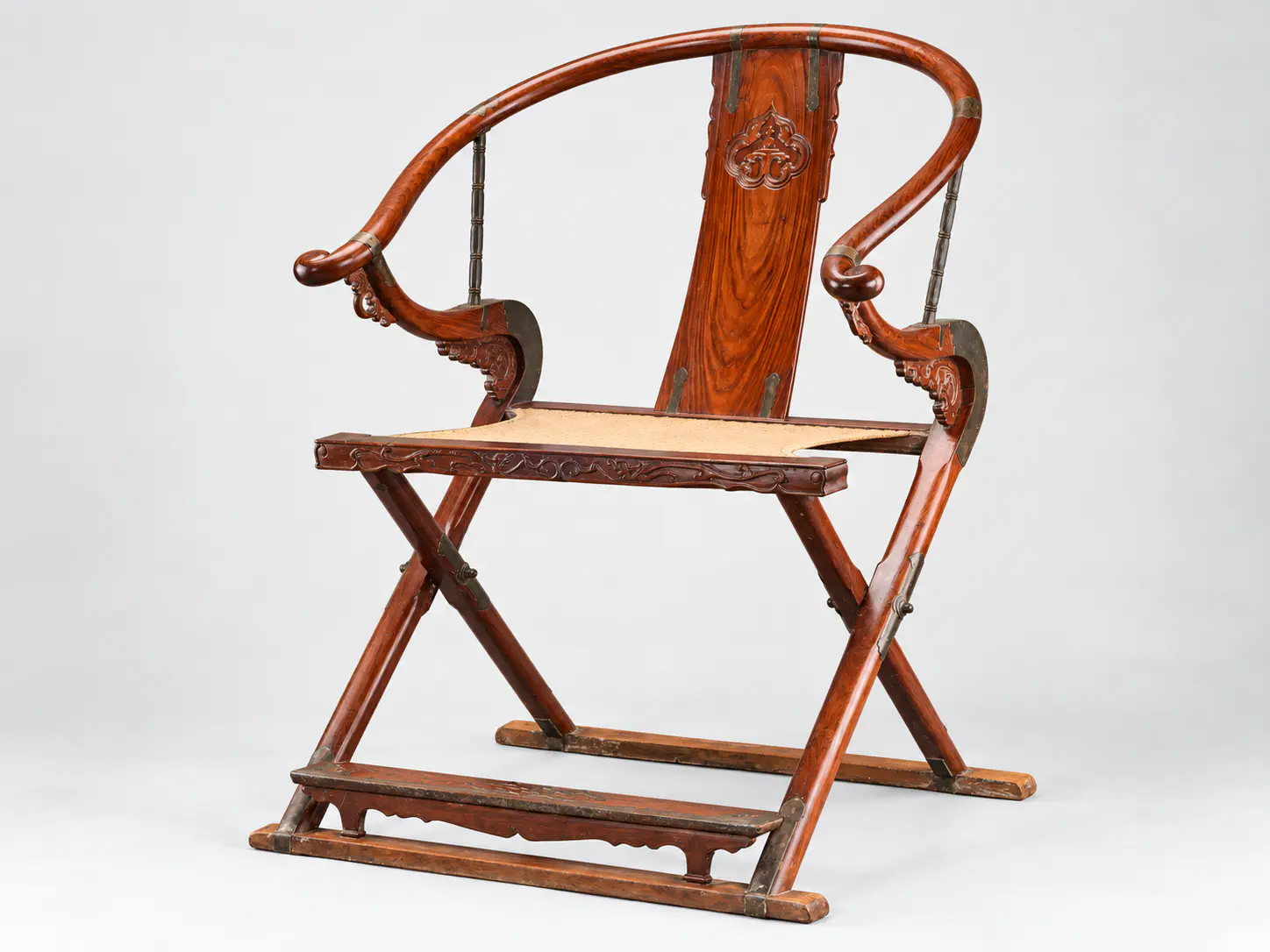
*Huali armchair, Qing dynasty, circa 1700. The Metropolitan Museum of Art, Public Domain. Period attribution depends on documented comparison, not on whether a chair merely “looks old.”*
Examine the Construction
Joinery
Classical Chinese furniture is renowned for sophisticated wooden joinery, especially mortise-and-tenon systems. Traditional joinery is evidence of a construction tradition, not proof of antiquity. Traditional mortise-and-tenon joinery can also be used in modern reproductions.
Look at how joints fit; whether members belong together; later screws or plates; reinforced joints; plugged holes; splices; replacement blocks; changed stretchers; altered feet; and rebuilt seat frames. Metal fasteners may represent repair rather than proving that an entire piece is modern. For the construction systems themselves, see the Chinese furniture joinery guide. Here the goal is to map structure and alteration, not to catalogue every joint type.
Look Underneath
Inspect the underside of tabletops and seat frames, the backs of cabinets, interior surfaces, bottoms of feet, inner faces of drawers, joints not normally visible, and transitions between original and replacement timber. Specialist collecting guidance specifically recommends the underside because repairs may be concealed there. Genuine Chinese furniture was used in daily life, and even important pieces may have patches, repaired legs or arms, and reinforced joints. Untouched or less-visible areas can retain more useful evidence than polished show surfaces—but an underside does not automatically reveal age.
Examine the Wood Carefully
Identify the Material First
Furniture attribution and wood identification are separate questions. A seller claiming a “Ming huanghuali chair” is making at least three claims: furniture form, material and date. Each requires evidence. Material identification and age attribution are separate questions. Identifying Chinese furniture woods requires experience and comparison—including color, grain and weight—and photographs can misrepresent appearance. Home smell, burn or destructive tests are unreliable; do not sand or cut an object to “prove” wood species.
Huanghuali
Huanghuali is botanically associated with *Dalbergia odorifera*. Grain and color vary considerably; surface treatment and oxidation alter appearance further. Color alone is not sufficient to identify huanghuali. A later materials page can treat identification in more depth; for authentication, treat species claims as hypotheses that must fit the rest of the evidence.
Zitan
Zitan is dense, dark and historically important in elite furniture. Material identification should not rely solely on apparent darkness. Dark wood ≠ zitan.
Mixed and Replacement Woods
An old piece may contain replacement stretchers, feet, patches, substituted panels or repaired rails. Examine wood component by component. One visible board cannot classify an entire object.
Surface, Patina and Signs of Use
Natural Wear Has Context
Genuine wear should make sense relative to how an object was handled—chair arms, seat edges, feet, drawer pulls, cabinet handles, edges and tabletop contact areas. Rigid rules such as “genuine antiques always have worn feet” are not decisive. Furniture may have been restored, refinished, carefully stored or heavily used.
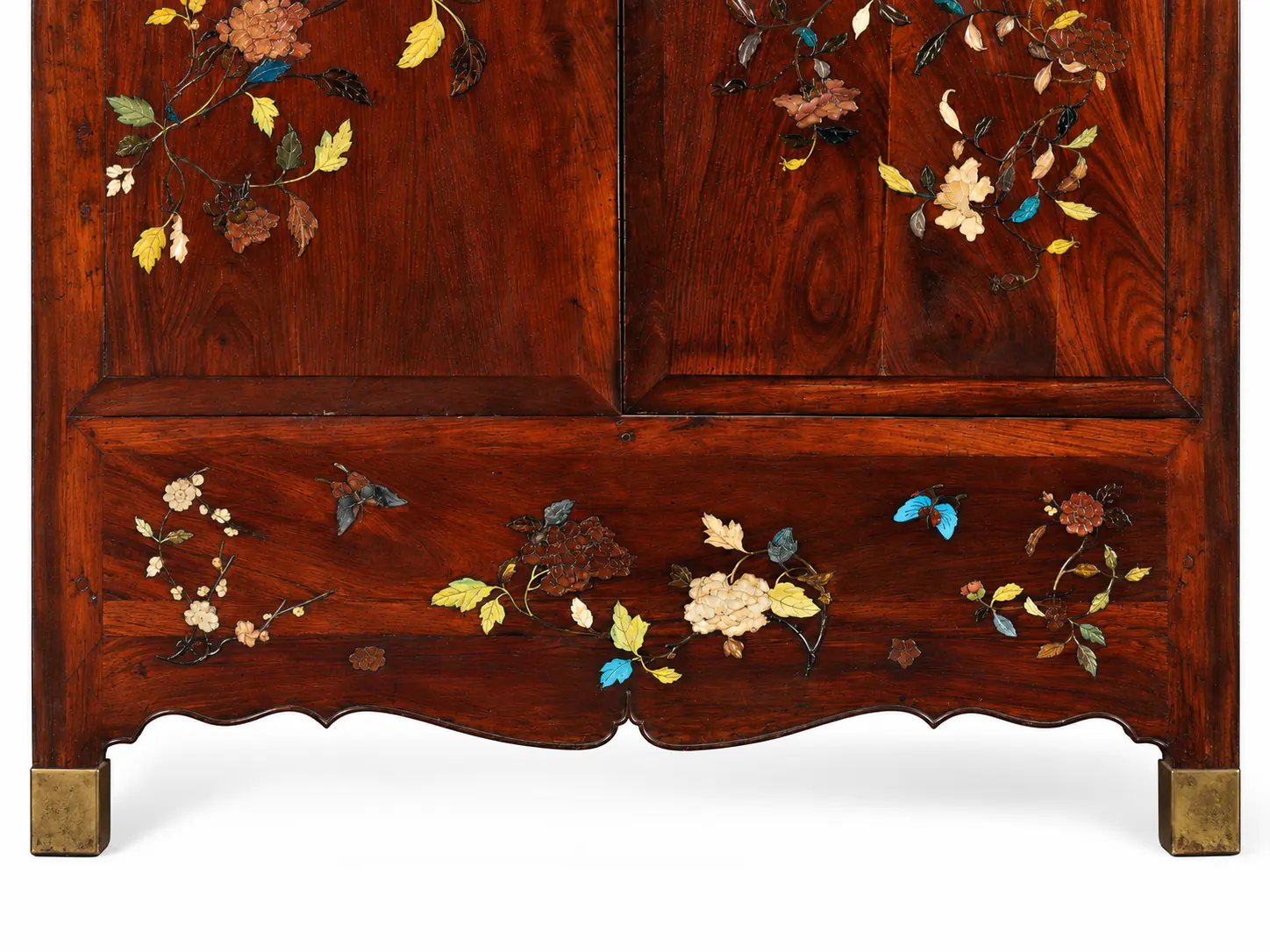
*Colourful floral and bird motifs animate the lower panels of a wooden cabinet.*
Patina Is Not a Single Color
Patina is accumulated surface change—oxidation, handling, polishing, grime, wax, fading, abrasion and previous restoration—not a magic authentication feature. Modern surfaces can be artificially aged. An “old-looking” surface is evidence to investigate, not proof of age.
Over-Refinishing Can Remove Evidence
Aggressive sanding or refinishing can erase wear patterns, tool traces, surface oxidation and finish history. A refinished piece is not automatically fake. Authenticity and condition are separate questions.
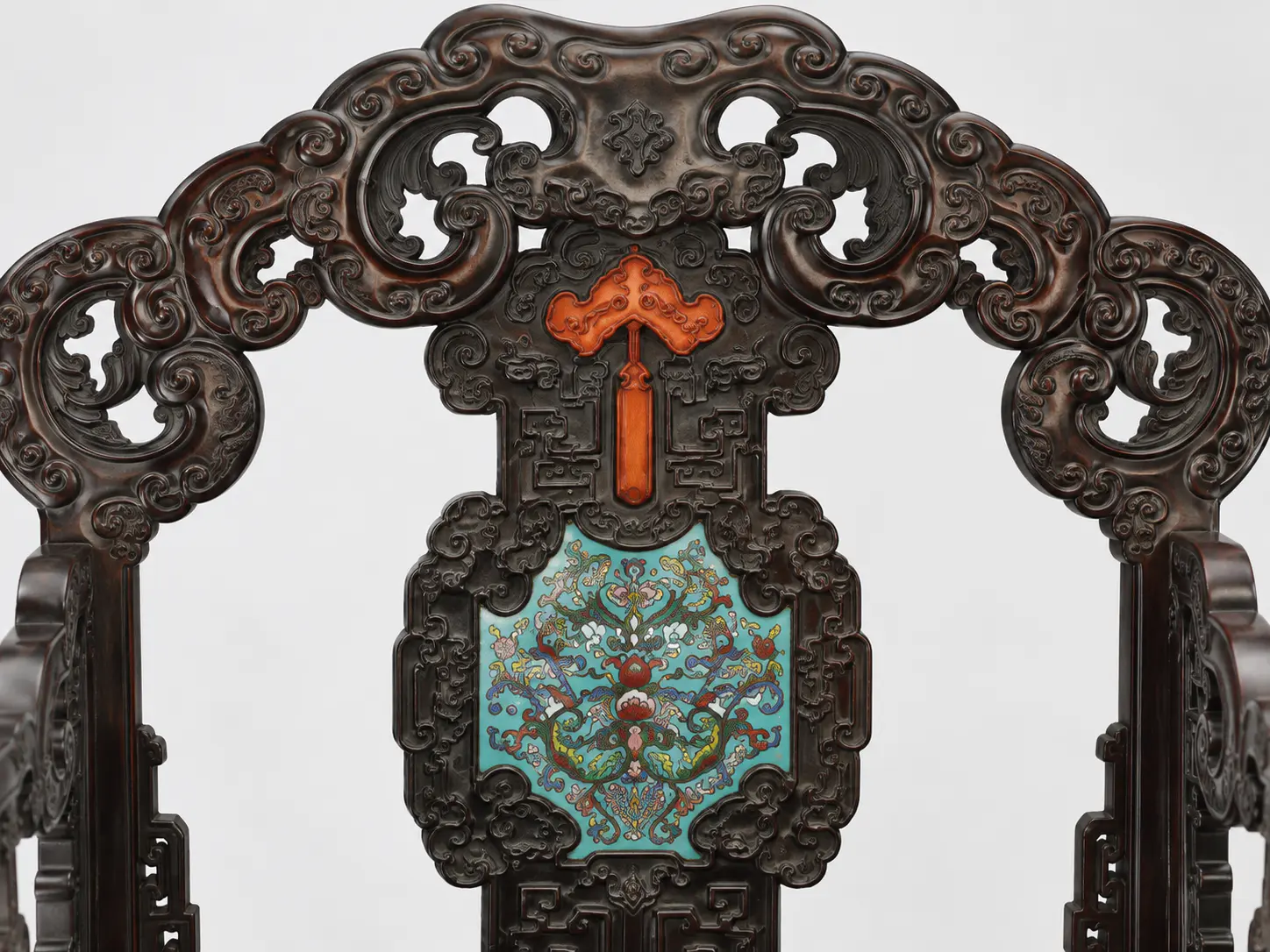
*Carved scrollwork and colourful decorative panels enrich the armchair’s backrest.*
Repairs and Replacement Parts
Documented historical Chinese furniture frequently contains repairs. Specialist auction condition reports for period furniture describe replaced or reattached legs, recarved feet, repaired cracks, replaced braces, reinforced joints, spliced aprons, replaced structural members and general wear. Restoration does not automatically make an object inauthentic. Genuine antique furniture may contain repairs and replacement components.
Ask instead: How much is original? Which components were replaced? Are replacements sympathetic? Has the form been materially altered? Does the attribution still apply to the surviving original structure?
Authenticity is not the same as untouched condition. A genuinely old chair may be repaired. A pristine-looking chair may be modern.
Hardware and Fittings
Hardware can provide evidence but should not be read in isolation. Inspect hinges, lock plates, pulls, corner fittings, decorative mounts, nail or screw holes and wear around fittings. Does the hardware fit naturally? Are there unused holes suggesting earlier fittings? Are screws obviously later replacements? Does hardware wear correspond to surrounding wood? Has hardware been moved?
Chinese furniture hardware varied considerably and fittings were often replaced. Avoid simplistic “old screw versus new screw” dating rules.
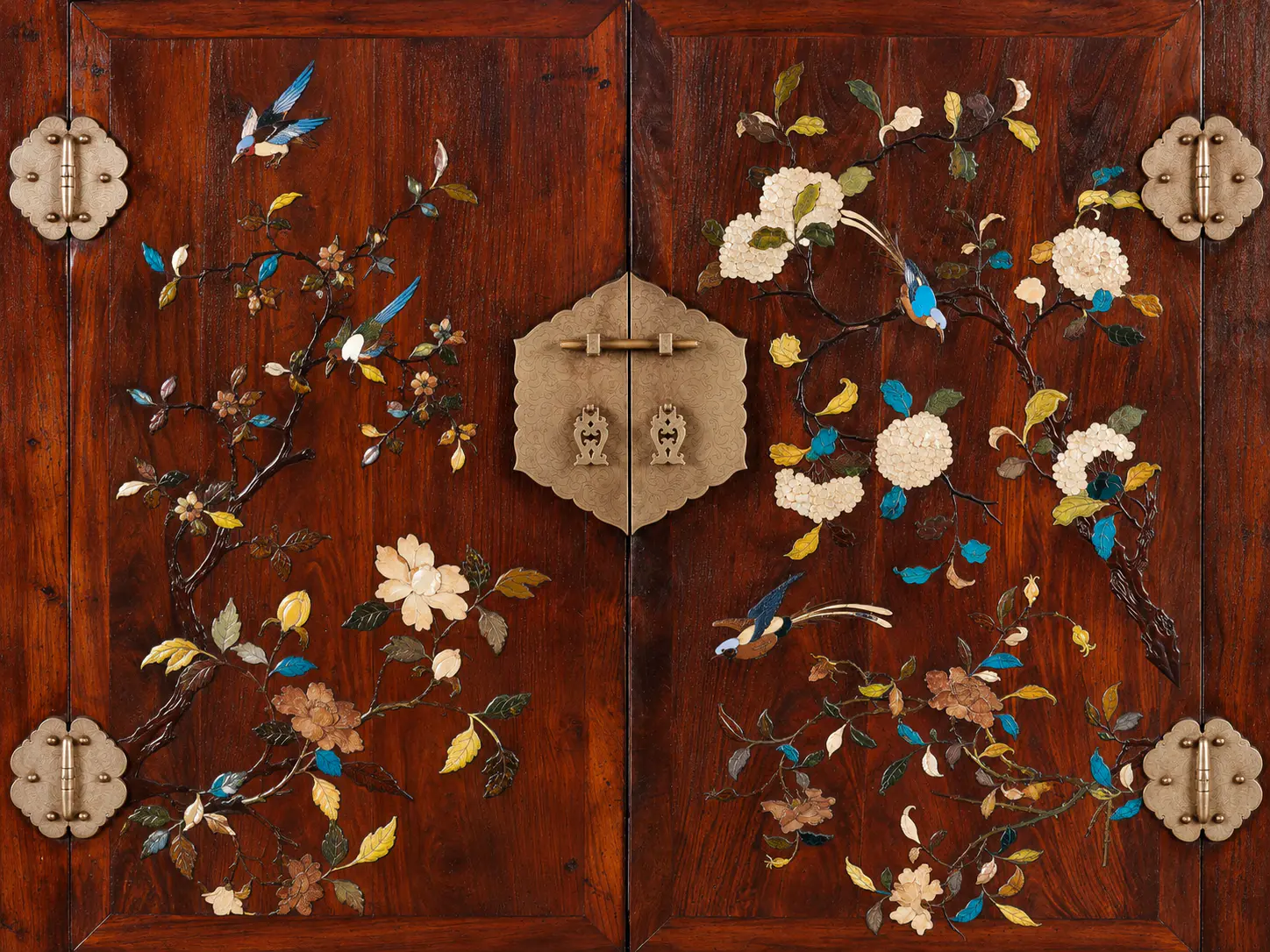
*Floral inlay and shaped metal fittings decorate the paired cabinet doors.*
Tool Marks and Workmanship
Less-visible surfaces may preserve saw traces, plane marks, chisel work, hand finishing and construction irregularities. Hand-tool marks do not prove age. Modern traditional workshops use hand tools. Machine-perfect surfaces can raise questions, but machine work on a repaired component does not necessarily make an entire object modern.
Provenance and Documentation
Provenance means the documented ownership history of an object. Useful evidence can include dated invoices, old collection labels, exhibition records, auction catalogues, published collections, old photographs, museum loans, dealer records and estate documentation. A continuous, credible ownership history can materially strengthen an attribution.
A story is not provenance. A handwritten label alone is not proof. An old receipt may describe the object incorrectly. Copied documentation exists. Cross-check documentation against the physical object. Published furniture scholarship and auction records often list prior collections, sales and literature precisely because provenance is part of object research—not a substitute for physical examination.
Ming, Qing, Antique, Vintage or Reproduction?
| Term | Meaning |
|---|---|
| Ming dynasty furniture | Furniture attributed to the Ming dynasty, 1368–1644 |
| Qing dynasty furniture | Furniture attributed to the Qing dynasty, 1644–1911 |
| Antique Chinese furniture | Older furniture; exact commercial/legal definitions of “antique” can vary by context |
| Vintage Chinese furniture | Informal market term, usually newer than major classical-period antiques |
| Ming-style furniture | Furniture using Ming-derived forms; may be old or modern |
| Qing-style furniture | Furniture using Qing-derived forms; may be old or modern |
| Reproduction | Later furniture intentionally based on an earlier historical design |
| Composite/restored furniture | Object containing a mixture of original and replaced/restored components |
Ming-style furniture is not necessarily Ming dynasty furniture.
Huanghuali does not automatically mean Ming dynasty.
Traditional joinery does not automatically mean antique.
Ming-style does not mean Ming dynasty. Huanghuali does not automatically mean Ming dynasty. Traditional joinery does not automatically mean antique.
A Practical Inspection Sequence
This is an ordered framework for examination—not a DIY certification checklist.
1. Identify the furniture form
Chair, table, cabinet, couch, screen and related types.
2. Compare the proportions
Use documented museum examples of the same form.
3. Examine visible construction
Understand how members join and whether they belong together.
4. Inspect underside and interior
Look for repairs, replacements and less-altered surfaces.
5. Assess the wood
Treat material identification as its own question.
6. Examine surface and wear
Ask whether wear is coherent with use and handling.
7. Examine hardware
Look for replacement or relocation evidence.
8. Map restoration
Identify what is original and what is later.
9. Check provenance
Ask for documentary evidence and cross-check it against the object.
10. Seek independent specialist examination for valuable purchases
The final step matters when price, rare materials or dynasty claims are material.
Common Red Flags — and Why None Is Conclusive Alone
| Observation | Why investigate |
|---|---|
| Seller relies only on “old appearance” | Artificial aging is possible |
| Dynasty claim but no comparable documented form | Attribution may be marketing-driven |
| Wood species asserted only from color | Color is unreliable |
| Extensive unexplained replacements | Originality may be limited |
| Inconsistent wear | Components may have different histories |
| Fresh tool marks in supposedly untouched areas | May indicate recent work |
| Modern hardware hidden underneath | Could indicate restoration or later construction |
| Provenance is only verbal | Difficult to verify |
| Seller refuses underside/interior inspection | Important evidence is unavailable |
| Price depends heavily on rare wood but material is unverified | Material identification materially affects value |
If you see any of these, investigate further. None of them, alone, proves that a piece is fake.
What Not to Use as an Authentication Test
Color alone; smell alone; weight alone; one joint; one old-looking screw; visible cracks; worm holes; “patina”; a seller story; style; one photograph; or an AI image-identification result cannot authenticate furniture by themselves.
Avoid damaging furniture by sanding, drilling, burning or chemically testing it. Any scientific material testing should be performed by an appropriate professional where justified.
When to Get a Specialist Opinion
Seek specialist examination when price is significant; the seller claims a Ming or early Qing date; huanghuali or zitan materially affects price; restoration is extensive; export or import is involved; provenance is unclear; the object combines several materials; or attribution affects insurance or resale.
Possible specialists include Chinese furniture specialists, Asian-art appraisers, furniture conservators, specialist auction-house departments and museum-trained furniture scholars where accessible. DragonTrail does not authenticate furniture; this guide is educational.
Travelers interested in historic furniture can examine documented museum collections in Beijing before shopping. Museum comparison should precede shopping advice. Related craftsmanship context appears in Chinese architecture, traditional Chinese houses and siheyuan guides.
Chinese Antique Furniture FAQ
How can you tell if Chinese furniture is antique?
No single feature can authenticate Chinese antique furniture. Specialists weigh form, construction, material, surface, condition, restoration, provenance and comparison with documented examples together. Convergence of evidence supports an informed judgment; one “test” does not.
Is mortise-and-tenon furniture always antique?
No. Traditional mortise-and-tenon joinery can also be used in modern reproductions. Joinery shows a construction tradition, not automatic antiquity.
How can you tell if furniture is huanghuali?
Wood identification requires experience and comparison. Color and photographs alone are unreliable. Material identification and age attribution remain separate questions.
Does patina prove furniture is old?
No. Patina is accumulated surface change and can be imitated. An old-looking surface is something to investigate, not proof of age.
Do repairs reduce the authenticity of antique Chinese furniture?
Not automatically. Age and authenticity, originality and condition are related but distinct. Genuine antique furniture may contain repairs and replacement components; a pristine surface may still be modern.
Is Ming-style furniture actually from the Ming dynasty?
No. Ming-style furniture is not necessarily Ming dynasty furniture. Style describes form language; dynasty describes a period attribution that needs further evidence.
Are cracks a sign that Chinese furniture is antique?
No. Wood movement, climate change, structural stress and later damage can all produce cracks. Cracks are not an age certificate.
What should I ask before buying antique Chinese furniture?
Ask about condition, restoration map, material identification basis, provenance documents, the basis of any dynasty attribution and comparable documented examples of the same form. Request underside and interior inspection when possible.
Can Chinese antique furniture be authenticated from photos?
Generally not conclusively. Photographs help preliminary questions but cannot replace physical examination—especially of underside, interiors, joinery and material—for valuable pieces.