
“Chinese rosewood furniture” is a convenient English phrase, but it can hide important differences between materials. Huanghuali, zitan and the modern Chinese category hongmu are related to the history and market of fine Chinese hardwood furniture, but they are not interchangeable terms. Readers who treat rosewood, hongmu, huanghuali and zitan as synonyms quickly lose the distinctions museums, forestry authorities and furniture specialists rely on. Understanding these terms requires separating historical furniture names, modern botanical identification and today’s standardized hongmu classification. For design language, see traditional Chinese furniture; for age and authenticity questions, see Chinese antique furniture; for the cluster overview, start at the Chinese furniture hub.
| Term | What it means |
|---|---|
| Rosewood | Broad English common/trade term used inconsistently for several dense tropical hardwoods |
| Huanghuali | Historical Chinese furniture wood strongly associated today with *Dalbergia odorifera* |
| Zitan | Historical Chinese precious hardwood term; important classical and imperial examples are associated with purple sandalwood / red sandalwood materials |
| Huali | Historical hardwood term broader or different from huanghuali depending on period and source |
| Hongmu | Modern Chinese standardized category covering multiple qualifying hardwood species; not one species |
These terms are not interchangeable synonyms. Historical furniture language and the modern national standard belong to different contexts: people in the Ming dynasty were not using today’s GB/T hongmu checklist.
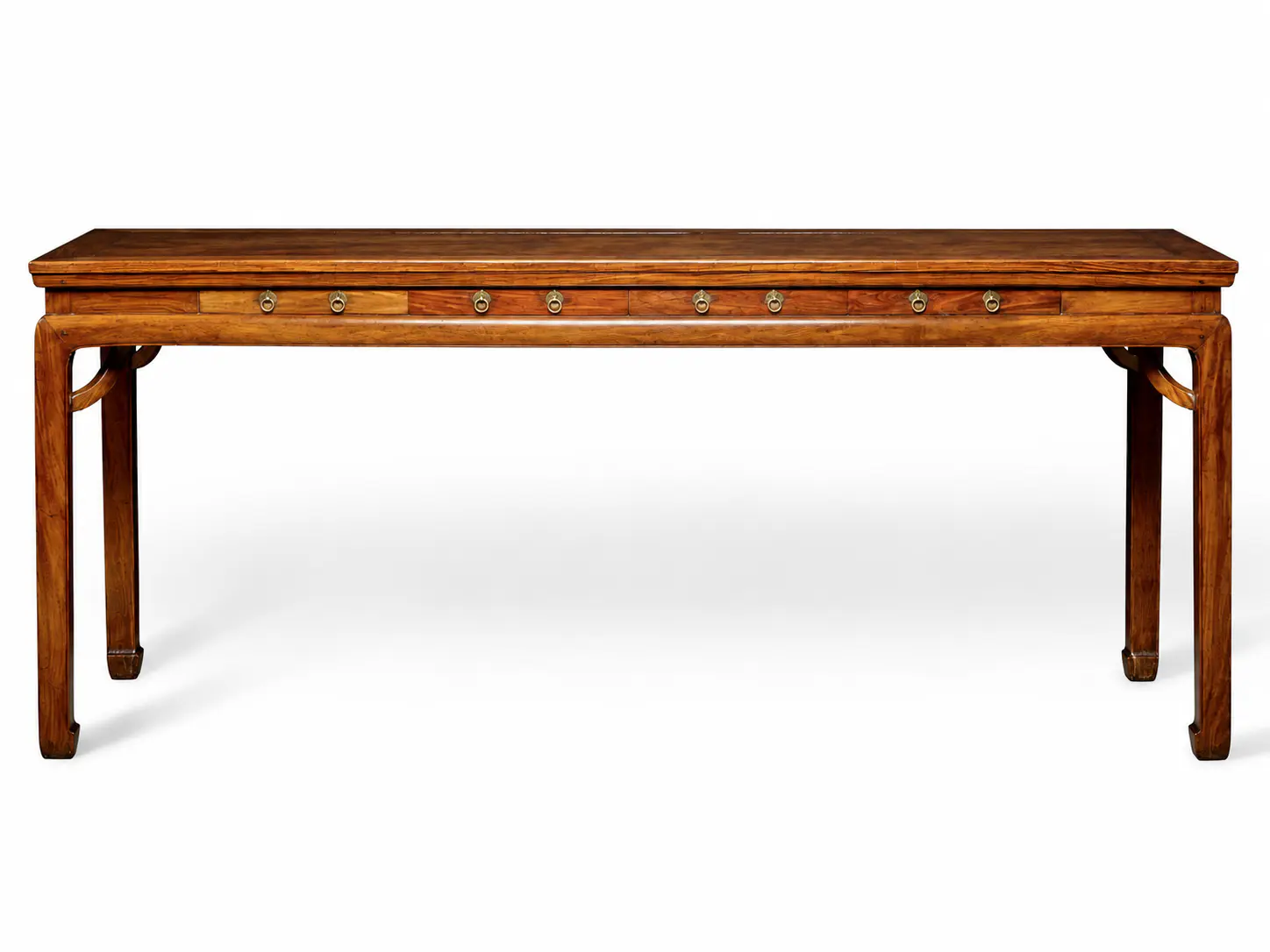
*A long side table with restrained proportions, everted ends and carved corner brackets.*
Chinese Furniture Woods at a Glance
| Material / term | Typical identification | Historical association | General appearance |
|---|---|---|---|
| Huanghuali | Commonly identified as *Dalbergia odorifera* | Particularly important in Ming and early Qing classical furniture | Golden-brown to reddish-brown; often highly expressive grain |
| Zitan | Historically prized dense purple/dark hardwood; modern Chinese terminology strongly associates 檀香紫檀 with *Pterocarpus santalinus* | Elite and especially Qing imperial furniture | Dark purple-brown to nearly black with fine texture |
| Huali | Historical hardwood term requiring contextual interpretation | Ming/Qing furniture catalogues | Varies by source and object |
| Hongmu | Modern standardized family of qualifying woods | Modern furniture/material classification | Many colors and species; not necessarily red |
Color ranges vary because wood changes with age, finish, oxidation, lighting and photography. Color alone cannot identify a species.
Huanghuali: The Signature Wood of Classical Chinese Furniture
What Is Huanghuali?
Today, huanghuali is generally associated with *Dalbergia odorifera*, the botanical identification used by institutions such as The Metropolitan Museum of Art and Chinese forestry authorities. The Met labels documented furniture as huanghuali (*Dalbergia odorifera*). China’s National Forestry and Grassland Administration lists 降香黄檀 (*Dalbergia odorifera*) with Chinese names including 黄花梨 and 香枝木.
That does not mean every historical object ever called huanghuali has been botanically tested as *Dalbergia odorifera*. Catalogue language, market language and laboratory identification remain separate layers of evidence.
What Does Huanghuali Look Like?
Visual tendencies include yellow-brown, honey or amber tones, reddish-brown areas, darker streaks and dramatic swirling grain. Collectors sometimes discuss figurative patterns under names such as “ghost face” or “ghost-eye” grain—but not all huanghuali shows them, and photographs exaggerate or flatten the same board.
Grain or color alone cannot authenticate huanghuali. Polish, oxidation, lighting and individual trees create substantial variation.
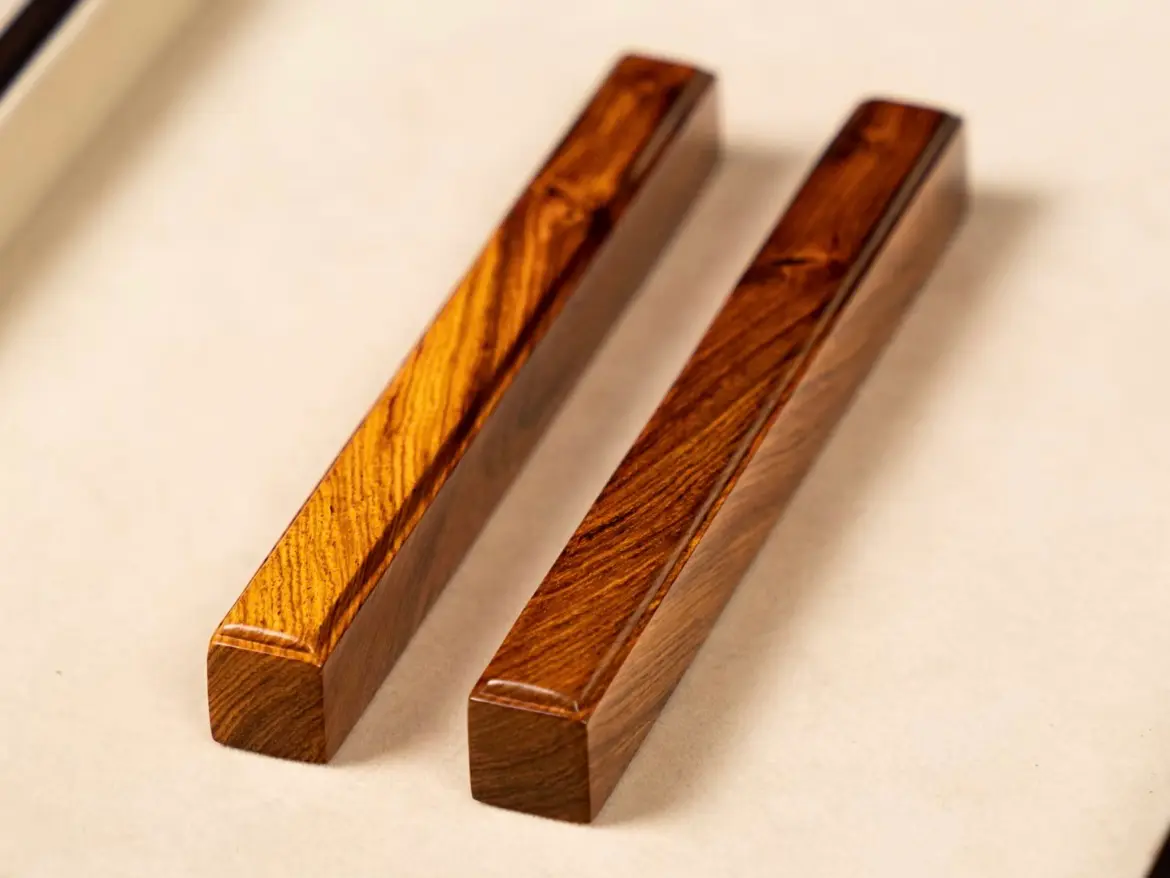
*A close detail showing variations in colour and grain across polished furniture wood.*
Why Huanghuali Worked So Well for Furniture
Huanghuali is strong enough for relatively slender structural members, takes a smooth polish, and often supplies visual decoration through grain rather than dense carving. Those material qualities align especially well with classical hardwood furniture that emphasizes line, proportion and visible structure—tendencies discussed in the traditional Chinese furniture guide.
Huanghuali became one of the materials most strongly associated with surviving elite Ming and early Qing hardwood furniture. It was never the only wood used. Ordinary households and many workshops relied on other hardwoods, softwoods, bamboo and lacquered timber.
Huanghuali and Ming Furniture
Documented museum examples include painting tables, side tables, yokeback chairs, cabinets, couches and stools. Large uninterrupted polished surfaces make grain part of the composition: aprons, legs and panels remain readable while the wood itself carries optical interest.
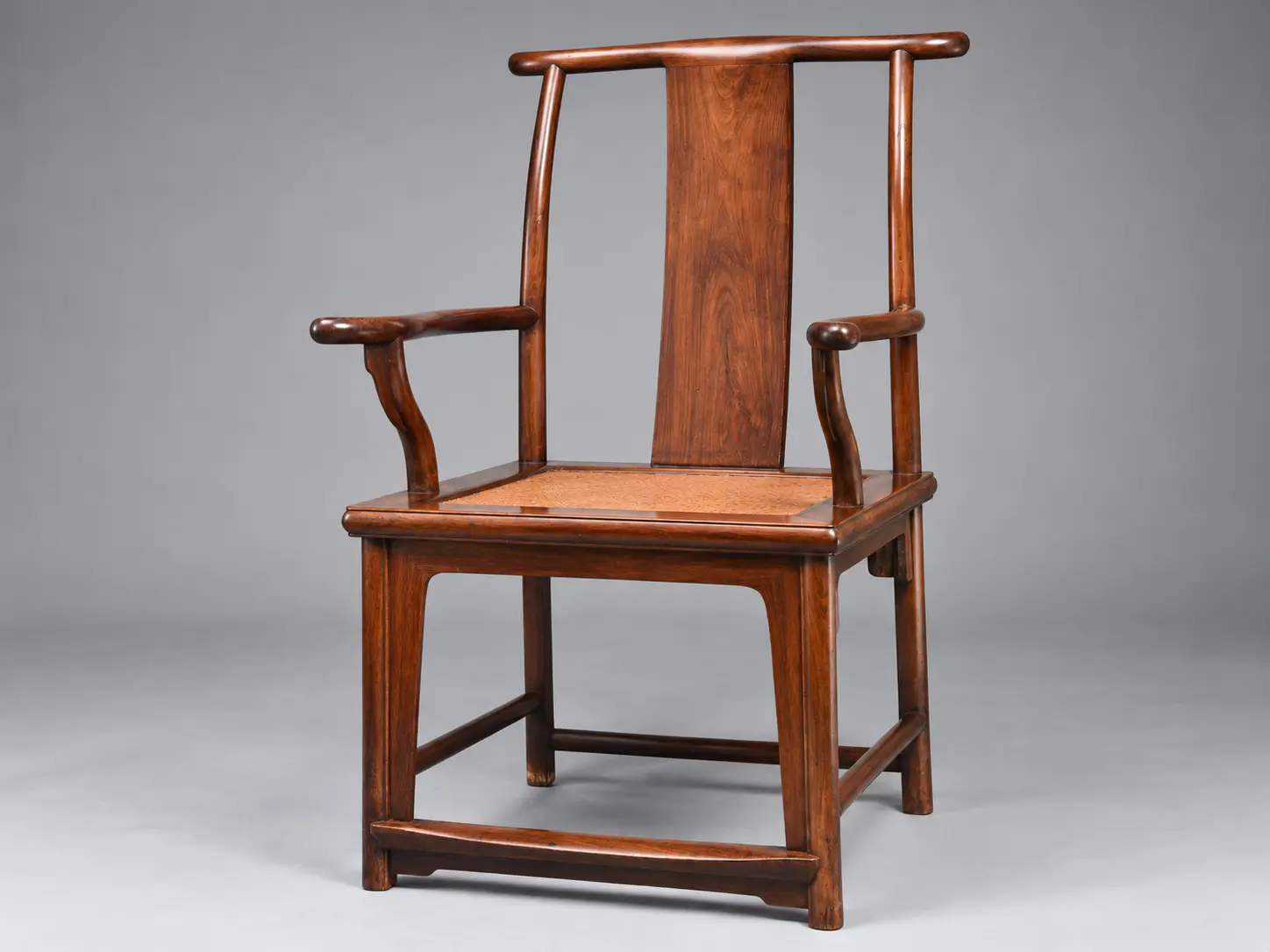
*A yokeback armchair distinguished by its tall back splat and open wooden frame.*
Why is huanghuali associated with Ming furniture? Surviving elite hardwood sets often preserve huanghuali chairs and tables whose proportions suit Ming-associated design taste. Association is not exclusivity: later workshops continued using related hardwoods, and Ming-period furniture also used other materials.
Zitan: Dense, Dark and Closely Associated With Imperial Furniture
What Is Zitan?
Zitan is the historical Chinese term associated with exceptionally dense, dark precious hardwood. The Metropolitan Museum of Art describes documented classical pieces as purple sandalwood (zitan). In modern Chinese botanical and hongmu terminology, *Pterocarpus santalinus* is classified as 檀香紫檀.
Not every historical object described as zitan has been scientifically identified as *Pterocarpus santalinus*. Historical naming and modern botanical placement should stay carefully separated.
What Does Zitan Look Like?
Typical tendencies include very dense structure, fine texture, deep red-purple when freshly worked, darkening toward purple-brown or near-black, relatively subdued grain compared with highly figured huanghuali, and a surface that can take intricate carving.
Dark color alone does not identify zitan. Smell, floating/sinking, scraping, burning or chemical home tests are unreliable and can damage objects.
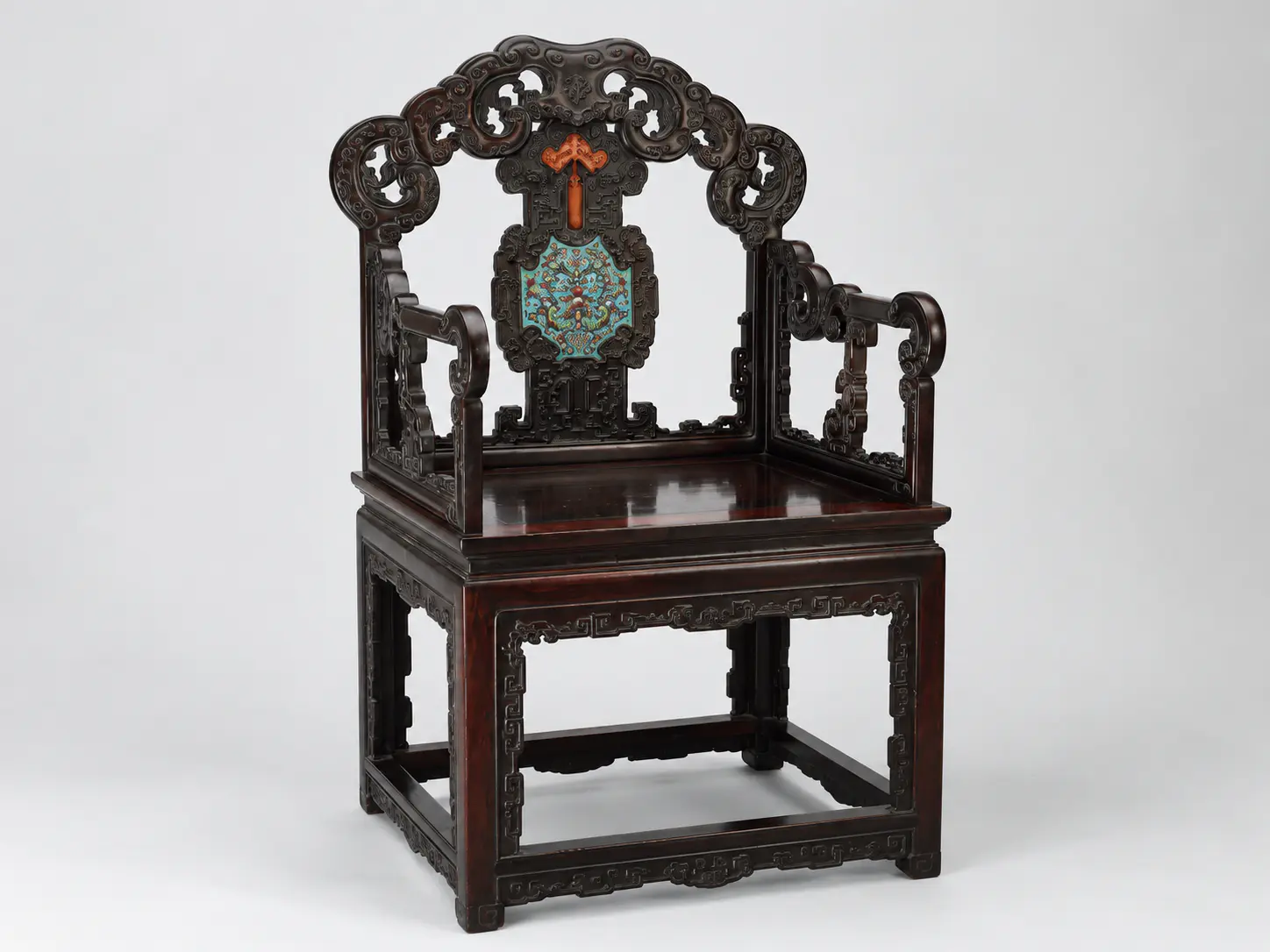
*Zitan armchair, 17th century, late Ming–early Qing period. The Metropolitan Museum of Art, Public Domain.*
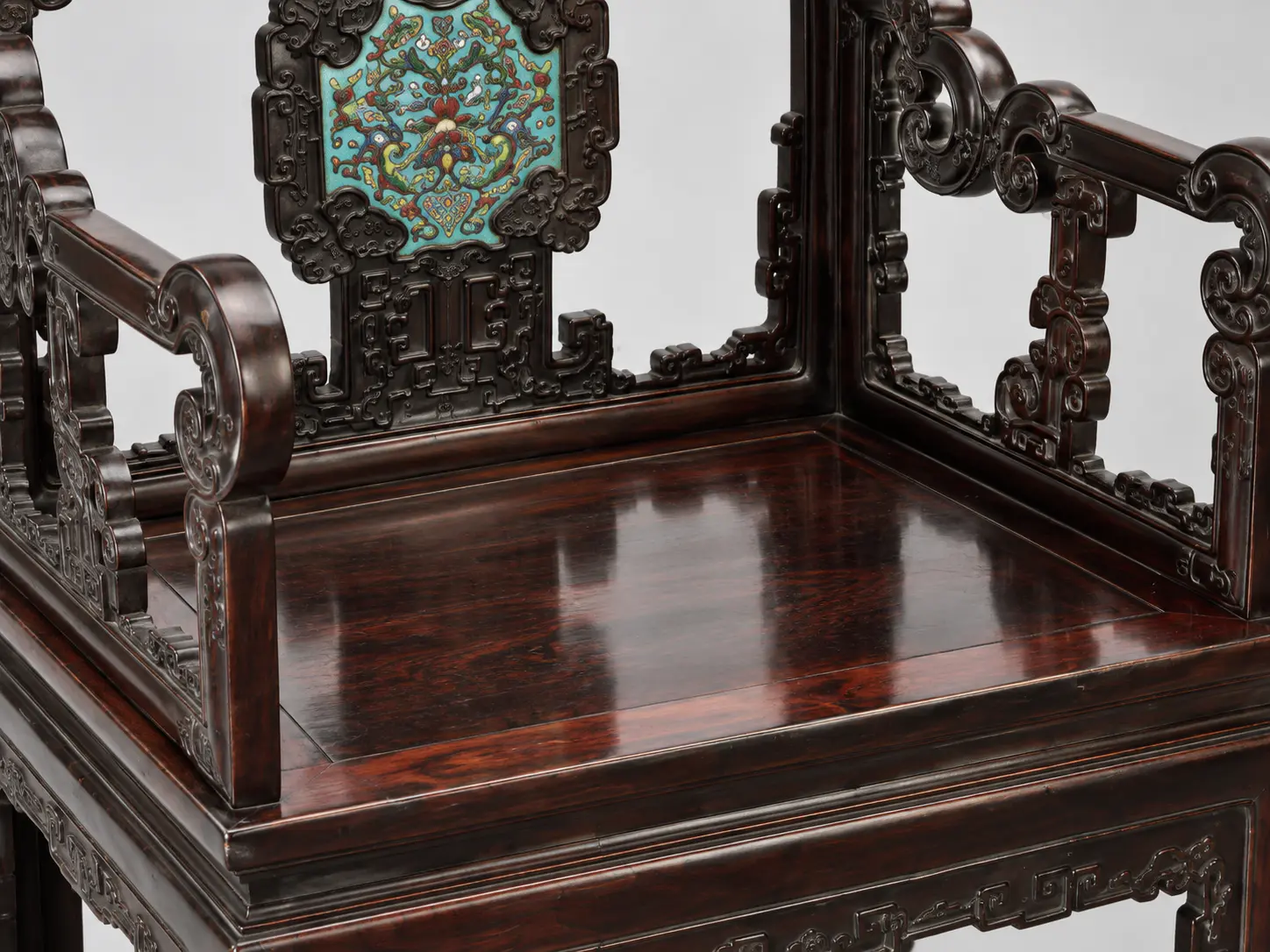
*The close view highlights the polished seat and densely carved surrounding frame.*
Why Zitan Became Important in Qing Furniture
Dense zitan supports carving, relief decoration, substantial members and highly finished surfaces—qualities that suit many Qing court programmes. The Palace Museum Furniture Gallery presents important hardwood furniture including zitan, huali and hongmu, and its Qing imperial holdings illustrate expensive materials and advanced craftsmanship, especially around the Qianlong period.
Avoid the rigid rule “Ming = huanghuali, Qing = zitan.” Materials overlapped across periods. Zitan appears in late Ming and early Qing objects; huanghuali continued after the Ming dynasty.
Huali, Huanghuali and the Problem of Historical Names
Historical wood names evolved. `huali` is not automatically the same as huanghuali, and huali does not map to one modern species. The Palace Museum distinguishes hardwood terminology including zitan, huali and hongmu. The Met separately labels some objects “hardwood (huali)” and others “huanghuali (*Dalbergia odorifera*).”
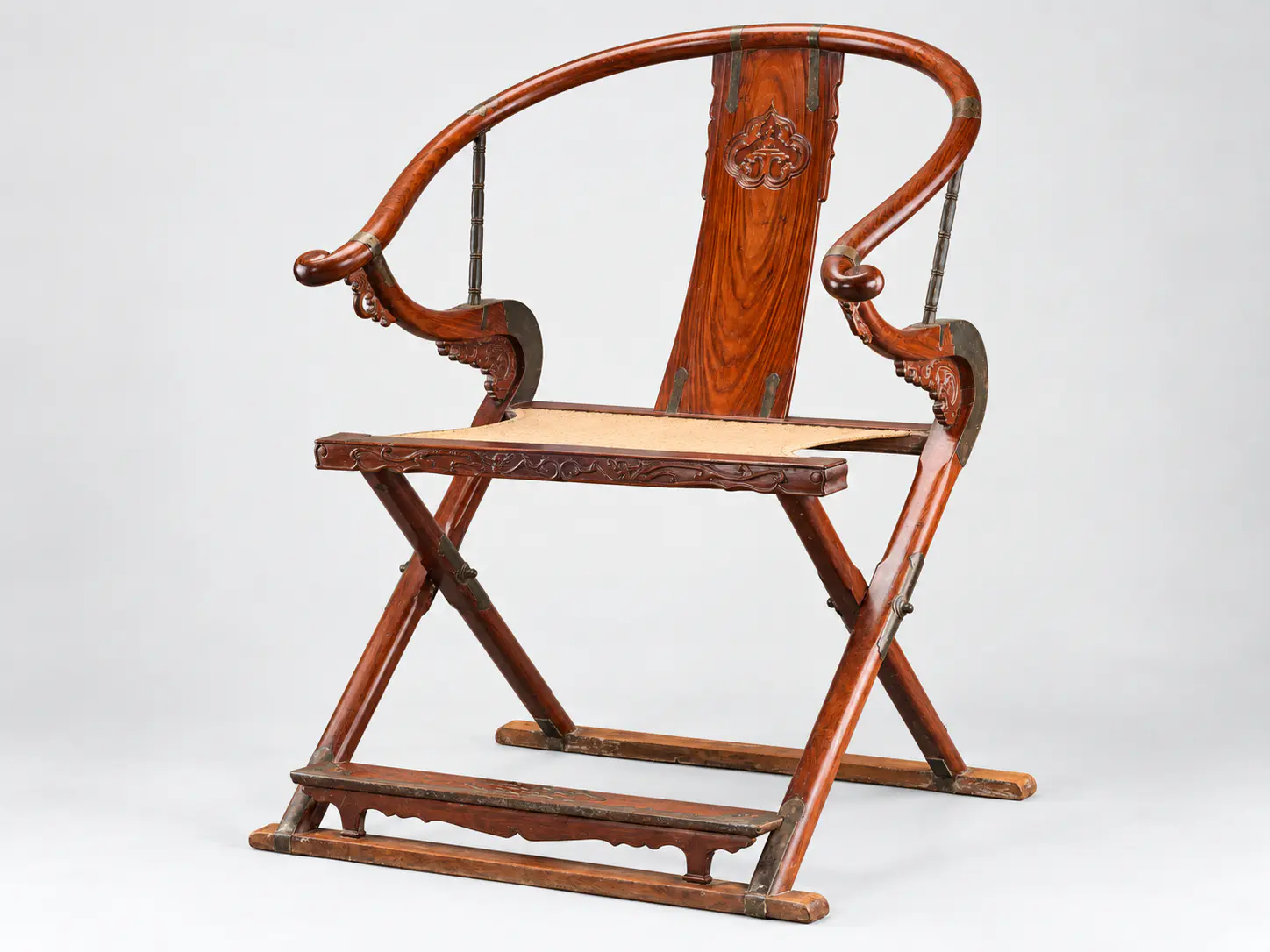
*A folding armchair combining curved supports with a tall central back splat.*
Practical reader rule: if a museum catalogue says huali, retain huali rather than rewriting it as huanghuali. Use huanghuali / *Dalbergia odorifera* only when the source specifically identifies that more precise pairing.
What Does Hongmu Actually Mean?
Hongmu Is Not One Species
In modern China, *hongmu* is a technical classification, not simply the Chinese translation of the English color word “red wood.” A wood does not become hongmu simply because it is reddish, dark, dense or expensive.
Hongmu is not a single species of wood. China’s current national standard GB/T 18107-2017 — Hongmu (红木) was published on 29 December 2017, became effective on 1 July 2018, replaced GB/T 18107-2000, and remains in force. Official public-service records show a further review on 8 December 2025 with the conclusion that the standard remains valid. The current system covers 5 genera → 8 groups → 29 species.
Asking “what species is hongmu?” is like asking for one species from a category containing multiple woods. Some English writers translate hongmu loosely as “rosewood,” but the standardized category is broader and includes several groups of dense decorative hardwoods. Hongmu is not simply “Chinese rosewood” without qualification.
The Eight Hongmu Groups
GB/T 18107-2017 organizes qualifying woods into eight Chinese groups. Exact English trade names vary, so the useful presentation is Chinese group name plus context—not a pretend one-to-one Western label:
| Chinese group | Pinyin (approx.) | Role in the standard |
|---|---|---|
| 紫檀木类 | zitanmu lei | Includes woods classed under the zitan-wood group |
| 花梨木类 | hualimu lei | Includes woods classed under the huali-wood group |
| 香枝木类 | xiangzhimu lei | Includes the fragrant-branch / xiangzhi group |
| 黑酸枝木类 | heisuanzhimu lei | Black suanzhi / black rosewood-type group |
| 红酸枝木类 | hongsuanzhimu lei | Red suanzhi / red rosewood-type group |
| 乌木类 | wumu lei | Ebony-type group |
| 条纹乌木类 | tiaowen wumu lei | Striped ebony-type group |
| 鸡翅木类 | jichimu lei | Chicken-wing wood group |
These are category labels inside a modern product standard, not Ming-dynasty workshop vocabulary. Retail “hongmu lists” that omit the eight-group structure, invent English species nicknames or treat every dark board as zitan should be treated with caution. Prefer the national standard wording and museum catalogue language over marketing glossaries.
Huanghuali Within Modern Hongmu Classification
*Dalbergia odorifera* / 降香黄檀 is included in the modern hongmu framework under the 香枝木 category. Huanghuali can therefore fall within modern hongmu classification, but huanghuali ≠ all hongmu. Think of a set relationship: huanghuali is one specific material inside a broader modern umbrella—not a synonym for the whole category.
Zitan Within Modern Hongmu Classification
*Pterocarpus santalinus* / 檀香紫檀 appears within the modern hongmu framework under 紫檀木类. Again: zitan-associated material is part of broader hongmu classification; zitan is not “all hongmu.”
Huanghuali vs Zitan
| Feature | Huanghuali | Zitan |
|---|---|---|
| Common modern botanical association | *Dalbergia odorifera* | *Pterocarpus santalinus* in modern Chinese terminology |
| General color | Golden/honey to reddish brown | Deep reddish-purple to very dark purple-brown |
| Grain | Often prominent and expressive | Usually finer and visually quieter |
| Density | Dense hardwood | Exceptionally dense |
| Historical association | Particularly famous in Ming/early Qing classical hardwood furniture | Especially prominent in high-status Qing/imperial furniture |
| Decorative strength | Grain often provides visual decoration | Dense wood supports detailed carving |
| Identification | Cannot be confirmed from color/grain alone | Cannot be confirmed from darkness/density alone |
Huanghuali and zitan are not interchangeable. These are general material tendencies, not authentication tests.
Rosewood Is a Translation Problem
English “rosewood” is a common/trade name rather than a single universally consistent botanical category. Depending on the source, a writer may call different *Dalbergia* or related tropical hardwoods “rosewood.”
“Rosewood” is less precise than a botanical species name. When researching Chinese furniture, the botanical name is usually more useful than the English word “rosewood.”
Useful hierarchy:
- Best: botanical species name
- Useful: precise Chinese wood term
- Contextual: historical catalogue terminology
- Least precise: generic English “rosewood”
Historical cataloguers did not always know exact botanical species. They often worked with workshop language, trade names and visual comparison.
Can You Identify Chinese Rosewood by Eye?
Not reliably at species level. Color, grain, pore structure, density and surface character can offer clues, but they overlap between species and change with age and finish. Wood species cannot reliably be authenticated from color alone.
For valuable furniture, identification may involve experienced wood anatomists, microscopic structure, documented provenance and laboratory methods where appropriate. Avoid sanding, drilling, burning or chemically testing furniture at home. Broader evaluation questions—age, repairs, provenance—are covered in the Chinese antique furniture guide.
Conservation and International Trade
Several valuable hardwood species are subject to international conservation and trade controls. Current CITES listings place *Dalbergia* species (including *Dalbergia odorifera* via the genus listing) in Appendix II, and list *Pterocarpus santalinus* in Appendix II under its own annotation. Controls differ by species, product type, source, annotation, country and current regulation.
Anyone planning to export valuable hardwood furniture from China should verify the current rules for the exact species, object, age, origin and destination before purchase or shipment. This page does not provide customs advice and does not claim that every antique huanghuali object always requires—or never requires—a permit.
Where to See Huanghuali and Zitan Furniture in Beijing
Palace Museum Furniture Gallery
The Palace Museum Furniture Gallery holds a major Ming and Qing furniture collection—more than 6,200 pieces or sets in published museum descriptions—including important works in zitan, huali, hongmu, lacquer and other woods. Qing imperial holdings are especially useful for seeing how dense precious hardwoods supported carving and court display.
China Red Sandalwood Museum
Beijing’s China Red Sandalwood Museum focuses on red sandalwood art, traditional and classical Chinese furniture, Ming- and Qing-style furniture, carving and woodworking. It is a practical place to study zitan / red-sandalwood culture in a museum setting rather than in a shop.
Museum comparison should precede shopping advice. Related craftsmanship context continues in Chinese architecture.
Chinese Rosewood Furniture FAQ
What is Chinese rosewood furniture?
It is a broad English description of hardwood furniture associated with Chinese classical materials and markets—not a precise material identification. The same English phrase may point to huanghuali, zitan, other hongmu-group woods or imprecise trade labels.
Is huanghuali a rosewood?
Huanghuali is generally associated today with *Dalbergia odorifera*, a species often called rosewood in English trade language. Botanical terminology is clearer than the word “rosewood,” which is applied inconsistently.
What is zitan wood?
Zitan is a historical Chinese precious-hardwood term for exceptionally dense, dark wood. Modern Chinese terminology associates 檀香紫檀 with *Pterocarpus santalinus*. Historical catalogue use and modern botanical placement should not be collapsed without evidence.
What is hongmu?
Hongmu is a modern Chinese standardized wood classification. China’s current GB/T 18107-2017 Hongmu standard covers 5 genera, 8 groups and 29 species. It is a category, not one tree.
Is hongmu the same as rosewood?
No. Some English sources translate hongmu loosely as rosewood, but the national standard is a multi-species technical category—not a one-word English synonym.
Is huanghuali the same as hongmu?
No. Huanghuali (as *Dalbergia odorifera* / 香枝木) can fall inside the modern hongmu framework, but huanghuali is not the whole of hongmu.
What is the difference between huanghuali and zitan?
They are different materials with different modern botanical associations, typical colors, grain characters and historical prestige patterns. Huanghuali is often linked to expressive golden-to-reddish hardwood surfaces; zitan to denser, darker wood suited to refined carving. Neither can be confirmed from color alone.
How can I tell if Chinese furniture is huanghuali?
Appearance is insufficient for reliable species authentication. Use documented terminology, specialist examination and—where justified—anatomical or laboratory methods. See Chinese antique furniture identification for the broader authenticity framework.
Why is huanghuali furniture associated with the Ming dynasty?
Surviving elite Ming and early Qing hardwood furniture frequently preserves huanghuali chairs and tables whose grain and polish suit classical emphasis on line and proportion. Association is strong in collections; exclusivity is not. Other woods were used in the Ming period, and related hardwoods continued later.
Where can I see huanghuali and zitan furniture in Beijing?
Start with the Palace Museum Furniture Gallery and the China Red Sandalwood Museum for documented material context before considering shops or private sales.