
Traditional Chinese furniture is famous for *sunmao* (榫卯), a family of mortise-and-tenon connections in which projecting wooden tenons fit into corresponding mortises. The system allows legs, rails, aprons, stretchers and panels to function as an integrated structure while keeping much of the engineering visually hidden. Classical furniture uses many variations rather than one universal “Chinese joint,” and the form of each joint depends on the forces and components it must connect. Joinery is the hidden engineering behind the visible form. For the broader craft tradition, start with the parent Chinese furniture guide.
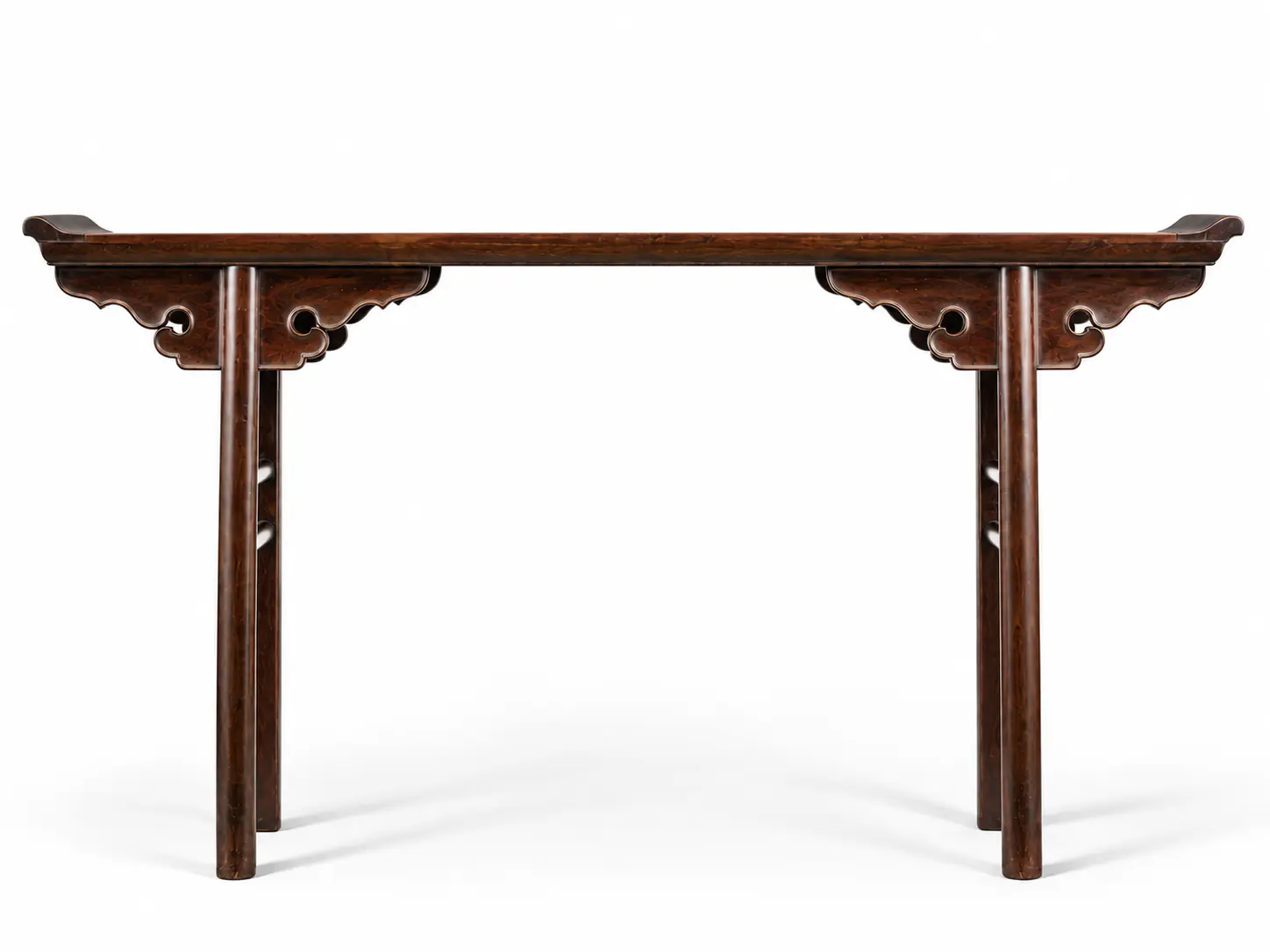
*Everted ends and pierced corner brackets define the table’s upper frame.*
Chinese Furniture Joinery at a Glance
| Component | Structural role |
|---|---|
| Mortise | Recess cut into one wooden member |
| Tenon | Projection shaped to enter the mortise |
| Frame | Joined members forming a rigid perimeter |
| Panel | Broad board held within a frame |
| Apron | Horizontal member below a tabletop or seat |
| Stretcher | Member connecting and stabilizing legs |
| Dovetail | Interlocking joint resisting withdrawal in a particular direction |
| Peg / wedge | Can lock or tighten certain joint configurations |
| Sunmao 榫卯 | Chinese term encompassing mortise-and-tenon connection systems |
There is no single “Chinese mortise-and-tenon joint.” Classical furniture uses many joint configurations designed for different structural problems.
Sunmao (榫卯) is the Chinese term for mortise-and-tenon connection systems based on projecting tenons fitting corresponding mortises. Official China Keywords material from the State Council Information Office describes sunmao as a principal traditional connection system for wooden components in both Chinese furniture and timber architecture. Precisely: 榫 / sǔn is the projecting tenon; 卯 / mǎo is the receiving mortise or recess. After this introduction, this guide uses mortise-and-tenon, sunmao and joinery interchangeably for the same family of connections.
How Mortise-and-Tenon Joinery Works
Mortise and Tenon
One wooden component contains a recess—the mortise. The adjoining component carries a projecting element—the tenon. When fitted, mating surfaces resist unwanted movement; shoulders transfer load; the joint controls alignment; and geometry can resist pulling, twisting or racking depending on design. Not every mortise-and-tenon joint behaves identically. Different joints solve different loading problems: a chair crest rail, a table apron and a cabinet stile do not need the same geometry.
Mortise-and-tenon joinery connects legs, rails, aprons, stretchers, frames and other furniture components into coordinated wooden assemblies. The structural sequence is straightforward even when the visible furniture looks simple:
individual wooden members → mortise + tenon → locking structural joints → frames → floating panels / stretchers / aprons → complete furniture.
Why the Joint Is Often Hidden
An important Chinese furniture characteristic is that the engineering frequently disappears inside the finished form. From outside, the viewer may simply see leg meeting apron, or chair post meeting rail. Internally there may be one tenon, multiple tenons, dovetailed elements, wedges or interlocking shoulders. That concealed complexity creates the visual impression of continuous structural members and clean intersections.
Museum and specialist descriptions often note that sophisticated joining systems allow visually seamless transitions between horizontal and vertical furniture elements. The point for travelers and readers is not to invent what cannot be seen: if a joint is concealed, treat it as concealed. That concealment itself is part of the design language.
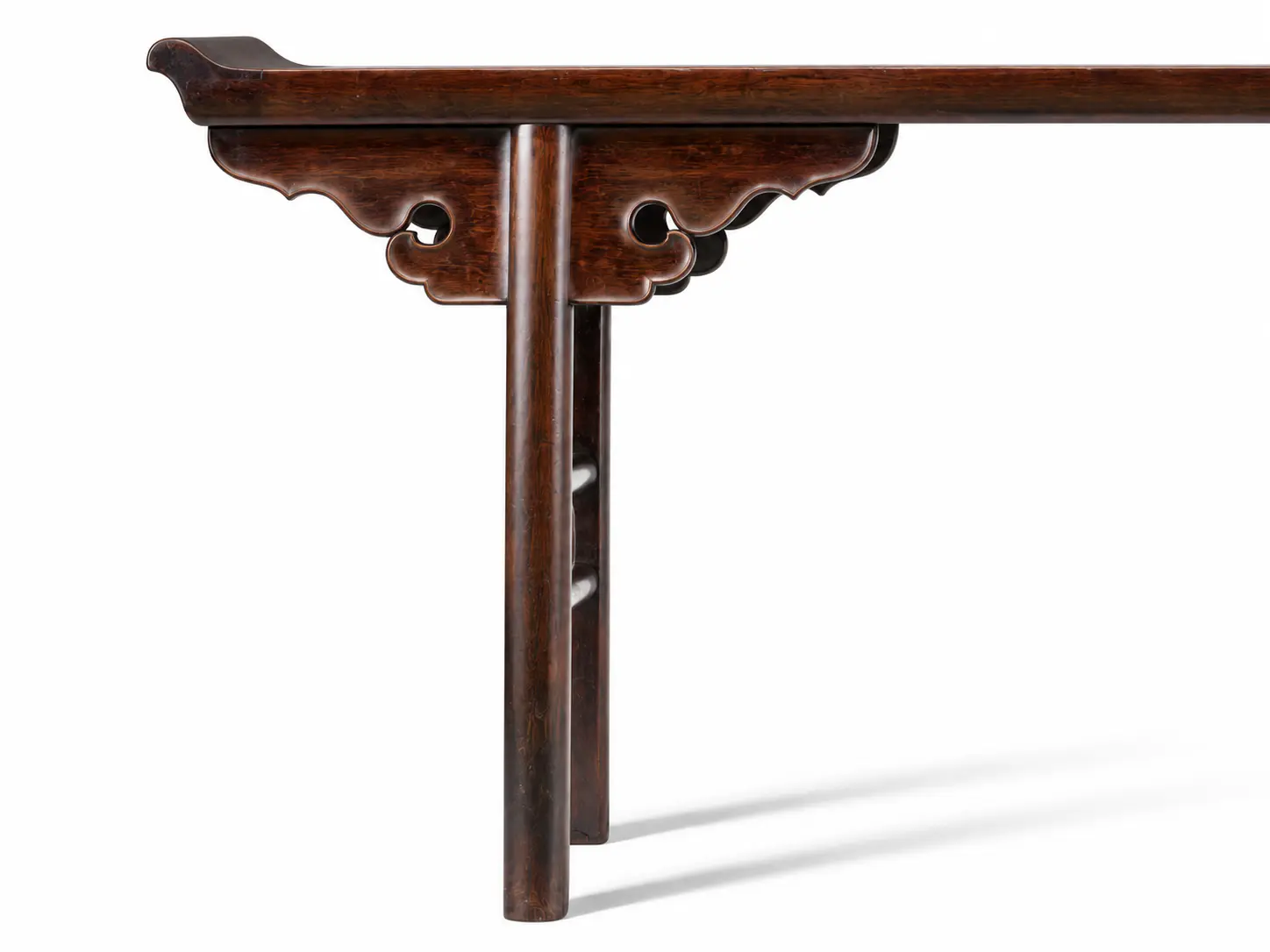
*The close view isolates the structural and decorative junction between the leg and apron.*
Frame-and-Panel Construction
Frame-and-panel construction is one of the most important systems in classical Chinese furniture. In outline:
four-sided frame → groove around the inside edge → thinner panel with a projecting tongue → panel captured inside the frame.
The panel is not simply nailed flat onto the frame as a surface skin. Frame-and-panel construction allows a broad wooden panel to be held inside a joined frame. Traditional examples appear in tabletops, cabinet doors, cabinet sides, screens and bed elements.
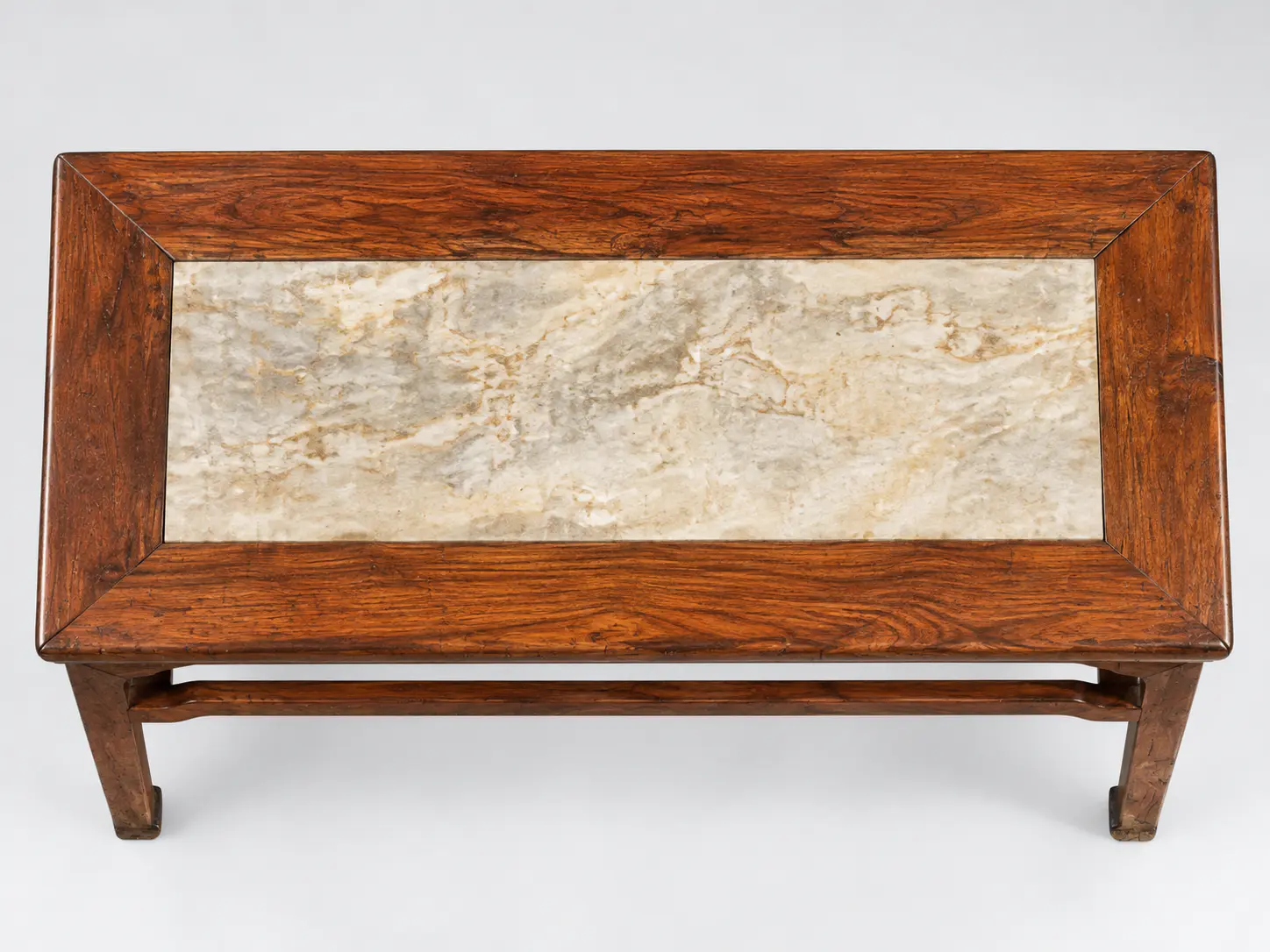
*The top view highlights a framed-panel tabletop constructed around a pale central surface.*
Why Use a Separate Panel?
A separate panel can use valuable timber efficiently, keep a relatively large usable surface stable, and allow the broad board to participate in a structural system rather than forcing the entire top or door to behave as one solid slab. Frame members carry much of the perimeter stiffness; the panel fills the opening.
Floating Panels and Wood Movement
Wood responds dimensionally to changes in moisture. Across its grain, a broad panel can expand or contract more substantially than along its length. A panel captured in grooves can therefore be allowed some movement within its frame rather than being rigidly fixed across its entire width. The panel and frame behave as a coordinated system rather than as one solid slab. A floating panel can accommodate some dimensional wood movement as humidity changes.
That does not mean every historical panel was deliberately loose enough to visibly slide, and humidity is not the only reason frame-and-panel construction existed. Material economy, surface quality, repairability and structural clarity all matter.
Why Old Panels Sometimes Show Gaps
A historic framed panel may shrink relative to its frame. Observers sometimes see narrow edge gaps, exposed unfinished border areas or altered relationships around panel edges. A gap does not prove that furniture is antique. Modern furniture can move; old furniture may have been repaired or reglued. Treat panel gaps as observational clues, not authentication certificates. For assessment practice, see Chinese antique furniture.
How Tables Are Joined
Tabletop Frame
Many classical tables present a perimeter frame, a central field and underside support that joins the top to the apron and leg structure. Corner joins in the top frame and the relationship between tabletop and supporting members are part of the same joinery system that keeps the finished table looking calm from above.
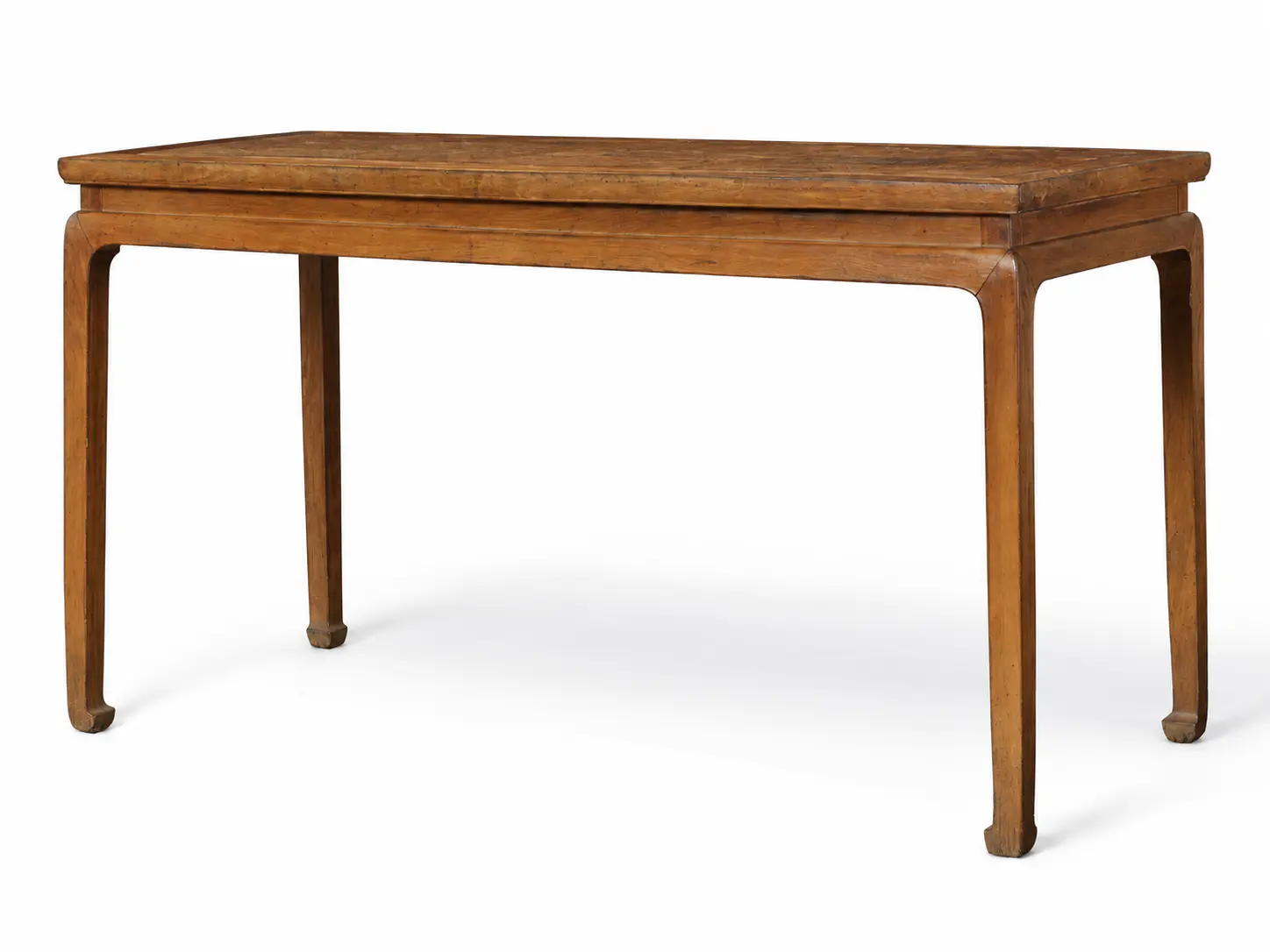
*Huanghuali painting table, late 16th–early 17th century, Ming dynasty. The Metropolitan Museum of Art, Public Domain. Clear apron, leg and stretcher relationships make table joinery easier to read than on highly carved forms.*
Legs and Aprons
Table legs must resist vertical loading, lateral movement and racking. Aprons connect legs while also supporting the upper structure. Different Chinese table types solve this connection differently; there is no universal table joint. What remains constant is the structural problem: transfer load from top to legs while controlling sideways movement without depending on a dense grid of visible metal fasteners.
Stretchers
Stretchers are horizontal members connecting legs lower down in the structure. Functions can include stabilizing the legs, resisting spreading, reducing racking and visually integrating the base.
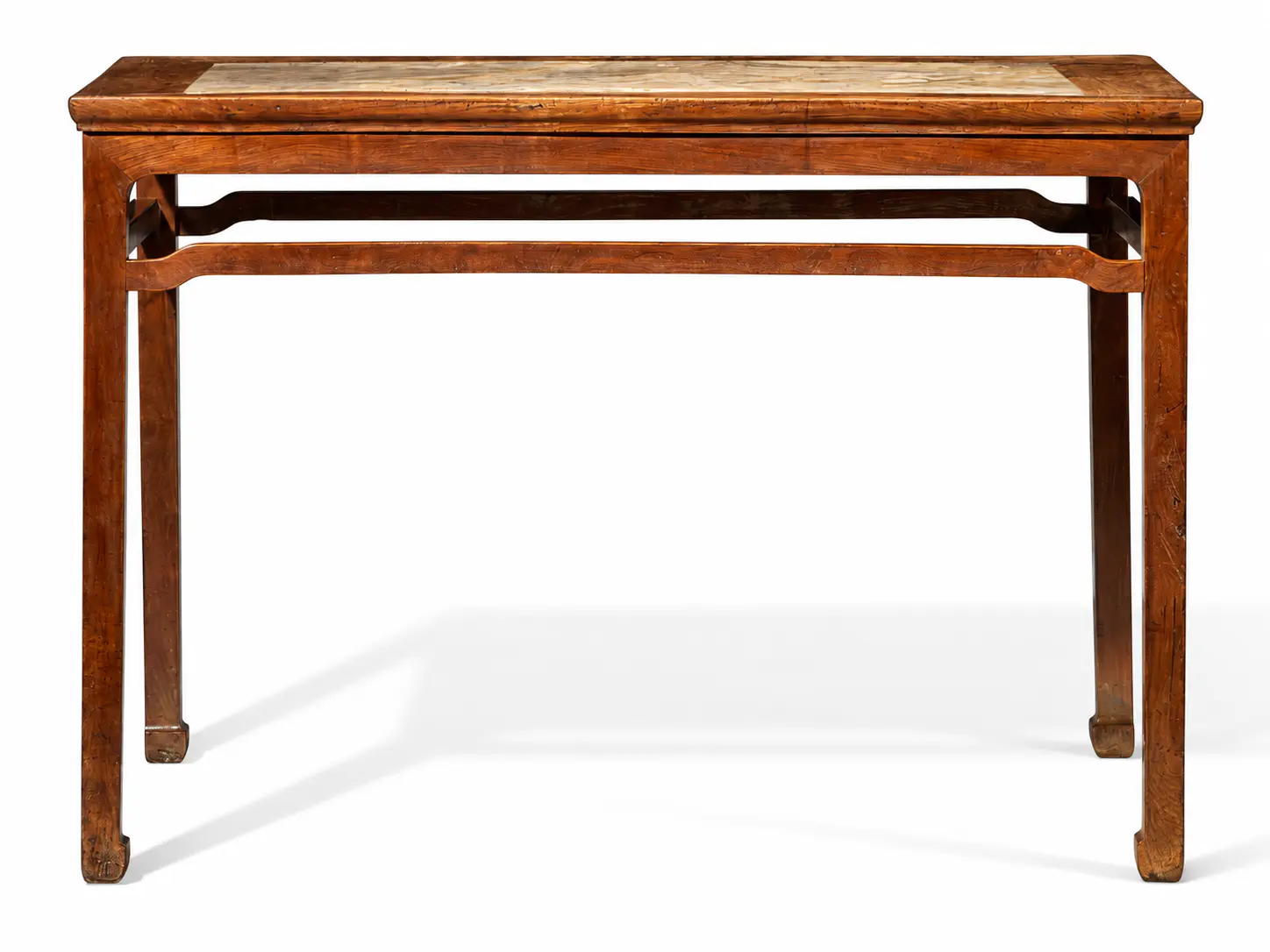
*The open lower frame shows how the legs and long stretchers relate structurally.*
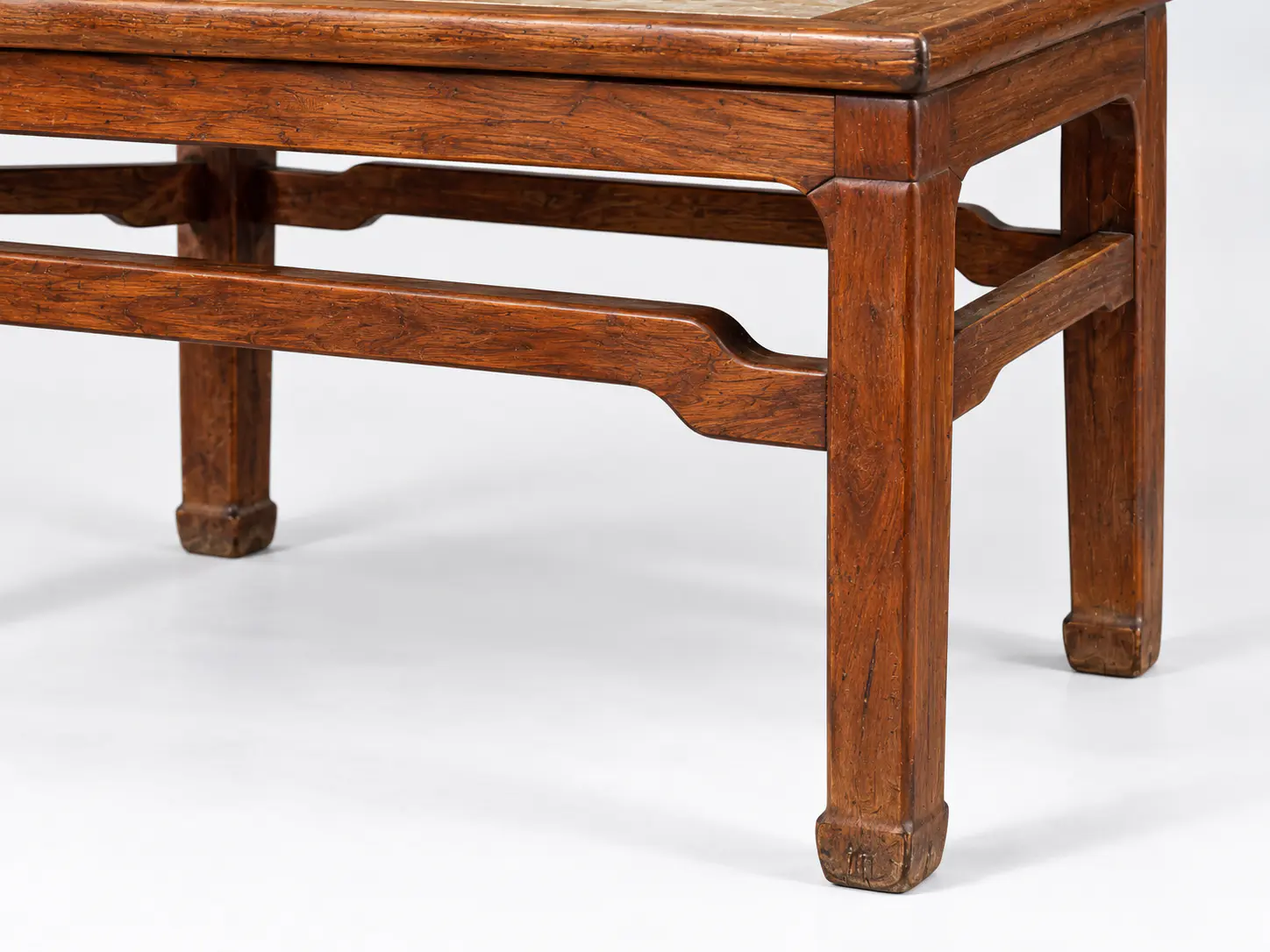
*Horizontal stretchers connect the legs and reinforce the table’s open lower frame.*
Recessed-Leg Construction
In recessed-leg tables, legs sit inward from the ends or corners of the top; legs may splay outward; stretchers often connect them; and aprons or spandrels mediate between top and legs. Visually this differs from corner-leg construction, where the legs rise more obviously at the corners of the top. The Cleveland *Side Table with Everted Ends* is a strong museum example of a recessed-leg Ming form whose open structural space makes apron and leg relationships readable even when individual tenons remain hidden.
Corner-Leg and Flush Construction
In other furniture, legs rise visually to the corners; horizontal frame members meet at those corners; and complex multi-directional joints can be concealed beneath apparently simple intersections. Three-way or mitered joinery can become important here. Specialist Chinese joint names are easy to overuse; what matters for this guide is the structural idea—multiple members meeting at one intersection, with geometry doing work that nails alone cannot do as cleanly.
Dovetails in Chinese Furniture
Mortise-and-tenon is not the only interlocking geometry. Dovetail forms can help resist withdrawal. Historical furniture documentation includes sliding dovetails, dovetailed apron connections, dovetail housings for braces and joints that combine mortise-and-tenon with dovetail geometry. Documented 17th-century platforms described in specialist furniture scholarship use both slide-lock dovetail and mortise-and-tenon joints. Traditional Chinese furniture joinery also includes dovetail and combined joint forms. Chinese joinery is a system of related connection techniques rather than one repetitive joint.
Through-tenons can sometimes be visible even when most joinery is concealed. Brooklyn Museum documentation for a Ming camphorwood cabinet (accession 82.174.1, c. 1600) specifically notes that mortise-and-tenon construction is visible at the corners because the ends of the through-tenons can be seen on the sides—an unusually direct joinery clue on a finished object. That observation belongs to the museum’s object record; this guide does not invent cutaways of joints that remain inside the wood.
Aprons, Spandrels and Braces
Apron
An apron is the horizontal element immediately beneath a tabletop, stool seat or chair seat. It can be plain, shaped or carved. It may be structural and decorative simultaneously.
Spandrel
A spandrel mediates between structural components, particularly around apron, leg and frame junctions. It can stiffen the transition and shape the silhouette.
Brace
A brace is a secondary structural element that helps support or stabilize another member. In classical Chinese furniture, a component can perform both structural and aesthetic work. That is one reason joinery and design cannot be separated cleanly: the same apron that stiffens a table can also define its visual rhythm.
Chair Joinery Is a Different Structural Problem
A chair must deal with seated vertical load, backward pressure against the back, lateral movement, forces on arms and repeated use. Connections among legs, seat frame, back posts, arms, crest rails and stretchers therefore have different structural requirements from a table. Yokeback and horseshoe-back chairs, discussed in the traditional Chinese furniture guide, are useful reminders that chair joinery must keep a relatively open frame stable under shifting human loads—not merely hold a flat working surface.
Why Hardwood Changed What Joinery Could Do
Dense hardwoods such as huanghuali and zitan could support precisely shaped joints, relatively slender structural members, strong connections, highly polished surfaces and intricate carving. See huanghuali, zitan and hongmu. Sophisticated Chinese joinery does not exist only in rare hardwood furniture. Softwood and vernacular furniture traditions also use joinery. The famous surviving hardwood tradition simply demonstrates the system particularly clearly because hard, stable timber can hold fine geometry without relying on heavy bulk.
Ming and Qing furniture both inherit this joinery culture, even when surface taste diverges. For dynasty tendencies in form and decoration, see Ming vs Qing furniture.
Furniture Joinery and Chinese Architecture
Mortise-and-tenon techniques also play a central role in traditional Chinese architecture. Both furniture and architecture use the general principle: projecting member → corresponding recess → mechanically coordinated wooden structure. Courtyard houses and timber halls discussed in traditional Chinese houses share that woodworking logic at building scale.
Furniture joints and architectural joints should not be treated as identical systems scaled up or down. They face different loads, dimensions, component geometries, movement and construction requirements. Traditional Chinese furniture and timber architecture share mortise-and-tenon principles but do not use identical joint systems in every context. The comparison explains a shared craft language; it does not claim that a chair is literally a miniature Chinese building.
Why This Joinery Matters to Furniture Design
Structure Creates Proportion
Joinery determines where legs can meet frames, rails can curve, aprons can thin and panels can float. Therefore joinery affects visible proportions. A recessed-leg table’s open understructure, a painting table’s long apron line and a chair’s crest-rail height are all constrained by what the joints can safely do.
Joints Can Disappear
Sophisticated joints can remain concealed. This lets grain, silhouette, line and proportion dominate the exterior. The furniture becomes readable as a composed object rather than as a display of fasteners.
Furniture Can Look Simpler Than It Is
The visual restraint of classical Chinese furniture often conceals substantial structural complexity. What looks like a quiet meeting of two members may contain multiple tenons, interlocking shoulders or combined dovetail geometries. That is the design lesson: simplicity of silhouette is not simplicity of construction.
Does Mortise-and-Tenon Mean No Nails or Glue?
Classical Chinese furniture is famous for relying primarily on interlocking wooden joints and often minimizing visible metal fasteners. However, “completely nail-free and glue-free” should not be treated as a universal historical rule.
Fine classical Chinese furniture is renowned for using interlocking wooden joinery as its primary structural system, often minimizing visible nails or other metal fasteners. Historical construction and later repairs nevertheless vary, and documented period furniture can contain pegs, adhesives, metal fittings, nails or later reinforcement. Specialist scholarship has described late-Ming huanghuali tables that use extensive mortise-and-tenon construction while also employing metal nails on the underside of aprons. A nail therefore does not automatically prove modern furniture, and a mortise-and-tenon joint does not automatically prove antique furniture. Classical Chinese furniture is renowned for minimizing visible mechanical fasteners, but not every historical piece is literally free of glue, pegs, nails or metal.
Can Joinery Help Identify Antique Chinese Furniture?
It provides evidence, but cannot authenticate a piece by itself. Modern craftsmen can reproduce mortise-and-tenon, dovetails, frame-and-panel construction and classical joint geometry. Therefore examine joinery together with form, wood, surface, wear, repairs, tool marks, provenance and documented comparisons. Mortise-and-tenon construction does not prove that a piece is antique. For the fuller authentication sequence, use the antique Chinese furniture guide rather than treating this page as a second authentication manual.
Where to See Chinese Furniture Joinery in Beijing
Palace Museum Furniture Gallery
The Palace Museum’s furniture holdings include major historical examples from imperial and elite contexts. Display conditions vary; do not assume every joint is visible on every object. Still, Beijing palace furniture collections remain among the most important places to study classical forms whose construction depends on sunmao systems.
Jingzuo Sunmao Art Museum
京作榫卯艺术馆 (Jingzuo Sunmao Art Museum) focuses explicitly on Beijing-school woodworking and mortise-and-tenon craftsmanship. Official Haidian district information published in March 2026 listed the museum in the Wenhuiyuan Road area, normally open Tuesday–Sunday with free admission. Recheck current hours and access before visiting, because museum schedules change. A 2026 Cultural Heritage Bureau-listed exhibition at the museum focused on traditional woodworking processes, Ming-style horseshoe-back chairs, mortise-and-tenon structure and furniture craftsmanship—useful evidence of the museum’s subject focus. That temporary exhibition has ended; do not treat it as a current show.
Longshuncheng / Jingzuo Intangible Cultural Heritage Museum
Beijing’s official English government tourism materials identify Jinyu Longshuncheng Cultural and Creative Industrial Park as a municipal-level industrial tourism demonstration site. It includes Jingzuo Museum of Intangible Cultural Heritage, Lu Ban Workshop programming, mortise-and-tenon woodworking experiences, antique furniture restoration viewing, traditional courtyard architecture and rosewood furniture displays. Confirm current visitor access on official channels. It is a natural future stop for craft-focused Beijing itineraries, without turning this guide into a tour sales page.
Chinese Furniture Joinery FAQ
What is Chinese mortise-and-tenon joinery?
It is a family of interlocking wooden connections in which projecting tenons fit corresponding mortises so that furniture members—legs, rails, aprons, stretchers, frames and panels—work as an integrated structure.
What does sunmao mean?
Sunmao (榫卯) is the Chinese term for mortise-and-tenon connection systems. 榫 (*sǔn*) is the projecting tenon; 卯 (*mǎo*) is the receiving mortise.
Is Chinese furniture really made without nails?
Fine classical Chinese furniture is renowned for using interlocking wooden joinery as its primary structural system and often minimizing visible metal fasteners. Documented period furniture can still include pegs, adhesives, metal fittings, nails or later repairs, so “completely nail-free” is not a universal historical rule.
What is frame-and-panel construction?
A joined four-sided frame holds a thinner panel, usually captured in grooves, rather than nailing a broad board flat onto a frame as a simple skin.
Why are panels allowed to move?
Wood changes dimension with moisture, especially across the grain. A panel held in grooves can accommodate some movement within its frame instead of being rigidly fixed across its full width.
What is a stretcher in Chinese furniture?
A stretcher is a horizontal member connecting legs lower in the structure, helping stabilize the base and resist spreading or racking.
What is an apron on a Chinese table?
An apron is the horizontal member immediately beneath a tabletop or seat. It can be structural, decorative or both.
Are dovetails used in Chinese furniture?
Yes. Chinese furniture employs multiple interlocking joint geometries, including dovetail forms and combinations of dovetail and mortise-and-tenon construction.
Is mortise-and-tenon furniture automatically antique?
No. Modern makers can reproduce classical joinery. Joinery is evidence, not proof of age.
Is Chinese furniture joinery the same as Chinese architectural joinery?
They share a related structural principle—projecting members fitting corresponding recesses—but furniture and timber architecture face different loads, scales and construction requirements and should not be treated as identical systems.