
Chinese furniture is a family of traditional and classical woodworking traditions rather than a single style. Surviving classical furniture is especially associated with the Ming (1368–1644) and Qing (1644–1912) dynasties, when refined wooden forms, interlocking joinery, hardwoods such as huanghuali and zitan, lacquer finishes, and major object types—chairs, tables, beds, cabinets and screens—came to define how collectors and museums still describe the craft. This guide focuses on traditional and classical Chinese furniture, not modern factory production or wholesale sourcing.
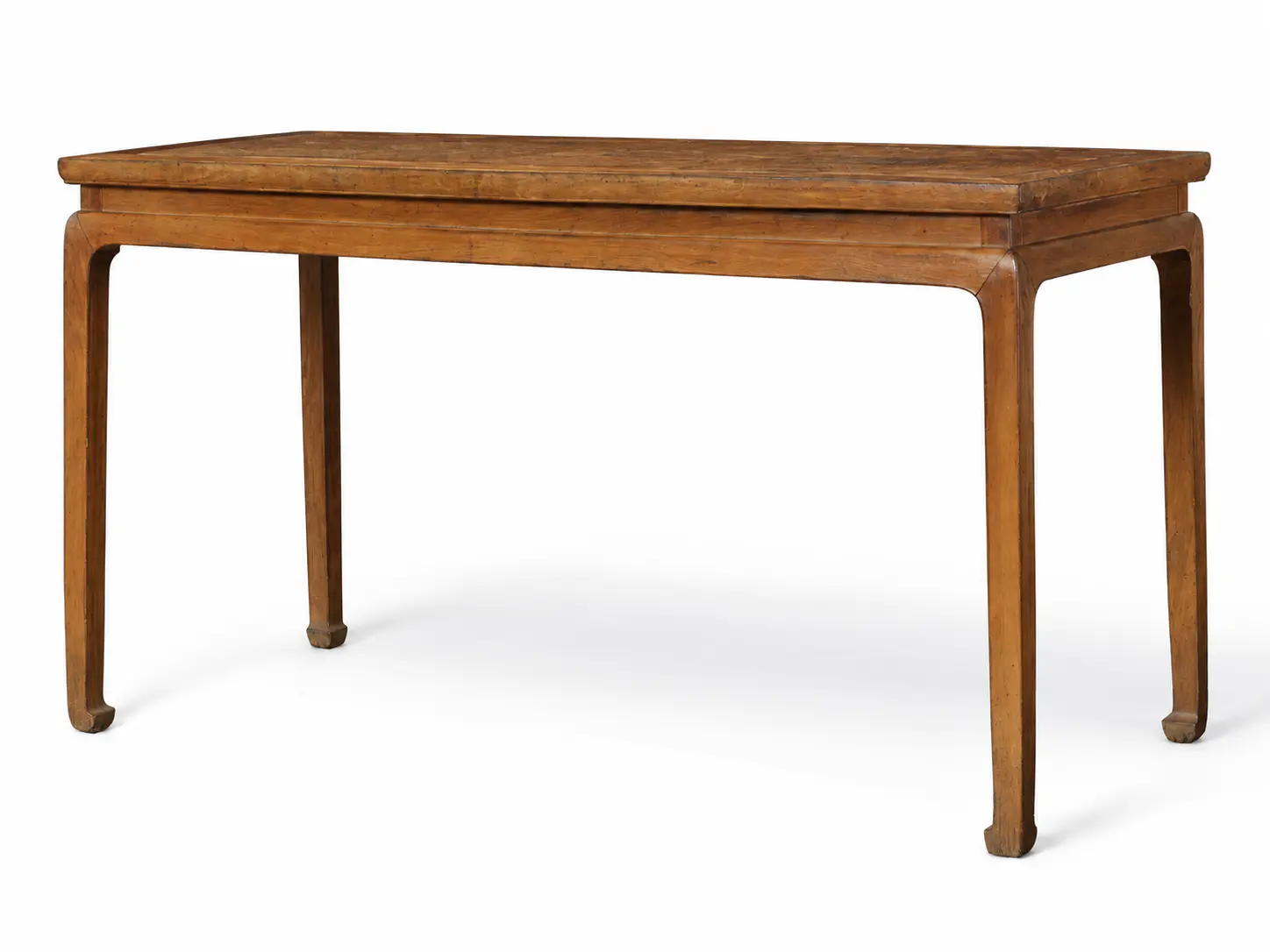
*Late 16th–early 17th-century huanghuali painting table, Ming dynasty. Metropolitan Museum of Art, Public Domain.*
Chinese Furniture at a Glance
| Topic | Summary |
|---|---|
| Best-documented classical period | Ming and Qing dynasties |
| Signature construction | Interlocking wooden joinery, especially mortise-and-tenon systems |
| Important classical hardwood terms | Huanghuali, zitan, huali |
| Modern material category | Hongmu — a standardized multi-species category, not one wood species |
| Other materials | Elm and other woods, bamboo, lacquered wood |
| Major furniture groups | Chairs, beds, tables, cabinets, screens |
| Common finishes | Polished wood, lacquer, carved lacquer, inlay |
| Important Beijing collections | Palace Museum Furniture Gallery; China Red Sandalwood Museum |
These are tendencies used by museums and specialists, not rigid rules for every region or workshop.
How Chinese Furniture Developed
Before the Ming Dynasty
Chinese seating and household furnishings developed over a long span before the Ming period. Earlier centuries moved from floor-level seating traditions toward elevated chairs, stools, tables and related forms. Archaeological finds, tomb models and later texts show that raised seating and specialized tables already belonged to elite and ritual life long before surviving classical hardwood pieces become abundant in museum collections.
Classical Ming and Qing furniture did not invent woodworking from nothing; it refined forms, materials and joinery that had already been developing for generations. Precise invention dates are rarely recoverable for every type, and many earlier wooden objects have not survived. This guide therefore treats the Ming–Qing corpus as the best-documented classical phase rather than the absolute beginning of Chinese furniture history.
Ming Furniture
Surviving Ming and late-Ming furniture became especially influential because so many pieces show a clear relationship between structure and appearance. Balance and proportion matter: legs, rails, frames and panels often remain visually legible. Decoration is frequently economical rather than absent. Hardwood construction—famously including huanghuali—supports refined chairs and tables associated with scholar and elite domestic interiors.
Not every Ming piece is “minimal.” Carving, beading and shaped aprons appear where workshops wanted emphasis. The enduring impression, especially in museum presentations of classical hardwood furniture, is structural clarity and controlled ornament rather than a blanket aesthetic of emptiness. Late-Ming works also bridge into early Qing taste, which is why many catalogs carefully date pieces across the dynastic boundary.
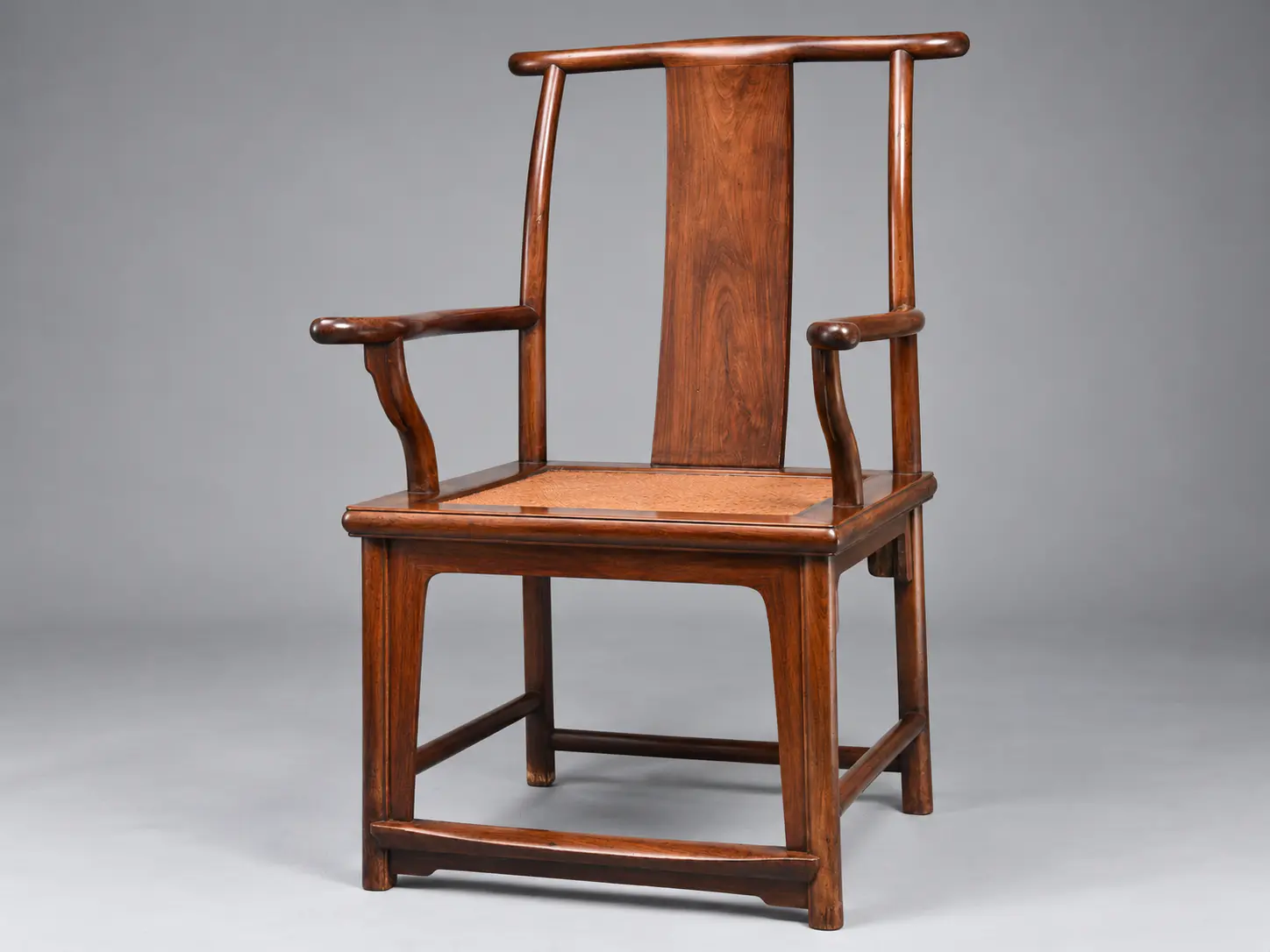
*17th-century huanghuali yokeback armchair, late Ming to early Qing. Metropolitan Museum of Art, Public Domain.*
Qing Furniture
Qing furniture continues many Ming-derived forms while expanding materials, workshops and decorative ambition. Imperial workshops under rulers such as Kangxi, Yongzheng and Qianlong produced elaborate hardwood, lacquer and inlaid works alongside more restrained domestic traditions. Costly materials, carving and surface decoration become especially visible in court contexts.
Qing furniture is not uniformly ornate. Early Qing workshops often preserved Ming silhouettes; later Qianlong-period interiors could favor denser ornament, heavier visual mass and spectacular lacquer or inlay programs. Regional workshops and vernacular hardwoods remain part of the same historical field. Reading Qing furniture therefore means asking which workshop culture, which material and which room type you are looking at—not applying a single “Qing style” label.
What Makes Traditional Chinese Furniture Distinctive
Traditional Chinese furniture is best understood through form + structure + material + surface + historical context. It is not simply “old wooden furniture.” Identity comes from how proportion, timber choice, joinery, finish and room function work together.
Joinery and Structure
Classical Chinese furniture is renowned for sophisticated interlocking wooden joinery, particularly mortise-and-tenon systems. Fine construction could minimize reliance on metal fasteners, while glue could be used sparingly in some traditional woodworking contexts. Despite that craft reputation, historical furniture was not universally free of nails, adhesives, pegs, metal fittings or later reinforcement.
Structure often remains visible in the finished object: rails seat into legs, stretchers stabilize frames, and panels sit within clearly expressed members. Mitred frames, half-laps and related joints support both strength and clean line. That engineering logic relates closely to traditional Chinese timber architecture, where interlocking members also carry both load and visual order—see the Chinese architecture guide for the building-side counterpart.
Proportion, Line and Form
Continuous lines, leg-and-rail relationships, framed panels and visual balance give classical pieces their silhouette. Curved members (as in horseshoe-back chairs) and rectilinear frames (as in many cabinets and painting tables) can coexist within the same tradition. Negative space between legs or under aprons is often as carefully judged as carved detail.
Forms that repay close looking include yokeback chairs, horseshoe-back armchairs, recessed-leg tables, couch or luohan beds, cabinets and screens. In each case, the structural members are usually meant to be read, not hidden behind upholstery or applied cladding. When ornament appears, it typically follows the frame rather than erasing it.
Furniture as Part of a Room
Traditional furniture belonged to rooms with hierarchy and purpose: reception halls, scholars’ studies, sleeping spaces, courtyard houses and palace interiors. Placement, scale and finish tracked social and spatial order as much as taste. A pair of chairs flanking a table, a screen closing a view, or a painting table set for writing all depend on wall axes, doorways and courtyard light.
Reading furniture with traditional Chinese houses, house layout and design and siheyuan clarifies why a painting table, a pair of chairs or a screen can feel incomplete when removed from its architectural setting. Gardens and palace corridors add another layer of thresholds and framed views—useful context from the Chinese gardens cluster when screens and outdoor pavilions enter the story.
Main Types of Chinese Furniture
Museum collections often group classical Chinese furniture into broad functional families. The summary below follows that practical taxonomy.
Chairs
Yokeback chairs and horseshoe-back armchairs are among the most recognizable classical seating forms. The yokeback’s crest rail and uprights create a tall, architectural silhouette; the horseshoe-back’s continuous curved arm and crest rail wrap the sitter in a single flowing line. Stools and folding seating expand the range for informal or portable use. Silhouette—crest rail, arms, legs and stretchers—usually carries as much information as surface ornament.
Tables
Painting tables, side tables, recessed-leg tables and low couch tables supported writing, display, dining-adjacent use and room division. Long painting tables especially show how length, apron and leg joinery create a calm horizontal plane for scholarly work. Recessed-leg designs pull the legs inward beneath the top, clarifying the overhang and emphasizing the floating plane of the table surface.
Beds and Couches
Beds and couch-like seating (including luohan-style forms) blur sleeping, resting and receiving. Canopy structures, railings and low tables nearby can turn a bed into a semi-enclosed room within a room. In palace and elite domestic settings, bed platforms also organized textile display and seasonal adjustment, so the wooden frame is only part of the original ensemble.
Cabinets and Storage
Wardrobes and cabinets organize clothing, documents and valuables. Large paired cabinets are common in museum displays; doors, hardware and panel framing repay attention as carefully as chair silhouettes. Interior shelving, baitong or other metal fittings, and the rhythm of framed panels often reveal workshop priorities more clearly than a front-on photograph suggests.
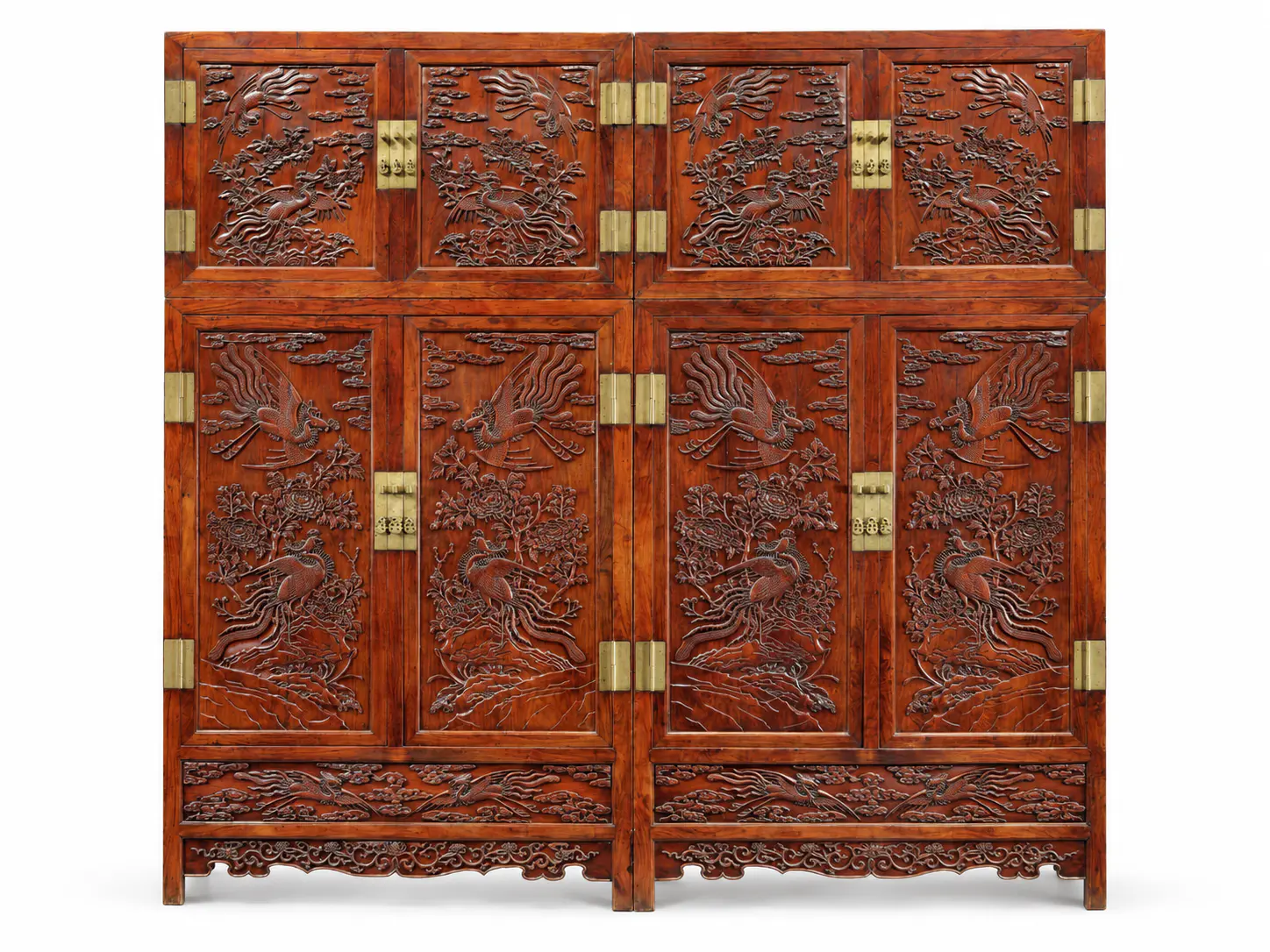
*16th-century huanghuali wardrobe, Ming dynasty. Metropolitan Museum of Art, Public Domain.*
Screens
Standing and folding screens shape space and view; smaller table screens decorate desks and display surfaces. Lacquer, painting and inlay often concentrate on screens even when nearby hardwood furniture remains comparatively restrained.
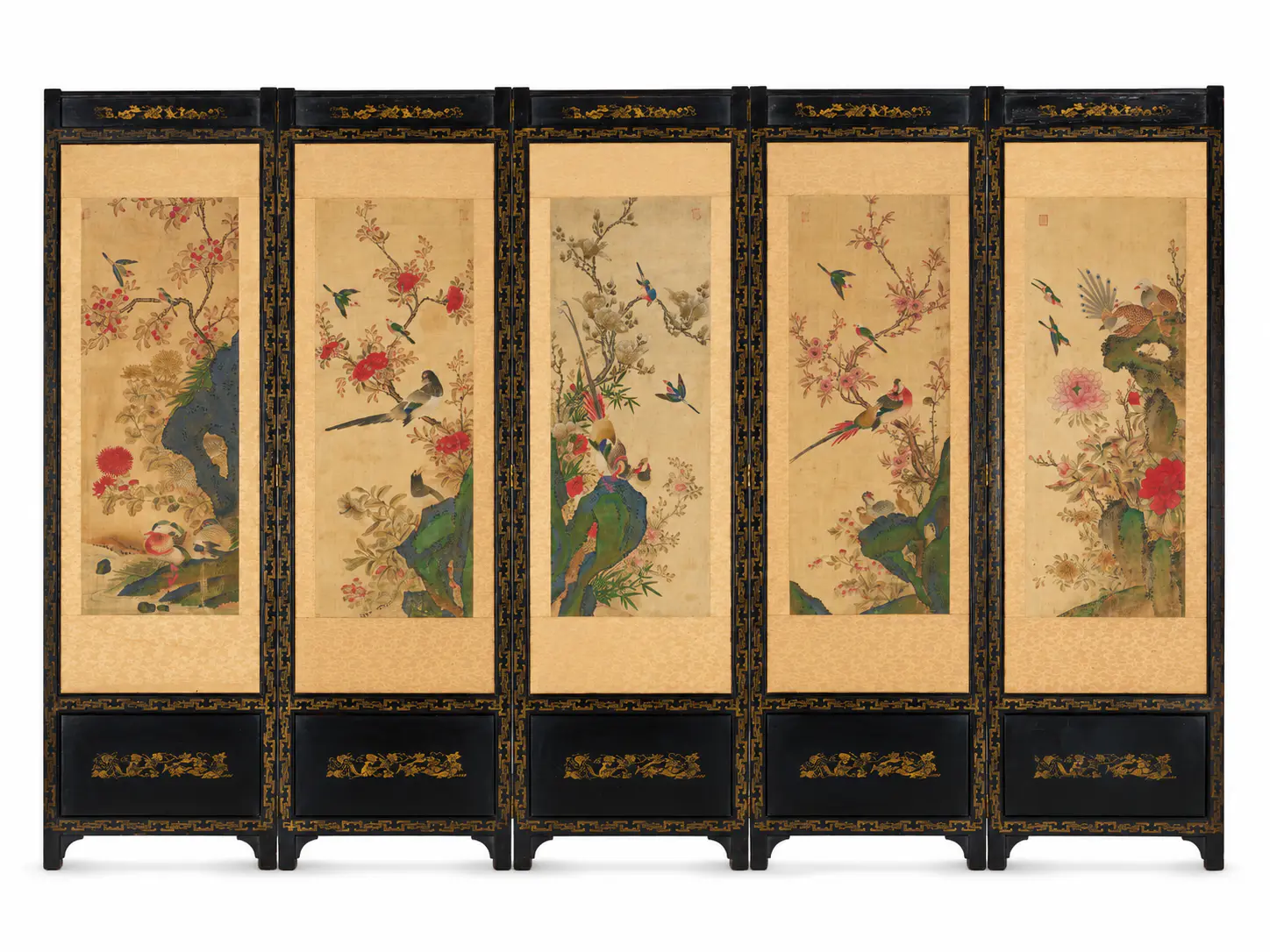
*A folding screen composed as five vertical bird-and-flower paintings.*
Woods, Lacquer and Decorative Materials
Huanghuali
Huanghuali—commonly associated botanically with *Dalbergia odorifera*—is the hardwood most closely identified with refined classical Chinese furniture, especially Ming and early Qing chairs and tables. Warm tones and characteristic grain made it prized for pieces where surface polish and joinery remain visible. Museums and collectors treat well-documented huanghuali furniture as a reference class for classical proportion, not merely as a market grade. For material identification and authenticity questions, see the dedicated guide to huanghuali, zitan and hongmu and the antique-furniture guide.
Zitan
Zitan is a dense, dark purplish hardwood strongly associated with elite and imperial furniture. Its mass and colour suited detailed carving and the heavier visual presence of many Qing court works. Collectors and museums often contrast zitan displays with lighter huanghuali ensembles nearby. The China Red Sandalwood Museum in Beijing specialises in this material culture, while the Palace Museum Furniture Gallery places zitan within a broader imperial inventory.
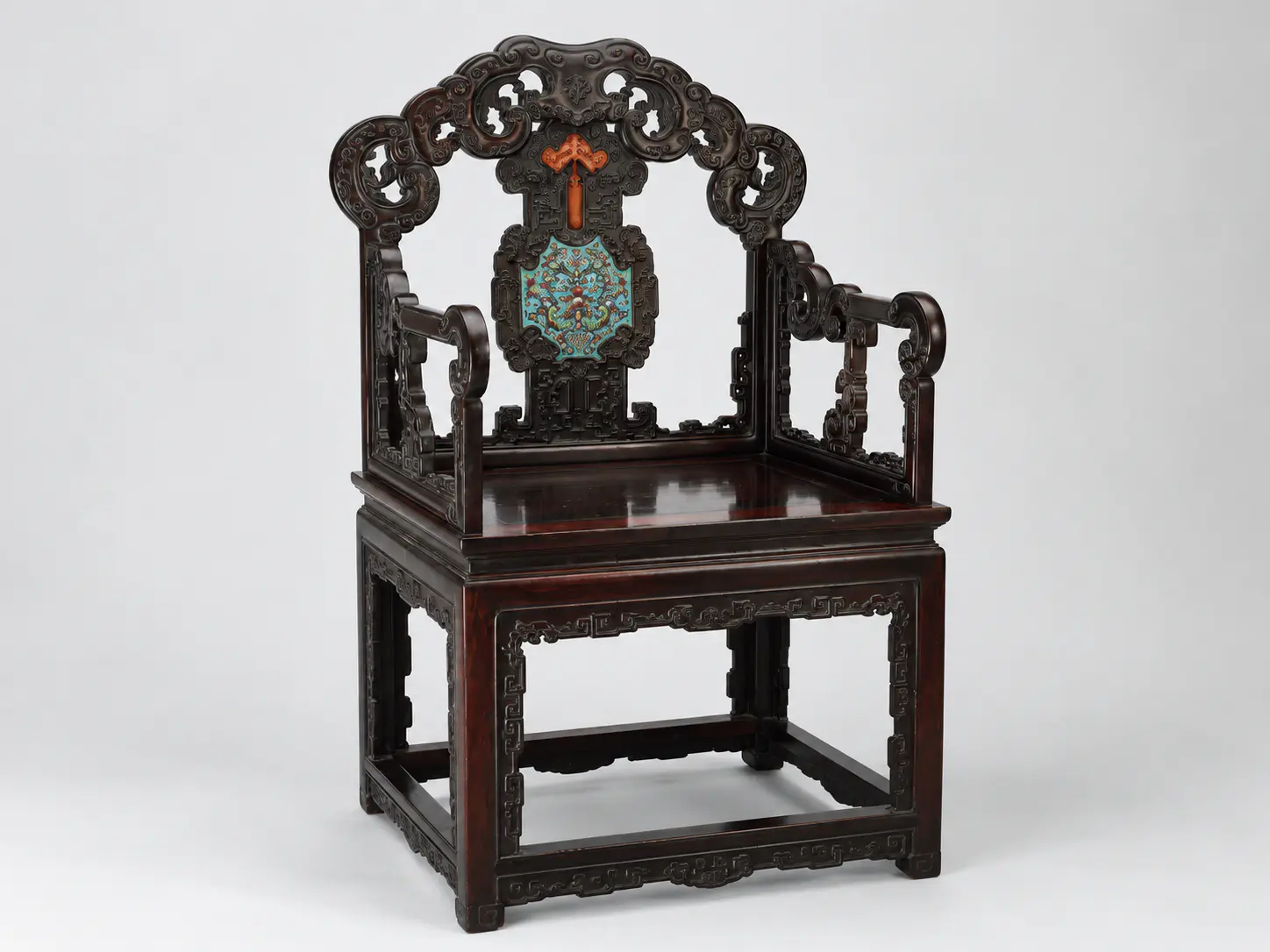
*Late Ming–early Qing zitan armchair. Metropolitan Museum of Art, Public Domain.*
Huali, Hongmu and Other Woods
Modern commercial labels such as “rosewood” or *hongmu* do not map cleanly onto every historical workshop term. Classical inventories used overlapping names for related hardwoods, and later market categories sometimes flatten those distinctions. Elm and other more available woods supplied ordinary domestic furniture for centuries—elite tropical hardwoods were never the whole story of Chinese furniture history. Bamboo furniture and lacquered softwood constructions further widen the material range beyond the hardwood canon.
Lacquer and Inlay
Red and black lacquer, carved lacquer, and mother-of-pearl or other inlays form a parallel tradition to polished hardwood. Surface decoration can dominate the object’s reading—as in Qianlong-period carved red lacquer cabinets—or remain a restrained frame around pictorial panels. Lacquer furniture often rewards looking at layering, colour depth and pictorial programme as carefully as one studies joinery on a hardwood chair. Jade and precious-material inlays appear selectively; for jade as a material culture topic see Chinese jade.
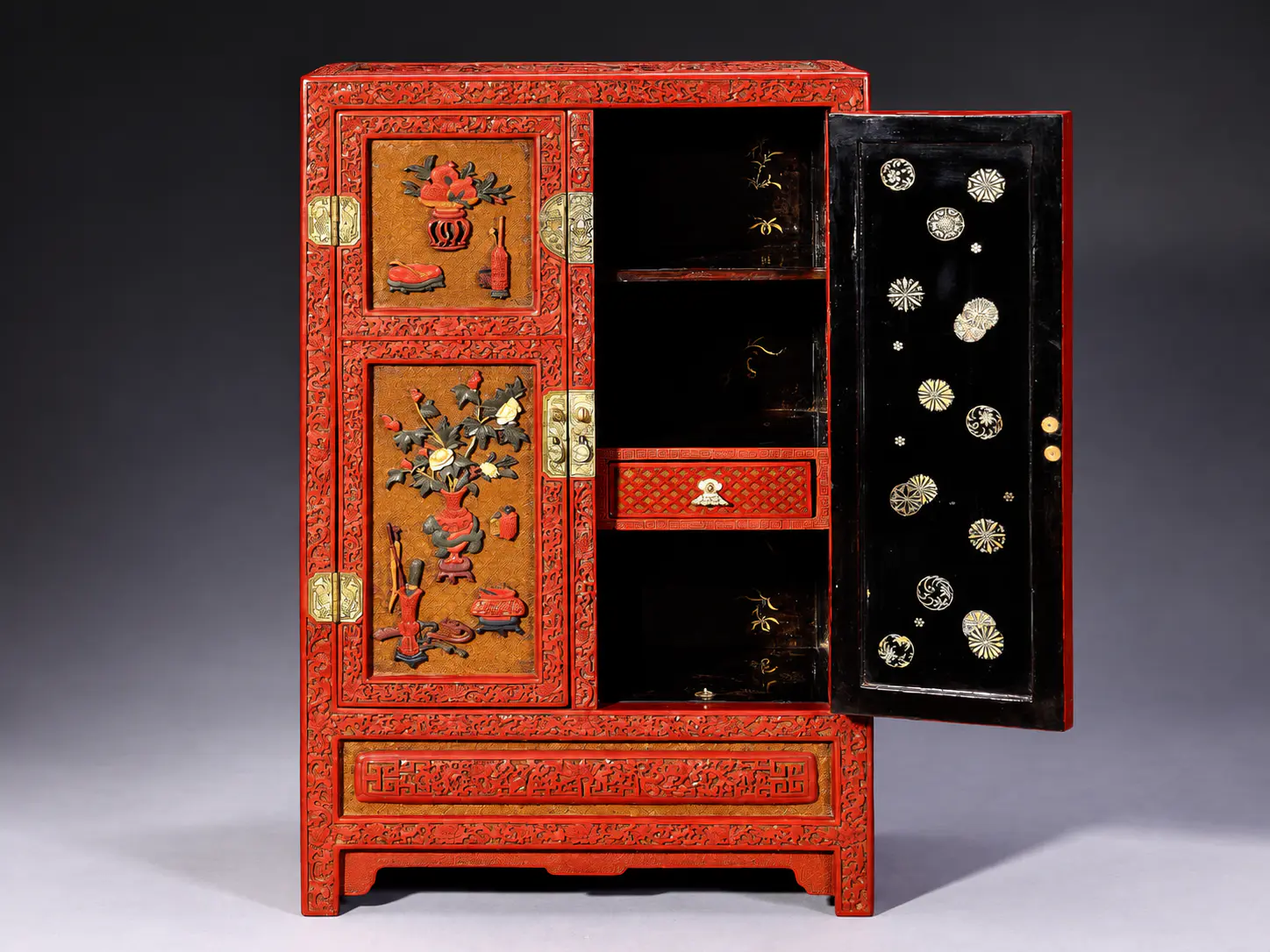
*Carved red lacquer cabinet with figures in a landscape, Qing dynasty, Qianlong period. Metropolitan Museum of Art, Public Domain.*
Ming vs Qing Chinese Furniture
| Feature | Ming traditions | Qing traditions |
|---|---|---|
| Overall emphasis | Structure, proportion and line often prominent | Wider range from restrained forms to highly elaborate court furniture |
| Common associations | Huanghuali and refined hardwood construction | Zitan, hardwood, lacquer, carving and inlay |
| Decoration | Often controlled and subordinate to form | Can become increasingly elaborate, especially in imperial contexts |
| Visual mass | Frequently lighter and structurally legible | Many court examples use heavier visual mass |
| Cultural setting | Scholar, domestic and elite contexts | Domestic traditions plus extensive imperial workshop production |
These are tendencies, not absolute rules. Ming-derived forms continued into the Qing period, especially during the early Qing. A single room or collection can hold both restrained hardwood seating and richly lacquered cabinets.
Where to See Chinese Furniture in Beijing
Palace Museum Furniture Gallery
The Palace Museum maintains a dedicated Furniture Gallery within the former imperial palace. Its Ming and Qing furniture holdings are extensive—more than 6,200 pieces or sets according to the museum’s own collection information—and include substantial Qing imperial furniture. Visitors can see chairs, beds, tables, cabinets, screens, lacquer furniture and hardwood furniture in an architectural setting that already frames how these objects were meant to be used.
Because the gallery sits inside the palace complex, furniture can be compared with the halls, courtyards and axial routes that once organized imperial daily life. Pair a Furniture Gallery visit with broader Forbidden City planning rather than treating furniture as an isolated checklist item.
China Red Sandalwood Museum
Beijing’s China Red Sandalwood Museum focuses on red sandalwood art, traditional and classical furniture, Ming- and Qing-style furniture, materials, construction, carving and related architectural models. Displays often make joinery, timber character and decorative carving easier to study at close range than palace interiors alone allow.
It is a useful complement when travelers want craftsmanship depth beyond monument photography. Opening hours, ticketing and exhibition rotations change, so confirm current visitor information before building a fixed itinerary around a single museum stop.
For travelers interested in Chinese craftsmanship rather than only major monuments, furniture can be read together with Beijing’s palace interiors, courtyard architecture, museums and traditional craft districts. Related architecture and house guides—Chinese architecture, siheyuan and Chinese gardens—help place furniture inside the same cultural landscape DragonTrail uses for trip planning.
If you are designing a Beijing day that already includes the Palace Museum, adding the Furniture Gallery (when open on your visit date) is often the highest-yield way to see classical chairs, tables, cabinets and screens without treating furniture as a separate shopping itinerary. Craft-focused travelers can then deepen the reading at the China Red Sandalwood Museum or by comparing palace interiors with courtyard-house spatial habits described in the house and siheyuan guides.
Chinese Furniture FAQ
What is traditional Chinese furniture?
Traditional Chinese furniture refers to classical woodworking traditions—especially as documented in Ming and Qing pieces—defined by form, proportion, timber choice, interlocking joinery and surface treatments such as polish or lacquer. It includes chairs, tables, beds, cabinets and screens used in domestic, scholarly and imperial settings, not modern factory furniture marketed only as a national style.
What is Ming-style Chinese furniture?
Ming-style furniture usually emphasizes structural clarity, balanced proportion and controlled ornament, often in hardwoods such as huanghuali. Surviving Ming and late-Ming chairs and tables make the relationship between engineering and silhouette especially readable. “Ming-style” can also describe later works that continue those forms, so dating and workshop context still matter.
What is the difference between Ming and Qing furniture?
Ming traditions are often associated with structurally legible hardwood forms; Qing traditions span continued Ming-derived pieces and more elaborate imperial hardwood, lacquer, carving and inlay—especially under Kangxi, Yongzheng and Qianlong. These are tendencies, not absolute rules: early Qing workshops frequently preserved Ming silhouettes.
What woods are used in Chinese furniture?
Classical collections highlight huanghuali, zitan and related hardwoods, while elm and other woods supplied much ordinary domestic furniture. Bamboo and lacquered wood constructions also appear. Modern commercial “rosewood” or hongmu labels do not map perfectly onto every historical workshop term.
What is huanghuali furniture?
Huanghuali furniture is classical Chinese furniture associated with the warm-toned hardwood botanically linked to *Dalbergia odorifera*. It is especially important for Ming and early Qing chairs and tables where grain and joinery remain visible. This guide introduces the material; authentication and market grading need a dedicated treatment.
Is traditional Chinese furniture made without nails?
Classical Chinese furniture is renowned for sophisticated interlocking wooden joinery, particularly mortise-and-tenon systems. Fine construction could minimize reliance on metal fasteners, while glue could be used sparingly in some traditional woodworking contexts. It is safer not to claim that every Chinese piece was made entirely without glue or nails.
What are the main types of traditional Chinese furniture?
Museum taxonomies commonly group classical furniture into chairs, tables, beds and couches, cabinets and storage, and screens. Within those groups, distinctive silhouettes include yokeback chairs, horseshoe-back armchairs, painting tables, recessed-leg tables, luohan-style couches, wardrobes and lacquer folding or table screens.
Where can I see traditional Chinese furniture in Beijing?
The Palace Museum Furniture Gallery is the primary place to see Ming and Qing furniture inside the former imperial palace; the museum reports more than 6,200 pieces or sets in its furniture holdings. Beijing’s China Red Sandalwood Museum focuses on red sandalwood art, classical furniture, materials, construction and carving. Confirm current opening details before you go.