| Item | Detail |
|---|---|
| Chinese | 火锅 (huǒguō); locally 重庆火锅 |
| Core association | Beef tallow, chilli and Sichuan pepper broth; offal-forward menus |
| Serving format | Often a nine-grid divided pot (九宫格) in traditional-style restaurants |
| Spice range | Adjustable, but many Chongqing restaurants default to fully spicy |
| Notable local format | Some restaurants operate inside former air-raid shelters ("cave hotpot") |
| Best for | Groups, spice-tolerant diners, evening dining |
Why Chongqing Is Known For Hotpot
Chongqing's hotpot reputation comes from density and intensity as much as any single defining rule: the city has a very large number of hotpot restaurants relative to its size, many of them long-running, neighbourhood institutions rather than tourist-oriented venues. Locals eat hotpot year-round, including in summer heat, and the meal is treated as an everyday social occasion rather than a special-occasion dish. That said, Chongqing hotpot is not one uniform product—broth strength, oil level, spice defaults and ingredient range vary meaningfully between restaurants, from old-fashioned neighbourhood spots to modern chains.
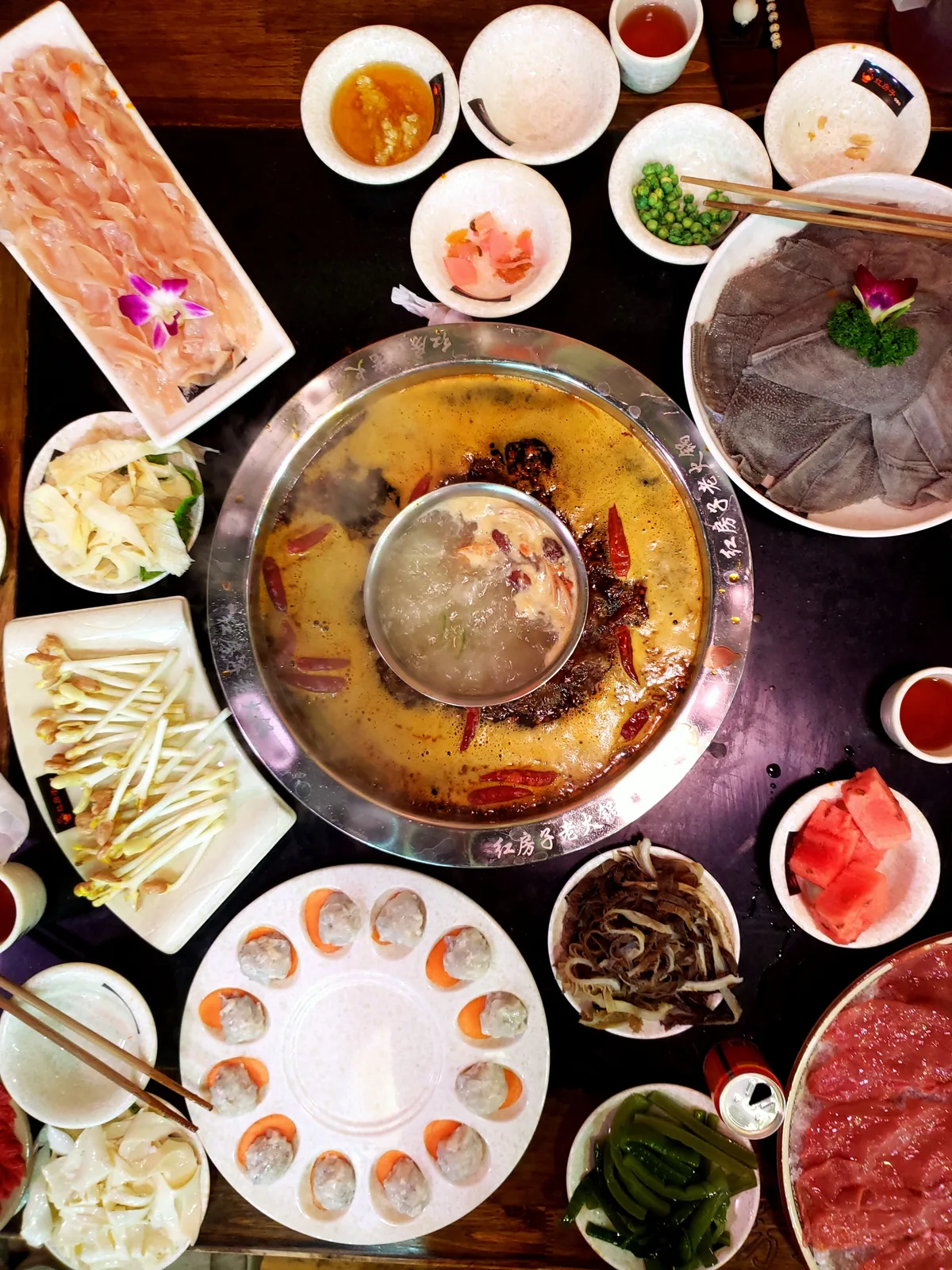
*Hotpot dining in Chongqing. DragonTrail editorial image.*
Beef Tallow, Chilli And Sichuan Pepper
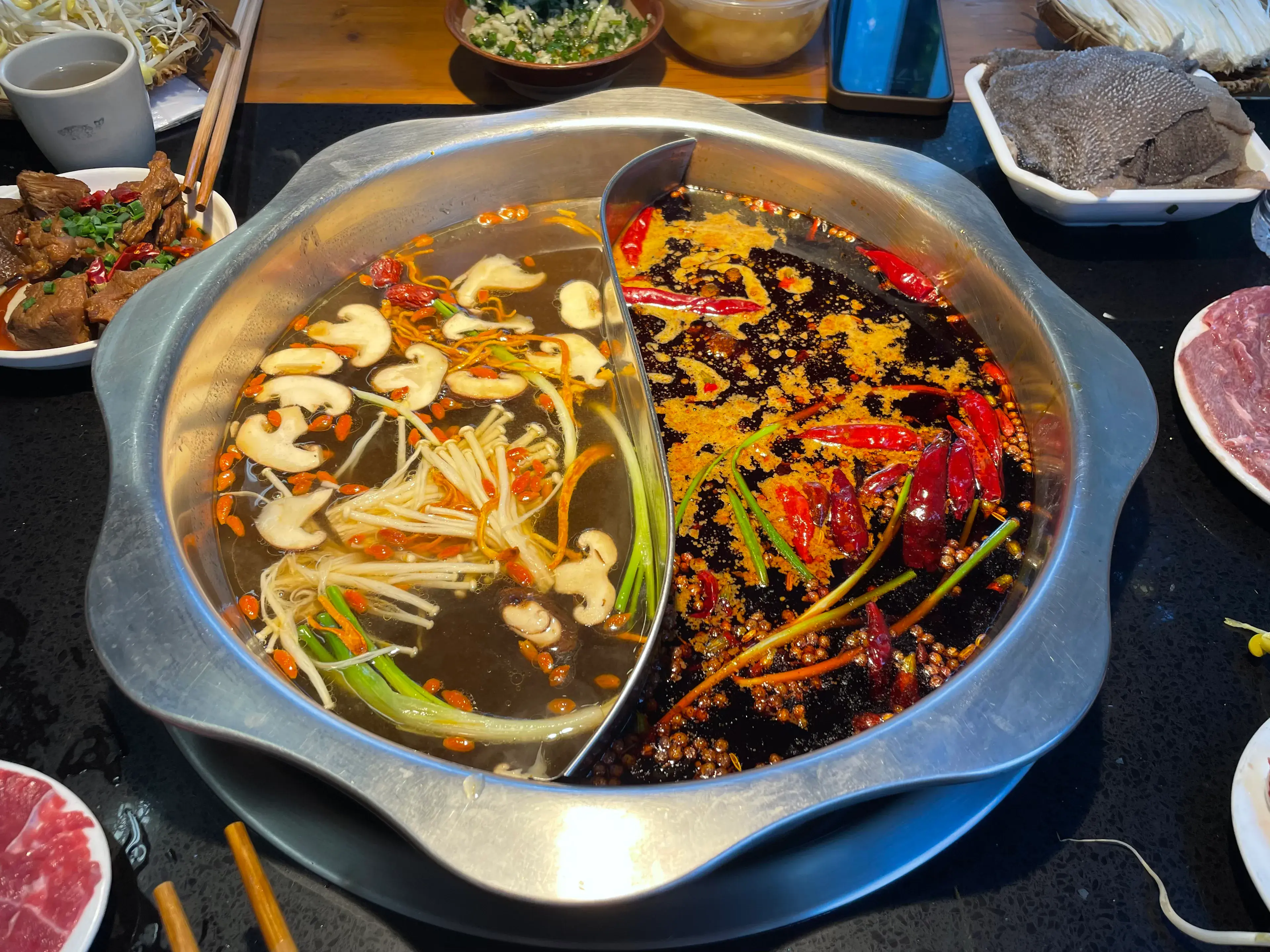
The base of most traditional Chongqing hotpot broth is beef tallow (牛油) rendered together with dried chilli, chilli oil and Sichuan pepper (花椒, huājiāo), producing the combined chilli-heat-plus-numbing sensation known as málà (麻辣). This is the same flavour family covered on the málà guide and shared with wider Sichuan cuisine. Beef tallow gives the broth its characteristic richness and a layer of oil on top; restaurants that use lighter vegetable-oil broths are offering a deliberately milder alternative to the traditional base, not a lesser version of it.
The Nine-Grid Pot (九宫格)
Many traditional-style Chongqing hotpot restaurants serve broth in a nine-grid pot (九宫格, jiǔgōnggé)—a metal divider splitting one pot into nine sections that share the same broth but sit at different distances from the heat source. In practice this creates rough heat zones: the centre grid runs hottest and suits quick-cooking items such as tripe or duck intestine, the side grids run at a more moderate simmer, and the corner grids cook more slowly, suiting items that benefit from longer stewing. The nine-grid format is traditional and widely used, but it is not universal—many restaurants, especially newer or chain venues, use a single open pot or a two-section split pot instead.
Classic Ingredients: Tripe, Intestine And Beyond
Offal has a strong association with traditional Chongqing hotpot menus, alongside standard sliced meats and vegetables:
| Ingredient | Chinese | Notes |
|---|---|---|
| Beef tripe | 毛肚 (máodǔ) | A classic quick-cooking item; usually cooked briefly, not stewed |
| Duck intestine | 鸭肠 (yācháng) | Another quick-cooking offal item, common on traditional menus |
| Thin-sliced beef and lamb | 肥牛 / 羊肉 | Standard, widely eaten by all diners |
| Lotus root, potato, winter melon | — | Root vegetables suited to longer cooking |
| Tofu and tofu skin | 豆腐 / 豆皮 | Common, mild-tasting additions |
| Enoki mushroom, leafy greens | — | Quick-cooking vegetable options |
Offal items are a genuine and long-standing part of traditional Chongqing hotpot culture, but they are optional additions on an à la carte menu, not a required part of the meal—diners who prefer not to eat offal can order entirely around sliced meats, tofu and vegetables.
Dipping Oil (油碟)
As in Chengdu, most Chongqing hotpot restaurants offer a self-serve dipping sauce bar, most commonly built around a sesame-oil base (油碟, yóudié) with garlic and scallion, used to cool ingredients after they leave the hot broth. Some diners add a dry chilli-and-peanut mix on top. Sauce-bar setups differ by restaurant, so it is worth tasting a small amount before assembling a full bowl, especially at restaurants with unfamiliar house blends.
How To Order Spice Level
Spice terminology is the same as elsewhere in Sichuan-style hotpot dining:
- Bù là (不辣) — not spicy.
- Wēi là (微辣) — mild.
- Zhōng là (中辣) — medium.
- Tè là (特辣) — very spicy, often the restaurant default.
A meaningful caution for Chongqing specifically: many traditional restaurants default to a fully spicy broth and do not automatically offer a non-spicy option unless asked—some old-style venues serve spicy broth only, with no mild alternative at all. Confirm whether a split or mild pot is available before sitting down if spice tolerance is a concern.
Beginner-Friendly Choices
For a first Chongqing hotpot meal:
- Ask for a split pot (鸳鸯锅) if the restaurant offers one, rather than assuming a single pot can be made mild.
- Start with sliced meats and vegetables before trying offal, so the broth and spice level can be judged first.
- Order in small rounds rather than a full table of ingredients at once—cooking times vary widely between items.
- Keep the sesame-oil dip close by to cool the mouth between bites if the broth runs spicier than expected.
Non-Offal And Milder Options
Travelers who prefer to avoid offal, or who want a lower-spice meal, have real options in Chongqing despite the city's spicy, offal-forward reputation:
- Sliced beef, lamb and pork belly are standard menu items at every hotpot restaurant, offal or not.
- Tofu, mushrooms and root vegetables make up a large share of most orders regardless of spice tolerance.
- Split pots and tomato- or mushroom-based mild broths are available at many restaurants, particularly chains and newer venues aimed at a broader customer base.
- Clear broth without chilli exists at some restaurants but is less universally offered in Chongqing than in some other cities—confirm availability before arrival if this matters.
Cave Hotpot: A Traveler Phenomenon
A number of Chongqing hotpot restaurants operate inside former World War II-era air-raid shelters—tunnels originally dug into the city's hillsides for civilian protection during Japanese bombing raids, and repurposed for commercial use from the late 1970s onward. Known locally as cave hotpot or "air-raid-shelter hotpot," these restaurants are a genuine, documented local dining format and a popular draw for visitors, valued partly for the tunnels' naturally cool temperature in Chongqing's hot, humid summers. This is a real subset of Chongqing's hotpot scene, not its default format—most Chongqing hotpot restaurants are ordinary street-level or multi-storey venues, and cave-hotpot restaurants are a specific, sought-out experience rather than the typical one.
Pairing Hotpot With Chongqing Nightlife
Chongqing's riverside setting and dramatic, multi-level cityscape make it a natural fit for an evening built around a hotpot dinner followed by a night-time city view—river cruises, illuminated skyline viewpoints and the Hongyadong area are common pairings for visitors staying downtown. DragonTrail can arrange a guided hotpot dinner as part of an evening out: Chongqing hotpot night tour.
FAQ
Is all Chongqing hotpot the same spice level?
No. Spice level, oil richness and offal use vary by restaurant. Traditional venues often default to fully spicy broth; chains and newer restaurants more often offer mild or split-pot alternatives.
What is the nine-grid pot?
A metal divider splitting one pot into nine sections that share broth but cook at different speeds depending on distance from the heat. It is traditional and common, but not used at every restaurant.
Do I have to eat offal in Chongqing hotpot?
No. Offal such as tripe and duck intestine is a well-known part of the tradition, but it is ordered à la carte—sliced meats, tofu and vegetables make up a complete meal on their own.
What is cave hotpot?
Hotpot restaurants operating inside former WWII-era air-raid shelters, repurposed from the late 1970s onward and valued for their cool tunnel temperature. It is a real, popular format, not the city's only or default hotpot setting.
Can I get a non-spicy hotpot in Chongqing?
Often, yes, especially at chains and newer restaurants offering split pots or mild broths—but some traditional venues serve spicy broth only. Ask before sitting down if this matters.
How is Chongqing hotpot different from Chengdu hotpot?
Both share the same core chilli-tallow pantry; Chongqing has a stronger reputation for offal and intensity, Chengdu for a slightly milder average. See Chengdu vs Chongqing hotpot for detail.
What should I order as a first-timer?
Sliced meats, tofu and vegetables to start, with a split pot if available, ordered in small rounds rather than all at once.
Can DragonTrail arrange a Chongqing hotpot evening?
Yes. See the Chongqing hotpot night tour, which pairs dinner with the city's night-time riverside views.
Continue with Chinese hotpot
Book Chongqing hotpot experiences
Sources & Review
- Chinese Culinary Association — Eight Great Cuisines educational framework (Sichuan flavour context)
- Fuchsia Dunlop, *Land of Plenty* — Sichuan and Chongqing hotpot pantry background
- AP News — WWII-era air-raid-shelter hotpot restaurants in Chongqing
- Chongqing municipal cultural tourism materials on air-raid-shelter adaptive reuse
- Chinese characters verified
- Author: DragonTrail editorial
- Last reviewed: August 2026