
| Risk | Why travelers miss it | What to confirm |
|---|---|---|
| Broth / stock | “Vegetable pot” can still use bone stock | Ask what the soup is made from |
| Animal fat | Mala and Sichuan-style bases often use beef tallow | Oil vs tallow; vegetable-oil option |
| Sauces | Oyster sauce, shrimp paste, meat floss dips | Sauce-bar ingredients |
| Cross-contact | Shared pot + shared tongs | Dedicated pot / utensils |
| Related pages | Vegetarian & Vegan Food in China | Wider dining context |
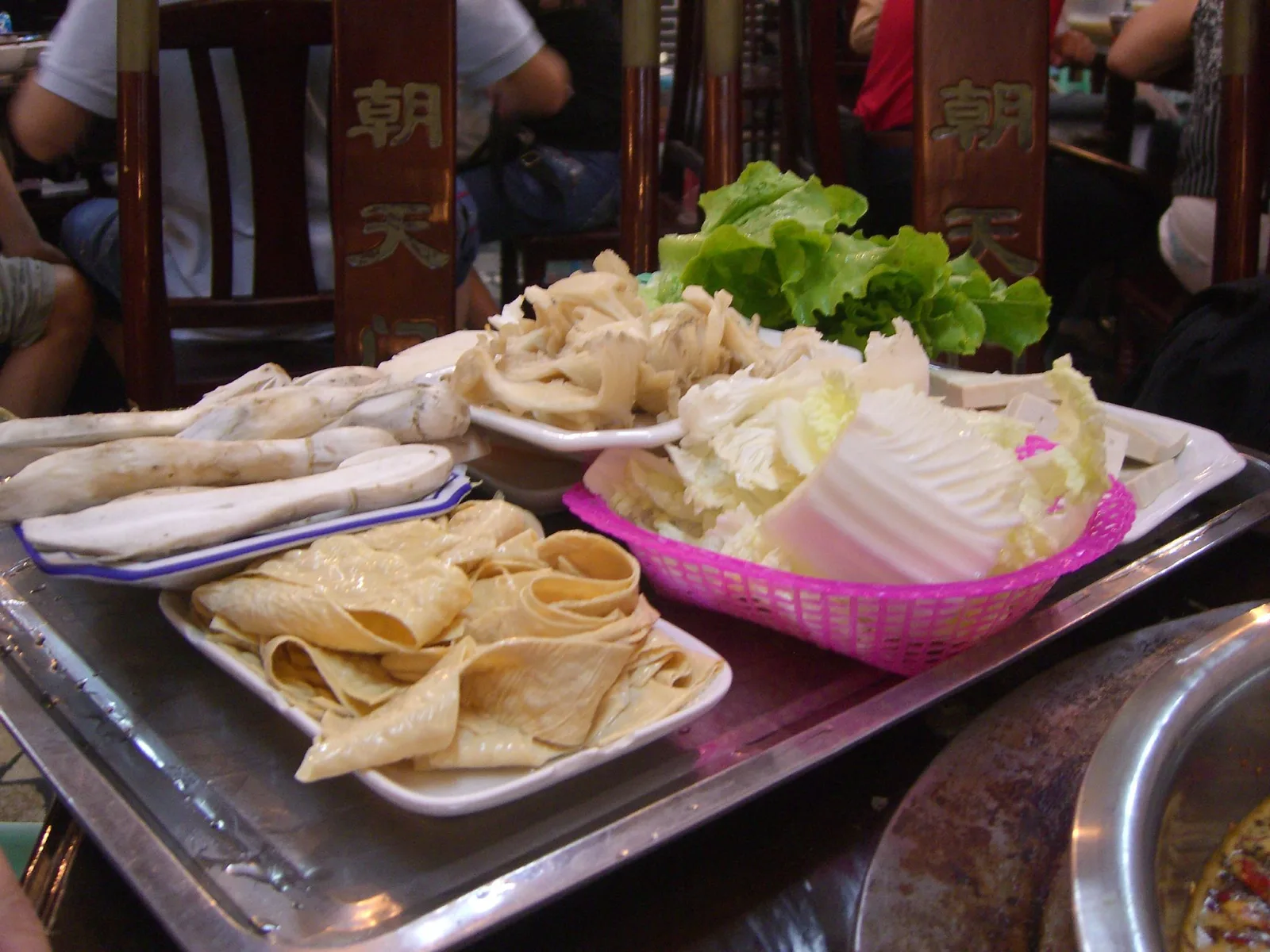
*Vegetable and mushroom trays commonly ordered for Sichuan-style hot pot. Plant ingredients do not guarantee a vegetarian broth, cooking fat or sauce bar—confirm stock and fat separately. DragonTrail editorial image.*
Vegetable Plates ≠ Vegetarian Meal
Hot pot menus make it easy to order lotus root, mushrooms, tofu, greens and noodles—see Hot Pot Ingredients. Those trays look plant-based, and many travelers assume the meal is vegetarian once meat is skipped. In a typical Chinese hot pot restaurant that assumption fails for three structural reasons:
- The broth is usually meat-based unless the kitchen explicitly builds a vegetable stock.
- The oil layer in spicy pots is often beef tallow (牛油) or another animal fat.
- Shared-pot dining means another diner’s meat, offal or seafood cooks in the same liquid you are eating from.
Treat vegetable ordering as the easy half of the problem. The hard half is broth, fat, sauce and pot discipline. For national vegetarian dining beyond hot pot, see Vegetarian & Vegan Food in China.
Broth: The Main Hidden Animal Ingredient
Most hot pot broths—clear, tomato, mushroom and mala alike—can include chicken, pork or beef bone stock. A “mushroom broth” may still be finished on a meat base; a tomato pot may be tomato-flavored meat stock. Only a kitchen that states vegetable stock / 素汤 (and can explain the fat) is a reliable starting point.
Practical questions to ask (or show in writing):
- 这个锅底是素的吗?— Is this broth vegetarian?
- 有没有用鸡汤 / 骨头汤?— Does it use chicken stock / bone stock?
- 油是牛油还是植物油?— Is the fat beef tallow or vegetable oil?
See Hot Pot Broths & Soup Bases for how national broth families are built, and the Chinese Hot Pot hub for regional styles.
Animal Fat in Spicy Broths
Sichuan- and Chongqing-style mala pots frequently rely on beef tallow for body and aroma. Ordering “no meat” while keeping a classic spicy pot can still leave you eating animal fat. Some restaurants can prepare a vegetable-oil chilli base or a mild vegetable broth on request; others cannot. Do not assume “微辣 / mild spicy” means vegetarian—mild refers to chilli level, not diet.
Vegan travelers should treat tallow the same way as meat stock: confirm or avoid.
Sauces and the Dip Bar
Self-serve sauce bars are part of how most people eat hot pot—sesame paste, garlic, chilli oil, fermented tofu, scallion. Hidden animal products can include:
- Oyster sauce or seafood extracts in house mixes.
- Shrimp paste or dried shrimp in chilli oils.
- Meat floss or lard-based pastes in some regional dips.
- Shared spoons that have already touched meat-based sauces.
Ask which dips are vegetarian/vegan, or mix a simple sesame-oil + garlic + cilantro dip from ingredients staff confirm as plant-only. When in doubt, skip complex house pastes.
Cross-Contact at a Shared Pot
Even with a vegetarian broth, a shared pot becomes non-vegetarian the moment meat, offal, fish balls or shrimp go into the same liquid. Options that reduce risk:
- Book a table where everyone orders vegetarian ingredients.
- Request a dedicated pot (or a private split side that meat never enters).
- Use dedicated serving utensils so meat tongs never move vegetarian food.
Cross-contact standards vary widely; street-adjacent shops and busy chains may have limited flexibility. Specialist Buddhist vegetarian (斋) restaurants and modern vegan hot pot shops—where they exist in large cities—are usually easier than improvising at a general mala chain.
Vegan vs Vegetarian at the Hot Pot Table
| Need | Extra checks beyond “no meat” |
|---|---|
| Lacto-ovo vegetarian | Confirm no meat stock/fat; egg may appear in some fish-ball-style products or wrappers—ask |
| Vegan | Also exclude egg, dairy, honey; confirm vegetable oil; avoid oyster/shrimp sauces |
| Buddhist-style (斋) | May also avoid garlic, leek, onion (五荤)—ask the venue’s rule set |
English menus that say “vegetable” rarely encode these distinctions. Use Chinese confirmation when the meal matters.
Where Plant-Forward Hot Pot Is Easier
Large cities—Beijing, Shanghai, Chengdu, Guangzhou and similar—are more likely to have Buddhist vegetarian restaurants, vegan cafés that run hot-pot nights, or chains that advertise a 素汤 option. Tourist-heavy Sichuan/Chongqing mala specialists built around beef tallow and offal need more questioning. Beijing’s classic mutton copper-pot format is meat-centered by design—vegetable sides may exist, but the default broth identity is not vegetarian.
When a specialist vegetarian venue is unavailable, the least-fragile improvisation is usually: confirmed vegetable broth + vegetable oil + plant ingredients only + dedicated pot.
Common Misconceptions
- "I ordered only vegetables, so the meal is vegetarian." Broth and fat can still be animal-based.
- "Mushroom or tomato broth is automatically vegetarian." Flavoring is not the same as a vegetable stock base.
- "Tofu and greens make a vegan hot pot." Not if the pot contains tallow, bone stock, egg products or seafood sauces.
- "Split pot solves everything." Only if the vegetarian side never receives meat and the broth itself is vegetarian.
FAQ
Are vegetable hot pot ingredients enough for a vegetarian meal?
No. Broth, cooking fat and sauces often contain animal products even when every tray you order is plant-based. Confirm the soup base and oil before assuming the meal is vegetarian.
Is hot pot broth usually vegetarian?
No. Most clear, tomato, mushroom and mala broths can include meat or bone stock unless the restaurant explicitly builds a vegetable soup (素汤). See Hot Pot Broths & Soup Bases.
Does Sichuan spicy hot pot use animal fat?
Often yes—many Sichuan- and Chongqing-style pots use beef tallow (牛油). Ask whether a vegetable-oil base is available if you avoid animal fat.
Can I share a pot if others order meat?
Shared-pot liquid mixes everything. For a vegetarian or vegan meal, use a dedicated pot or dine only with plant ingredients in a confirmed vegetarian broth.
What should vegans double-check?
Besides meat stock and tallow, confirm no egg products, dairy, honey, oyster sauce or shrimp paste in sauces and fish-ball-style items, and ask for vegetable oil.
Where can I learn about vegetarian dining beyond hot pot?
See Vegetarian & Vegan Food in China for Buddhist 斋 restaurants, hidden animal ingredients and city practicality, plus Hot Pot Ingredients for plant trays commonly ordered at the table.
Does “mild spicy” mean vegetarian?
No. Mild (微辣) refers to chilli intensity, not diet. A mild mala pot can still use beef tallow and meat stock.
Continue with Chinese Hot Pot
Dietary context
Sources & Review
- DragonTrail Vegetarian & Vegan Food in China — 素菜 / 斋菜 framing and hidden animal ingredients
- TravelChinaGuide — Chengdu and Sichuan regional dining context for mala / tallow norms
- Chinese characters verified
- Author: DragonTrail editorial
- Last reviewed: August 2026