
| Item | Chengdu | Chongqing |
|---|---|---|
| Broth base | Chilli oil / beef tallow, often lighter oil ratio | Beef tallow, often heavier and richer |
| Typical spice default | Adjustable; many diners order medium | Often defaults to fully spicy unless asked |
| Offal emphasis | Present, moderate | Strongly associated, more prominent on menus |
| Pot format | Split pot (鸳鸯锅) very common | Nine-grid pot (九宫格) traditional; split pot also common |
| Notable local format | Teahouse/evening dining culture pairing | Cave hotpot in former air-raid shelters |
| Related pages | Chengdu Hot Pot | Chongqing Hot Pot |
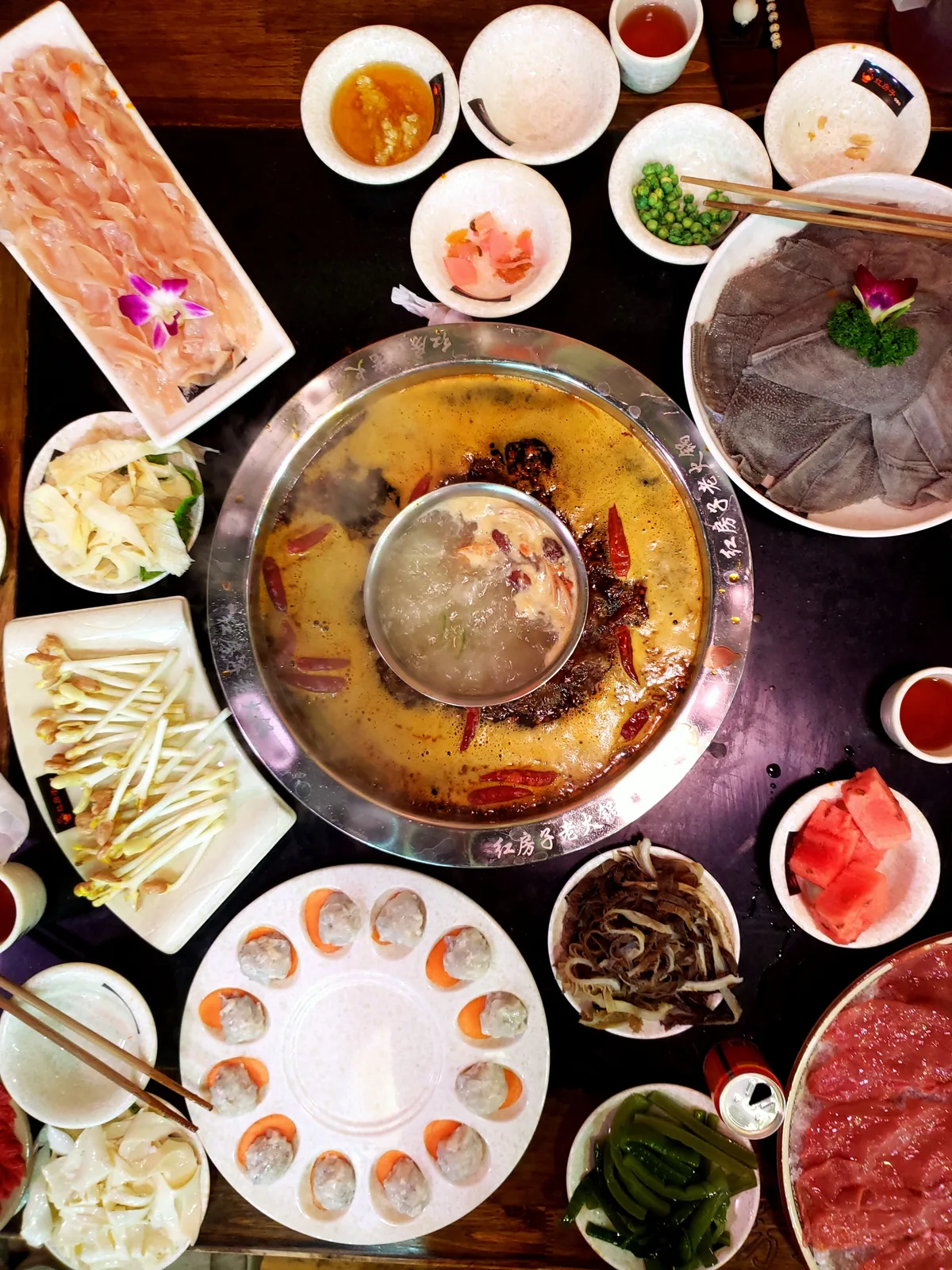
*A shared meal centred on a divided spicy hotpot.*
Why These Two Cities Get Compared
Chengdu and Chongqing sit close together geographically, share Sichuan pepper and chilli-oil traditions, and are the two cities most travelers associate with what is loosely called "Sichuan-style hot pot." Historically part of the same province until Chongqing became a separate municipality in 1997, the two cities' food cultures grew from overlapping roots—which is exactly why the comparison matters and why treating them as identical misses real, if inexact, differences that locals and long-time visitors do notice. See the Chinese Hot Pot hub for how these two styles fit into the wider national picture, and Sichuan Hot Pot for the regional umbrella both belong to.
Broth: Tallow Ratio and Richness
Both cities build their classic broth on chilli, Sichuan pepper and fat, but Chongqing's tradition is more strongly identified with beef tallow (牛油) as the dominant fat, giving the broth extra richness, body and a visible oil layer. Chengdu restaurants also use beef tallow but more often blend it with vegetable oil or offer a lighter-oil version as a deliberate milder alternative. Neither city uses one fixed ratio across every restaurant—this is a tendency in emphasis, not a laboratory-verified formula that every kitchen follows.
Spice Intensity and Defaults
A meaningful practical difference is the default spice level a restaurant serves without being asked. Many traditional Chongqing restaurants default to a fully spicy broth and, at some old-style venues, do not offer a non-spicy alternative at all unless a split pot is specifically requested. Chengdu restaurants more commonly build a mild option—clear, tomato or mushroom broth—into the standard menu, and asking for medium spice is a more reliable route to a moderate result. Both cities use the same spice vocabulary:
- Bù là (不辣)—not spicy.
- Wēi là (微辣)—mild.
- Zhōng là (中辣)—medium.
- Tè là (特辣)—very spicy.
Confirm availability of a mild or split option before sitting down in Chongqing specifically, since it is less guaranteed there than in Chengdu.
Offal: How Central Is It?
Offal—beef tripe (毛肚), duck intestine (鸭肠), duck blood (鸭血)—appears on both cities' menus, but Chongqing's traditional identity leans more heavily on offal as a signature category, while Chengdu menus tend to give offal a smaller, more optional share of the ordering list relative to standard sliced meats and vegetables. In both cities, offal is ordered à la carte, so travelers who prefer to skip it can build a complete meal from meat, tofu and vegetables regardless of which city they are in.
Pot Format: Split Pot vs Nine-Grid
Chengdu restaurants commonly offer the split pot (鸳鸯锅, yuānyāng guō), dividing one pot into two broths side by side. Chongqing's more traditional-style restaurants often use a nine-grid pot (九宫格, jiǔgōnggé), a metal divider splitting one pot into nine sections that sit at different distances from the heat, creating rough hot and cool zones for different ingredients. Neither format is exclusive to one city—Chongqing restaurants also use split pots, and Chengdu restaurants occasionally use grid dividers—but the nine-grid format is more closely tied to Chongqing's traditional dining scene.
Atmosphere and Dining Culture
Chengdu's hot pot culture sits inside a broader teahouse and slower-paced evening-leisure identity, and a hot pot dinner is commonly paired with an evening activity such as a Sichuan opera performance. Chongqing's hot pot culture is tied more to the city's dramatic riverside topography and night-time skyline, and to a distinctive local format—cave hotpot, served inside former WWII-era air-raid shelters repurposed from the late 1970s onward, valued partly for their cool tunnel temperature in summer. Neither city's atmosphere is "better," but the surrounding experience differs.
Side-by-Side Comparison Table
| Factor | Chengdu tendency | Chongqing tendency |
|---|---|---|
| Broth / fat | Chilli oil and/or beef tallow; often a lighter oil ratio | Beef tallow more strongly identified; richer, heavier broth |
| Chilli / Sichuan pepper | Same mala pantry; defaults more often adjustable | Same mala pantry; defaults more often fully spicy |
| Pot formats | Split pot (鸳鸯锅) very common | Nine-grid pot (九宫格) traditional; split pot also common |
| Ingredients | Wide menu; offal present but more optional | Wide menu; offal (tripe, duck intestine) more central |
| Dipping sauce | Sesame-oil (油碟) bar with garlic, cilantro, scallion | Same sesame-oil / sauce-bar pattern in most venues |
| Atmosphere | Teahouse and slower evening-leisure pairing | Riverside night dining; cave hotpot in former shelters |
| Beginner-friendliness | Higher—mild and split options more often built in | Lower unless you confirm mild/split before sitting |
| What to choose | Mixed groups, first-timers wanting flexibility | Travelers seeking the more intense, traditional-leaning default |
Which Should a First-Time Visitor Try?
Neither city's version is objectively "better"—the choice depends on spice tolerance and what kind of evening a traveler wants. A heat-sensitive first-timer visiting either city should default to a split pot and confirm a mild option is available before ordering; a traveler specifically chasing the more intense, offal-forward experience associated with the tradition may find Chongqing's traditional-style restaurants a closer match to that expectation, while Chengdu offers more built-in flexibility for mixed groups. Visiting both cities and comparing hot pot directly is a common and practical way for travelers to judge the difference for themselves rather than relying on any single description.
Common Misconceptions
- "Chengdu and Chongqing hot pot are the same thing." They overlap heavily but differ in typical intensity, offal emphasis and pot format.
- "Chongqing hot pot is always unbearably spicy." Spice is adjustable at most restaurants, though some traditional venues default to spicy-only.
- "Only Chongqing uses the nine-grid pot." It is more closely associated with Chongqing but is not the only format used there, and it is not entirely absent from Chengdu.
FAQ
What is the main difference between Chengdu and Chongqing hot pot?
Chongqing's tradition leans toward a heavier beef-tallow broth, more offal emphasis and a spicier default; Chengdu's tends to run slightly milder on average with more built-in mild-broth options. Both share the same core mala pantry.
Is Chongqing hot pot spicier than Chengdu hot pot?
Generally, yes, on average—many Chongqing restaurants default to fully spicy broth—but individual restaurants in both cities vary, and mild options exist in both.
What is the nine-grid pot and where is it used?
A nine-grid pot (九宫格) divides one pot into nine sections at different distances from the heat, creating hot and cool zones. It is more closely associated with traditional Chongqing hot pot restaurants than with Chengdu.
Which city has more offal on the menu?
Chongqing's traditional menus tend to feature offal, such as tripe and duck intestine, more prominently, though it remains an optional à la carte item in both cities.
Can I get a mild hot pot in Chongqing?
Often yes, especially at chains and newer restaurants, but some traditional venues serve spicy broth only—confirm availability of a split or mild pot before sitting down.
Should I visit Chengdu or Chongqing for hot pot?
Both are legitimate hot pot destinations. Chengdu offers more built-in flexibility for mixed-spice groups; Chongqing offers the more intense, traditional-leaning experience many travelers specifically seek out.
Are Chengdu and Chongqing hot pot part of the same regional tradition?
Yes—both fall within the wider Sichuan hot pot tradition and share its mala flavor system, chilli-oil pantry and shared-pot format.
Continue with Chinese Hot Pot
City hot pot guides
Sources & Review
- Chinese Culinary Association — Eight Great Cuisines educational framework (Sichuan cuisine context)
- Fuchsia Dunlop, *Land of Plenty* — Sichuan and Chongqing hot pot pantry background
- AP News — WWII-era air-raid-shelter hotpot restaurants in Chongqing
- Chinese characters verified
- Author: DragonTrail editorial
- Last reviewed: August 2026