
Chinese Bronzeware at a Glance
| Topic | Orientation |
|---|---|
| Chinese term | 青铜器 |
| Pinyin | qīngtóngqì |
| Major Bronze Age periods | Erlitou / Shang / Zhou |
| Core object family | Ritual vessels |
| Important technologies | Piece-mold casting, casting-on, later lost-wax methods |
| Important decoration | Taotie, dragons, birds, geometric motifs |
| Writing | Bronze inscriptions / jinwen |
| Ritual music | Zhong and bianzhong |
| Major regional tradition | Sanxingdui / ancient Shu |
| Later development | Song–Qing archaistic bronze revival |
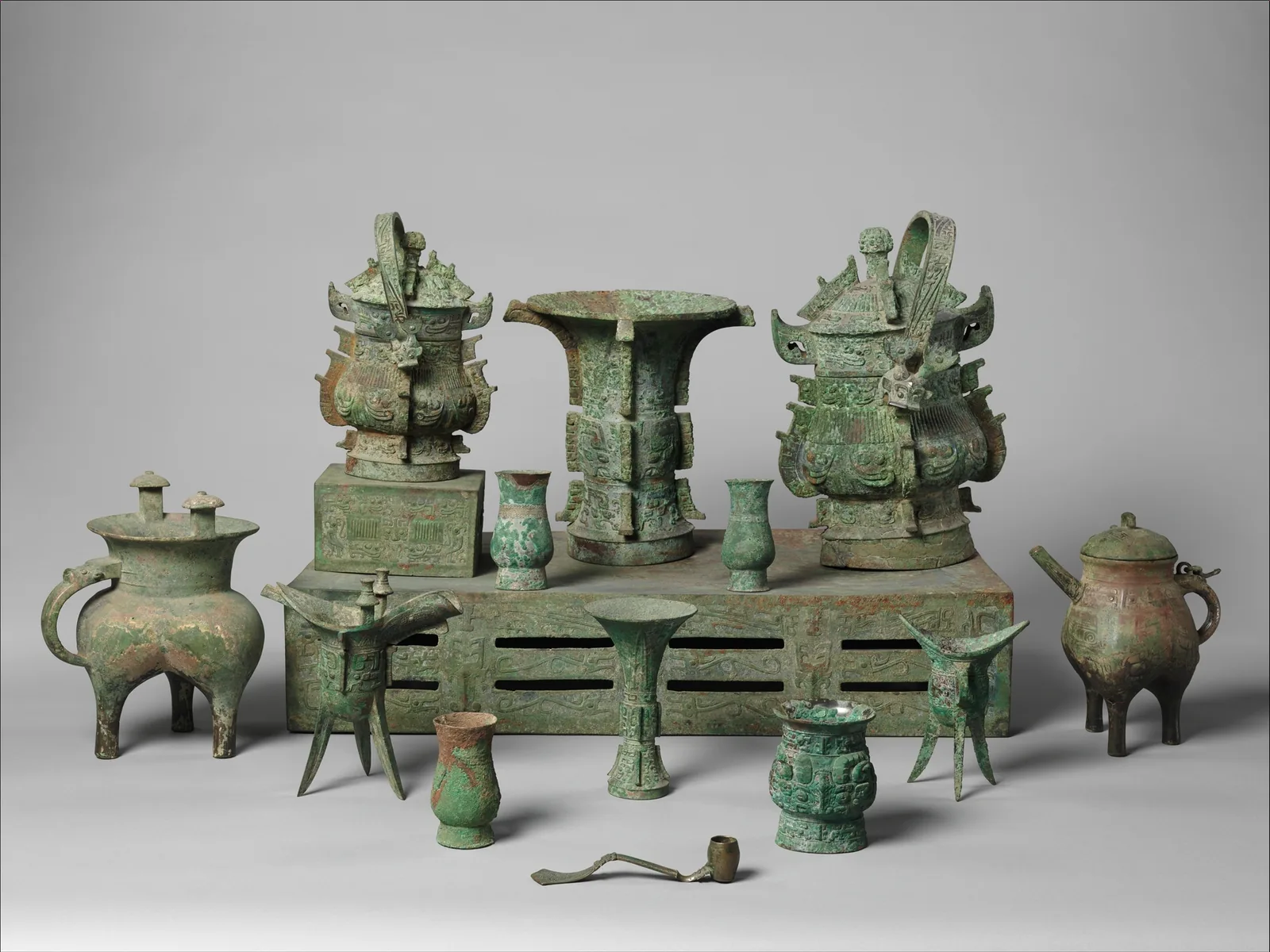
*Ritual altar set with multiple bronze vessels, late 11th century BCE. The Metropolitan Museum of Art — Public Domain.*
What Is Chinese Bronzeware?
Chinese bronzeware means objects made primarily from bronze—copper alloys commonly containing tin and often lead in varying proportions—within Chinese historical and archaeological traditions. In museum practice the term covers far more than “art bronzes.” Travelers walking a Shang or Zhou gallery will usually see:
- Ritual vessels for food, wine and water offerings
- Bells and related musical instruments
- Weapons and armor fittings
- Chariot and harness fittings
- Occasional tools and other cast objects
The English word *bronzeware* is useful because it keeps the category open. Calling every ancient Chinese bronze a “sculpture” collapses the most important distinction in the galleries: most early masterpieces are containers and instruments, not free-standing statues of people or gods. For the sculpture side of the story, see Chinese Bronze Sculpture.
For travelers, the practical test is simple. If the object has a mouth, belly, legs and handles designed to hold offerings, it is vessel logic. If it is a freestanding human or animal image meant to be viewed as a figure, it sits closer to sculpture logic—even when both are bronze.
Why Bronze Became So Important
Bronze mattered because it was hard to produce, expensive relative to ceramic, and durable enough to carry political and ancestral meaning across generations. Early Chinese elites used bronze for the equipment of ritual and warfare—the two arenas where status was most publicly performed.
Archaeology and museum catalogues show bronze vessels deposited in tombs, sometimes in large sets, and sometimes inscribed with dedications or administrative language. That combination of technical cost and ritual use is why Shang–Zhou bronzes sit at the center of China’s Bronze Age story, not because bronze was the only material people used day to day.
Bronze also created a durable writing surface. When workshops cast inscriptions into vessels, they fused metallurgy with administration and memory. A ding could feed a ritual and still announce who commissioned it. That dual role—object and document—helps explain why bronzeware remains foundational for Chinese archaeology and early history.
China’s Bronze Age in One Timeline
Treat dates as scholarly orientation, not tourist slogans. Approximate traveler chronology:
| Phase | Rough frame | What travelers should notice |
|---|---|---|
| Early bronze experiments | 2nd millennium BCE and earlier | Workshops and early vessel forms appear in Central Plains contexts (e.g. Erlitou culture; its relationship to textual Xia history remains debated) |
| Shang | c. 1600–1046 BCE | Dense ritual vessel systems; Anyang (Yinxu) late capital assemblages; taotie decoration |
| Western Zhou | c. 1046–771 BCE | Continuity from Shang forms; longer inscriptions; food-vessel emphasis grows in many contexts |
| Eastern Zhou | 770–256 BCE | Regional styles; bells and inlay become more visible; political fragmentation of bronze taste |
| Later Chinese history | Han onward | Archaistic and collecting traditions revive Bronze Age forms in new materials and meanings |
Iron appears toward the end of the Eastern Zhou period in Chinese archaeology; that does not erase bronze’s ritual prestige. Related crafts: Chinese Arts and Crafts.
Ritual Vessels
Ritual bronze vessels are the heart of Chinese bronzeware as most travelers encounter it. Shapes such as Ding (鼎, dǐng), Gui (簋, guǐ), Jue (爵, jué), Gu (觚, gū), Zun (尊, zūn), You (卣, yǒu) and Hu (壶, hú) were cast as high-status containers for offerings, not as empty “decorative antiques.”
Dedicated guide: Ritual Bronze Vessels.
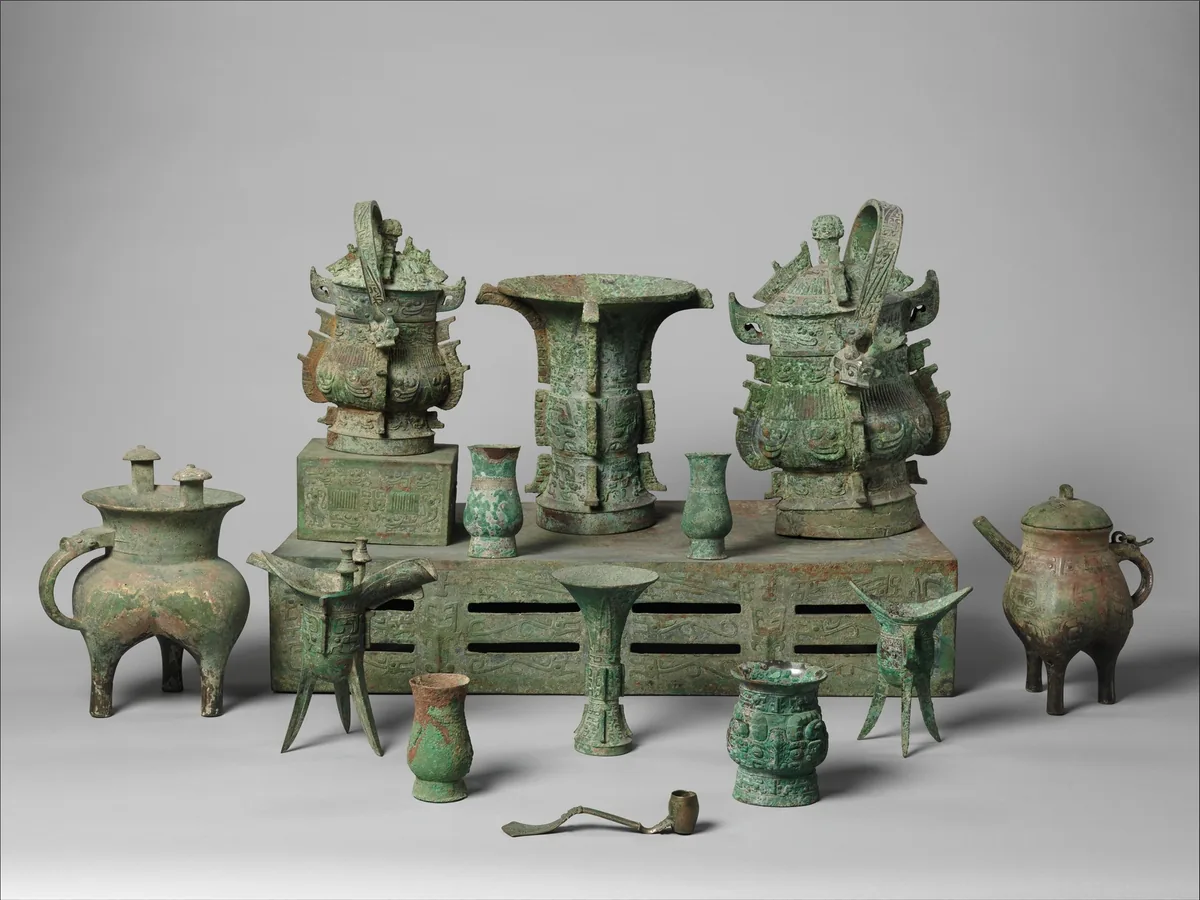
*Ritual altar set with multiple bronze vessels (inline view). The Metropolitan Museum of Art — Public Domain.*
Shang Bronzes
Shang bronzes are the vessels, weapons and related objects cast mainly during the Shang dynasty, with late capital archaeology at Anyang (Yinxu) providing some of the densest published assemblages. Shang decorative programs often feature taotie masks and dense animal ornament; inscriptions are usually short.
Guide: Shang Bronzes.
Zhou Bronzes
Zhou bronzes continue Shang casting traditions after the Zhou conquest and then transform them. Western Zhou examples often carry longer inscriptions about gifts, appointments and lineage claims. Eastern Zhou production diversifies regionally; bells and inlaid decoration become especially visible in many collections.
Guide: Zhou Bronzes.
Taotie and Animal Motifs
Taotie (饕餮, tāotiè) is the conventional name for the frontal animal-like mask on many Shang and early Zhou vessels. Eyes on a central axis are the most stable landmark; horns, jaws and split bodies may appear. The original Bronze Age meaning remains uncertain—describe first, interpret cautiously.
Guide: Taotie Motifs.
Bronze Inscriptions
Cast inscriptions (金文, jīnwén; often called bronze script) range from short clan marks to longer Western Zhou texts recording events, gifts and status claims. They are primary historical evidence when read carefully with archaeology—not mystical captions for every motif on the vessel.
Guide: Bronze Inscriptions.
How Ancient Chinese Bronzes Were Cast
Most Shang–Zhou ritual vessels were produced by piece-mold casting: artisans built clay molds in sections around a model, assembled them, and poured molten bronze. The method allowed sharp relief decoration and complex vessel profiles without requiring lost-wax for every masterpiece. Technical detail: Bronze Casting Techniques.
Sanxingdui Bronzes
Sanxingdui bronzes belong to the ancient Shu cultural sphere in Sichuan. Large masks, standing figures and tree-like bronzes from sacrificial pits are not a minor workshop variation of Anyang Shang vessels. They are a regional Bronze Age tradition that forces travelers to widen the map beyond the Central Plains.
Public archaeology writing often places Sanxingdui horizons in broad contemporaneity with late Shang discussions, but contemporaneity is not identity. Different object priorities, facial conventions and deposition practices mean Sichuan and Anyang should be compared, not collapsed.
Guide: Sanxingdui Bronzes.
Bronze Bells and Bianzhong
Bronze bells, including sets known as Bianzhong (编钟, biānzhōng), show that Chinese bronzeware is also a musical and ceremonial instrument tradition. Sets can encode pitch relationships and elite performance culture, especially in Zhou contexts.
Guide: Bronze Bells and Bianzhong.
Later and Archaistic Bronzes
Later Chinese dynasties collected, catalogued and remade Bronze Age forms. Archaistic bronzes and antiquarian copies can look “ancient” without being Shang or Zhou originals. Dating depends on fabrication clues, inscriptions, archaeology and museum attribution—not atmosphere alone.
Guide: Archaistic Bronzes.
Bronzeware vs Bronze Sculpture
| Category | Typical objects | Traveler confusion |
|---|---|---|
| Bronzeware | Ritual vessels, bells, weapons, fittings, inscribed containers | Calling every Shang vessel a “statue” |
| Bronze sculpture | Free-standing figures, masks meant as images, later Buddhist gilt-bronze icons, palace animals | Assuming all Chinese bronze history is figural sculpture |
| Sanxingdui overlap | Figural bronzes and masks within a regional bronzeware story | Treating Shu bronzes as ordinary Anyang ding sets |
Deep sculpture reading: Chinese Bronze Sculpture.
How to Look at a Chinese Bronze in a Museum
- Read the label for period and site before inferring a story from the motif alone.
- Identify the object type—vessel, bell, weapon, fitting or figure.
- Name the vessel shape if it is a container (ding, gui, jue, gu, zun, you, hu…).
- Check function class—food, wine or water—when the gallery or catalogue indicates it.
- Scan decoration structure: eyes/axis (taotie?), dragons, birds, leiwen ground.
- Look for inscriptions inside, under the rim or on lids; short marks still matter.
- Ask how it was cast—piece-mold joins and relief sharpness are technical clues.
- Separate evidence from interpretation: “excavated at X” is evidence; “meant to scare spirits” is interpretation unless the label argues it.
Where Travelers Can See Chinese Bronzeware
Museum displays rotate, so confirm current gallery information with the institution before visiting.
- Beijing — National Museum of China: Shang, Zhou and other bronzes appear within the permanent Ancient China galleries (currently listed across Galleries N20–N25 and S15–S20) and collection-based exhibitions; check the current exhibition guide before visiting. Do not assume a separately listed permanent “Ancient Chinese Bronzeware Gallery.” The Palace Museum holds major bronzes, but which pieces are on view can change with rotations—confirm current displays.
- Shanghai — Shanghai Museum East currently maintains a dedicated Ancient Chinese Bronze Gallery, with English guided tours offered for that gallery. For travelers with limited inland time, this is the clearest dedicated bronze-gallery recommendation in a major coastal city.
- Xi’an / Shaanxi — Provincial and related museums present Western Zhou and Shaanxi archaeological bronzes that pair well with later Qin–Han itineraries. The Terracotta Warriors are a later Qin project, not Zhou bronzeware, but they sit on the same historical travel arc.
- Chengdu / Sichuan — Sanxingdui Museum (Guanghan area) remains the principal destination for ancient Shu bronzes and regional Bronze Age contrast with Anyang-centered narratives.
- Henan — Anyang / Yinxu-related museums add late Shang capital context that coastal galleries can only summarize. Treat that as an optional deep stop, not a requirement for every first trip.
Turn Bronze Age History into a China Itinerary
Bronzeware galleries reward unhurried looking. These museums can be incorporated into broader Beijing, Xi’an or Chengdu itineraries when early Chinese history is a priority:
- Explore Imperial Beijing — private Beijing planning that can leave real time for the National Museum’s Ancient China galleries alongside Forbidden City and hutong days.
- Continue into Ancient Xi’an — Xi’an continuation for travelers following China’s early dynastic arc; Terracotta Warriors are Qin, not Shang–Zhou bronzeware.
- Explore Chengdu & Ancient Shu — Chengdu-based planning for Sanxingdui and Sichuan archaeology after Central Plains museum days.
Common Misconceptions
- Chinese bronzeware is not the same as bronze sculpture. Most Shang–Zhou masterpieces are vessels, bells and fittings.
- Not every important Chinese bronze is from Anyang. Anyang is crucial; it is not the whole Bronze Age map.
- Sanxingdui is not a minor Shang style variant. It is a regional Shu tradition with different object priorities.
- Taotie does not have one settled symbolic meaning. Designs vary; meaning is debated.
- Long inscriptions are not present on every vessel. Many Shang examples are short or unmarked.
- Vessel count alone does not mechanically prove rank for every tomb. Literary rank schemes and archaeological assemblages must be compared carefully.
- “Looks ancient” does not prove Shang date. Later archaistic bronzes deliberately revive early forms.
- Bronze Age China is not only ding tripods. Wine, water and food vessel systems, plus bells and weapons, share the story.
- Calling every mask a monster from later mythology is unsafe. Later texts and Bronze Age decoration are not automatic synonyms.
Explore Chinese Bronzeware
- Ritual Bronze Vessels
- Shang Bronzes
- Zhou Bronzes
- Taotie Motifs
- Bronze Inscriptions
- Bronze Casting Techniques
- Sanxingdui Bronzes
- Bronze Bells and Bianzhong
- Archaistic Bronzes
Related sculpture path: Chinese Bronze Sculpture. Parent crafts hub: Chinese Arts and Crafts.
FAQ
What is Chinese bronzeware?
Chinese bronzeware (青铜器, qīngtóngqì) includes ritual vessels, bells, weapons, fittings and other bronze objects. Ritual vessels are especially central in Shang and Zhou museum displays, and the category is broader than figurative bronze sculpture.
What were ancient Chinese bronze vessels used for?
Elite ancestral and ceremonial offerings—especially food, wine and water service in Shang and Zhou ritual contexts. They were not ordinary household dinnerware for most people.
What are ding, gui, jue and zun?
Ding (鼎) and gui (簋) are major food-related vessel types; jue (爵) and zun (尊) belong to wine-serving or storage traditions. Full shape guide: Ritual Bronze Vessels.
Why were Shang and Zhou bronzes important?
They combined costly casting technology with vessel systems, animal decoration and (especially under Zhou) inscriptions that record lineage, grants and appointments—core evidence for early Chinese elite culture.
What is a taotie?
Taotie is the conventional name for the frontal animal-like mask on many Shang and early Zhou bronzes. Original Bronze Age meaning remains uncertain. Guide: Taotie Motifs.
How were ancient Chinese bronze vessels cast?
Most Shang–Zhou ritual vessels used piece-mold casting with sectioned clay molds and an internal core. Detail: Casting Techniques.
What are Chinese bronze inscriptions?
Texts cast or inscribed on bronzes (金文, jīnwén). They range from short Shang marks to longer Western Zhou records. Guide: Bronze Inscriptions.
What is special about Sanxingdui bronzes?
Sanxingdui (ancient Shu, Sichuan) produced monumental masks, heads, figures and bronze trees that differ visually from Central Plains Shang ritual vessel systems. Guide: Sanxingdui Bronzes.
Where can travelers see Chinese bronzeware in China?
Strong starts include Beijing (National Museum Ancient China galleries; Palace Museum holdings subject to rotation), Shanghai Museum East’s Ancient Chinese Bronze Gallery, Xi’an/Shaanxi museums, and Sanxingdui near Chengdu. Confirm current displays before visiting.
Sources & Review
- The Metropolitan Museum of Art — “Shang and Zhou Dynasties: The Bronze Age of China” (Heilbrunn Timeline of Art History) and related Chinese ritual bronze object records.
- The Metropolitan Museum of Art — Public Domain ritual altar set and Shang–Zhou vessel photography used for traveler orientation.
- Shanghai Museum — bronze gallery catalogues and exhibition texts for Shang and Zhou vessels.
- British Museum — Chinese bronze collection essays and object records for comparative viewing.
- National Museum of China — published Shang ritual bronze holdings (including major ding examples) and gallery orientation materials.
- Jessica Rawson — museum and scholarly overviews of Chinese bronzes, ritual systems and decorative change.
- Robert W. Bagley — studies of Shang bronze design, motif structure and casting technology.
- Archaeometallurgy literature on Chinese piece-mold casting and alloy practice (museum science and excavation reports).
Last reviewed: September 2026