
Two stones, one word
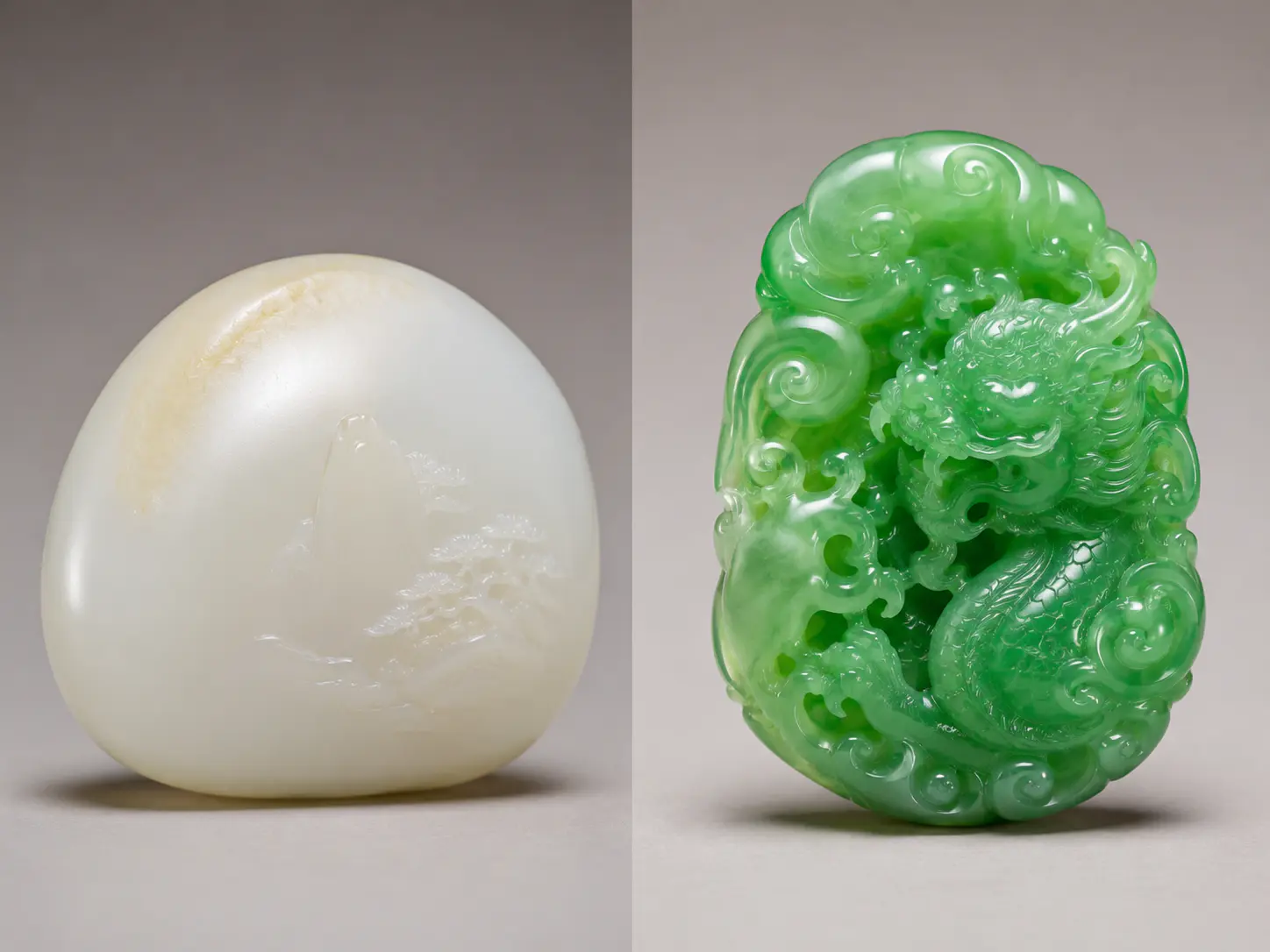 Click to enlarge
Nephrite and jadeite are both real jade, but color alone cannot prove material, treatment, origin, age, or value.
In everyday English, both nephrite and jadeite are called jade, but they are different minerals. Nephrite is the material most strongly associated with ancient and imperial Chinese jade, especially Khotan and Hetian stone from Xinjiang. Jadeite, often associated with vivid green color, came from Myanmar and became especially fashionable in Qing and modern jewelry culture. Museums usually label the material clearly; markets and souvenir shops often blur the difference.
Nephrite vs jadeite
| Attribute | Nephrite | Jadeite |
|---|---|---|
| Material family | Amphibole-group jade, traditionally important in China | Pyroxene-group jade, strongly associated with Myanmar sources |
| Common colors | White, pale green, grey-green, yellowish, brown, or russet-skinned | Green, lavender, white, black, and other colors |
| Chinese imperial context | Dominant in ancient, ritual, and Qing imperial collections | Entered Qing court use and became especially fashionable later |
| Famous source | Khotan / Hetian in Xinjiang | Myanmar / Burma |
| Beijing museum examples | Qing nephrite seals, vessels, scholar objects, and the Da Yu carving | Later Qing and modern green jadeite ornaments |
| Traveler caution | Pale or white jade can be culturally important | Bright green does not automatically mean old, rare, or valuable |
Which is 'real jade'?
Both nephrite and jadeite are real jade. The problem is not that one is real and the other is fake; the problem is that shops may use the word "jade" without explaining material, treatment, origin, or quality. In Chinese cultural history, nephrite is the older and more important material, especially for ritual objects, white jade, Hetian jade, and Qing court carvings.
- Nephrite and jadeite can both be genuine jade.
- Glass, dyed quartz, serpentine, and other stones may be sold as jade in tourist settings.
- For authenticity questions, read the real vs fake jade guide, but do not treat any online article as a substitute for expert testing.
Why creamy white matters
Many travelers expect Chinese jade to be bright green, but much of the older Chinese taste centered on nephrite, especially pale green, white, and creamy "mutton-fat" material. Khotan and Hetian nephrite carried high cultural prestige because of its texture, rarity, source, and connection with elite carving traditions. This is why a plain-looking white jade object in a museum may be more important than a brighter green souvenir.
- White jade is central to understanding Chinese jade taste.
- Hetian jade explains why Xinjiang nephrite mattered to imperial collections.
- Do not judge jade only by brightness or greenness.
When jadeite arrived
Jadeite came into Chinese court and jewelry culture through Myanmar sources. It was known in the Qing period and became especially fashionable and valuable later, particularly for vivid green ornaments. This created a different visual taste from the older nephrite tradition. For travelers, the safest summary is: ancient and imperial Chinese jade is often nephrite, while bright green jadeite belongs more strongly to later court fashion and modern jewelry culture.
- Do not treat jadeite as fake simply because it is not traditional nephrite.
- Do not treat bright green jadeite as automatically older or better.
- For the Qing context, continue to the Qing dynasty jade guide.
Traveler test
A traveler does not need to identify jade by eye. The practical test is contextual: where are you seeing it, how is it labeled, who is selling it, and what claim is being made? In museums, look for material, date, function, and provenance. In markets, be cautious with phrases such as "imperial jade," "Grade A," "old jade," or "investment quality," especially if the price seems too easy.
- Use museum labels for education, not street tests.
- Treat retail stickers and sales claims as marketing unless independently verified.
- DragonTrail does not appraise jade, certify authenticity, or guarantee market value. This guide is for cultural and traveler education only.
Museum pairing
The best Beijing comparison is the Forbidden City Treasure Gallery. Start with Qing nephrite objects such as vessels, seals, scholar pieces, and the Da Yu carving, then compare later green jadeite ornaments if they are on display. This makes the material difference visible: nephrite often carries the older Chinese cultural story, while jadeite helps explain later color fashion.
Nephrite vs jadeite mistakes
Equating jade with emerald green
Chinese jade is not always bright green. Many important museum pieces are white, pale green, grey-green, yellowish, brown, or russet-skinned nephrite.
Thinking nephrite is fake jade
Nephrite is genuine jade and is central to Chinese jade history. Many ancient ritual objects and Qing imperial pieces are nephrite, not jadeite.
Trusting retail labels too quickly
Terms such as "Grade A," "imperial," "old," or "Hetian" can be used carelessly in shops. Museum labels and independent gemological testing are different from sales language.
Nephrite vs jadeite FAQ
- Yes. Nephrite and jadeite are both real jade, but they are different minerals. In Chinese cultural history, nephrite is the older and more important material.
- Many important Forbidden City jade objects are nephrite, including major Qing imperial carvings and the Da Yu Taming the Floods carving. Some later green jadeite pieces may also appear in Qing collections.
- Yes. Hetian, also written Khotan in older contexts, is a famous nephrite source in Xinjiang and is central to Chinese white jade taste.
- Jadeite came from Myanmar sources and was known in the Qing period. It became especially fashionable and valuable later, particularly for vivid green ornaments and jewelry.
- There is no simple rule. Value depends on material quality, color, texture, carving, age, provenance, treatment, fashion, and documentation. DragonTrail does not appraise jade.
- Not reliably. Color alone is not enough. Travelers should use museum labels for education and avoid relying on street tests or sales claims.
- DragonTrail does not appraise jade, certify authenticity, or guarantee market value. This guide is for cultural and traveler education only.
Explore jade as culture, not commodity
The nephrite and jadeite distinction is easiest to understand through museum objects: Hetian white jade, Qing nephrite carvings, later green jadeite ornaments, and clearly labeled Beijing collections.
DragonTrail does not sell jade or offer authentication. For buying questions, read our traveler-education pages and treat any purchase as your own risk.