
Ancient jade before the empire
 Click to enlarge
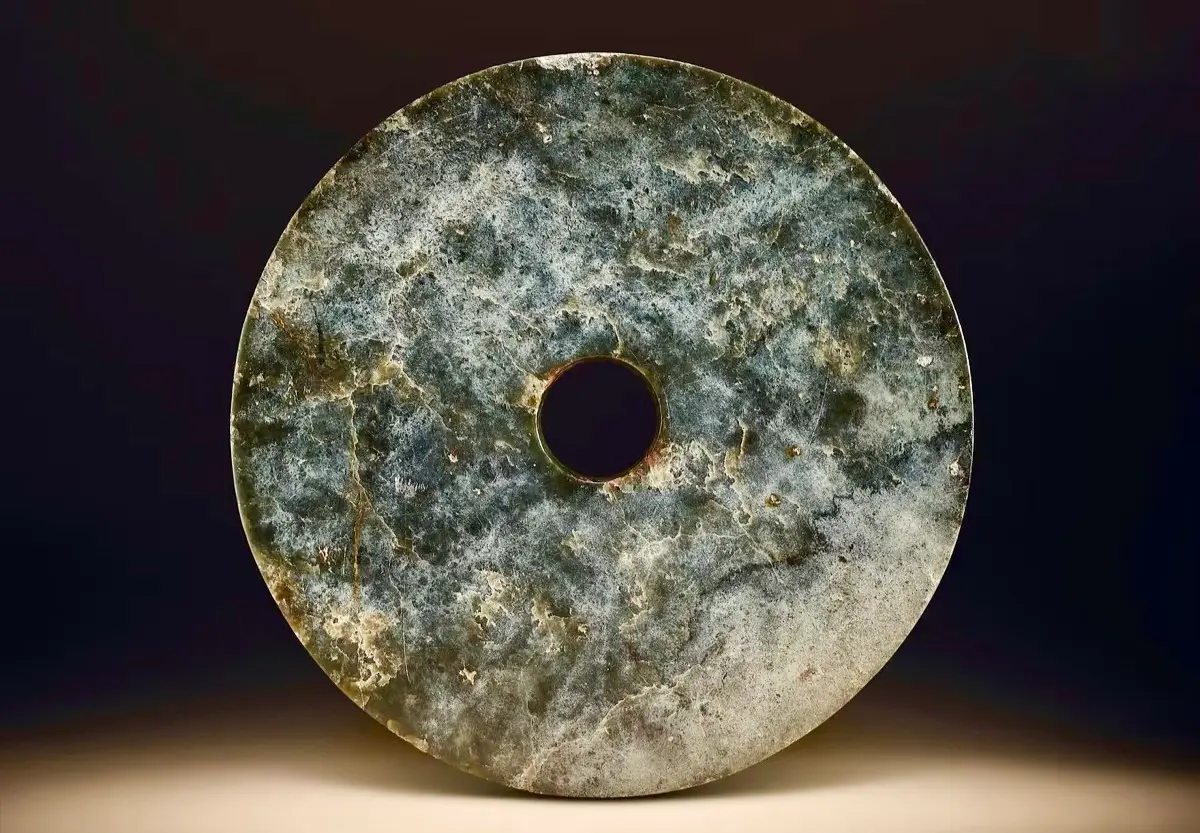
Neolithic ritual disc from the Liangzhu culture.
Ancient Chinese jade begins long before imperial China. In Neolithic cultures along the Yangtze delta and in the northeast, polished stone was buried with elites as ritual equipment rather than jewelry in the modern sense. Liangzhu culture produced the classic bi discs and cong tubes, Hongshan culture carved coiled pig-dragon forms, and later Shang and Zhou states refined ritual blades and ornaments. For travelers, the key is museum context: the National Museum of China's ancient galleries help explain burial setting, shape, material, and ritual interpretation.
Ancient jade cultures at a glance
| Culture / era | Signature forms | Traveler sight |
|---|---|---|
| Liangzhu culture | Bi discs, cong tubes | Look for early ritual geometry and elite burial context |
| Hongshan culture | Coiled pig-dragon forms | Look for early animal symbolism before imperial dragon imagery |
| Shang and Zhou | Ritual blades, ornaments | Look for jade as status, ritual, and court material |
| Han dynasty | Burial plugs, cicadas, jade suits | Look for jade's connection with body, tomb, and afterlife belief |
Liangzhu: bi discs and cong tubes
Liangzhu jade is important because it shows a highly developed ritual language before written imperial history. Bi discs are flat circular jade objects with a central hole, while cong tubes have square outer walls and a round inner bore. They are often interpreted through heaven-and-earth symbolism, but their exact meaning is still debated. In a museum, read them through shape, burial context, workmanship, and placement rather than decoration alone.
- Bi discs are circular jade forms, often plain or minimally carved.
- Cong tubes combine square outer faces with a round inner opening.
- For a deeper explanation, continue to the bi discs and cong guide.
- In Beijing, the National Museum of China is the strongest starting point for early jade context.
Hongshan and early zoomorphic jade
Hongshan culture in northeast China is known for early jade animal forms, especially coiled pig-dragon carvings. These objects show that animal symbolism in jade developed long before Qing imperial dragon workshops. Their exact meanings remain debated, so it is better to read them as early ritual or symbolic forms rather than as direct ancestors of every later dragon image.
- Coiled animal forms are among the most memorable early jade objects.
- For later motif reading, continue to the jade animals guide.
- Museum labels are important because material, date, and excavation context change the meaning.
From ritual object to burial belief
By the Han dynasty, jade became deeply connected with elite burial practice. Tombs could include jade plugs, cicada-shaped objects, and in the most famous cases, full jade burial suits made from many small plaques. These objects show jade as a funerary and status material, not as ordinary decoration.
- Han jade burial suits are among the most dramatic examples of funerary jade.
- For the wider sequence, read the Shang, Zhou, and Han jade guide.
- Burial context changes how jade symbolism should be interpreted.
How ancient jade connects to later dynasties
Later dynasties did not leave ancient jade behind. Qing emperors collected earlier objects, commissioned new carvings, and sometimes reused ancient shapes as symbols of legitimacy and refinement. This is why understanding Neolithic geometry helps when you later see Qing court jade: some imperial pieces quote older ritual forms instead of inventing an entirely new visual language.
- Imperial jade often looked backward as well as forward.
- For Qing court taste, continue to the Qing dynasty jade guide.
- For the cultural layer, read the meaning of jade guide.
What this means for travelers in Beijing
For a Beijing visitor, ancient jade is best approached at the National Museum of China before the Forbidden City. Start with early ritual and burial jade so that bi discs, cong tubes, and Han funerary objects become familiar. Then visit the Palace Museum or Treasure Gallery to see how later imperial jade reinterpreted older forms.
- Start with the where to see jade in Beijing guide.
- Use the jade museums guide if you want to compare the National Museum, Palace Museum, and Capital Museum.
- Visit museums first; leave markets for later, if at all.
Common mistakes: Ancient Chinese Jade
Assuming ancient jade was wearable jewelry
Many early jade objects were ritual or funerary pieces, not personal jewelry in the modern sense. A bi disc is not a bangle, and a cong tube is not a decorative vase.
Skipping National Museum neolithic rooms
Without seeing early bi discs and cong tubes in a museum setting, later jade symbolism can feel abstract. The ancient galleries give shape, period, and burial context.
Trusting market 'Han dynasty' labels
Be very cautious with any market claim that an object is "Han dynasty" or "ancient." Authentic ancient jade requires serious provenance and specialist evaluation; DragonTrail does not authenticate jade.
Ancient Chinese Jade FAQ
- Bi discs are flat circular jade objects with a central hole. Cong tubes have square outer walls and a round inner bore. They are often discussed through ritual and cosmological interpretation, but their exact meaning is still debated.
- Start with the National Museum of China''s ancient galleries for early ritual and burial jade. The Palace Museum is better known for later imperial jade, especially Qing court carvings.
- No. They are different Neolithic cultures from different regions. Hongshan is known for coiled pig-dragon jade, while Liangzhu is strongly associated with bi discs and cong tubes.
- In elite tombs, jade could express rank, ritual belief, and ideas about the body and afterlife. Museums present this as historical funerary practice, not as a modern protective guarantee.
- DragonTrail does not appraise jade, certify authenticity, or guarantee market value. This guide is for cultural and traveler education only.
Explore jade as culture, not commodity
Ancient jade is easiest to understand through museum objects: Neolithic ritual forms, early animal carvings, Shang and Zhou ritual pieces, and Han funerary jade.
DragonTrail does not sell jade or offer authentication. For buying questions, read our traveler-education pages and treat any purchase as your own risk.