
| Item | Detail |
|---|---|
| Four examinations (四诊) | Inquiry (问), inspection (望), listening/smelling (闻), palpation (切) |
| Tongue inspection (舌诊) | Body color, coat, moisture, shape—interpreted in full clinical context |
| Pulse palpation (脉诊) | Finger positions at wrist; many classical pulse qualities |
| Pattern differentiation (辨证) | Grouping signs into patterns for professional reasoning—not public self-labeling |
| DragonTrail boundary | We explain the system; we do not diagnose readers |
The Four Examinations in Overview
| Method | Chinese | What it includes (classical) |
|---|---|---|
| Inquiry | 问 | Symptoms, history, lifestyle—asked in structured interview |
| Inspection | 望 | Face color, tongue, posture, skin—visual observation |
| Listening/smelling | 闻 | Voice, breath, odors—where relevant |
| Palpation | 切 | Pulse, abdomen, points, joints—touch-based assessment |
Modern licensed practitioners also use biomedical tests when appropriate in hospital settings. See TCM vs Western Medicine.
Tongue Diagnosis: What Charts Show
Museum and textbook tongue charts classify observations such as:
- Body color (e.g. pale, red, purple in classical description)
- Coating (thin, thick, yellow, white, peeled)
- Moisture and shape (swollen, thin, teeth marks)
Interpretation depends on full context—age, medications, hydration, food just eaten, and pattern differentiation training. A photo on social media is not equivalent to clinical tongue diagnosis.
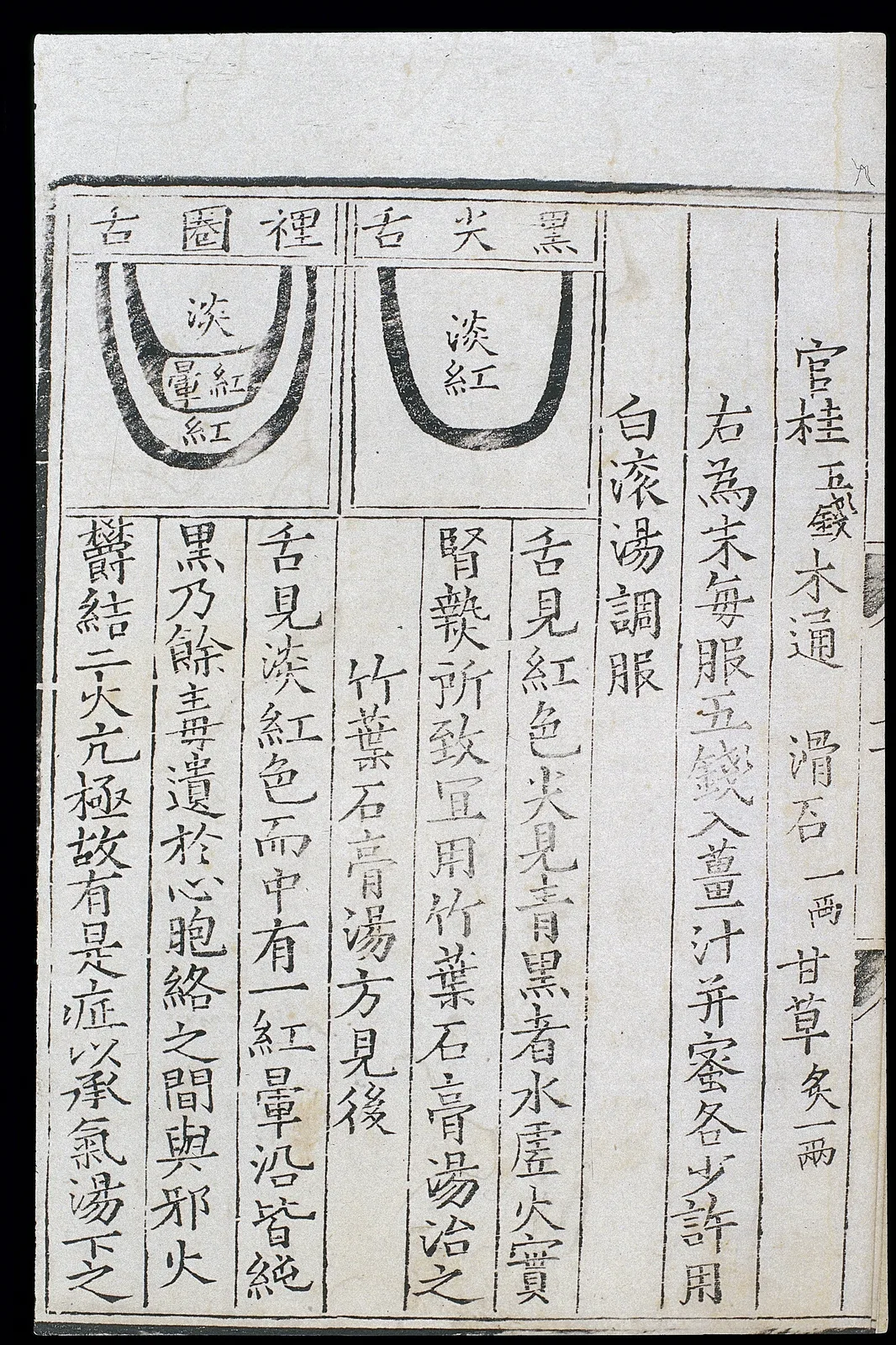
*Tongue diagnosis illustration from Chinese medicine teaching tradition. Wellcome Collection. Cropped/resized for web; non-generative.*
Travel note: Coffee, wine, and candy color the coat; wait before assuming a demo reading is stable.
Pulse Palpation: More Than Heart Rate
Classical pulse examination uses three finger positions on each wrist and many named qualities (e.g. floating, deep, slow, rapid, slippery, wiry—in translated teaching terms). Practitioners train for years; wristwatches measure heart rate, not the full classical pulse map.
DragonTrail does not instruct readers to self-palpate pulses to decide treatment.
Pattern Differentiation (辨证)
Clinical TCM organizes signs into patterns (证)—such as patterns described with yin–yang, qi/blood, or organ–channel language—before choosing modalities within scope. That step is professional, not a quiz for tourists.
Related vocabulary: Yin, Yang & Five Elements; Qi, Meridians & Acupoints.
What Visitors See on Cultural Experiences
Introductory sessions may include light tongue glance or pulse touch as demonstration without full diagnosis. Wellness venues sometimes oversimplify ("your pulse is weak—buy herbs"). Treat commercial scripts skeptically; see Evidence & Safety.
A Traditional Chinese Medicine cultural experience focuses on education—not replacing your doctor.
Boundaries: What This Page Does Not Do
- No "what your tongue says about your disease" lists for readers
- No instructions to stop prescribed medication based on pulse demos
- No remote diagnosis from photos
If you are ill, use licensed medical pathways—TCM Medical Care for Foreigners covers logistics, not treatment choice.
FAQ
Can I diagnose myself using a tongue chart?
No. Tongue observation is one part of four examinations in professional context—not standalone self-diagnosis.
Why did two practitioners describe my pulse differently?
Pulse art involves training and subjective classification; also ask whether each used TCM pattern language vs biomedical vitals.
Is TCM diagnosis the same as Western diagnosis?
Often different categorization for the same patient signs—hospitals may document both—see TCM vs Western Medicine.
Do wellness spas perform real四诊?
Many offer simplified performance for marketing; verify licensing and scope.
Where can I see tongue and pulse teaching tools?
TCM Museums in Beijing and university museums display charts and mannequins.
Continue Exploring
Sources & Review
- Standard TCM diagnostic textbooks (four examinations framework)
- Wellcome Collection historical illustrations — pedagogical, not clinical guidance
- Chinese characters verified
- Author: Chuan Shi
- Last reviewed: September 2026