
The history of Traditional Chinese Medicine spans classical texts, imperial medical bureaus, regional schools, pharmacy brands, and modern university–hospital integration—not a single founder or one unchanged doctrine. This page is the chronological spine for the Traditional Chinese Medicine guide; legendary attributions are noted as tradition, not laboratory proof.
| Period | Approximate date | TCM milestone |
|---|---|---|
| Early classics | Han and pre-Han | *Huangdi Neijing* (黄帝内经) tradition—foundational cosmology and organ–channel language |
| Systematization | Tang–Song | Imperial medical education; printed medical texts; pharmacy regulation expands |
| Famous physicians | Tang–Ming | Sun Simiao (孙思邈); Li Shizhen (李时珍) and the *Bencao Gangmu* (本草纲目) |
| Qing | 1644–1912 | Case records (医案); pharmacy trade; encounter with Western medicine |
| Modern | 1912–present | National TCM colleges, hospital departments, research institutes, heritage brands |
| Contemporary | 21st century | Integration with biomedical hospitals; global interest; strict wellness vs medical regulation |
What We Can Say Confidently About Early Medical Texts
Chinese medical writing accumulates over millennia in layered texts. The *Huangdi Neijing* (*Inner Canon of the Yellow Emperor*) is the foundational classical corpus for yin–yang, five phases, qi, and organ–channel language in later teaching—compiled in tradition attributed to the Yellow Emperor but reaching readable form through Han and later commentary. Travelers encounter *Neijing* quotations in museums; they do not read the full classical Chinese on a short visit.
Shen Nong (神农) tasting hundreds of herbs is legendary attribution for herbal knowledge—not a dated archaeological event. See Chinese Herbal Medicine.
Tang and Song: Imperial Medicine and Printing
Tang (618–907) and Song (960–1279) dynasties expanded imperial medical offices, pharmacy oversight, and educational pathways for court physicians. Printing spread medical books beyond elite copyists. Sun Simiao (孙思邈, 581–682), honored as the "King of Medicine" (药王), wrote influential Tang texts emphasizing ethics and clinical breadth—his image appears in museums and pharmacy shrines.
Song culture also advanced formulary and pharmacy organization, linking classical theory to materia medica lists travelers later see in Tongrentang displays.
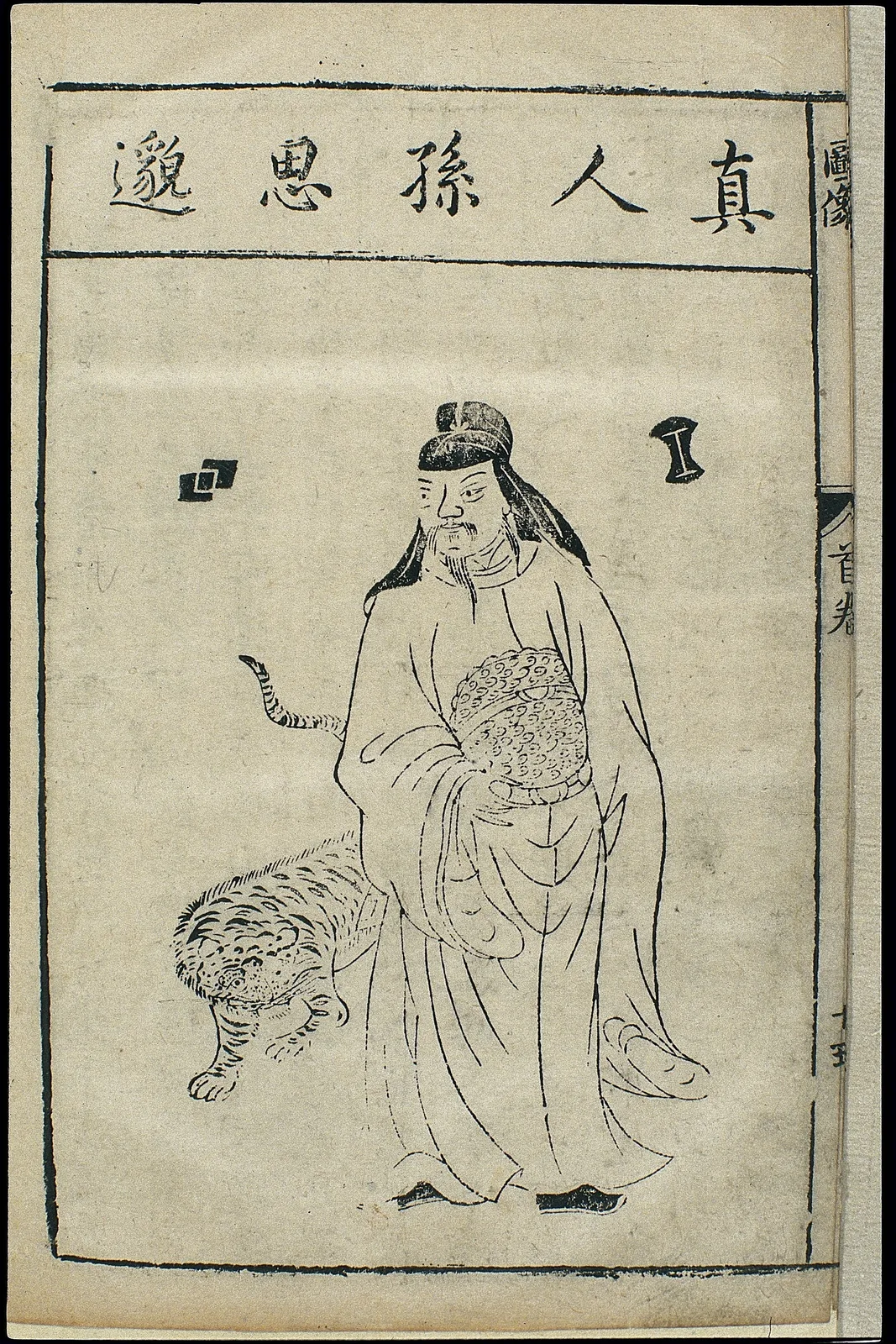
*Sun Simiao (孙思邈) in Chinese medical tradition—common in museum and pharmacy heritage displays. Wellcome Collection. Cropped/resized for web; non-generative.*
Ming and Qing: Materia Medica and Case Records
The Ming dynasty (1368–1644) produced Li Shizhen (李时珍, 1518–1593) and the *Bencao Gangmu* (*Compendium of Materia Medica*)—a monumental classified catalog of substances with historical citations. It is a pharmacy and natural-history landmark, not a modern drug approval list. See Chinese Herbal Medicine.
Qing (1644–1912) physicians refined case record literature (医案)—narratives of individual encounters that trained pattern-thinking. Qing Beijing also hosted imperial medical institutions tied to the Forbidden City—see Imperial Medicine.
Encounter with Western Medicine and Modern Institutions
Late Qing and Republican-era China debated Chinese vs Western medicine (中西医之争)—not purely "old vs new" but institutional, educational, and political. The People's Republic developed TCM universities, hospitals, and research institutes alongside biomedical departments; many large hospitals today have a TCM department (中医科) and a Western medicine department (西医科).
Travelers should not assume one national story of "integration" without checking the specific hospital or clinic. See TCM vs Western Medicine.
Heritage Brands and Living Pharmacy Culture
Long-running pharmacy brands—notably Tongrentang (同仁堂), founded in 1669—connect museum history to retail pharmacy floors tourists can visit in Beijing. Heritage status is cultural and commercial continuity, not a guarantee that every shelf product suits every visitor. See Tongrentang in Beijing.
What Changed: Theory, Institutions, Tools, Global Reach
Across this timeline, four layers shift together:
- Textual canon — from classical cosmology texts to printed formularies and modern textbooks.
- Institutions — court medical offices → national TCM colleges and hospital departments.
- Tools and modalities — needles, moxa, cups, herbs, tuina—described in dedicated guides: Acupuncture, Moxibustion, Cupping, Tuina.
- Social setting — imperial court, folk practitioners, urban pharmacies, park tai chi, international wellness marketing. See Tai Chi & Qigong.
Where Travelers Can See TCM History Today
| Setting | What you see | Practical note |
|---|---|---|
| Beijing University of Chinese Medicine museum | Academic history, specimens, charts | See TCM Museums |
| Tongrentang stores / culture halls | Brand history, product displays | Retail ≠ personal prescription |
| Forbidden City context | Imperial medical offices (interpretive) | Imperial Medicine |
| Cultural experience | Living explanation, not archaeology | TCM in Beijing |
Short-stay visitors usually combine museum or pharmacy context with a non-medical cultural session—for example Traditional Chinese Medicine experience or Royal Medicine tour—rather than expecting a full historical archive in one hour.
FAQ
Who was Li Shizhen and why does he matter?
Li Shizhen (李时珍) compiled the Ming-dynasty *Bencao Gangmu* (*Compendium of Materia Medica*), a landmark classified catalog of medicinal substances cited in museums and pharmacy heritage—not a modern clinical formulary for self-use.
Is the Yellow Emperor a real person who wrote medical books?
The *Huangdi Neijing* is attributed in tradition to the Yellow Emperor; scholars treat it as a layered classical corpus, not a single author's diary.
When did TCM hospitals appear?
Modern TCM colleges and hospital departments developed through the 20th century alongside biomedical institutions; exact dates vary by city—Beijing hosts major universities and hospitals visitors can research via TCM Medical Care for Foreigners.
Can I understand TCM history without reading classical Chinese?
Yes—museums, guided tours, and this English guide cluster provide traveler-level context; specialist study requires language and training.
How does imperial medicine relate to everyday TCM today?
Court institutions influenced pharmacy prestige and archival records; modern clinical TCM follows national licensing and hospital pathways—not imperial prescriptions for tourists.
Where should I start after reading this page?
Yin, Yang & Five Elements for classical vocabulary, or TCM in Beijing for practical visits.
Continue with Traditional Chinese Medicine
Plan a Visit
Sources & Review
- Li Shizhen, *Bencao Gangmu* — standard reference editions and museum panels
- *Huangdi Neijing* — classical corpus; scholarly introductions (English overviews in university museum texts)
- Beijing University of Chinese Medicine — public museum information — verify hours before visiting
- Chinese characters verified
- Author: Chuan Shi
- Last reviewed: September 2026