
| Item | Detail |
|---|---|
| Chinese | 中药 (zhōngyào) — Chinese materia medica |
| Forms | Raw herbs for decoction; granules; pills, tablets, ointments |
| Classical landmark | *Bencao Gangmu* (本草纲目) — Li Shizhen's Ming materia medica catalog |
| Regulation | Licensed TCM prescribing in medical settings; OTC products still need caution |
| DragonTrail boundary | No formulas, dosage, or "take this for your condition" advice |
What Chinese Herbal Medicine Is
Herbal TCM uses multi-ingredient formulas (方剂) chosen after pattern differentiation—not one-herb-one-disease mapping in professional practice. Ingredients are categorized by classical properties (nature, flavor, channel entry in teaching language).
Modern hospitals may integrate herb–drug interaction screening where systems exist; do not assume every retail clerk performs that check.
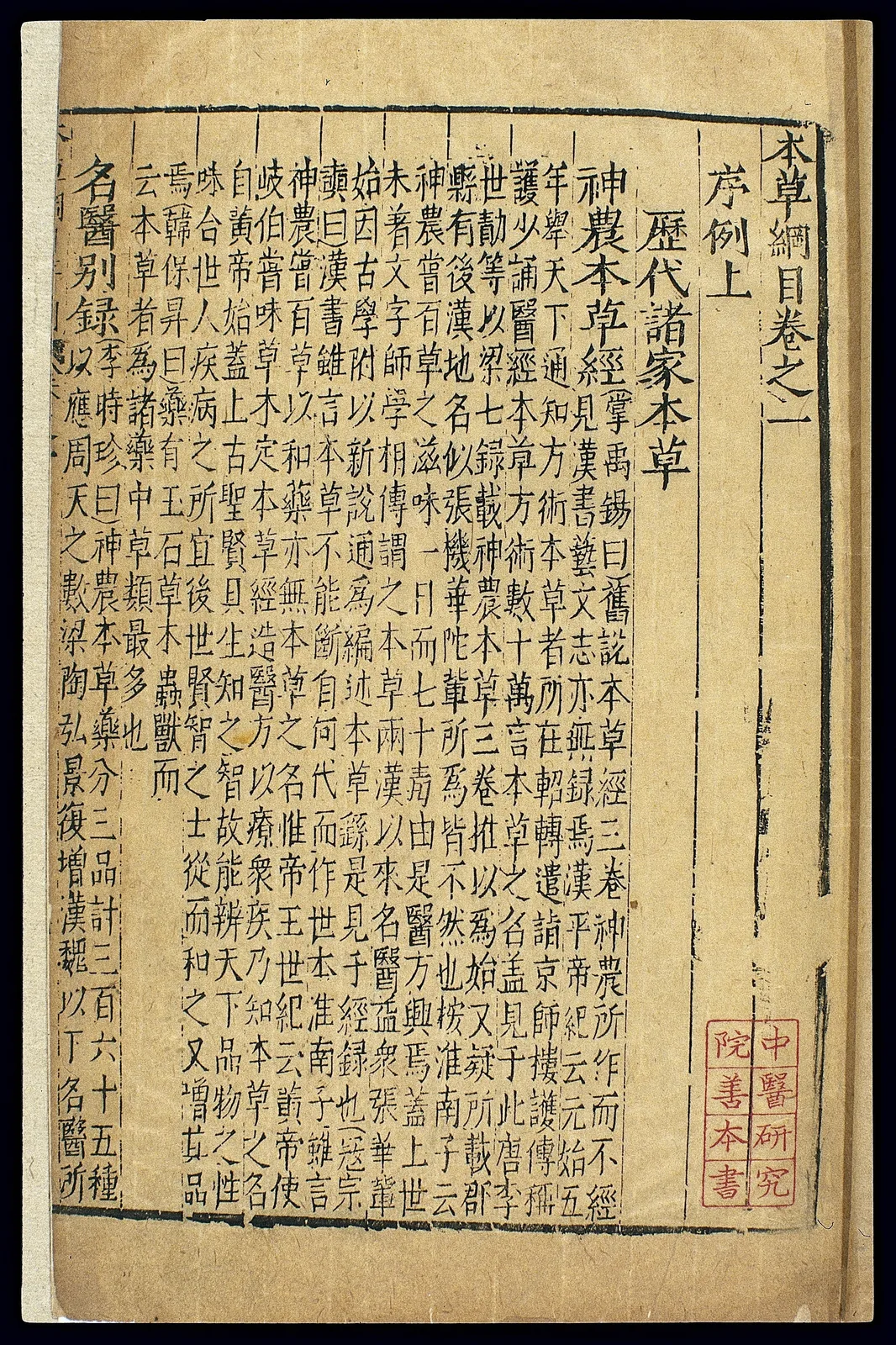
*Materia medica illustration tradition linked to the *Bencao Gangmu*. Wellcome Collection. Cropped/resized for web; non-generative.*
Common Forms Travelers See
| Form | Traveler note |
|---|---|
| Decoction (汤药) | Boiled raw herbs—strong smell; short-stay tourists rarely commit |
| Granules (颗粒) | Dissolved in hot water—clinic-dispensed |
| Patent medicines (中成药) | Prepackaged pills—labels in Chinese; OTC does not mean safe for everyone |
| Topical | Plasters, liniments for external use—still read ingredients |
See History of TCM for pharmacy development.
Heritage Pharmacies vs Personal Prescriptions
Tongrentang and similar brands display history and product lines—see Tongrentang in Beijing. Shopping is cultural retail, not automatic individualized care.
Avoid coaches that end in expensive "emperor tonic" packs with diagnosis from a glance—see Evidence & Safety.
Quality, Labeling, and Travel
- Language barrier: Ingredients and contraindications may be Chinese-only.
- Import rules: Many countries restrict plant and animal product entry—check customs before buying bulk herbs.
- Quality risks: Herbal products can involve contamination, adulteration, incorrect ingredients, or wide quality variation across channels. Reputable licensed pharmacies reduce but do not eliminate risk.
DragonTrail does not recommend specific products or brands for treating diseases.
Interactions and Medical Boundaries
Herbs can interact with anticoagulants, blood pressure drugs, immunosuppressants, and more. NCCIH notes that Chinese herbal products can have side effects and interact with medicines. If you take prescription medication or have chronic conditions, coordinate with your existing doctors before ingesting TCM formulas—see TCM Medical Care for Foreigners.
Non-medical TCM wellness providers in China are not permitted to prescribe medicines under the NATCM *中医养生保健服务规范(试行)* (2023).
We do not publish detox, weight-loss, or anti-cancer herbal claims. “Natural” does not mean safe.
Relation to Food Culture
Some ingredients appear in soup and cuisine (goji, dates, ginger) as food—not concentrated therapy. Food & Diet Therapy discusses classical dietary language; Chinese Food covers meal culture.
Common Misconceptions
- "Natural means safe." Many pharmacologically active plants have side effects.
- "One famous herb fixes everything." Professional TCM uses formulas in context.
- "Museum shop herb equals hospital prescription." Retail packaging lacks your medical workup.
FAQ
Can tourists buy Chinese herbs in Beijing?
Yes at heritage pharmacies and markets—but purchase is at your own risk without prescriber guidance; check import laws.
What is the Bencao Gangmu?
Li Shizhen's Ming-dynasty classified materia medica—historical and cultural landmark, not a modern prescribing manual for self-use.
Are patent medicines OTC?
Many are sold OTC in China; OTC status does not replace medical advice for complex health situations.
Do herbs work?
Some ingredients have modern pharmacological research; many traditional claims lack rigorous proof—see Evidence & Safety.
Where can I learn without buying?
TCM Museums and Royal Medicine tour.
Continue Exploring
- Traditional Chinese Medicine guide
- Food & Diet Therapy
- Tongrentang in Beijing
- TCM vs Western Medicine
- Evidence & Safety
Sources & Review
- Li Shizhen, *Bencao Gangmu* — historical catalog context
- NCCIH — Traditional Chinese Medicine: What You Need To Know — herbal side effects and interaction awareness
- National Medical Products Administration (NMPA) — China’s national medical products regulator
- National Administration of Traditional Chinese Medicine — 中医养生保健服务规范(试行) (2023) — non-medical wellness providers may not prescribe medicines
- Chinese characters verified
- Author: Chuan Shi
- Last reviewed: September 2026