
| Item | Detail |
|---|---|
| Qi (气) | Classical term for functional vitality, movement, and transformation—not a single measurable gas |
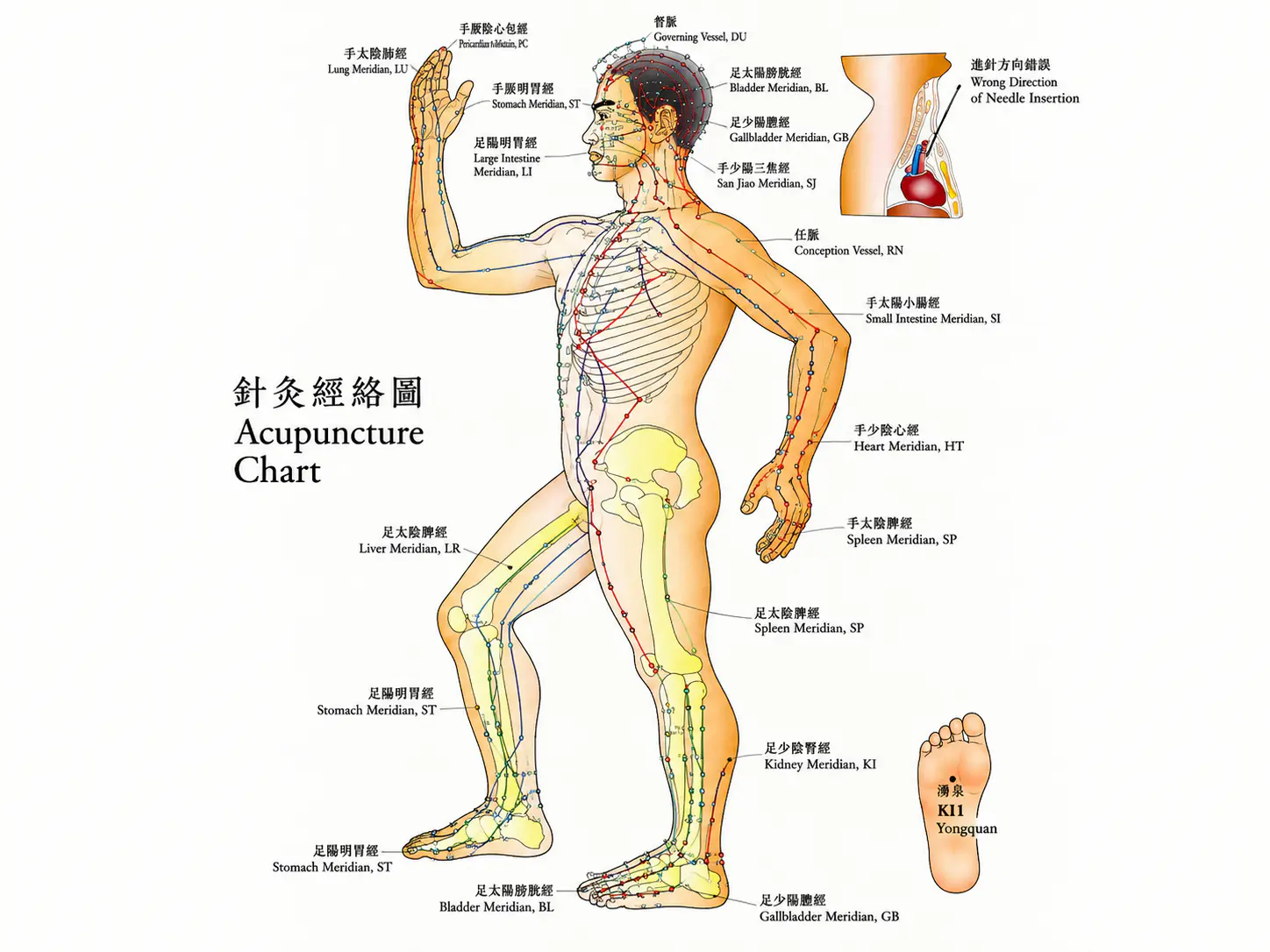
| Meridians (经络) | Classical pathway maps linking regions and organs in teaching tradition |
| Acupoints (穴位) | Named locations on meridian maps and extra points—targets for needles, pressure, heat |
| Modern debate | Research uses neurophysiology, connective tissue, and placebo frameworks—distinct from classical map claims |
| Related guides | Acupuncture; Yin, Yang & Five Elements |
What Qi Means at a Traveler Level
Qi in classical texts is process language: growth, warmth, movement, defense, and transformation described as dynamic activity rather than one Western organ. Teachers contrast qi, blood (血), body fluids (津液), and spirit (神) as interrelated categories.
English marketing sometimes sells "low qi" products. DragonTrail does not treat qi as a diagnosable deficiency for readers or recommend supplements to "boost qi."
Meridians: Maps, Not Subway Lines Under Skin
Meridian charts show interconnected pathways with named branches reaching organs in TCM organ–function language. Students memorize routes and point locations; museums display mannequins with lines drawn for teaching.
Modern anatomy courses in medical schools teach nerves, vessels, muscles, and organs as different evidence bases. TCM vs Western Medicine explains how both can appear in one hospital without merging into one map.
Acupoints: Names, Locations, Uses
Hundreds of standard acupoints have coded names (often describing geography or function in Chinese). Examples travelers see on charts:
| Point | Chinese | Common teaching association (classical) |
|---|---|---|
| Hegu | 合谷 | Hand point widely used in demonstrations |
| Zusanli | 足三里 | Leg point often cited in wellness talk |
| Baihui | 百会 | Top of head in classical maps |
Location requires training—demonstration dolls differ from locating points on a living person with safe depth and angle. See Acupuncture for modality context, not DIY needling.
How Qi and Meridians Link to Other Modalities
| Modality | How maps appear |
|---|---|
| Acupuncture | Needles at acupoints |
| Moxibustion | Heat near points or regions |
| Tuina | Manual techniques along channels and joints |
| Cupping / gua sha | Often applied along back regions correlated with meridian teaching |
| Tai chi / qigong | Movement described as cultivating qi—not medical treatment by default |
What Research Discusses (Without Overclaiming)
Modern studies of acupuncture often ask whether needling at defined points differs from sham controls for specific symptoms—results vary by condition and trial quality. Neuroimaging and fascia research explore physiological correlates; they do not simply "prove meridians exist as drawn."
See Evidence & Safety for how to read headlines responsibly.
What Travelers See in Museums and Classes
- Acupuncture mannequins and meridian wall charts
- Ear or hand micro-system charts in some displays
- Tai chi instructors using qi as movement metaphor
- Spa menus listing "meridian massage" without clinical licensing
Verify whether a venue offers non-medical wellness (中医养生保健服务) or licensed medical care before assuming hospital standards.
Common Misconceptions
- "Meridians are invisible vessels like blood vessels." Classical maps are teaching tradition; modern anatomy uses different structures.
- "Press this point to cure disease." Point stimulation appears in professional care and folk advice; DragonTrail does not prescribe self-treatment for illnesses.
- "Qi is electricity you can charge with gadgets." Consumer "energy" devices are commercial, not classical TCM core.
FAQ
What is qi in simple terms?
Classical language for vitality and functional process in the body—not a single lab test value.
How many meridians are there?
Teaching traditions commonly describe twelve primary meridians plus additional vessels and collateral branches—exact numbering varies by textbook.
Are acupoints the same as trigger points?
Some locations overlap in practice discussions, but naming systems and training paths differ; do not equate them casually for self-treatment.
Can I learn acupoints from a chart alone?
Charts support education; safe needling requires licensed training—see Acupuncture.
Do tai chi and qigong "open meridians"?
Instructors may use that language metaphorically; movement classes are not automatic medical therapy—see Tai Chi & Qigong.
Continue Exploring
Sources & Review
- Standard acupuncture point nomenclature (WHO Western Pacific Region historical efforts; modern Chinese national textbooks)
- Museum meridian mannequins and university teaching charts
- Chinese characters verified
- Author: Chuan Shi
- Last reviewed: September 2026