
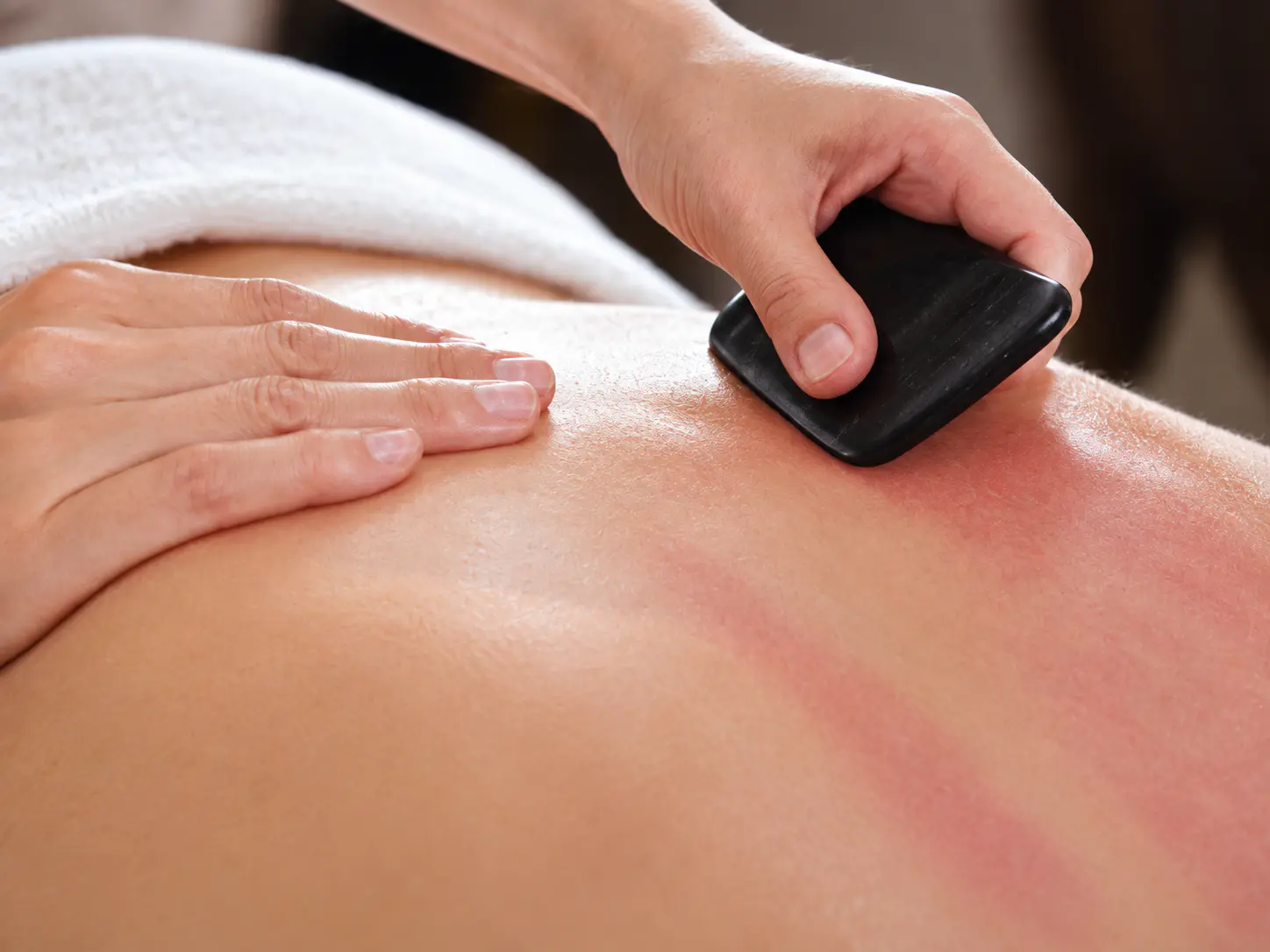
| Item | Detail |
|---|---|
| Chinese | 刮痧 (guāshā) |
| Tool | Smooth edge (jade, horn, ceramic, plastic spoon) |
| Typical site | Back, shoulders, neck; sometimes limbs |
| Mark appearance | Linear or patchy petechiae—not identical to cupping circles |
| DragonTrail boundary | No claims that mark color diagnoses organ disease |
What Gua Sha Is in TCM Teaching
Classical explanations describe releasing exterior patterns, moving qi and blood, or clearing heat—pattern language from diagnosis traditions. Contemporary discussions also mention microcirculation and fascial layers; research is limited compared to marketing volume.
How a Session Usually Works
- Oil applied to skin.
- Practitioner scrapes with firm steady strokes along muscle regions.
- Petechiae appear as sha emerges (variable by pressure and skin).
- Provider stops when deemed sufficient; client rests and hydrates.
Intensity should stay within communicated tolerance—excessive force is not "more effective."
Marks and Social Planning
Sha marks resemble striped bruises; they fade typically within 2–5 days (individual variation). Avoid gua sha before events with exposed skin or professional photos.
Do not interpret mark shade with internet "toxin charts"—not validated for self-diagnosis.
Safety Considerations (General)
Seek professional caution or avoid if you have:
- Anticoagulant therapy or bleeding disorders
- Open wounds, sunburn, or active skin infection
- Recent surgery over area
- Pregnancy (abdominal/strong back work traditionally restricted—provider judgment)
- Osteoporosis over spine with aggressive pressure
See Evidence & Safety.
Gua Sha vs Cupping vs Tuina
| Technique | Mechanism | Mark shape |
|---|---|---|
| Gua sha | Scraping stroke | Linear petechiae |
| Cupping | Suction | Round marks |
| Tuina | Kneading/pushing | Usually minimal marking |
Wellness menus in Beijing may combine all three—see TCM Massage & Wellness in Beijing. Confirm whether the venue is a licensed medical setting or non-medical TCM wellness (中医养生保健服务); non-medical providers are not permitted to diagnose or treat illness.
Facial Gua Sha Trend
Facial gua sha with jade rollers is popular globally as cosmetic massage, often lighter pressure than clinical back gua sha. Cosmetic claims ("instant facelift") are marketing—not DragonTrail medical advice.
Common Misconceptions
- "Dark sha means more toxins." Color correlates with pressure and capillary fragility as much as any classical pattern.
- "Gua sha cures flu." Some TCM texts discuss exterior patterns; travelers with fever should use medical care, not spa scraping alone.
- "DIY gua sha with a coin is traditional and safe." Unsupervised hard scraping risks skin injury.
FAQ
Does gua sha hurt?
Strong pressure can be uncomfortable; it should not feel like cutting—speak up.
How is gua sha different from cupping?
Scraping vs suction; mark patterns differ—see Cupping.
How visible are gua sha marks after a session?
Usually linear or patchy redness that can look like bruising. Marks often fade within a few days; plan around photos or clothing that shows the treated area.
Is gua sha licensed medical care?
It may appear in licensed TCM clinical settings or as non-medical wellness. Non-medical TCM wellness providers are not permitted to conduct medical diagnosis or treatment—ask which scope the venue operates under.
Where can I learn more without trying it?
Traditional Chinese Medicine experience may explain modalities without full sha session.
Continue Exploring
Sources & Review
- Classical TCM gua sha technique descriptions in teaching literature
- NCCIH — Traditional Chinese Medicine: What You Need To Know
- Chinese characters verified
- Author: Chuan Shi
- Last reviewed: September 2026