
The qipao, also commonly called the cheongsam, is a one-piece Chinese women's dress whose form changed dramatically during the 20th century. Its history is linked to Manchu dress of the Qing period, but the fitted silhouette now recognized around the world developed especially through Republican-era fashion and Shanghai tailoring. For the wider map of Chinese dress—including Hanfu and later styles—start with the parent Traditional Chinese Clothing: Hanfu, Qipao & Chinese Dress Styles hub. To separate Hanfu from qipao at a glance, see Hanfu vs Qipao: What's the Difference?.
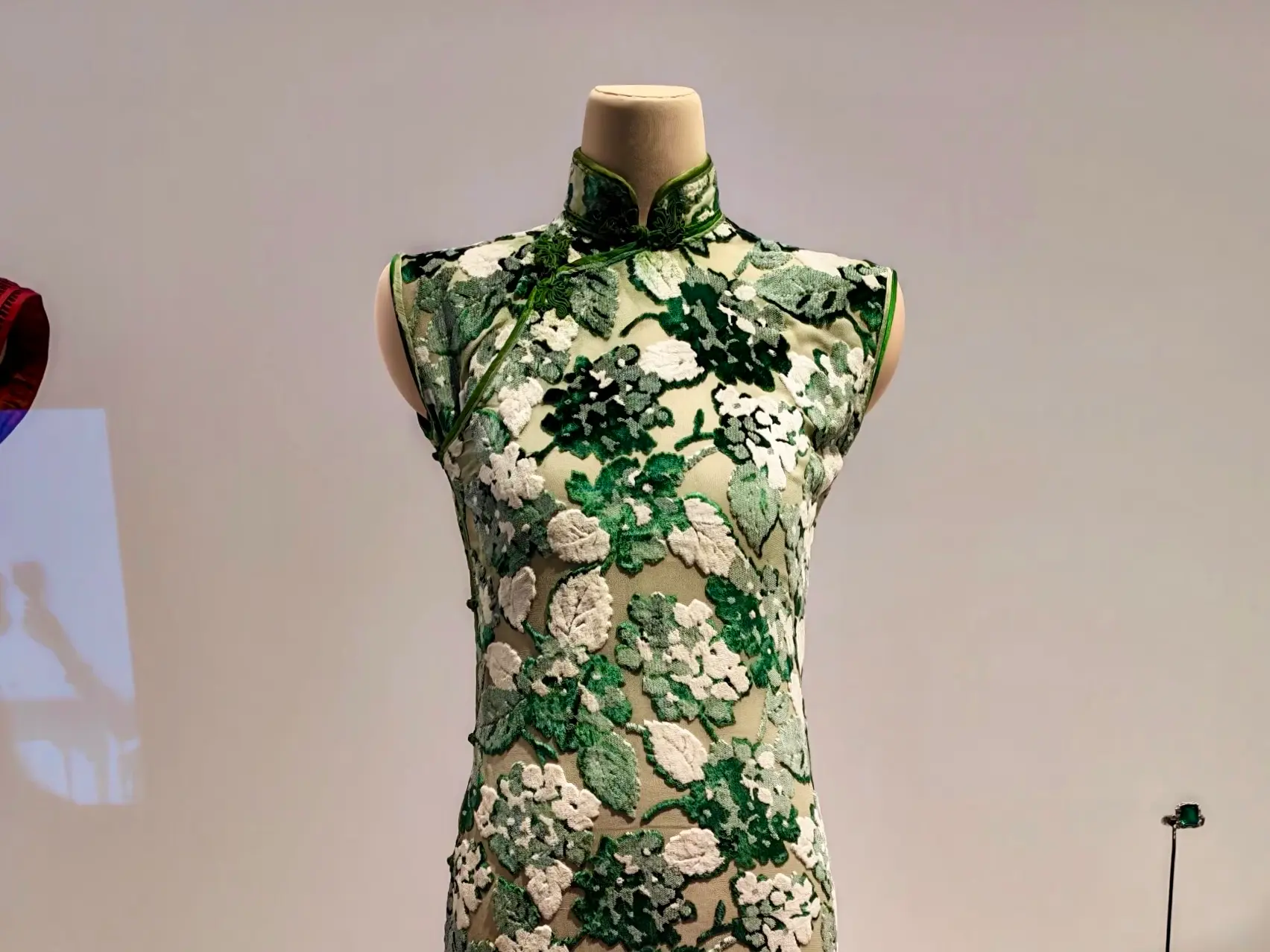
*Qipao / cheongsam on museum display.*
Qipao at a Glance
Qipao and cheongsam usually refer to the same modern women's dress, although the two words come from different Chinese linguistic traditions. The garment is generally one-piece, but its length, fit, collar, sleeves, openings and decoration have changed considerably over the past century.
| Fact | Summary |
|---|---|
| What is it? | A one-piece Chinese women's dress |
| Also called | Cheongsam |
| Historical roots | Connected to Manchu/Qing clothing traditions |
| Modern development | Especially important in Republican-era Shanghai |
| Typical collar | Standing collar |
| Typical front | Asymmetric or diagonal opening |
| Typical fastening | Pankou / frog closures |
| Fit | Ranges from loose and straight to highly fitted |
| Length | Historically varied from long to shorter modern forms |
| Modern use | Formalwear, weddings, cultural events, fashion, photography and bespoke tailoring |
The key thing to understand
The modern fitted qipao is not simply an unchanged Qing dynasty robe.
Its recognizable modern form is the result of substantial changes in tailoring, fit, length, sleeve design, collar, fabric, decoration and social use during the 20th century. Treating today's body-conscious Shanghai-style silhouette as if it had existed unchanged since the Qing period is historically misleading.
What Qipao and Cheongsam Mean
What does “Qipao” mean?
In Chinese, 旗袍 (qípáo) is commonly glossed as a “banner gown.” Qi refers historically to the Banner system / Banner people associated with Manchu society under the Qing; pao means a robe or gown. That literal shorthand is useful for historical context.
It does not mean that modern Mandarin speakers are consciously thinking “Banner gown” every time they say qipao. Everyday usage names a dress category; the etymology records a historical connection rather than a live translation exercise.
What does “Cheongsam” mean?
Cheongsam is the English spelling based on Cantonese pronunciation of 長衫 / 长衫, literally “long garment” or “long dress.” Hong Kong's Conservation Office notes that qipao is generally called cheongsam in Hong Kong. For modern English readers, qipao and cheongsam generally refer to the same women's dress.
Are Qipao and Cheongsam exactly the same?
In most contemporary English contexts, yes. “Qipao” is especially common in Mandarin and mainland-China contexts, while “cheongsam” became strongly established through Cantonese-speaking Hong Kong and overseas Chinese communities. Historical terminology is more complicated, but these are not two separate modern dress categories. For the terminology in detail, see Qipao vs Cheongsam.
Is Qipao Hanfu?
No. Qipao is not generally classified as Hanfu. Hanfu names historical Han Chinese clothing systems across many periods; qipao belongs to a different lineage connected to Manchu/Qing dress and 20th-century urban fashion. For the full comparison, see Hanfu vs Qipao.
The History of the Qipao
Keep the chronology as ancestry and transformation—not as a claim that one silhouette froze in place for centuries.
Qing and Manchu roots
Hong Kong Palace Museum research describes qipao as evolving from Manchu court dress in Beijing before entering civilian fashion after the Qing dynasty. The Qing ruled from 1644–1911. Manchu society was organized partly around the Eight Banners, and Manchu clothing traditions differed from pre-Qing Han clothing systems.
Long-robe traditions associated with Banner people provide important historical background for qipao. That is ancestry and lineage—not a claim that the modern fitted qipao existed in 1644, or that Banner dress was worn unchanged until today.
From court attire to civilian fashion
After the Qing dynasty ended, clothing conventions changed. Former court and ethnic dress elements entered new civilian contexts; women's fashion became increasingly experimental; and the garment that became modern qipao developed during a period of rapid social change. Hong Kong Palace Museum framing emphasizes this Beijing-to-civilian transition rather than a single inventor or invention year. Do not compress the transformation into one designer or one calendar date.
Qipao in 1920s Shanghai
Shanghai's official intangible cultural heritage material notes that qipao was fashionable among women of different ages in the 1920s and functioned both as everyday and formal clothing. That popularity matters—but 1920s qipao was not necessarily tightly fitted. Earlier examples could be straighter, wider, less shaped at the waist and relatively robe-like. Modern readers often imagine only the later body-conscious silhouette; the 1920s record is broader.
*1930s Chinese qipao in black silk gauze dyed with ju-liang root and tannin-rich mud. RISD Museum source via Wikimedia Commons, CC0.*
The 1930s Shanghai transformation
In the 1930s, Shanghai tailors increasingly incorporated three-dimensional / Western-influenced tailoring approaches. Shanghai's official ICH material documents features such as fitted busts, cinched waists, shoulder seams and cuffed sleeves. Those changes helped create what became known as haipai qipao / Shanghai-style qipao. Fit became progressively more body-conscious in many fashionable designs.
That is not the same claim as “Western fashion created qipao.” Traditional Chinese garment features interacted with modern urban tailoring methods. Shanghai transformed, modernized and popularized the modern qipao; it did not invent the garment from nothing in a single year.
Qipao as modern urban fashion
By the 1930s and 1940s, qipao could vary dramatically in collar height, sleeve length, hem length, waist shaping, fabric, ornament and slit height. This was fashion, not a frozen traditional uniform. Period photographs and surviving garments show how quickly urban taste could shift within one dress category. Treating any single mid-century look as the eternal “traditional” qipao flattens that history.
Hong Kong and Cheongsam
Hong Kong's Conservation Office describes the one-piece cheongsam as especially fashionable there from the 1930s to the 1970s. Shanghainese tailoring traditions moved into Hong Kong; cheongsam continued to evolve there; Hong Kong became another important center of qipao/cheongsam craftsmanship; and the Cantonese term “cheongsam” became internationally familiar. This page notes that continuity without becoming a full Hong Kong fashion history.
Decline and revival
Everyday qipao use declined as Western-style clothing became dominant, while the garment remained visible in Hong Kong, Chinese communities abroad, formalwear, cultural events, film and fashion. Later revival and reinterpretation turned qipao into both a heritage garment and a modern fashion form. The clothing story here is about design continuity and craftsmanship—not a long political digression.
Compact timeline
* Qing period — Manchu/Banner dress background * Early Republic — court/ethnic clothing traditions enter changing civilian fashion * 1920s Shanghai — qipao becomes widely fashionable * 1930s — more shaped tailoring and Shanghai-style qipao develops * Mid-20th century Hong Kong — cheongsam remains a major women's fashion * Today — heritage craftsmanship + bespoke tailoring + contemporary reinterpretation
How a Qipao Is Designed
Design features identify many modern qipao examples, but they vary by decade, maker and occasion. No single combination defines every historical or contemporary dress.
One-piece structure
Qipao is generally one principal dress: vertically continuous and cut around the body rather than assembled as a visible upper + skirt combination. Silhouette still varies considerably. All qipao are not body-hugging. Straight and looser cuts belong to the same dress category.
Standing collar
A standing collar is one of the strongest visual identifiers. Collar height varies; shape can be narrow or more substantial; historical fashion repeatedly changed collar height; contemporary designers modify it for comfort and style. “Standing collar” is often the more precise neutral descriptive term. “Mandarin collar” is acceptable as a familiar English label for a related standing form, but it should not erase historical variation.
Asymmetric front opening
Typical qipao may feature a diagonal opening, curved opening, asymmetric placket, or a closure continuing toward the side seam. Exact pattern varies by tailor and period. One placket shape does not define all qipao.
Pankou / frog closures
盘扣 (pankou)—often translated as frog closures or knotted buttons—are both functional fastenings and decorative elements. They are constructed from shaped fabric cord, often positioned around the collar and front opening, and can range from simple knots to elaborate designs. Shanghai's official ICH material identifies knotted-button construction as part of traditional qipao craftsmanship. Avoid attaching unverified symbolic meanings to every knot.
Piping and edging
Contrasting or matching fabric edging can emphasize the collar, define the front opening, outline cuffs and frame slit or hem. Shanghai qipao craftsmanship includes sophisticated inlaying and edging techniques that read as clean edge definition rather than applied ornament alone.
Side slits
High thigh slits are not inherent to every qipao. Slit height changed historically; some early qipao were much more closed; modern formal qipao can range from low slit to high slit. Slit design interacts with hem length and mobility—garment engineering and movement, not a fixed “signature” height.
Darts and body shaping
Shanghai-period transformation made bust shaping, waist shaping, shoulder construction, darts and fitted side seams more important in many fashionable designs. Those techniques helped create later body-contoured silhouettes. They do not define every historical qipao.
Sleeves
Qipao sleeves can be long, three-quarter, elbow-length, short, cap sleeve or sleeveless, depending on decade, climate, occasion and designer. Sleeve variation is one of the clearest reminders that qipao is a living fashion form.
Hem length
Historical examples vary from ankle/floor length to calf length, knee length and shorter modern styles. There is no single “traditional” length.
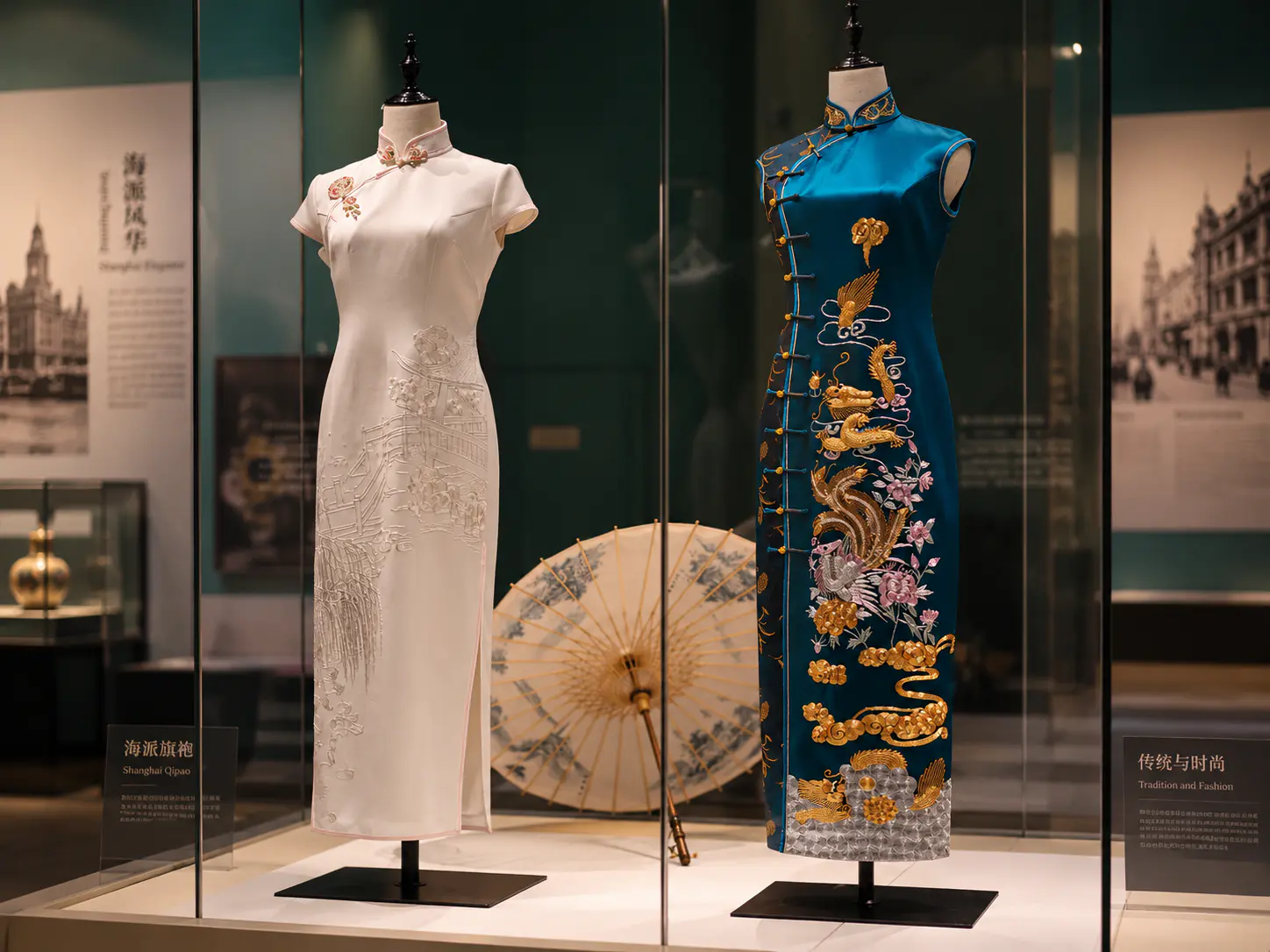
*Several cheongsam dresses displayed at a temporary exhibition at the Suzhou Pingtan Museum; dresses associated with female Pingtan performers. Photograph by N509FZ, Wikimedia Commons, CC BY-SA 4.0 Shown as design range—not as a chronological historical sequence.*
Design anatomy table
| Feature | Typical function | How it varies |
|---|---|---|
| Standing collar | Frames neckline | Height and shape |
| Front placket | Opening/closure | Straight, diagonal, curved |
| Pankou | Fastening + decoration | Simple to elaborate |
| Piping | Edge definition | Contrast or matching |
| Sleeves | Coverage/style | Long to sleeveless |
| Waist shaping | Fit | Loose to highly fitted |
| Side slits | Movement/design | Low to high |
| Hem | Overall proportion | Long to short |
Qipao Fabrics, Decsheets & Craftsmanship
Silk
Silk is strongly associated with high-quality qipao, but qipao is not required to be silk. Possible silk fabrics include satin, brocade, jacquard, gauze and other woven silks. Use exact textile names only where the object or maker documentation supports them.
Other fabrics
Modern qipao may use cotton, linen, wool blends, synthetic fabrics and stretch materials depending on daily wear, climate, formal use, price and design. Authenticity is not defined solely by fabric.
Embroidery
Embroidery appears as floral motifs, birds, geometric designs and, where relevant, landscape or figurative work. Treat embroidery primarily as surface design, craftsmanship and customization. Do not assign symbolic meaning to every motif unless a specific design is reliably sourced.
Piping, inlaying and decorative edging
Shanghai's ICH sources identify traditional craft techniques that group usefully into edge treatment, surface decoration and closure craftsmanship—including inlaying, edging/rimming, embroidery, curved seam work and knotted buttons. The point for travelers is quality of hand and finish, not a ritual checklist of every named technique.
Fit as craftsmanship
High-quality qipao tailoring depends heavily on shoulder fit, collar fit, bust, waist, hip, armhole, hem, slit placement and fabric behavior. That is why custom qipao can differ meaningfully from generic ready-to-wear dresses. Fit is craftsmanship across body shapes—not a rule that qipao “only suits” one body type.
Pattern matching and finishing
When inspecting a dress, look for alignment of repeated motifs, clean piping, even seams, secure pankou, collar structure, lining and inside finishing. Those checks prepare you for a later Beijing shopping conversation without turning this page into a store directory.
The Qipao Today
Formalwear and celebrations
Modern qipao appears at weddings, receptions, Lunar New Year gatherings, formal dinners, cultural occasions, diplomatic events and portrait photography. It is not everyday national dress for most people.
Contemporary qipao design
Contemporary designers continue to change length, fabrics, collar, slit, fit and closures. Modern makers may use wool blends, cotton/linen, stretch fabrics and modern synthetic textiles while retaining qipao-derived design vocabulary—standing collar, asymmetric opening, pankou references and continuous one-piece structure.
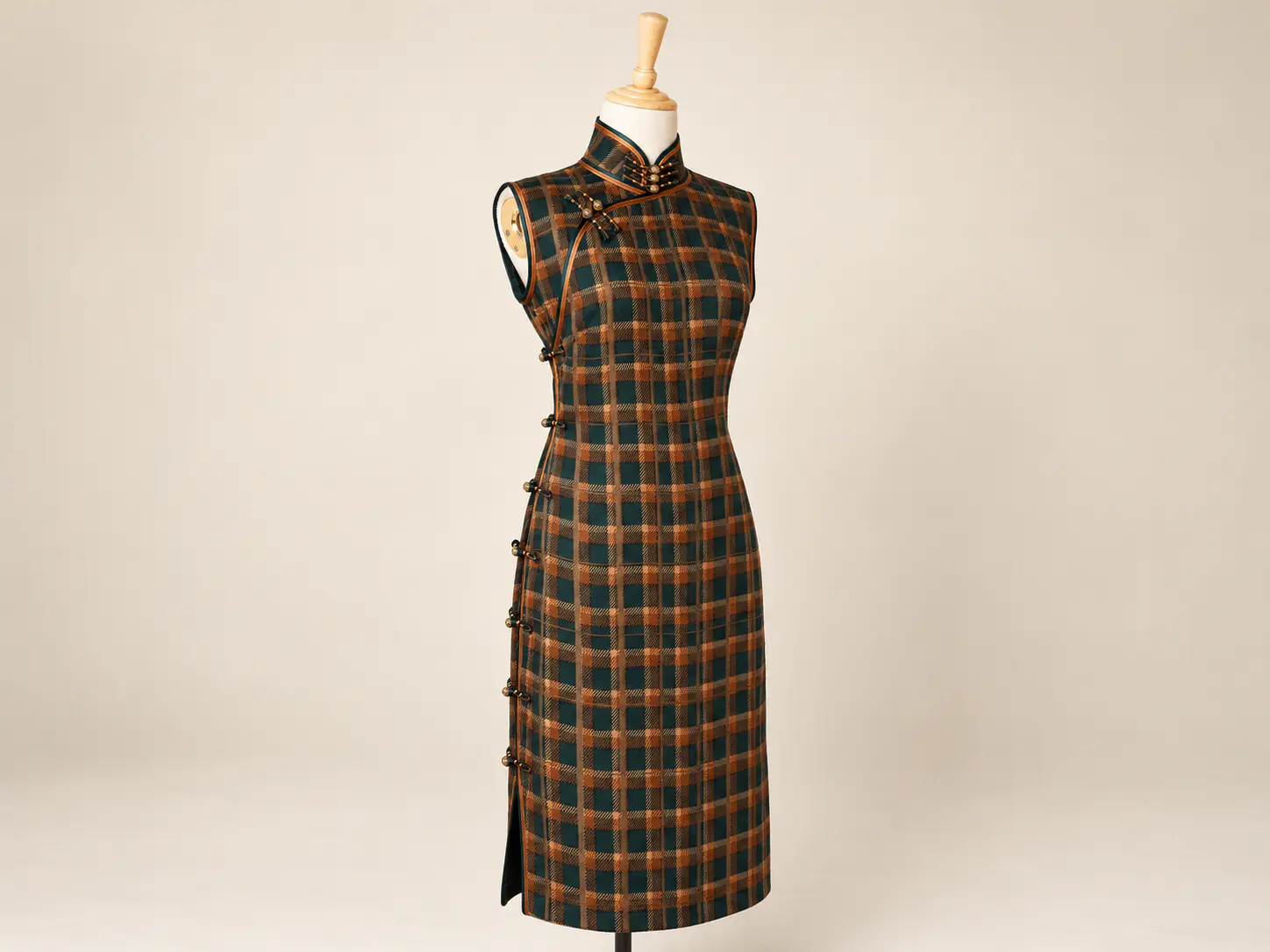
*Contemporary cheongsam made from tartan fabric in Hong Kong (2021). Photograph by Peachyeung316 (cropped version by SMcCandlish), Wikimedia Commons, CC BY-SA 4.0 Useful as contemporary design vocabulary—not as evidence of historical qipao textiles.*
Traditional vs modern qipao
| Traditional / heritage-oriented | Modern / contemporary | |
|---|---|---|
| Construction | Often hand-tailored | Tailored or ready-to-wear |
| Fabric | Silk/brocade common | Very wide range |
| Pankou | Often handmade/prominent | Traditional, simplified or omitted |
| Length | Often longer | Any length |
| Fit | Varies | Often modern body shaping |
| Use | Formal, cultural, collectible | Formal, work, casual, fashion |
“Traditional” here means heritage-oriented craft and presentation—not automatically older or superior.
Qipao as living craftsmanship
Shanghai's Longfeng qipao / cheongsam tradition is nationally recognized as intangible cultural heritage. That recognition shows qipao as living craftsmanship, not only a museum object. This page does not recommend a specific shop.
Qipao outside Shanghai
Hong Kong, Beijing and overseas Chinese communities developed local qipao/cheongsam practices. Local traditions exist, but rigid “Beijing style vs Shanghai style vs Hong Kong style” labels need careful scholarship. For classification by design direction, fit, length, sleeve, fabric, decoration and occasion, see Qipao Styles.
Qipao / Cheongsam FAQ
What is a Qipao?
A qipao is a one-piece Chinese women's dress associated with modern Chinese fashion, especially the 20th century. Its history is linked to Manchu/Qing dress traditions but its modern form developed substantially during the Republican period.
Is Qipao the same as Cheongsam?
Generally yes in modern English usage. “Qipao” is common in Mandarin and mainland contexts; “cheongsam” is strongly established through Cantonese/Hong Kong and overseas usage. They usually name the same women's dress category.
What does Qipao mean?
旗袍 is commonly interpreted as “banner gown,” referring to the historical Banner context associated with Manchu society. Everyday speakers use the word as a dress name; the etymology records ancestry rather than a live literal thought.
Is Qipao ancient Chinese clothing?
Not in the same sense as Hanfu traditions dating to earlier imperial periods. Qipao has Qing-era historical roots, but its recognizable modern form developed mainly during the 20th century.
Did Qipao come from Shanghai?
Shanghai did not create the garment from nothing, but it became one of the most important centers in shaping and popularizing the modern qipao during the 1920s and 1930s.
Why does Qipao have a high collar?
Standing collars became one recognizable design element, but collar height and shape varied substantially over time. There is no single required height and no need to invent a universal symbolic meaning.
What are the buttons on a Qipao called?
Pankou, often translated as frog closures or knotted buttons. They are both functional fastenings and decorative craft elements.
Are all Qipao tight?
No. Earlier and some modern versions can be relatively straight or loose; highly fitted designs became particularly important during later Republican-era and contemporary tailoring.
What fabric is Qipao made from?
No single required fabric. Silk, brocade and jacquard are strongly associated with formal qipao, but cotton, wool and modern fabrics are also used.
Shop for or Experience Qipao in Beijing
Shopping and tailoring are the main visitor pathways for qipao in Beijing—not a generic costume rental day.
Ready-made Qipao
Ready-made qipao suits visitors who have limited time, want something wearable immediately, prefer lower commitment, and can find a suitable fit off the rack. Sizing varies widely by maker; try sitting, walking and raising your arms before buying.
Custom-tailored Qipao
Custom work suits visitors who care strongly about fit, want fabric choice, want collar/sleeve/length customization, want specific pankou or embroidery, and have enough time for measurement and fitting. Do not assume same-day tailoring unless a supplier has explicitly confirmed it.
What to check before buying
* collar sits comfortably * shoulders lie cleanly * bust/waist/hip do not pull * wearer can sit and walk comfortably * side seams remain straight * slit height feels appropriate * pankou are secure * piping is even * patterns align reasonably * inside finishing is clean
Qipao photography
Visitors may also choose a qipao for portraits, Republican-era styling, historical interiors, hutong/courtyard settings and 20th-century architecture. Imperial Ming settings are not always the most historically appropriate backdrop for a 20th-century dress form.