
Hanfu is not one particular robe or dress. It is an umbrella term for historical clothing traditions associated with the Han Chinese, encompassing garments, headwear, footwear, hairstyles and accessories that changed substantially over different periods. Cross-collars and flowing robes are familiar features, but Hanfu has never had a single fixed silhouette. For the wider map of Chinese dress—including qipao/cheongsam and later styles—start with the parent Traditional Chinese Clothing guide.
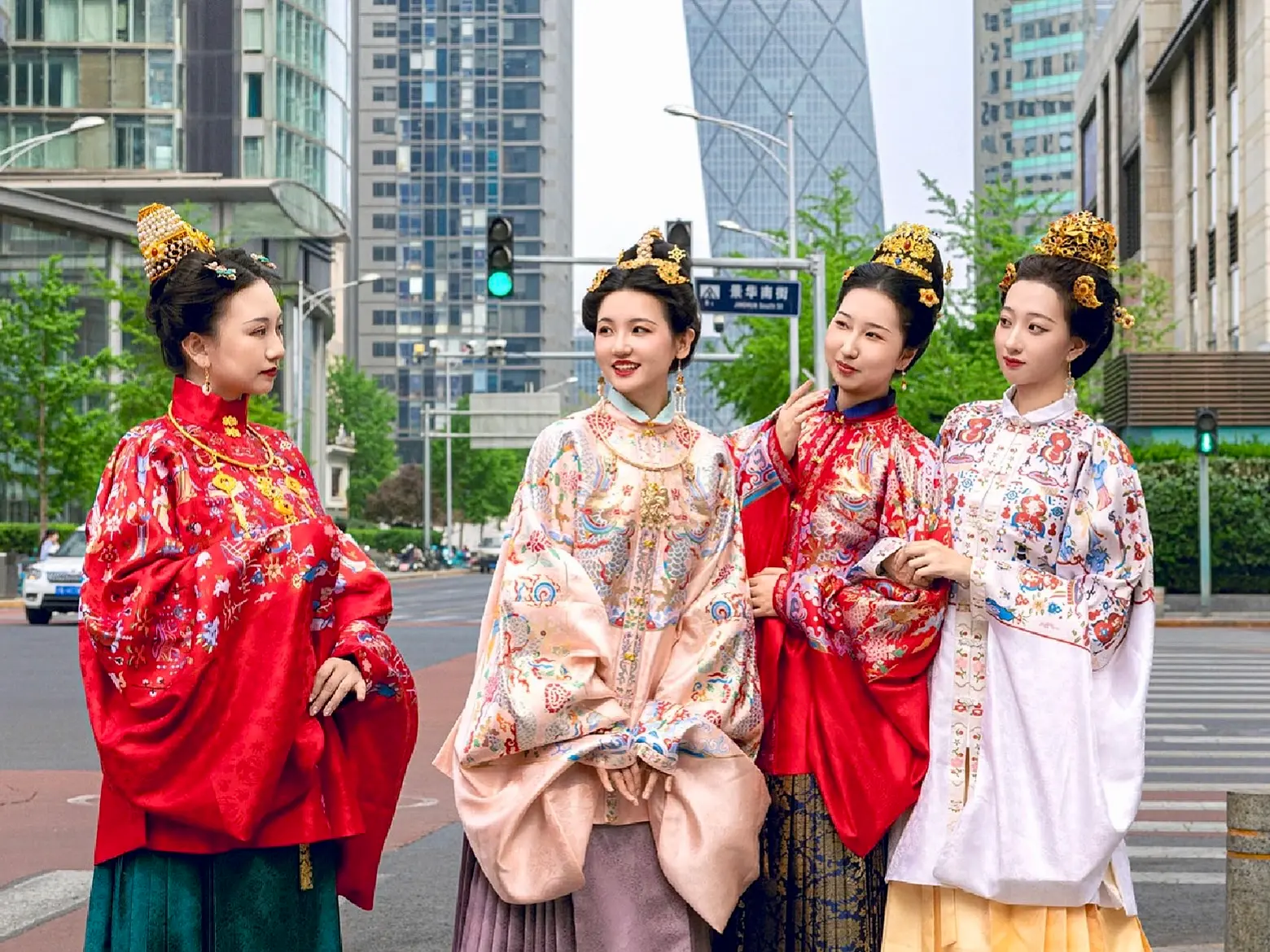
*Contemporary interpretations of Ming dynasty-style Hanfu based on historical ceremonial clothing. Modern Hanfu can range from research-based reconstruction to looser historical inspiration. Photograph by N509FZ, Wikimedia Commons, CC BY-SA 4.0.*
Hanfu at a Glance
Hanfu (汉服) literally refers to clothing associated with the Han Chinese, but the term describes a clothing system rather than one fixed garment.
| Fact | Summary |
|---|---|
| What it is | Historical clothing traditions associated with the Han Chinese |
| One garment or many? | Many garment forms and combinations |
| Time span | Styles developed and changed over long periods of Chinese history |
| Typical elements | Robes, jackets, skirts, trousers, sashes, headwear, footwear and accessories |
| Recognizable feature | Cross-collar garments closing to the right are common and historically important, but not universal |
| Who wore it | Men and women, with clothing varying by age, status, occupation and occasion |
| Today | Worn for cultural events, photography, ceremonies, festivals and increasingly as contemporary fashion |
The most important thing to understand
Hanfu is not:
* one costume * clothing only from the Han dynasty * a synonym for every traditional Chinese garment * the same thing as qipao/cheongsam
What Hanfu Means
What does “Hanfu” mean?
In Chinese, 汉 (Hàn) refers to the Han people, and 服 (fú) means clothing or attire. The Academy of Contemporary China and World Studies defines Hanfu as a complete traditional attire system of the Han people that includes clothing, headwear, hairstyles, face ornaments, shoes and accessories.
Modern English usage generally treats Hanfu as a broad category covering historical Han clothing systems and reconstructed or revived forms based on them. Hanfu is also a modern umbrella and revival term: contemporary wearers and researchers use it to group and reconstruct historical Han Chinese dress traditions from different periods, but that does not mean people in every dynasty understood all of those garments as one unchanged clothing system under today's category.
Hanfu is a clothing system
Hanfu is easier to understand if you stop looking for one iconic robe. Historical dress often combined upper and lower garments, robes, belts or sashes, headwear, shoes, ornaments and hairstyle into a coordinated attire system. A jacket-and-skirt set, a long robe, a formal official outfit and a festival look can all belong inside the same umbrella while looking very different.
Clothing, ritual and social identity
Historical Chinese dress could communicate social rank, court position, ritual context, gender, occasion and period. Formal clothing was not only aesthetic. Surviving portraits, rank badges and ritual regulations show that dress could encode institutional status as clearly as fabric taste. Vague claims about cosmic symbolism are less useful than these concrete social and ritual functions.
How Hanfu Is Constructed and Worn
Upper and lower garments
Many historical outfits use separate upper and lower pieces. In common modern vocabulary, a short upper garment or jacket may be called a ru, a skirt a qun, and the combination ruqun. These terms help describe structure, but they do not mean all Hanfu is ruqun. Period, gender and occasion produce many other combinations.
Robes and long garments
Long garments also matter. Broad categories include pao (robes), shenyi, zhiduo and related long forms. This page introduces them as structural options rather than a full taxonomy. For dynasty-by-dynasty style comparison, see Types of Hanfu: Styles Through the Chinese Dynasties. Treat long garments as one major branch of the clothing system, not the whole story.
Cross-collar construction
Jiaoling youren (交领右衽) is one of the most recognizable Hanfu constructions. Collars cross at the front, and the left side of the garment typically overlaps toward the wearer’s right, creating a Y-shaped neckline. Institutional summaries often identify jiaoling youren as a typical form—not the sole form.
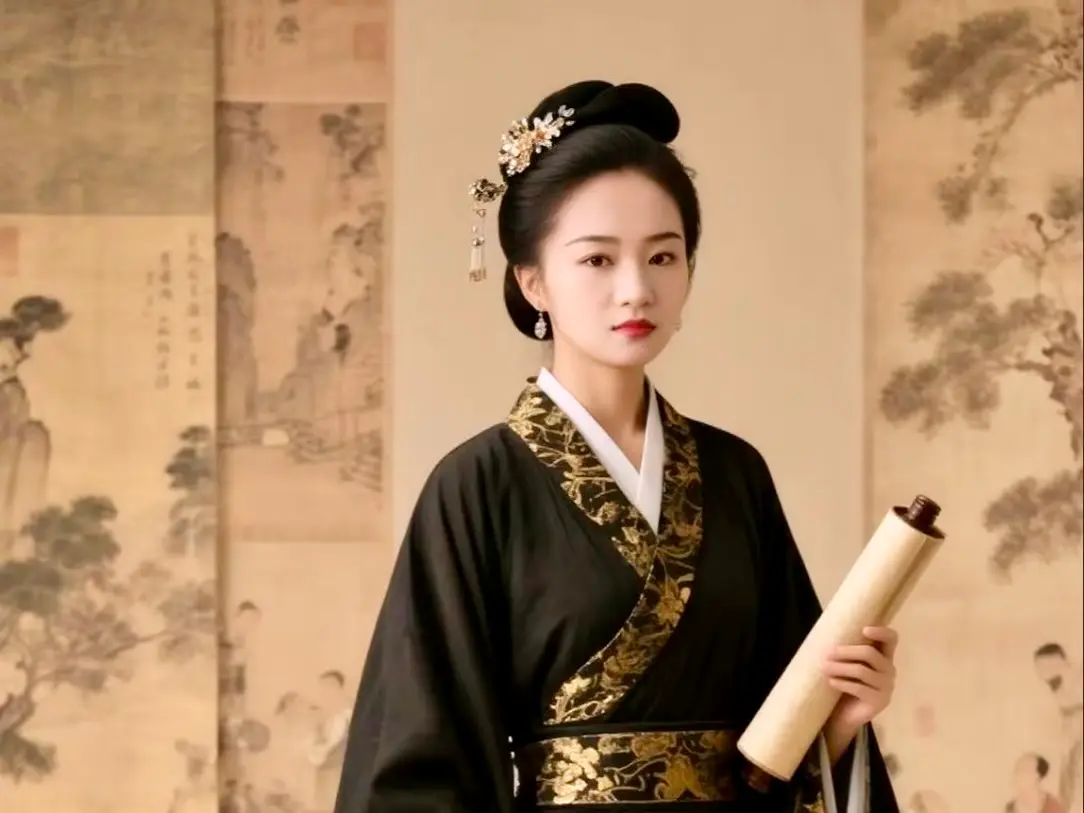
*A modern Hanfu-style robe showing the left-over-right jiaoling youren collar arrangement.*
Other collar and opening forms
Hanfu also included round collars (yuanling), parallel-front openings (duijin) and other neckline configurations. If you leave this page thinking “Hanfu = cross collar,” the visual map is incomplete. Collar form is a strong clue; it is not a universal ID badge.
Sashes and closures
Many garments were secured with ties and sashes. Methods varied by garment and period. Later clothing can incorporate additional fastening systems. It is safer not to claim that buttons never existed in Chinese clothing; fastening technology and taste both changed.
A Brief History of Hanfu
This is a compressed chronology. It establishes change without becoming the full dynasty-styles article.
Early clothing traditions
Traditional accounts associate the origins of Chinese clothing with the legendary Yellow Emperor. That is a cultural legend, not an archaeological invention date. Surviving objects, tomb art, figurines and written sources provide progressively more evidence for historical clothing systems over time. Early foundations matter, but they should not be narrated as a single fixed “first Hanfu outfit.”
Han to Tang
From Han through Tang, clothing forms continued to evolve. Robes, upper/lower combinations and different collars coexisted. Tang clothing is especially visible for diversity and international cultural exchange in elite contexts, while court, elite and ordinary clothing still differed. This page does not catalogue Tang subtypes; it only marks that the clothing system was already visually varied long before modern revival photography.
Song and Ming
Song and Ming periods continued to develop distinct silhouettes and garment combinations. Many forms popular in today’s historical reconstruction draw heavily on surviving paintings, tomb finds and records from these eras. Ming clothing is particularly visible in today’s reconstruction community—not because it is the “final” or “most authentic” Hanfu, but because sources and reconstruction practice make Ming silhouettes especially accessible.
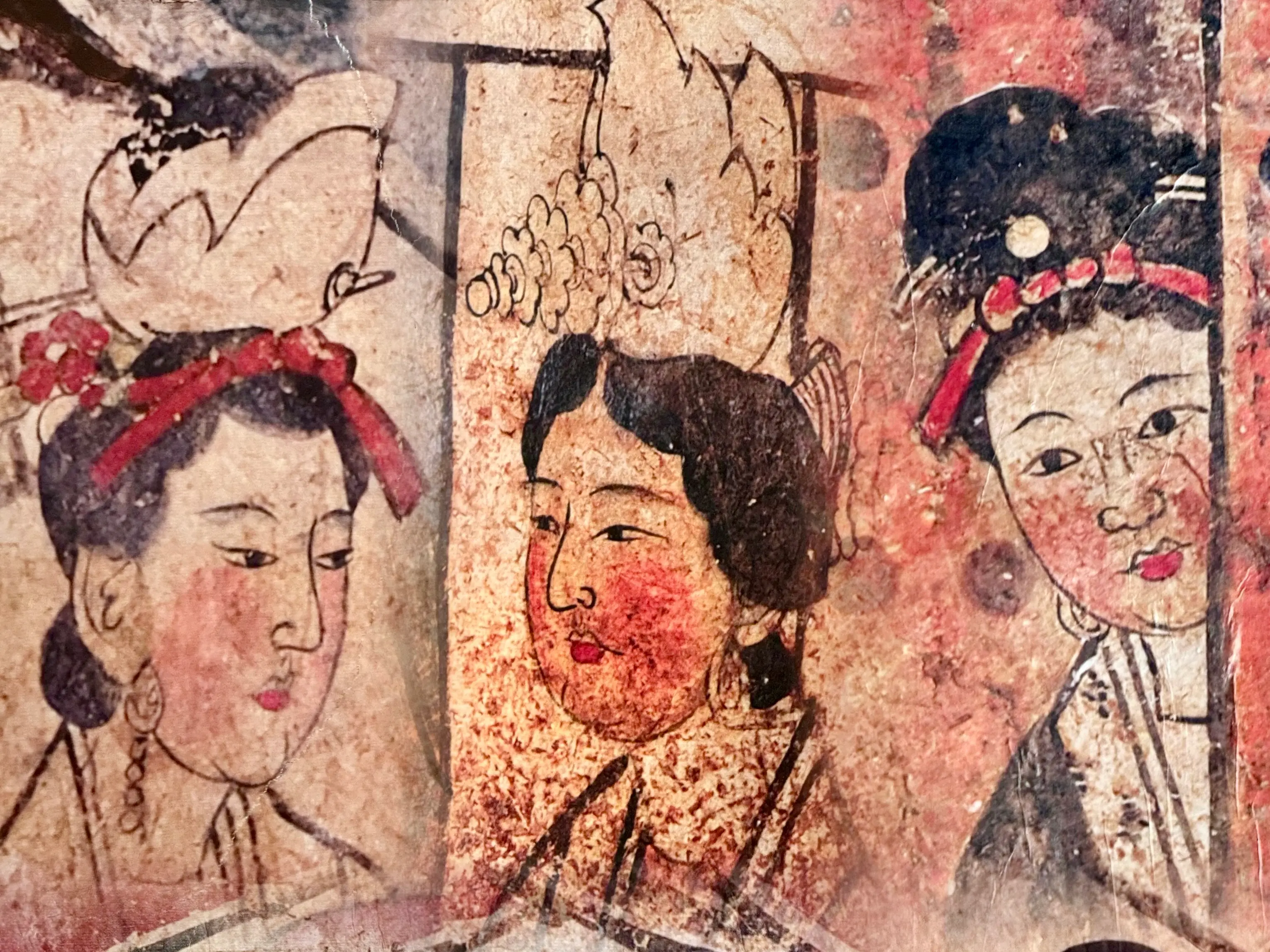
*Women’s hairstyles and clothing preserved in an ancient Chinese tomb mural.*
Qing transition
The early Qing transition involved major clothing and hairstyle policies, especially affecting men’s public dress. Continuity, exemptions, women’s clothing, religious clothing and later urban fashion make the history substantially more complex than internet slogans such as “Hanfu disappeared completely in 1644” or “Hanfu was totally banned for 300 years.” This page notes the break and complexity without trying to settle every definitional debate about Qing-era Han clothing.
Revival in the 21st century
The twenty-first century revival includes multiple approaches.
Historical reconstruction
Reconstruction attempts to reproduce clothing using excavated garments, tomb murals, paintings, figurines, written records and historical textile techniques. University and specialist institutes have described work with figurines, murals, historic textiles and natural dyes as part of research-based reconstruction.
Historically inspired Hanfu
Historically inspired clothing uses historical forms but may adapt fabric, fit, color, construction or practicality for contemporary wear.
Contemporary Hanfu / fashion adaptations
Contemporary adaptations blend historical visual vocabulary with modern dress. Costume used in film and fantasy (guzhuang) is not automatically Hanfu. Reconstruction, historically informed reproduction, historically inspired fashion and fantasy aesthetics coexist—and visitors should not treat every rental outfit as museum-accurate.
Key Features of Hanfu
There is no universal checklist that identifies every Hanfu garment. Use the following as orientation.
Layering
Many historical outfits combine several garments. Visible layers affect silhouette and proportion; outer and inner relationships vary by period. Looking for a single one-piece “dress” often misses how the system works.
Collars
Expect cross-collar, parallel-front and round-collar options. Cross-collar is important, not exclusive.
Sleeves
Hanfu does not always mean enormous sleeves. Some ceremonial garments use broad sleeves; other clothing has narrow, practical, shorter or layered sleeveless/short-sleeved pieces. Sleeve volume is period- and function-dependent.
Skirts, robes and trousers
Hanfu can include skirts, robes, trousers with upper garments, jackets and long outerwear. It is not only women’s dress. Men’s historical clothing systems were extensive.
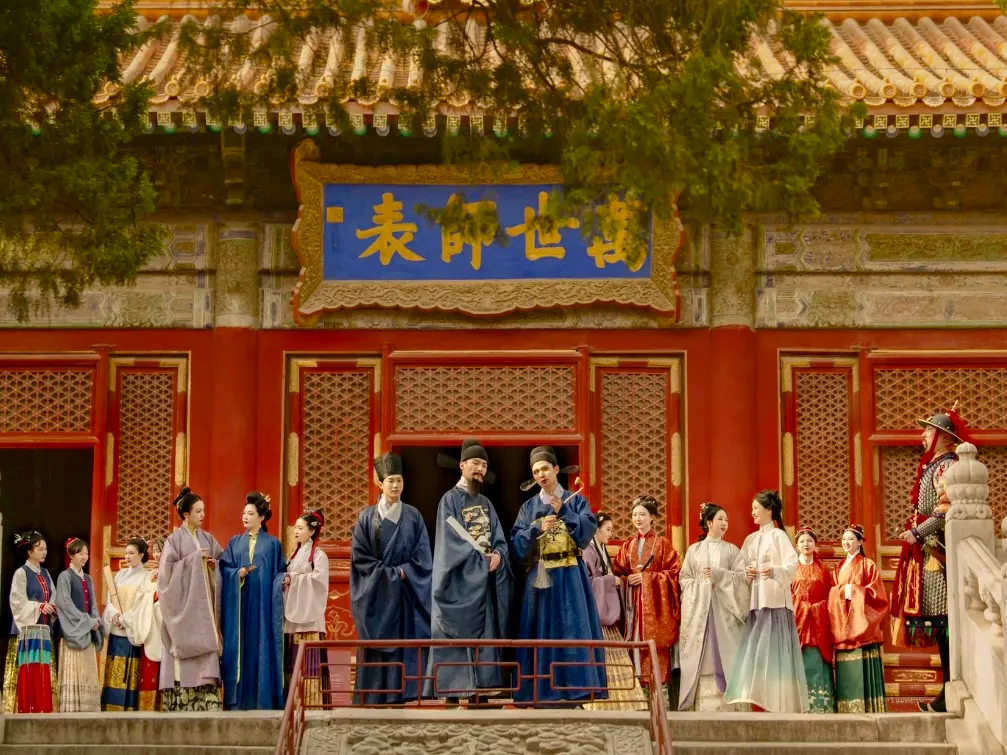
*Modern clothing inspired by historic Chinese dress worn during a group presentation.*
Fabric and decoration
Silk is famous, but linen/hemp historically, cotton in later periods, woven patterns, embroidery and rank decoration all appear. “Hanfu is made of silk” is false as a universal rule. Fiber and ornament help you read formality and workshop taste; they do not by themselves prove dynasty.
Headwear and accessories
Because Hanfu is an attire system, headwear, hair ornaments, belts/sashes, footwear and jewelry matter. A photograph that crops to the robe alone can hide half of the social signal.
Status and formal dress
Formal dress could encode institutional status. Late imperial portraits with official rank badges make that visible without reducing clothing to decoration alone.
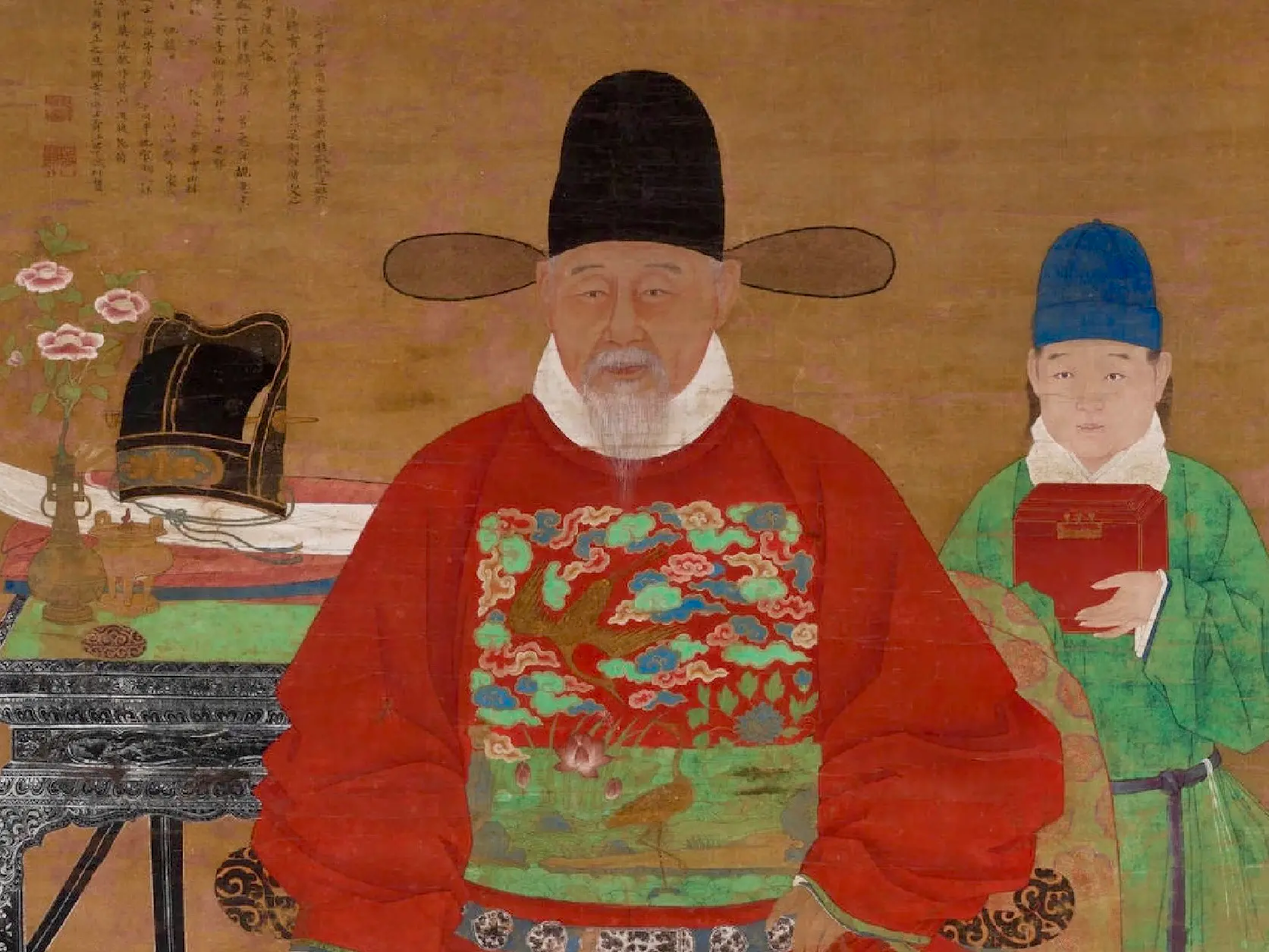
*A Ming official wears a red court robe and an embroidered rank badge in this formal portrait.*
Common misconceptions
| Common assumption | More accurate explanation |
|---|---|
| Hanfu is one dress | It is a broad clothing system |
| Hanfu is clothing from the Han dynasty | The modern term encompasses many historical periods |
| All Hanfu has crossed collars | Cross-collars are important but other collar forms existed |
| Hanfu always has very wide sleeves | Sleeve forms varied |
| Hanfu is only women’s clothing | Historical Han clothing included extensive men’s dress systems |
| Qipao is Hanfu | Qipao belongs to a different historical clothing tradition |
| Modern Hanfu is always historically exact | Reconstruction and modern reinterpretation coexist |
Hanfu in China Today
The Hanfu revival
Since the early twenty-first century, Hanfu has seen a visible revival among younger wearers. Festivals, cultural events, photography, museums, heritage interest, social media and contemporary fashion all amplify the look. Specialist institutes and universities continue research-based reconstruction—using figurines, murals, historic textiles and related material evidence—while Hanfu rental and photography have become established parts of tourism in several Chinese cities. Market numbers change quickly; the durable point is that Hanfu is now both a heritage research subject and a living visitor experience.
Reconstruction vs fashion
Modern Hanfu often falls along a spectrum:
research reconstruction → historically informed reproduction → historically inspired fashion → fantasy/guzhuang
These categories do not have universally agreed hard boundaries. The useful traveler takeaway is simpler: ask whether an outfit aims at a documented historical form, a practical historical inspiration, or a fantasy look. Guzhuang used in film and television may borrow historical silhouettes without intending research reconstruction.
When people wear Hanfu today
People wear Hanfu for cultural festivals, traditional holidays, photography, heritage sites, ceremonies, performances, weddings and—for some enthusiasts—daily fashion. Availability in tourist cities does not by itself certify historical accuracy.
Hanfu FAQ
What is Hanfu?
Hanfu is an umbrella term for historical clothing traditions associated with the Han Chinese. It covers garments, headwear, footwear, hairstyles and accessories that changed across periods rather than one fixed robe or dress.
What does Hanfu mean?
Hanfu combines 汉 (Han) and 服 (clothing/attire). Modern usage treats it as a complete attire system of the Han people, including clothing and related accessories, not only a single garment name.
Is Hanfu traditional Chinese clothing?
Yes. Hanfu is a major tradition of Chinese clothing associated specifically with the Han Chinese. It should not be used as a synonym for every traditional clothing tradition in China.
Is Hanfu only from the Han dynasty?
No. The modern term encompasses clothing traditions and reconstructions across many historical periods. Limiting Hanfu to the Han dynasty is one of the most common misunderstandings.
Is Hanfu the same as Qipao?
No. Qipao/cheongsam belongs to a different historical clothing tradition, with its recognizable modern form especially associated with twentieth-century fashion.
What are the main features of Hanfu?
Hanfu is structurally diverse. Look first for layered garment systems, then collar type, sleeve form, skirts/robes/trousers, sashes and accessories. Cross-collar construction is important but not universal.
Does all Hanfu have crossed collars?
No. Jiaoling youren is characteristic and highly recognizable, but round collars, parallel-front openings and other configurations also appear.
Did men wear Hanfu?
Yes. Historical Han clothing included extensive men’s dress systems—robes, official clothing, jackets and other forms—alongside women’s clothing.
Is modern Hanfu historically accurate?
Some pieces aim for reconstruction from archaeological and pictorial evidence; others are historically inspired or modern adaptations. Fantasy costume used in entertainment is not automatically Hanfu.
Experience Hanfu in Beijing
Reading about Hanfu and wearing it are different experiences. In Beijing, visitors can rent Hanfu, choose a historical style, arrange hair and makeup, and combine the clothing with photography around traditional or imperial architecture.
Simple Hanfu rental
Best for visitors who primarily want clothing and independent photos.
Styling and makeup
Hair, makeup and accessories can materially change the finished look.
Professional photography
Useful for visitors who want a structured shoot rather than phone photos alone.
More historically informed styling
Some visitors care whether the outfit reflects a particular historical period. Asking about Ming-, Song- or Tang-inspired options—and about reconstruction versus fashion styling—helps avoid a generic “Chinese costume” experience.