
Yes — in modern English, qipao and cheongsam usually refer to the same Chinese women's dress. The difference is mainly linguistic and regional. But the two names come from different Chinese words, so saying that one is simply the Mandarin pronunciation and the other the Cantonese pronunciation of the same term misses an important part of the history.
For the full garment history, design features and craftsmanship, start with the parent Qipao / Cheongsam: History, Meaning & Design guide. For how qipao differs from Hanfu, see Hanfu vs Qipao. The wider clothing map lives on Traditional Chinese Clothing.
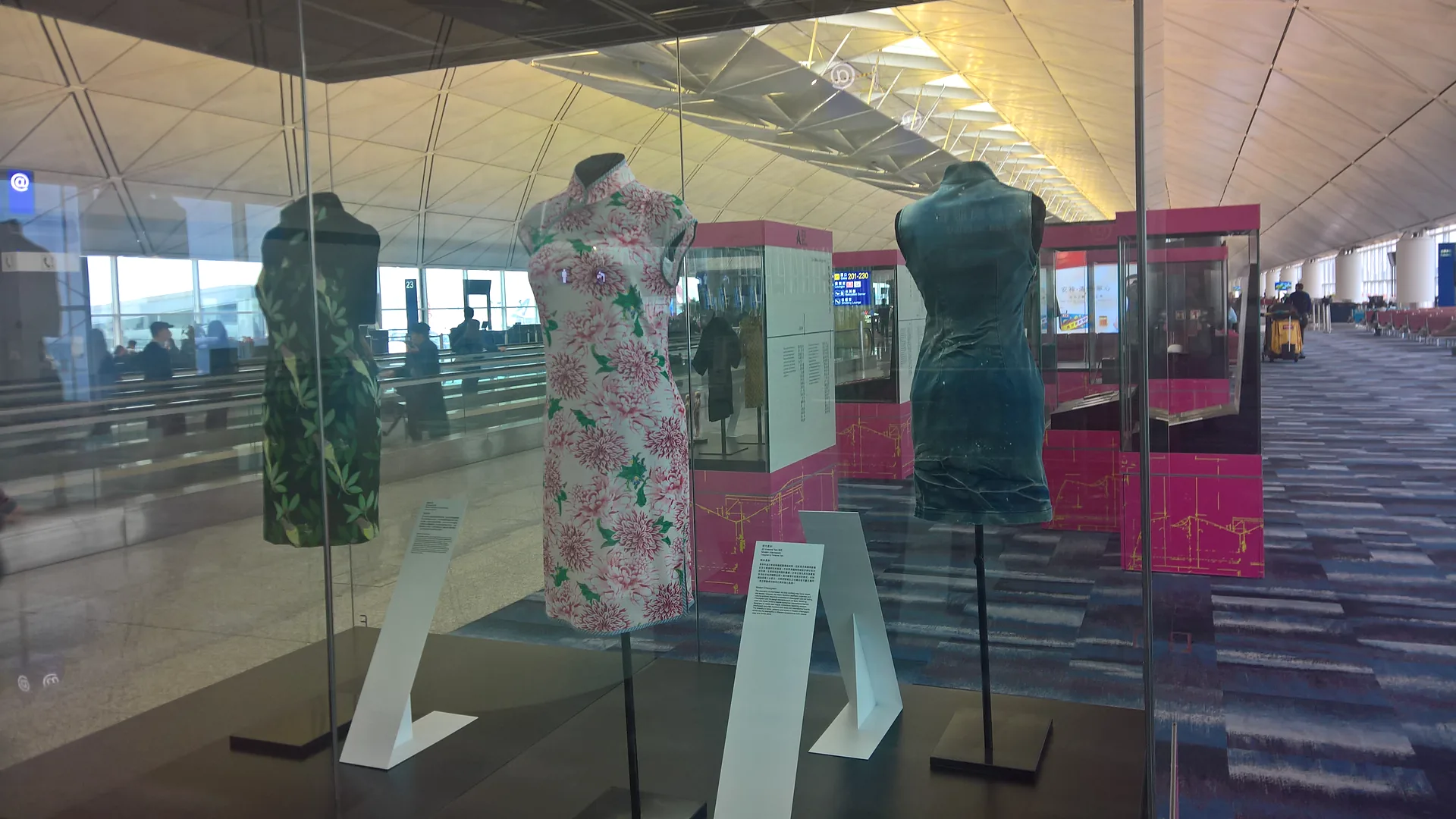
*Cheongsam exhibition by the Hong Kong Museum of History (display photographed at Hong Kong International Airport, 2018). Hong Kong played an important role in establishing “cheongsam” as the English-language name for the dress. Photograph by Donald Trung, Wikimedia Commons, CC BY-SA 4.0.*
Qipao vs Cheongsam at a Glance
Qipao and cheongsam generally refer to the same women's dress today. The main difference is the history and regional use of the two names rather than a consistent difference in garment design.
| Qipao | Cheongsam | |
|---|---|---|
| Chinese | 旗袍 | 長衫 / 长衫 |
| Common pronunciation context | Mandarin | Cantonese |
| Literal historical sense | Banner robe / Banner gown | Long garment / long dress |
| Common region today | Mainland China, Taiwan | Hong Kong; common in international English |
| Modern women's garment | Yes | Yes |
| Different dress style? | Usually no | Usually no |
| Historical terminology | Linked to Banner/Manchu dress terminology | Historically broader; also connected to men's long robes |
| English usage | Common | Common |
They normally refer to the same women's dress in modern usage. They do not have exactly identical meanings historically.
The one-sentence answer
Qipao and cheongsam are usually two names for the same modern women's dress, but the words themselves have different linguistic and historical origins.
What the Two Names Actually Mean
Qipao: 旗袍
旗袍 (qípáo) is the Mandarin term. Qi (旗) refers historically to Banner affiliation in the Qing context; pao (袍) means a robe or gown. Hong Kong government heritage material glosses qipao as referring historically to a Manchu/Banner robe.
The name preserves a historical connection with Banner clothing, even though the modern qipao developed substantially after the Qing period. That ancestry is not the same claim as “today's fitted dress existed unchanged in the Qing dynasty.” For the full development from Qing roots through Shanghai and Hong Kong, see Qipao / Cheongsam: History, Meaning & Design.
Cheongsam: 長衫
Cheongsam is the English spelling based on Cantonese pronunciation of 長衫 / 长衫, approximately chèuhngsāam. The literal sense is long garment / long gown / long dress.
This is not the Cantonese pronunciation of 旗袍. They are different Chinese terms. Treating them as Mandarin and Cantonese readings of identical characters is a common but incomplete shortcut.
Why that distinction matters
English-language articles often reduce the difference to Mandarin vs Cantonese. That is useful as a shorthand for modern regional usage, but incomplete historically.
The more precise model is:
different Chinese terms → regional clothing histories → both converge on the same women's dress in modern English usage.
What did Changshan originally mean?
Hong Kong Memory notes that in Guangdong, changshan / cheongsam was habitually used for the long robe worn by Chinese men. During the 1920s, the English loanword cheongsam expanded to include women's long robes.
This is why translating 長衫 mechanically as “women's qipao” in every historical context can be misleading. Historical men's-robe usage and modern women's-dress usage share a word lineage; they are not the same category in every period.
Why Hong Kong Says Cheongsam
Cantonese terminology
Hong Kong is Cantonese-speaking. As the modern dress became established there, cheongsam became the familiar local name. Hong Kong Conservation Office material states that qipao was generally referred to as cheongsam in Hong Kong, meaning “long dress.”
Shanghai influence on Hong Kong
Modern qipao developed strongly through mainland urban fashion, especially Shanghai. Later, Hong Kong became a major center for cheongsam tailoring, daily wear, film and fashion, and craftsmanship continuity. Hong Kong's Conservation Office notes that the one-piece cheongsam was particularly fashionable from the 1930s through the 1970s.
That is continuation and localization—not a claim that Hong Kong invented the modern qipao from nothing. Full design history belongs on the parent Qipao page.
Why Cheongsam entered English
International exposure to Chinese culture historically passed substantially through southern Chinese ports, Cantonese-speaking migrants, Hong Kong and overseas Chinese communities. Cantonese-derived words therefore entered English; cheongsam is one example. That structural path explains English familiarity without requiring a claim that every Chinese loanword in English followed the same route.
Mainland China and Taiwan
Hong Kong Memory states explicitly that for this women's garment:
* qipao is the normal name in mainland China and Taiwan * qipao and cheongsam are used interchangeably in Hong Kong * “cheongsam” carries a particularly Hong Kong flavor
| Context | Most useful term |
|---|---|
| Mainland China / Mandarin conversation | Qipao / 旗袍 |
| Taiwan | Qipao / 旗袍 |
| Hong Kong | Cheongsam / 長衫; Qipao also understood |
| International English | Both Qipao and Cheongsam |
| Travel writing | Use both |
| Asking a Beijing tailor/shop | Qipao / 旗袍 |
Regional language still varies by speaker and setting; treat the table as practical guidance, not a rigid rulebook.
Do Qipao and Cheongsam Look Different?
There is no reliable modern design rule that makes one garment a qipao and another a cheongsam.
Many commercial blogs invent distinctions such as qipao = traditional/loose and cheongsam = modern/fitted, or long vs short. Those are not universal definitions. Do not shop or describe garments as if the English label alone encodes silhouette.
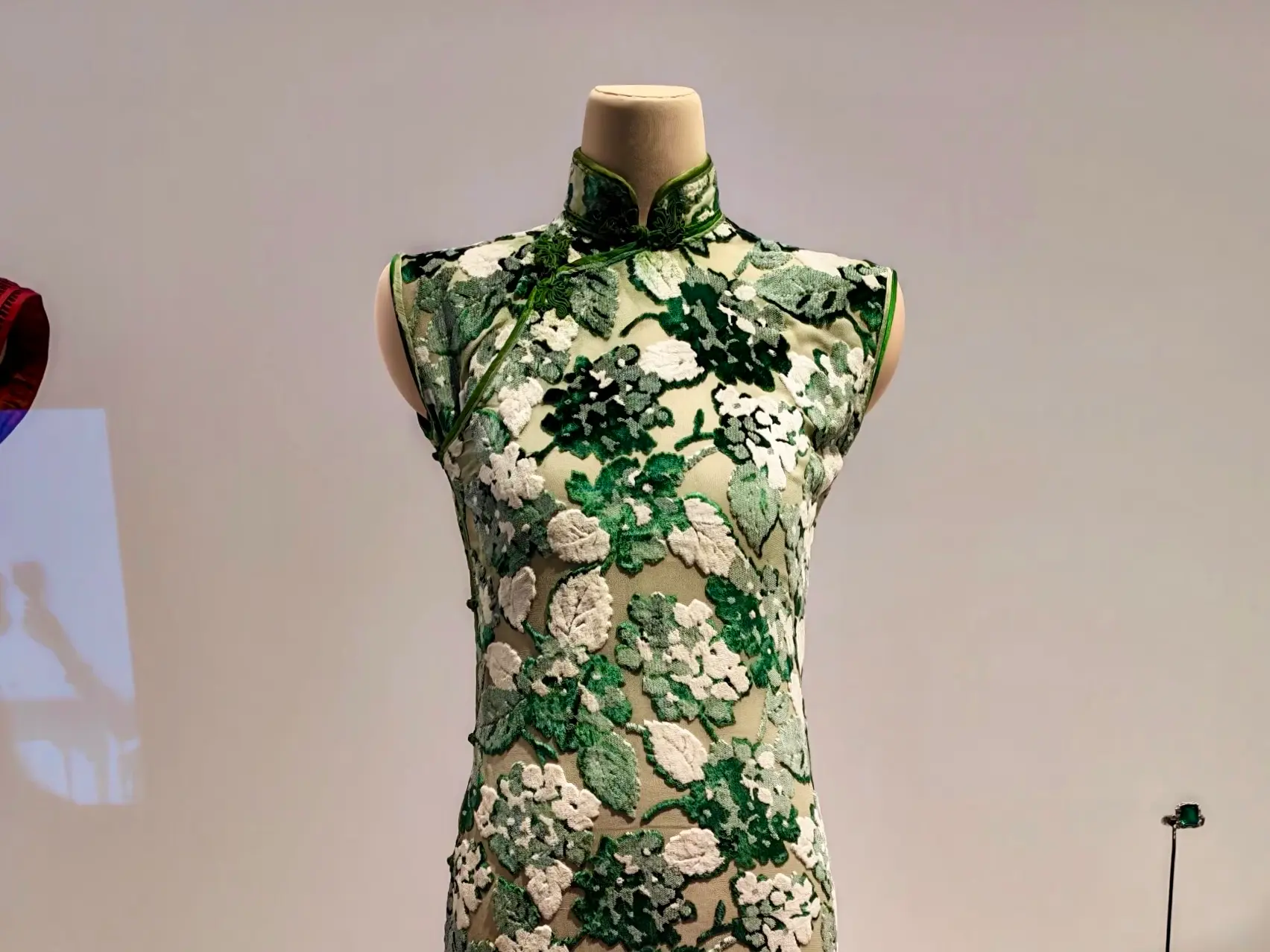
*The same garment can legitimately be described as either qipao or cheongsam in modern English; the naming difference does not depend on one fixed silhouette. Photograph by Gary Todd, Wikimedia Commons, CC0.*
The common “traditional vs modern” claim
Some writers or retailers use qipao for earlier/looser forms and cheongsam for later fitted forms. That is a marketing or personal convention, not a universally accepted linguistic rule. Hong Kong heritage sources use cheongsam for the women's clothing tradition broadly. DragonTrail terminology follows institutional usage, not ecommerce label pairs.
Length does not decide the name
Neither “long = qipao / short = cheongsam” nor the reverse is a reliable rule. Dress length changed with fashion.
Fit does not decide the name
Neither “loose = qipao / fitted = cheongsam” is a reliable universal rule. Modern qipao/cheongsam design ranges widely.
Collar does not decide the name
Both words can describe garments with standing collars, modified collar heights or modernized necklines, depending on design.
Fabric does not decide the name
Silk, brocade, cotton, wool blends and contemporary fabrics may appear in garments described by either term.
| Claim | Better explanation |
|---|---|
| Qipao and cheongsam are different dresses | Usually false in modern usage |
| Qipao is Mandarin for the same Chinese characters | Incomplete — the Chinese terms are 旗袍 and 長衫 |
| Qipao is traditional, cheongsam is modern | Not a consistent historical rule |
| Qipao is loose, cheongsam is fitted | Not a reliable distinction |
| Qipao is mainland, cheongsam is Hong Kong | Useful regional shorthand, but both terms can overlap |
| Cheongsam means women's dress historically | Historically 長衫 had broader usage, including men's long robes |
Which Word Should You Use?
When writing in English
On first mention where maximum clarity is useful, write Qipao (Cheongsam). Then use whichever term fits the geographic or contextual discussion. In international English, Qipao is the primary label and Cheongsam is an important synonym; repeating “qipao/cheongsam” in every sentence is unnecessary.
In mainland China
Use qipao / 旗袍. For a taxi driver, shop or tailor, 旗袍 will be clearer than an English transliteration. This is especially relevant in Beijing.
In Hong Kong
Cheongsam is natural and culturally embedded. Qipao is also understood. Neither term is “correct” and the other “wrong.”
When shopping online
Search both terms because sellers may optimize for different international markets. Evaluate garments by construction, fit, fabric and tailoring rather than assuming the label qipao vs cheongsam signals quality or authenticity.
For museums and historical research
Use the terminology used by the institution or object record. Historical 長衫 references should not all be normalized into “qipao”; historical context matters.
Qipao vs Cheongsam FAQ
Are Qipao and Cheongsam the same?
For the modern women's dress, generally yes. They are commonly used as alternate names, especially in English and Hong Kong usage, but the terms have different linguistic and historical origins.
Is Qipao Mandarin and Cheongsam Cantonese?
That is a useful regional shorthand but not the whole story. Qipao is 旗袍, while cheongsam comes from Cantonese 長衫; they are different Chinese terms rather than different pronunciations of identical characters.
What does Qipao mean?
旗袍 is commonly glossed historically as Banner robe/gown, reflecting its connection to Qing Banner/Manchu clothing terminology. Everyday speakers use it as a dress name; the etymology records ancestry rather than a live literal thought every time the word is used.
What does Cheongsam mean?
長衫 literally means long garment/long gown. In Cantonese-speaking Hong Kong, cheongsam became the usual name for the women's dress.
Why do people in Hong Kong say Cheongsam?
Because Cantonese terminology and Hong Kong tailoring culture established cheongsam as the local name for the women's garment.
What do people in mainland China call Cheongsam?
Usually qipao / 旗袍 for the modern women's dress.
Is Qipao more traditional than Cheongsam?
No. The choice of name does not reliably indicate whether a dress is more traditional, older or more authentic.
Is Cheongsam more fitted than Qipao?
Not as a universal rule. Fit changed through fashion history, and both words can describe loose or fitted forms depending on context.
Which word should tourists use in Beijing?
Use qipao / 旗袍. It will generally be the clearest term in Mandarin-speaking Beijing.
Qipao and Cheongsam in Beijing
What to ask for
For a Beijing shop or tailor, use 旗袍, not simply the English word Cheongsam. Request categories may include ready-made qipao, custom qipao, silk qipao, modern qipao or wedding qipao—evaluate the actual garment rather than the English label alone.
Don't shop by terminology alone
A garment being called qipao, cheongsam, traditional qipao or Shanghai qipao does not guarantee quality, hand tailoring, silk, historical accuracy or bespoke construction. Instead evaluate fit, fabric, piping, pankou, seam quality, pattern alignment and finishing.
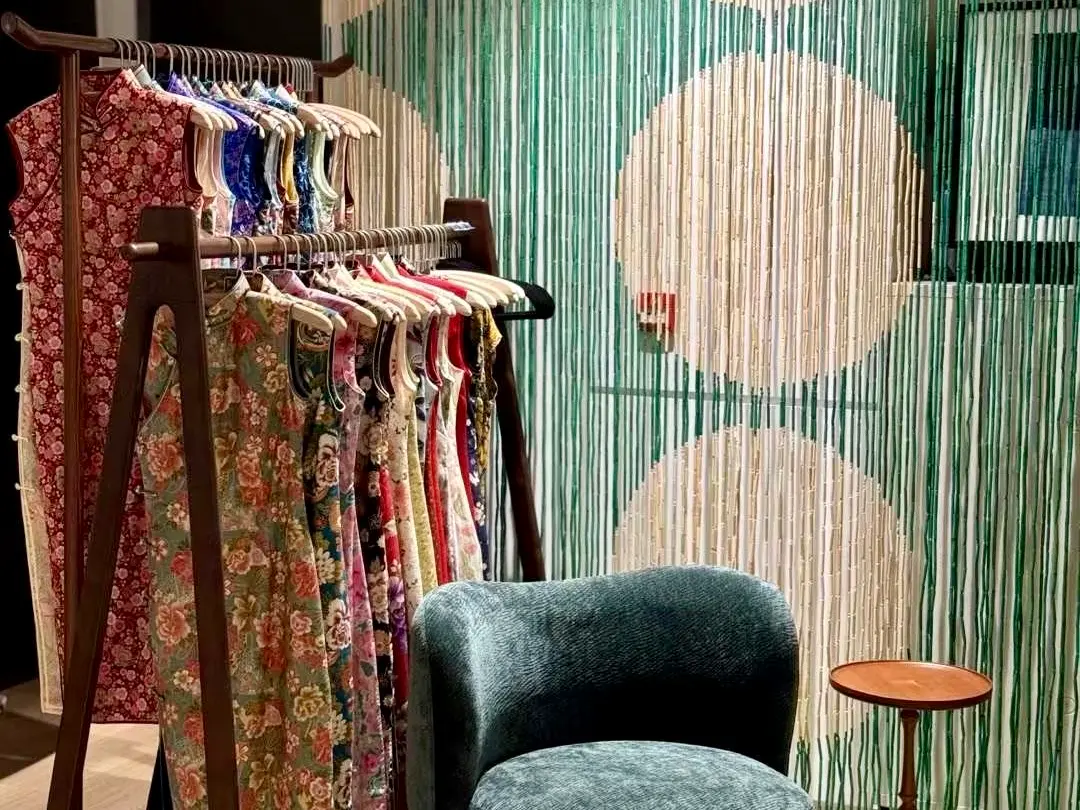
*Floral cheongsam garments displayed inside a tailor shop.*
Qipao shopping vs Hanfu experience
Qipao usually points visitors toward shopping, tailoring and portraiture. Hanfu more often points toward rental, historical styling and photoshoot experiences. For the garment-system comparison, see Hanfu vs Qipao.