
This is a curated selection of 12 landmark works and traditions for understanding Chinese sculpture—not a ranking of "the best," "greatest," or "most important." Chinese sculpture history has no single agreed-upon top-ten list, and treating any 12 entries as definitively superior would misrepresent a tradition with thousands of significant works across three millennia. The selection includes one Shang ritual bronze vessel (the Houmuwu ding) specifically to clarify the boundary between ancient Chinese bronzeware and free-standing sculpture, plus a few category entries (Northern Wei gilt-bronze Buddhas; Tang sancai tomb horses) that travelers encounter as traditions rather than single named objects. The 12 are presented in roughly chronological order as a reference set.
| # | Work | Period | Material | Location |
|---|---|---|---|---|
| 1 | Houmuwu ding | Shang dynasty | Bronze (ritual vessel) | National Museum of China, Beijing |
| 2 | Sanxingdui bronze standing figure and masks | Late Shang era (Shu culture) | Bronze | Sanxingdui Museum, Sichuan |
| 3 | Terracotta Army, Pit 1 | Qin dynasty | Fired clay | Near Xi'an, Shaanxi |
| 4 | Kneeling archer figure | Qin dynasty | Fired clay | Terracotta Army site, near Xi'an |
| 5 | Wu family shrine stone reliefs | Han dynasty | Stone (relief) | Jiaxiang, Shandong |
| 6 | Flying Horse of Gansu | Eastern Han dynasty | Bronze | Gansu Provincial Museum, Lanzhou |
| 7 | Vairocana Buddha, Fengxian Temple | Tang dynasty (completed 675) | Stone | Longmen Grottoes, near Luoyang |
| 8 | Northern Wei gilt-bronze Buddha figures | Northern Wei dynasty | Gilt bronze | Various museum collections |
| 9 | Tang sancai tomb horses | Tang dynasty | Glazed/painted pottery | Various museum collections |
| 10 | Ming Tombs Sacred Way stone animals | Ming dynasty | Stone | Near Beijing |
| 11 | Forbidden City gilded bronze dragons and lions | Ming–Qing dynasties | Gilded bronze | Forbidden City, Beijing |
| 12 | Monument to the People's Heroes reliefs | Modern (completed 1958) | Granite and marble | Tiananmen Square, Beijing |
1. Houmuwu Ding
A massive rectangular bronze ritual vessel from the late Shang dynasty, excavated at Anyang in 1939 and now held at the National Museum of China. At 832.84 kilograms, it is the heaviest bronze vessel known from anywhere in the ancient world. It is included here as a landmark example of what most ancient Chinese "bronze sculpture" actually is: a ritual vessel for ritual and ancestral ceremonies, not a figural statue. See the Chinese Bronze Sculpture guide.
2. Sanxingdui Bronze Standing Figure and Masks
Large free-standing bronze human figures and masks with dramatically protruding eyes, excavated from sacrificial pits at the Sanxingdui site in Sichuan starting in 1986, associated with the ancient Shu culture and roughly contemporary with the Shang dynasty. The best-known standing figure, at about 2.6 meters including its pedestal, is considered the largest bronze human figure from any Bronze Age culture found anywhere in the world—and a rare instance of genuine freestanding figural bronze sculpture from this early period.
3. Terracotta Army, Pit 1
The largest of the three main excavation pits near Xi'an, containing the bulk of the roughly 8,000 estimated soldier figures guarding the tomb of China's first emperor, Qin Shi Huang. Discovered by farmers in 1974, Pit 1 is what most visitors picture when they hear "Terracotta Army": long ranks of individually finished infantry figures standing in excavated trenches.
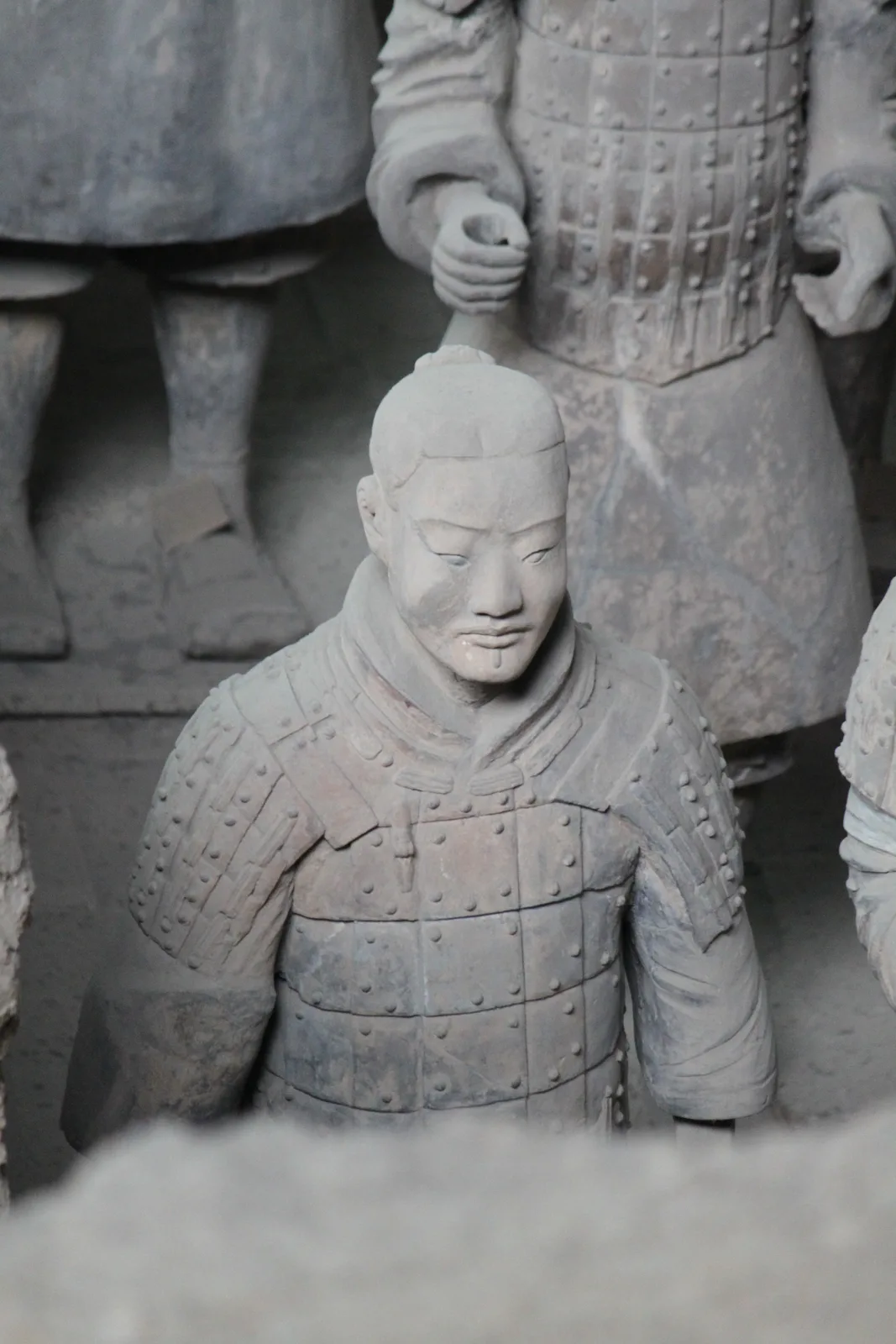
*Terracotta Army, Pit 1, near Xi'an. This pit holds the largest concentration of the roughly 8,000 estimated soldier figures.*
4. Kneeling Archer Figure
A specific Terracotta Army figure type worth calling out on its own: the kneeling archer, shown in a low firing stance with individualized facial features and even the tread pattern on the sole of his boot rendered in the clay. The kneeling archer is often cited as one of the best-preserved individual figures from the site, since its lower center of gravity made it less likely to be crushed when the wooden roof structure above the pits collapsed in antiquity.
5. Wu Family Shrine Stone Reliefs
A set of low-relief carved stone panels from a mid-2nd-century CE Han dynasty family shrine complex in Jiaxiang, Shandong, depicting Confucian moral exemplars, historical rulers and mythological scenes. Rediscovered and studied since the 18th century, these reliefs are foundational evidence for how Han China visualized its own history and values in permanent stone form. See the Tomb & Funerary Sculpture guide.
6. Flying Horse of Gansu
An Eastern Han bronze sculpture of a galloping horse balanced on one hoof atop a bird in flight, unearthed in 1969 from a tomb at Leitai, near Wuwei, Gansu, and now held at the Gansu Provincial Museum. Since 1983 its silhouette has served as China's official tourism emblem. See the Chinese Horse Sculpture guide.
7. Vairocana Buddha, Fengxian Temple
A colossal seated stone Buddha, 17.14 meters tall with a 4-meter head, carved into the cliff face at the Longmen Grottoes near Luoyang and completed in 675 CE under Emperor Gaozong with major sponsorship from Empress Wu Zetian. Widely treated as the high point of Tang dynasty Buddhist stone carving. See the Buddhist Sculpture guide.
8. Northern Wei Gilt-Bronze Buddha Figures
Small portable gilt-bronze Buddha and bodhisattva figures cast during the Northern Wei dynasty, often inscribed with donor dedications, representing the parallel tradition of household and temple devotional sculpture that ran alongside the monumental cave-temple projects of the same period. Examples are held in museum collections worldwide.
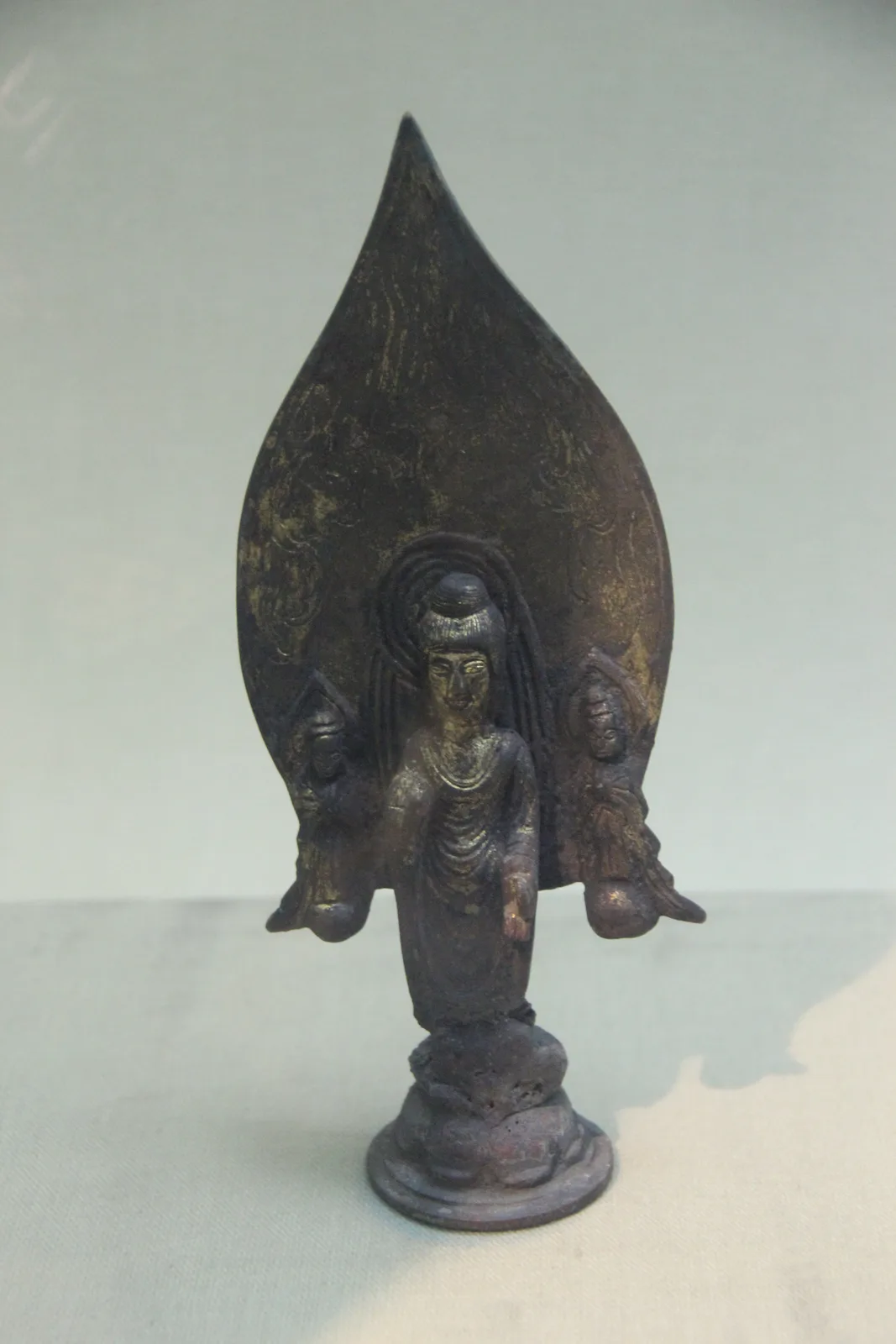
*Northern Wei-style gilt bronze Buddha figure, representative of the portable devotional sculpture produced alongside monumental cave-temple carving.*
9. Tang Sancai Tomb Horses
Lead-glazed and painted pottery horse figures, often shown with riders, made as mingqi (tomb goods) for Tang burials. These figures reflect both the practical importance of horses to Tang cavalry and frontier defense and the refined craft standard Tang workshops applied to funerary sculpture. See the Chinese Horse Sculpture guide.
10. Ming Tombs Sacred Way Stone Animals
Twenty-four monumental stone animals—lions, xiezhi, camels, elephants, qilin and horses, each in standing and kneeling pairs—lining the ceremonial approach to the Ming Tombs north of Beijing. Unlike the buried Terracotta Army, these were always meant to be seen, forming a visible processional avenue rather than a hidden underground guard. See the Tomb & Funerary Sculpture guide.
11. Forbidden City Gilded Bronze Dragons and Lions
Gilded bronze dragon and guardian-lion sculptures placed at key gates and courtyards throughout the Forbidden City, representing the highest tier of Ming and Qing imperial sculptural patronage. These pieces are outdoor sculpture, normally visible during Palace Museum opening hours, subject to temporary route and conservation restrictions. See the Chinese Dragon Sculpture and Chinese Guardian Lions guides.
12. Monument to the People's Heroes Reliefs
Ten large white marble bas-relief panels set into the base of the Monument to the People's Heroes in Tiananmen Square, completed in 1958 under a sculpture team led by Liu Kaiqu, depicting a century of Chinese revolutionary history. At nearly 38 meters total height, the monument is among the most visible works of modern Chinese public sculpture in Beijing. See the Modern & Contemporary Chinese Sculpture guide.
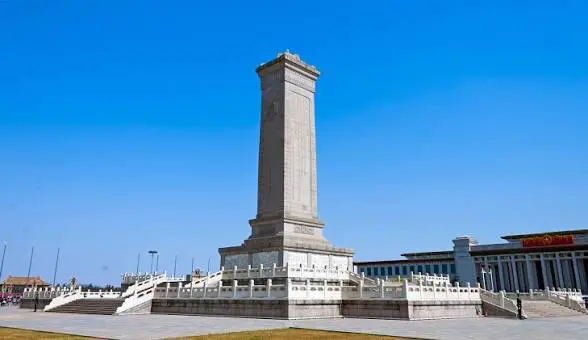
*Monument to the People's Heroes, Tiananmen Square, Beijing, completed 1958. Its marble bas-relief panels form a major public sculpture ensemble in modern China.*
How to See These Works
Of these 12, three (the Terracotta Army pieces, #3 and #4) require a dedicated trip to Xi'an via the Xi'an Terracotta Warriors tour. Two (#11 and #12) are viewable in Beijing outdoors, with the Forbidden City reachable via a Forbidden City private tour. One (#1) is at the National Museum of China in Beijing. The remainder are spread across Sichuan, Shandong, Gansu, Henan and international museum collections—see Where to See Chinese Sculpture in Beijing for what is realistically reachable on a Beijing-based trip.
FAQ
Is this a ranking of the best Chinese sculptures?
No. It is a curated, roughly chronological selection of 12 landmark works and traditions chosen to represent major eras, materials and genres—not a ranking of "the best," "greatest," or "most important."
Which of these 12 works are in Beijing?
The Forbidden City's gilded bronze dragons and lions (#11) and the Monument to the People's Heroes reliefs (#12) are in Beijing, along with the Houmuwu ding (#1) at the National Museum of China.
Which of these 12 works require a trip outside Beijing?
The Terracotta Army pieces (#3 and #4) require a trip to Xi'an. The Sanxingdui bronzes (#2) are in Sichuan, the Wu family shrine reliefs (#5) are in Shandong, the Flying Horse of Gansu (#6) is in Gansu, and the Vairocana Buddha (#7) is near Luoyang in Henan.
What is the oldest work on this list?
The Houmuwu ding and the Sanxingdui bronzes both date to the Shang era (roughly 1600–1046 BCE), making them the oldest works in this selection.
What is the newest work on this list?
The Monument to the People's Heroes reliefs, completed in 1958.
Why include a ritual bronze vessel like the Houmuwu ding alongside figural sculpture?
Because understanding that most ancient Chinese "bronzes" are ritual vessels, not figural statues, is essential context for reading Chinese sculpture history accurately. See the Chinese Bronze Sculpture guide for the full distinction.
Continue with Chinese Sculpture
- Chinese Sculpture guide
- History of Chinese Sculpture
- Tomb & Funerary Sculpture
- Modern & Contemporary Chinese Sculpture
Plan a Visit
- Xi'an Terracotta Warriors tour
- Forbidden City private tour
- Contact us to plan a wider itinerary
Sources & Further Reading
- UNESCO World Heritage Centre — Mausoleum of the First Qin Emperor
- UNESCO World Heritage Centre — Longmen Grottoes
- National Museum of China — Houmuwu ding
- Sanxingdui Museum — Sanxingdui bronzes
- Gansu Provincial Museum — Flying Horse of Gansu