
Chinese Painting at a Glance
| Topic | Orientation |
|---|---|
| Common Chinese term | 中国画 |
| Modern term | 国画 / guohua |
| Core tools | Brush, ink, paper, inkstone |
| Other major ground | Silk |
| Major subjects | Landscape, figures, flowers-and-birds |
| Important approaches | Gongbi, xieyi, literati, court/professional |
| Formats | Hanging scroll, handscroll, album, fan |
| Related arts | Calligraphy, poetry, seal carving |
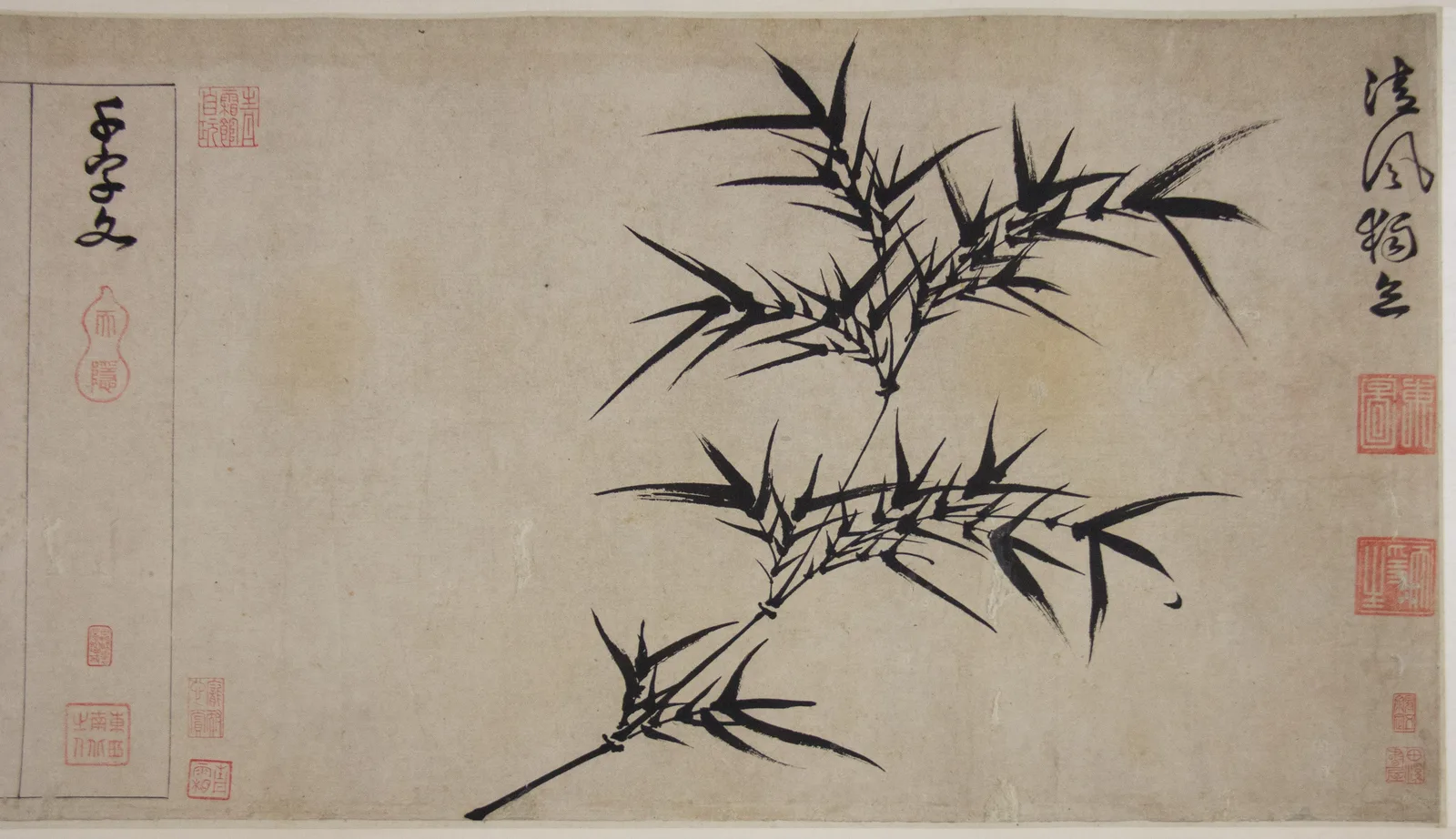
*Bamboo and the Thousand-Character Classic, Zhan Jingfeng, 1599. The Metropolitan Museum of Art — . Cropped and resized for web by DragonTrail; .*
What Is Chinese Painting?
Chinese painting is not a single style. Travelers usually meet it as a family of brush-based image traditions that developed with Chinese writing tools: flexible brush, soot-based ink, absorbent paper or silk, and often later mounting into scroll or album formats. Museum labels may say Chinese painting (中国画, Zhōngguó huà) for the broad historical tradition, while guohua (国画, guóhuà) is a modern category that contrasts traditional Chinese-style painting with Western-style media in modern Chinese art discourse. Guohua should not be projected uncritically onto every Tang or Song work.
Three subject traditions dominate many museum introductions: figures, landscapes, and flowers-and-birds. Approaches such as gongbi and xieyi describe how the brush is handled, not a full taxonomy of everything Chinese painters ever made. Court workshops, professional painters, religious ateliers and scholar-amateurs often overlapped in materials while differing in patronage and ideals.
Painting has a particularly close relationship with Chinese calligraphy and poetry. Broader craft context: Chinese Arts and Crafts.
A Short History of Chinese Painting
Early surviving Chinese painting is fragmentary compared with ceramics or bronzes. Tomb and cave murals, later copies of famous attributions, and transmitted texts give travelers a working chronology rather than a complete gallery of originals.
| Period | Traveler orientation |
|---|---|
| Early traditions | Tomb murals, religious imagery, figure narratives; many famous names survive as later attributions |
| Tang | Strong figure and horse traditions; mural painting in tomb and Buddhist contexts |
| Five Dynasties–Northern Song | Monumental landscape painting becomes a major museum category |
| Southern Song | More intimate landscapes, mist, diagonals; academy and court contexts |
| Yuan | Literati ink landscape ideals intensify for scholar painters |
| Ming | Scholar and professional schools coexist; theory and collecting expand |
| Qing | Court painting, individualist ink painters, archaistic taste |
| 20th century | Traditional brush media meet modern academies, nation-building imagery and international markets |
Treat this table as orientation. Individual works move across courts, temples, private collections and museums; paper and silk also rotate off display for conservation.
The Three Major Subject Traditions
Shanghai Museum's Chinese Painting Gallery and many textbook surveys group paintings by subject:
- Figure painting — people, narratives, court and religious scenes
- Landscape painting — mountains, water, mist, paths and retreat imagery; see Chinese Landscape Painting
- Flowers-and-birds — plants, birds and related natural motifs; see Subjects & Symbolism
Subject is not the same as style. A landscape can be meticulous or abbreviated; a bird can be finely outlined or dashed in wet ink.
Ink and Color
Black ink is central, but Chinese painting is not always monochrome. Painters dilute ink into graded washes, combine wet and dry strokes, and frequently add mineral or plant pigments. Blue-and-green landscapes, court flower-and-bird works and many silk paintings use color as a primary resource. See Chinese Ink Painting.
Brushwork and Calligraphy
The same family of brushes underlies painting and Chinese calligraphy. Shared skills include pressure, speed, moisture and tip control; painting also develops conventions for texture strokes, washes and modelling forms. For tools, see Chinese Brush Painting and the Four Treasures of the Study.
Chinese Landscape Painting
Landscape painting (山水画, shānshuǐ huà) became one of the central genres of Chinese painting. Many works construct cultivated or imagined space rather than copying one fixed optical viewpoint. Dedicated guide: Chinese Landscape Painting.
Gongbi, Xieyi and Literati Painting
Gongbi describes controlled, detailed brushwork. Xieyi emphasizes abbreviated, expressive handling. Literati (scholar) painting developed ideals linking painting to calligraphy and poetry. Court and professional painters worked under different patronage systems. These categories overlap; see Chinese Painting Styles.
Painting on Paper and Silk
Paper and silk are the two major painting grounds travelers see in galleries. Silk can mean the painted surface, while mounting silks on a scroll are a separate layer. Formats and materials: Chinese Scroll & Silk Painting.
Handscrolls, Hanging Scrolls, Albums and Fans
A handscroll is viewed in sections from right to left and then rerolled. A hanging scroll is displayed vertically. Albums and fans support shorter or more intimate viewing. Format changes how a painting is experienced as much as subject does.
Seals, Inscriptions and Colophons
Red seals, signatures, poems and later colophons form a second text layer around many paintings. A red stamp is not automatically the artist's signature. Guide: Seals, Signatures & Colophons.
Famous Chinese Painters
Names such as Fan Kuan, Guo Xi, Zhang Zeduan, Huang Gongwang, Dong Qichang, Shitao, Qi Baishi and Zhang Daqian help travelers recognize museum labels across periods. Chronological map: Famous Chinese Paintings & Painters.
Subjects and Symbolism
Dragons, bamboo, plum blossoms, lotuses and peonies recur, but meanings depend on period, inscription and context. Guide: Subjects & Symbolism.
How to Look at a Chinese Painting in a Museum
- Read date and attribution carefully.
- Identify the subject (figures, landscape, flowers-and-birds, other).
- Identify the format (handscroll, hanging scroll, album, fan, mural).
- Note ink versus color balance.
- Inspect brushwork: line, wash, dry texture, wet bloom.
- Notice blank or lightly worked space as part of the design.
- Find inscriptions and signatures.
- Distinguish artist seals from collector or imperial seals when the label helps.
- Remember paper and silk rotate; absence of a famous work does not mean the museum lacks painting holdings.
Chinese Painting vs Calligraphy
| Dimension | Chinese painting | Chinese calligraphy |
|---|---|---|
| Primary aim | Pictorial image (with frequent text overlays) | Written characters as visual art |
| Shared tools | Brush, ink, paper/silk | Brush, ink, paper/silk |
| Shared skills | Pressure, rhythm, moisture | Pressure, rhythm, moisture |
| Typical add-ons | Seals, poems, colophons | Seals, titles, dedications |
| Traveler tip | Related arts, not identical categories | Start with Chinese Calligraphy |
Where Travelers Can See Chinese Painting
Beijing and Shanghai are the strongest DragonTrail cities for major historical painting collections. Xi'an adds Tang tomb murals. Chengdu, Chongqing and Zhangjiajie are weaker as classical painting-museum destinations but strong for mountain-and-water landscape context. Full map: Where to See Chinese Painting.
Experience Chinese Art & Landscapes in China
Beijing — Explore Art & Imperial Culture in Beijing
Build a private Beijing itinerary around the Palace Museum, historic sites and your specific art interests. → Beijing private tour planning
Shanghai — Add a Museum Stop in Shanghai
Longer Shanghai layovers can include a museum when opening hours and flight timing allow. → Shanghai layover quote
Xi'an — Continue into Xi'an's Ancient Art
Move from Tang murals and Chinese painting history into Qin archaeology at the Terracotta Warriors. → Terracotta Warriors tour
Chengdu — Explore Qingcheng's Mountain-and-Water Landscape
Pair shanshui ideas with wooded mountain and water scenery around Qingcheng and Dujiangyan. → Dujiangyan & Qingcheng day tour
Chongqing — Explore Wulong's Mountain-and-Water Scenery
See dramatic karst, valleys and water landscapes outside Chongqing. → Wulong karst private day tour
Zhangjiajie — Experience Monumental Mountain Scenery
Explore Zhangjiajie's pillar mountains, mist and layered views as physical context for mountain-and-water aesthetics. → Zhangjiajie National Forest Park private tour
Common Misconceptions
- Chinese painting is not always monochrome.
- It is not always painted on paper.
- "Rice paper" is an imprecise blanket term for several papers.
- Guohua is not a timeless label for every historical Chinese painting.
- Seals are not all artist signatures.
- Shanshui is not simply realistic landscape depiction.
- Chinese painting and calligraphy are related but not identical arts.
Explore Chinese Painting
- Chinese Ink Painting
- Chinese Landscape Painting
- Chinese Brush Painting
- Chinese Painting Styles
- Famous Paintings & Painters
- Scroll & Silk Painting
- Seals, Signatures & Colophons
- Subjects & Symbolism
- Where to See Chinese Painting
FAQ
What is traditional Chinese painting?
Traditional Chinese painting refers to brush-based pictorial traditions using ink and often color on paper or silk, closely historically linked with calligraphy and poetry. It covers multiple subjects and approaches rather than one style.
What is Chinese painting called in Chinese?
A common broad term is 中国画 (Zhōngguó huà). Guohua (国画) is a modern umbrella for traditional Chinese-style painting contrasted with Western-style media.
What are the main types of Chinese painting?
Museum introductions often use subject genres—figures, landscapes and flowers-and-birds—plus approach terms such as gongbi, xieyi and literati painting.
What is Chinese ink painting?
Ink painting uses black ink in varied concentrations and moisture levels for lines, washes and textures; it may be monochrome or combined with color. See Chinese Ink Painting.
What is shanshui painting?
Shanshui literally means mountain-water and names Chinese landscape painting. See Chinese Landscape Painting.
What is the difference between gongbi and xieyi?
Gongbi emphasizes controlled, detailed brushwork; xieyi emphasizes abbreviated, expressive handling. They are approaches, not a complete map of all Chinese painting. See Styles.
Why does Chinese painting use so much empty space?
Blank or lightly worked areas can organize rhythm, mist, distance and attention. They are design choices, not unfinished backgrounds.
Why are there red seals on Chinese paintings?
Red seals may belong to artists, collectors, institutions or later owners. They record ownership and commentary as well as authorship claims. See Seals & Signatures.
Where can travelers see Chinese painting in China?
Start with Beijing and Shanghai collections, Xi'an Tang murals, then use landscape destinations for physical mountain-and-water context. See Where to See.
Sources & Review
- The Metropolitan Museum of Art, essay *Chinese Painting* and object records including Zhan Jingfeng, *Bamboo and the Thousand-Character Classic* (.
- Shanghai Museum, Chinese Painting Gallery overview (materials and major subjects).
- Palace Museum (Beijing) official collection information for imperial painting/calligraphy context.
- Editorial synthesis for travelers; no separate expert peer review claimed for this page.