
Shanshui at a Glance
| Topic | Orientation |
|---|---|
| Chinese | 山水 / 山水画 |
| Literal sense | Mountain-water |
| Peak museum eras | Northern Song monumental; Southern Song intimate; Yuan literati |
| Related pages | Ink, Styles, Famous painters |
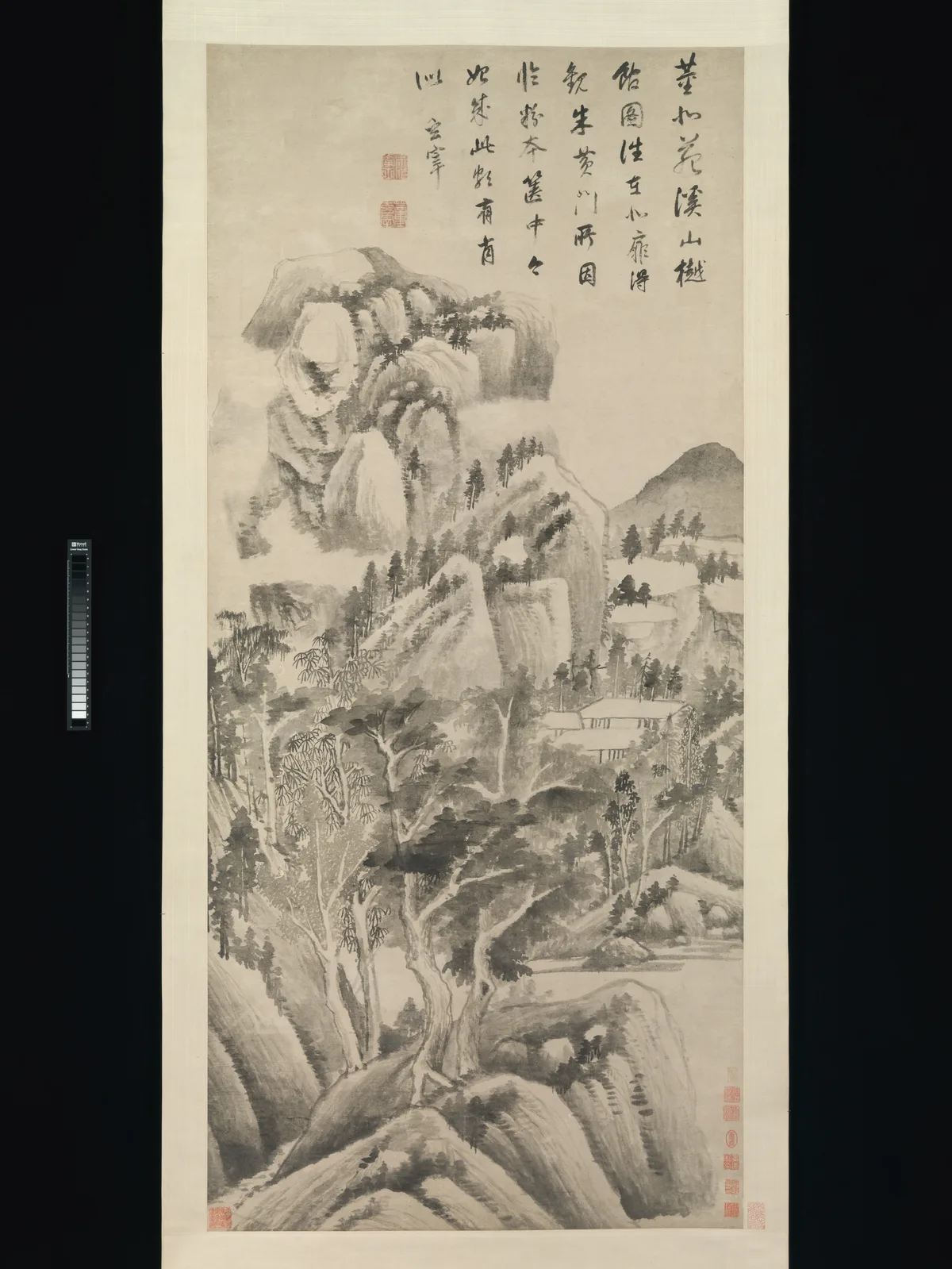
*Shaded Dwellings among Streams and Mountains, Dong Qichang, ca. 1622–25. The Metropolitan Museum of Art — . Resized; .*
What Does Shanshui Mean?
Shanshui names a genre organized around mountains and water as primary pictorial actors. Temples, boats, scholars’ huts and travelers often appear small. The genre’s cultural weight grew as landscape became a vehicle for cultivated identity and brush ideals, not only for recording a trip.
How Landscape Became an Independent Genre
Figure and narrative painting were early prestige categories. By the Northern Song, monumental landscapes occupy a central place in what travelers now meet as “classic Chinese painting.” Later periods reinterpret Song models rather than simply repeating them.
Northern Song Monumental Landscape
Northern Song works often present tall mountains, detailed rock systems and large vertical formats. Guo Xi’s *Early Spring* (1072) is a famous reference point travelers may know from reproductions even when the original is not on their itinerary.
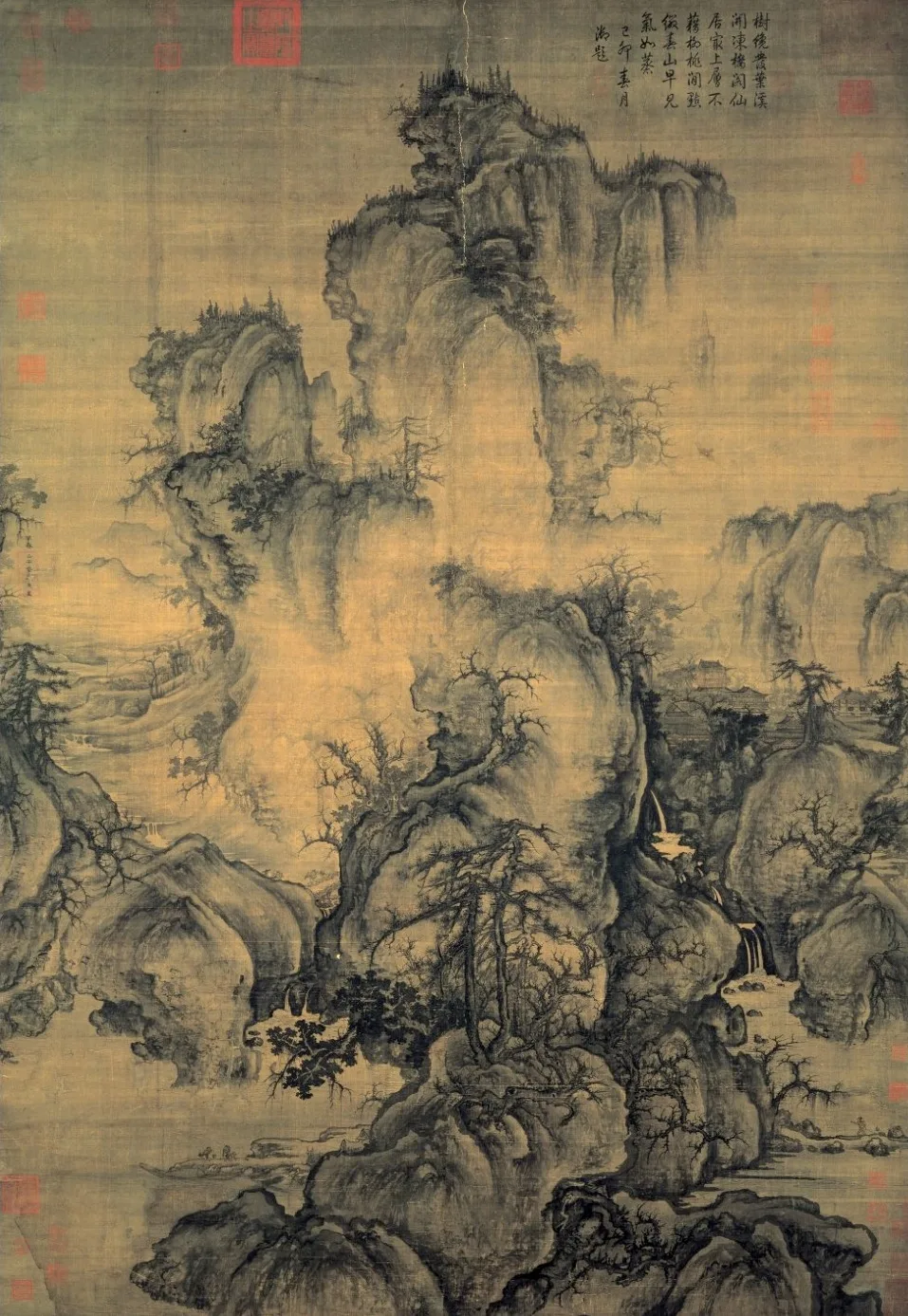
*Early Spring, Guo Xi, 1072. . Displayed near native source resolution (not AI-upscaled).*
Southern Song Landscape
Southern Song landscapes frequently feel more intimate: mist, truncated diagonals, and quieter corners of nature. Academy and court contexts matter here; do not collapse all Song painting into one “Northern style.”
Yuan Literati Landscape
Yuan scholar painters intensified ink landscape as a space for calligraphic brush values and personal tone. Names such as Huang Gongwang and Ni Zan become traveler landmarks in museum labels. See Famous Paintings & Painters.
Ming and Qing Reinterpretation
Ming and Qing painters debated Song and Yuan models, revived archaic manners, and continued court commissions. Dong Qichang’s theory and practice are especially visible in collecting histories and later copying cultures.
Mountains and Water
Mountains often structure vertical energy; water and mist open horizontal movement and depth. The pairing is compositional as well as symbolic.
Mist and Empty Space
Mist passages and lightly worked areas create distance and atmosphere. Empty space is an active design resource.
Multiple / Shifting Viewpoints
Many Chinese landscapes invite travel through a scene rather than locking one vanishing-point view. Traditional teaching texts discuss multiple ways of seeing mountains, but those systems should not be treated as a single universal formula applied to every painting without qualification.
Texture Strokes
Museum writing often notes textured brush methods used to model rock and earth. Exact Chinese technical names vary by school and later textbook tradition; travelers should treat label language as guidance and compare what the brush actually does on the surface.
Human Figures in Landscape
Small figures can give scale, suggest a path, or mark retreat. Their small size is usually compositional, not evidence that people were unimportant culturally.
Blue-and-Green Landscape
Blue-and-green (青緑) landscapes use mineral greens and blues in structured color programs. Wang Ximeng’s *A Thousand Li of Rivers and Mountains* is a major Palace Museum reference work; display rotates for conservation.
Landscape as Real Place vs Imagined Place
Some paintings name sites; many construct composite or ideal scenery. Do not assume every titled mountain equals a GPS pin.
Shanshui and Daoism
Retreat, nature and cultivated withdrawal appear in landscape culture, and Daoist sites matter for travelers. That does not reduce shanshui to “Daoist art.” Confucian, Buddhist and court contexts also shaped landscape production.
How to Look at a Chinese Landscape
- Identify format and scale.
- Trace path, water and mountain masses.
- Note mist and blank passages.
- Check ink density versus color.
- Locate figures, roofs and boats for scale.
- Read inscriptions after the pictorial structure.
See the Landscapes Behind the Aesthetic
Zhangjiajie — Experience China’s Monumental Mountain Scenery
Zhangjiajie’s pillar landscapes are not the origin of traditional shanshui painting, but their vertical scale, mist and layered mountain views give travelers a powerful physical reference for mountain-and-water aesthetics. → National Forest Park private tour · 2-day highlights
Chengdu — Mountains & Water near Chengdu
Qingcheng Mountain and Dujiangyan combine wooded mountains, streams and long cultural associations with Daoist landscape—useful context for travelers interested in shanshui ideas. → Dujiangyan & Qingcheng day tour
Chongqing — Explore Chongqing’s Dramatic Mountain-and-Water Landscape
Wulong’s karst, valleys, cliffs and water give a contemporary traveler a dramatic physical landscape to pair with the visual vocabulary of shanshui. → Wulong karst private day tour
City guides: Zhangjiajie, Chengdu, Chongqing.
Common Misconceptions
- Shanshui is not landscape photography.
- Not every landscape depicts a real location.
- Daoism is relevant but does not explain every landscape painting.
- Empty space is not unfinished background.
- Chinese painters used multiple spatial systems, not one Western perspective rule.
FAQ
What does shanshui mean?
Mountain-water; the common name for Chinese landscape painting.
What is Chinese landscape painting?
A major genre organizing mountains, water, mist and related motifs, often as cultivated rather than purely optical space.
Why are mountains important in Chinese painting?
They structure composition and cultural ideas of stature, retreat and nature.
Why is water important?
Water and mist create movement, distance and openness against mountain masses.
Why are people so small in many Chinese landscapes?
Scale and path cues; the landscape is often the main subject.
Did Chinese painters use perspective?
They used multiple spatial strategies; do not expect a single vanishing-point system in every work.
What does empty space mean in Chinese landscape painting?
It can signal mist, distance, rhythm or pause—design, not absence of skill.
Where can travelers experience shanshui-like landscapes in China?
Physical mountain-and-water context is strong in places such as Zhangjiajie, Qingcheng and Wulong; museum collections are strongest in Beijing and Shanghai. See Where to See.
Sources & Review
- The Met essays *Landscape Painting in Chinese Art* and *Chinese Painting*; Dong Qichang object record.
- .
- Palace Museum references for Wang Ximeng.
- Traveler synthesis; no separate expert review claimed.