
Chinese Painting Timeline
| Era | Traveler landmarks |
|---|---|
| Early attributions | Gu Kaizhi and figure narrative traditions (often later copies) |
| Tang | Figure and horse painting; mural cultures |
| Five Dynasties–Northern Song | Fan Kuan, Guo Xi; monumental landscape |
| Southern Song | Ma Yuan, Xia Gui; intimate landscape |
| Northern Song urban scroll | Zhang Zeduan, *Along the River During the Qingming Festival* |
| Yuan | Zhao Mengfu; Huang Gongwang; Ni Zan; Wang Meng |
| Ming | Shen Zhou; Wen Zhengming; Tang Yin; Dong Qichang |
| Qing | Shitao; Bada Shanren; court workshops |
| 20th century | Qi Baishi; Xu Beihong; Zhang Daqian |
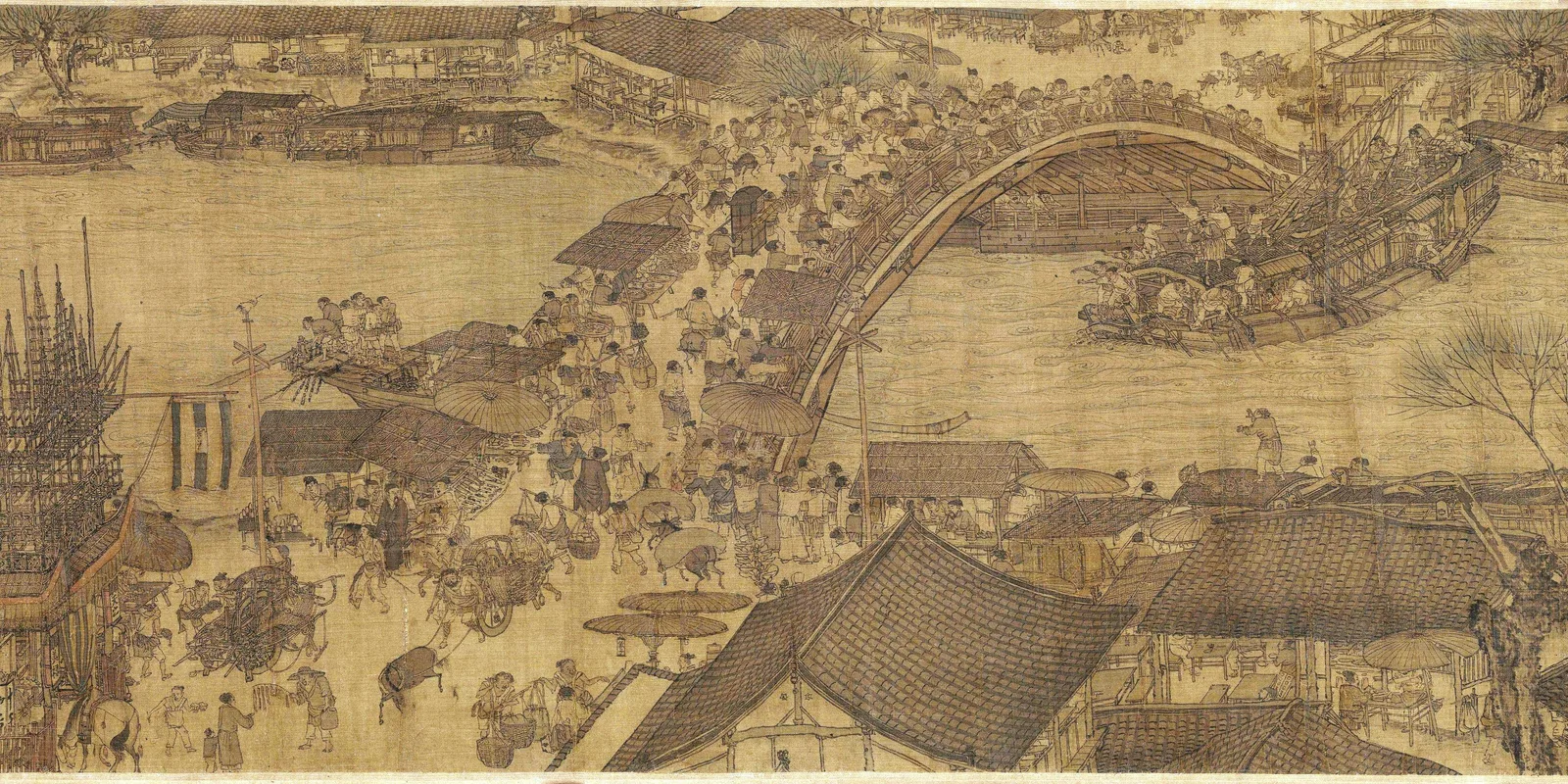
*Detail from Zhang Zeduan’s Along the River During the Qingming Festival. . Cropped/resized for web; .*
Early Masters and Surviving Attributions
Many early “masterpieces” known by famous names survive as later copies, workshop products or debated attributions. Museum labels usually signal that uncertainty. Travelers should read “attributed to” and “after” language carefully rather than treating every famous name as a securely autograph object.
Tang Dynasty
Tang painting culture is strong in figure traditions and horse painting (Han Gan is a frequent textbook name). For travelers, Tang tomb murals in the Xi’an region are often the most direct physical encounter with Tang pictorial culture. See Where to See Chinese Painting and Xi’an City Guide.
Five Dynasties and Northern Song
Fan Kuan and Guo Xi stand for monumental landscape ambition—tall mountains, complex rock systems and large hanging-scroll presence. These works shaped later ideals of what “serious” landscape could look like. Cross-link: Chinese Landscape Painting.
Southern Song
Ma Yuan and Xia Gui are associated with more intimate, misty, diagonally organized landscapes. Academy and court contexts matter; Southern Song is not simply “smaller Northern Song.”
Zhang Zeduan and Qingming Shanghe Tu
*Along the River During the Qingming Festival* (清明上河图) is one of the most reproduced Chinese paintings worldwide. The urban handscroll shows shops, bridges, boats and crowds in a continuous right-to-left narrative space. Later courts and painters made famous remakes; travelers should note whether a display is the Song composition tradition, a later version, or a reproduction.
Yuan Literati Painting
Zhao Mengfu bridges court and scholar ideals. Huang Gongwang, Ni Zan and Wang Meng became canonical literati landscape names. Ink values, calligraphic brush and cultivated identity intensify in this chapter of museum storytelling. See Styles.
Ming
Shen Zhou, Wen Zhengming and Tang Yin help travelers navigate Wu-school and professional/scholar intersections. Dong Qichang’s theory of painting lineages influenced collectors and copyists for centuries.
Qing
Shitao and Bada Shanren are often presented as individualist ink painters. Parallel Qing court workshops continued highly finished decorative and documentary painting. Both belong to Qing painting history.
20th Century Transformation
Qi Baishi brought flower-and-insect subjects into a modern popular-scholar idiom. Xu Beihong engaged academic figure traditions and national imagery. Zhang Daqian moved between archaistic skill, collecting and international careers. This page covers that transformation briefly; a separate Modern & Contemporary Chinese Art architecture is intentionally not opened here.
Ten Works Travelers Should Know
Representative works to recognize (not a ranked “greatest ever” list):
- Gu Kaizhi tradition figure narratives (often later copies)
- Guo Xi, *Early Spring*
- Zhang Zeduan tradition, *Qingming* scroll
- Wang Ximeng, *A Thousand Li of Rivers and Mountains*
- Huang Gongwang, *Dwelling in the Fuchun Mountains* (complex survival/split history)
- Ni Zan spare landscapes
- Dong Qichang landscapes and theoretical legacy
- Shitao ink paintings
- Qi Baishi flowers/insects
- Zhang Daqian landscapes and figure works
Where Are Famous Chinese Paintings Today?
Major holdings include the Palace Museum (Beijing), the National Palace Museum (Taipei), Shanghai Museum and international museums such as The Met. Paper and silk are light-sensitive; displays rotate. Absence of a celebrity painting on your visit day is normal conservation practice, not proof the museum “has no paintings.”
Beijing / Palace Museum
The Palace Museum official site highlights imperial painting and calligraphy holdings and prominently features Wang Ximeng’s *A Thousand Li of Rivers and Mountains* among collection highlights, within a vast overall collection. Painting and calligraphy galleries and special exhibitions change. Forbidden City guide: Beijing Forbidden City.
Explore the Palace Museum in Context
Painting and calligraphy displays rotate for conservation and exhibition planning. DragonTrail does not guarantee that a particular masterpiece will be on view during a standard Forbidden City visit.
Common Misconceptions
- There is no single “most famous” painter for all of Chinese history.
- Later copies and remakes are part of the tradition’s transmission.
- Famous paintings are not permanently hung like oil-gallery fixtures.
- Twentieth-century painters did not simply end traditional painting; they transformed it.
- Taipei and Beijing collections both matter for imperial painting history.
FAQ
Who is the most famous Chinese painter?
It depends on period and audience. Song landscapists, Yuan literati masters and modern names like Qi Baishi are all “famous” in different contexts.
What are the most famous Chinese paintings?
Works such as the *Qingming* scroll tradition, Guo Xi’s *Early Spring* and Wang Ximeng’s *Thousand Li* are frequent traveler landmarks.
Who painted Along the River During the Qingming Festival?
Zhang Zeduan is the traditional Song attribution for the famous composition; later versions also exist.
Who painted A Thousand Li of Rivers and Mountains?
Wang Ximeng; the work is associated with Palace Museum holdings and rotates for conservation.
Who were the major Song landscape painters?
Fan Kuan and Guo Xi are Northern Song landmarks; Ma Yuan and Xia Gui are Southern Song landmarks.
What is literati painting?
Scholar-centered painting ideals linking brushwork, calligraphy and poetry—especially influential from Yuan discussions onward.
Where are famous Chinese paintings displayed?
Beijing, Taipei, Shanghai and major international museums; check current exhibitions.
Why are some famous paintings not always on view?
Paper and silk are light-sensitive; museums rotate works for conservation.
Sources & Review
- Palace Museum official collection site (Wang Ximeng / imperial collections). *Qingming* detail reproduction.
- The Met Chinese Painting and landscape essays; artist object records.
- Traveler synthesis; no separate expert review claimed.