
Ink Painting at a Glance
| Topic | Orientation |
|---|---|
| Common English labels | Ink painting, ink wash painting |
| Chinese | 水墨 (shuǐmò) and related terms |
| Core variables | Concentration, moisture, speed, pressure, paper absorbency |
| Related arts | Calligraphy, literati painting |
| Not the same as | European watercolor as a whole category |
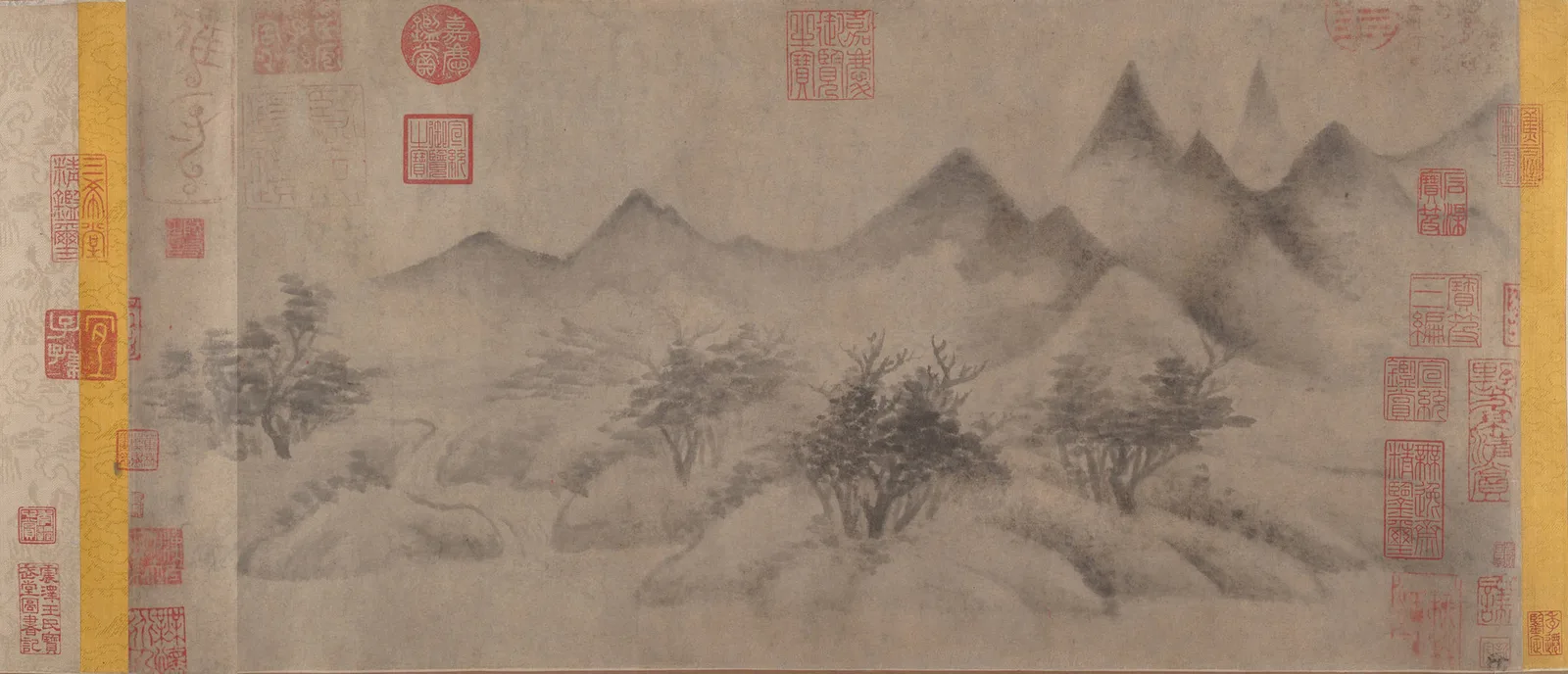
*Cloudy Mountains, Mi Youren, before 1200. The Metropolitan Museum of Art — . Resized for web; . Museum commentary associates wet “Mi-family” dots with later evocative ink-wash landscape.*
Ink, Ink Wash and Shuimo Terminology
Shuimo (水墨, shuǐmò) literally pairs water and ink. English “ink wash” emphasizes diluted tonal layers. In practice, travelers see works that mix dark outlines, mid-tone washes, dry scrapes and wet blooms on the same sheet. Terminology on labels varies by museum language; read the medium line (ink on paper / ink and color on silk) before assuming monochrome purity.
Why One Ink Can Create Many Tones
Chinese painting ink is typically soot-based and ground with water on an inkstone. Dilution, loading, and how long the brush rests on absorbent paper create a scale from pale mist to dense black. Painters also exploit paper’s absorbency: a wet stroke spreads; a drier stroke catches the fiber and leaves broken texture.
Wet vs Dry Brush
Wet brushwork can blur edges, suggest mist, or fuse forms. Dry brushwork can scrape texture across mountains, bark or rock. Neither is “better”; museum looking means noticing which passages stay wet and which stay dry.
Light Ink vs Dense Ink
Light ink often carries atmosphere and recession. Dense ink anchors trees, roofs, rocks or calligraphic accents. Many landscapes depend on that contrast rather than on Western chiaroscuro modelling.
Line vs Wash
Some passages are drawn as continuous lines; others are built as layered washes with little contour. Literati taste often valued calligraphic line, but court and professional traditions also used washes and color layers extensively.
Blank Space
Unpainted or lightly washed paper is part of the design. It can read as mist, water, sky, pause or simply as breathing room. It is not automatically “unfinished.”
Ink Painting and Calligraphy
Shared tools and training link ink painting to Chinese calligraphy. That relationship does not make every ink painting a poem, and it does not mean painting is only calligraphy in disguise. See also Chinese Brush Painting.
Ink Painting and Literati Culture
From the Yuan period onward especially, scholar painters celebrated ink’s capacity for personal expression, plain materials and calligraphic ideals. Court and professional painters continued other agendas at the same time. Literati preference for ink is historical taste, not a law of Chinese painting.
Ink Painting vs Watercolor
| Feature | Chinese ink painting | European watercolor (broad sense) |
|---|---|---|
| Primary medium | Soot ink (often with color additives) | Pigment suspensions in gum/water systems |
| Tool culture | Soft Chinese brush, inkstone grinding | Varied Western brushes and pans/tubes |
| Historical companions | Calligraphy, seals, scroll formats | Different paper/support traditions |
| Traveler caution | Do not equate the two as one technique under another name | Shared “water + tone” does not erase cultural systems |
Monochrome vs Ink-and-Color
Monochrome ink works are famous, especially in literati landscape. Many Chinese paintings still combine ink structure with color washes or opaque pigments. Color does not make a work “less Chinese.”
How to Look at Ink Painting
- Check medium: ink only, or ink and color.
- Scan for wet blooms versus dry scrapes.
- Compare densest blacks with palest washes.
- Notice whether forms are edged by line or built by wash.
- Read blank space as design.
- Cross-check inscriptions and seals without assuming they prove authorship alone.
Build a Beijing Art & Culture Day
If Chinese painting, calligraphy or museum collections are a priority, DragonTrail’s private Beijing planning can be built around your interests and available time. → Beijing private tour quote
For hands-on context, a calligraphy session uses related brush-and-ink tools. It is a calligraphy experience, not a Chinese painting class. → Hutong calligraphy & dumpling lunch
Common Misconceptions
- Ink painting is not automatically black-and-white only.
- Ink wash is not simply Chinese watercolor.
- Blank paper is not a mistake.
- Literati ink ideals do not erase court color painting.
- One famous Song handscroll does not define all later ink practice.
FAQ
What is Chinese ink painting?
It is painting that structures form primarily through black ink’s tones, lines and washes, often on paper or silk, sometimes with added color.
What is ink wash painting?
An English label for works that rely on diluted ink layers and atmospheric tone as well as line.
What does shuimo mean?
Shuimo (水墨) means water-and-ink and names ink-based painting practice.
Is Chinese ink painting always black and white?
No. Many works add color; others stay monochrome by choice.
Is ink wash the same as watercolor?
No. They share watery handling but differ in materials, tools and historical systems.
Why is blank paper important?
It can organize space, mist, rhythm and attention as part of the composition.
How is ink painting related to calligraphy?
Shared brushes, training and values—especially in literati culture—without making the arts identical.
Sources & Review
- The Met, *Cloudy Mountains* (Mi Youren) object record and Chinese Painting / landscape essays.
- Traveler synthesis; no separate expert review claimed.