
The history of Chinese porcelain begins with pottery that existed in China thousands of years before porcelain. Neolithic communities already produced technically and visually sophisticated ceramics for food, storage, ritual and burial. High-fired ceramics and glazed stonewares developed long before mature porcelain. The British Museum dates the first production of porcelain in China to around AD 600. Tang and especially Song ceramics expanded the technical and aesthetic range. During the Yuan and Ming periods, Jingdezhen became increasingly dominant. Qing imperial kilns pushed decoration and enameling further. Chinese terminology traditionally does not divide stoneware and porcelain in precisely the same way as Western ceramic classification. For the difference between pottery, stoneware and porcelain, start with the Chinese Porcelain & Ceramics guide.
| Period | Approximate date | Historical ceramic development |
|---|---|---|
| Neolithic cultures | before c. 2000 BCE | Painted and black pottery traditions develop across different regions |
| Shang & Zhou | c. 1600–256 BCE | High-fired stonewares and high-temperature glazes develop |
| Han | 206 BCE–220 CE | Glazed earthenwares, tomb ceramics and expanding kiln technology |
| Sui–Tang | 581–907 | Mature white wares, celadons and early porcelain; sancai flourishes |
| Song | 960–1279 | Regional kiln traditions reach exceptional technical and aesthetic refinement |
| Yuan | 1271–1368 | Jingdezhen expands; mature cobalt blue-and-white porcelain develops |
| Ming | 1368–1644 | Jingdezhen becomes dominant for imperial and export porcelain |
| Qing | 1644–1911 | Imperial production and overglaze enamels reach new levels of complexity |
Chinese Ceramics Before Porcelain
Chinese ceramics begin millennia before porcelain. The history of Chinese ceramics is a sequence of materials, kilns and markets: clays and mineral glazes, rising firing temperatures, and vessels made for daily use, ritual, burial and later court and export demand.
Neolithic pottery traditions
Settled agricultural communities in China produced pottery across different regions rather than from a single “origin culture.” Painted pottery traditions along the Yellow River basin—including Yangshao and Majiayao—are representative, not exhaustive. Eastern and southeastern Neolithic China developed distinctive black and gray pottery traditions of their own. Vessels served food preparation, storage, ritual and burial. Forms became more controlled, and painted or burnished surfaces show that decoration was already part of ceramic practice thousands of years before Jingdezhen imperial porcelain. Standing in front of a Majiayao painted jar makes the chronological point: this is Chinese pottery, not porcelain.
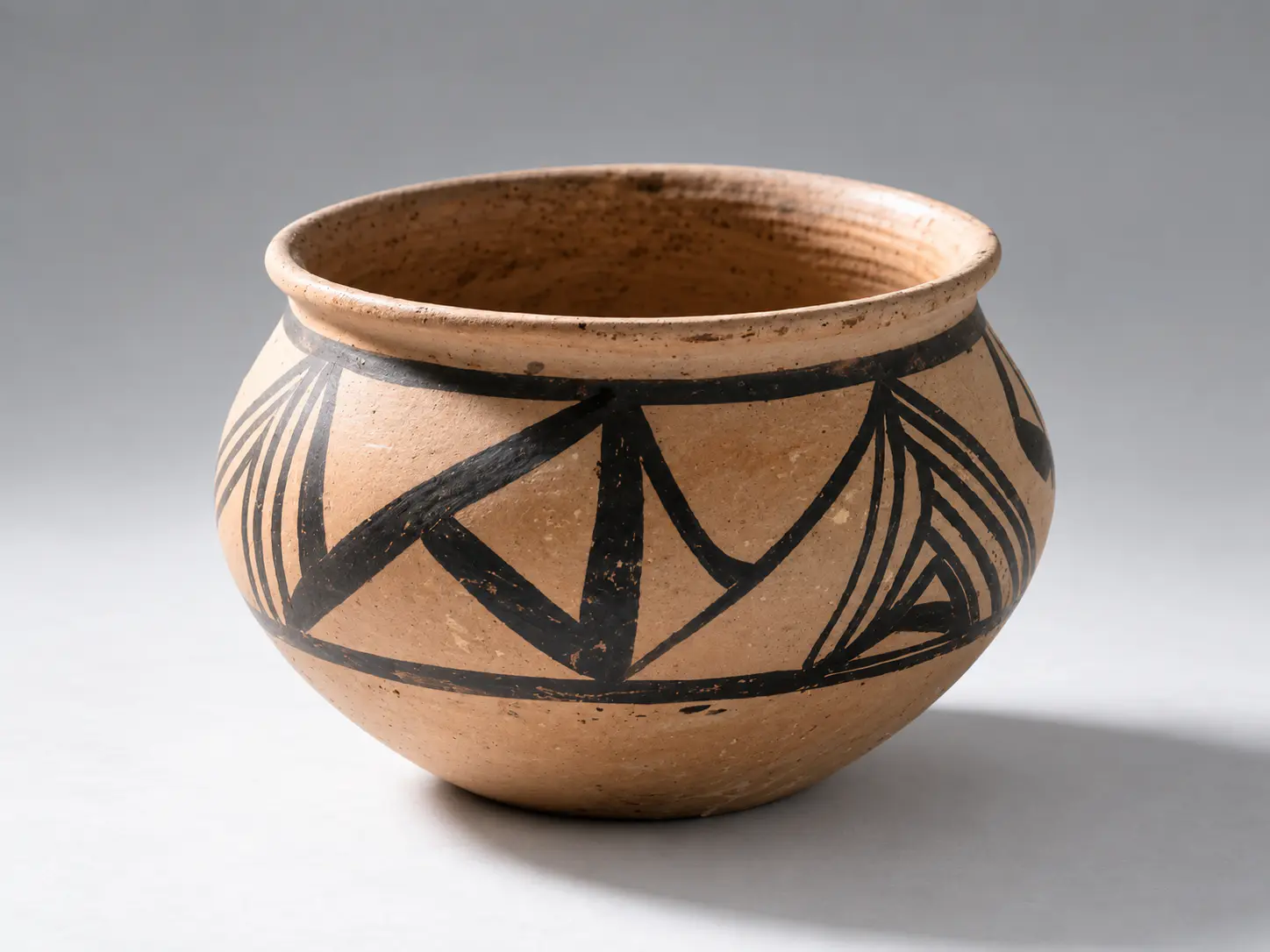
*Painted earthenware jar, Majiayao tradition, Machang phase, ca. 2300–2000 BCE. The Metropolitan Museum of Art, Public Domain.*
The Metropolitan Museum of Art’s survey of the Neolithic period in China emphasizes regional variety: painted wares in the Yellow River basin and other ceramic traditions in eastern and southern China. No one Neolithic culture represents all Chinese pottery.
Shang and Zhou: high-fired ceramics and glazes
The Shang and Zhou periods (c. 1600–256 BCE) matter because they mark a technological path toward porcelain, not because they “invent” it. Kiln temperatures rose. Ceramic bodies became denser. Early high-fired glazes appear. Some ceramic vessels borrow forms from contemporary bronze traditions, which is a reminder that ceramics sat inside a wider material culture of ritual and display. Workshops experimented with raw materials and firing atmospheres. The Met’s historical ceramic survey identifies high-fired stoneware and high-fired glaze as major developments during the Shang period. That is not the same claim as “Shang ware is porcelain.” In Western ceramic language, porcelain is a later, more specific class of high-fired, usually white and often vitrified ware. Shang high-fired stoneware is an earlier step on the same technical ladder: heat, body density and glaze, not a sudden white translucent porcelain industry.
Han ceramics and expanding kiln technology
Han ceramics (206 BCE–220 CE) continue that technical path. Production scaled. Lead-glazed earthenwares became important, including funerary ceramics made for tombs. High-fired southern wares continued. Specialization increased: more workshops, more distinct glaze and body types, more objects made for burial as well as for living use. Han kilns did not produce Jingdezhen blue-and-white, but they belong in the history of Chinese ceramics because large-scale firing, glaze chemistry and workshop organization were already in motion.
Sui and Tang: The Emergence of Porcelain
Porcelain by around AD 600
The British Museum dates the first production of porcelain in China to around AD 600. Ceramic terminology and the boundary between high-fired stoneware and porcelain are not perfectly universal, and Chinese historical language does not always split those categories the way modern Western museum labels do.
In Western ceramic terminology, porcelain is typically understood as high-fired, vitrified, usually white, and often translucent when sufficiently thin. That definition is a visitor’s tool, not a claim that every high-fired Sui–Tang ware looks like later Jingdezhen blue-and-white. For the difference between pottery, stoneware and porcelain, the parent guide remains the vocabulary page.
Tang sancai and the diversity of Tang ceramics
*Sancai* is associated with “three colors,” although actual palettes vary. It is lead-glazed earthenware, not porcelain. The ware is particularly associated with Tang funerary objects. Typical colors include green, amber or brown, cream, and sometimes blue. Figures, animals and vessels were made for tombs. Some cosmopolitan forms reflect contacts with Central and West Asian metalwork and trade. The Met notes that Tang sancai lead glazes were widely used on funerary objects in the late 7th and early 8th centuries, while some shapes reveal the influence of trade with western Asia. The amphora below is useful because the form itself carries that Silk Road connection: Tang ceramics plus exchange plus funerary glaze technology, without implying that sancai is an early porcelain.
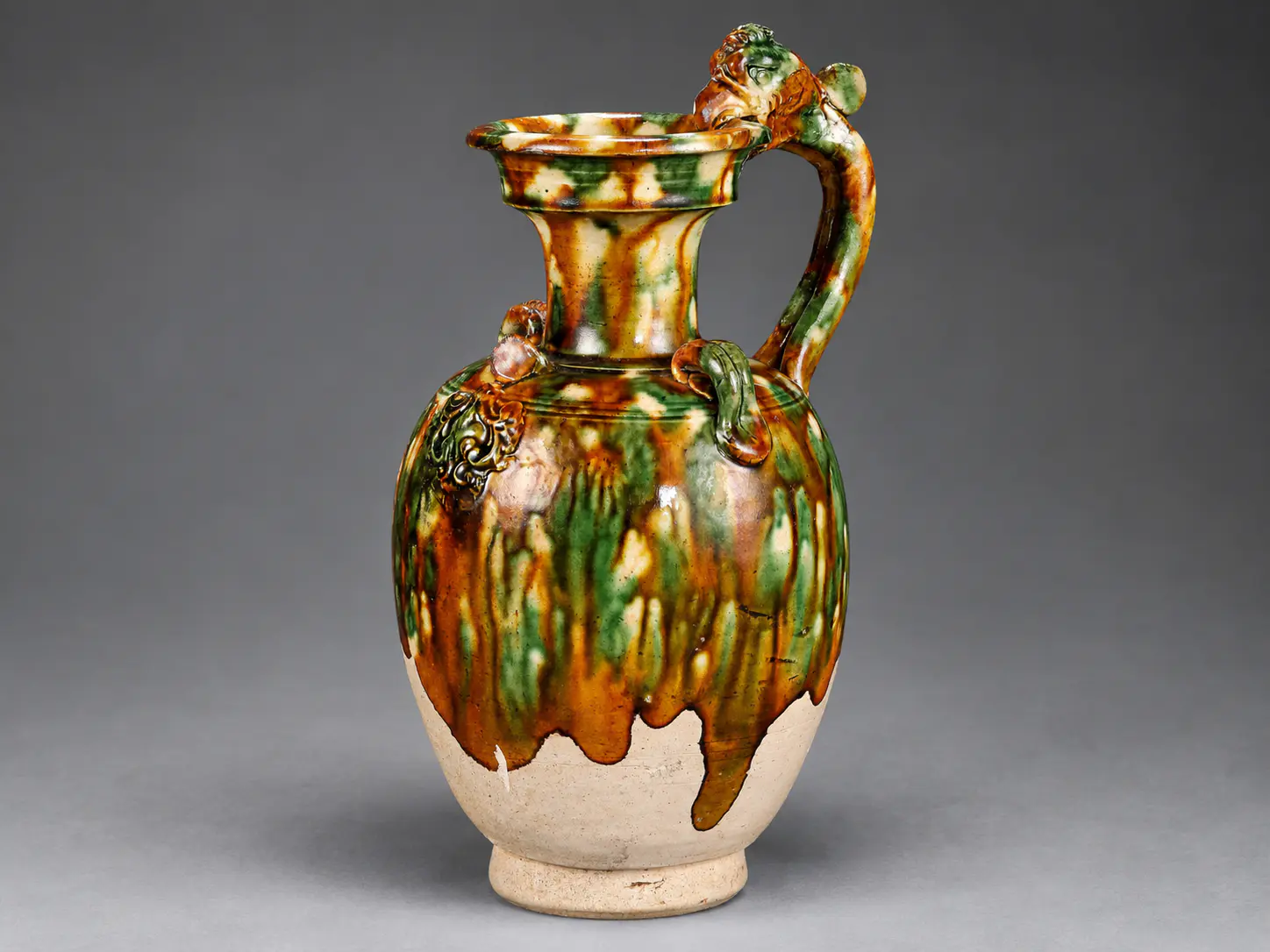
*Sancai-glazed earthenware amphora, Tang dynasty, late 7th century. Its form reflects contacts with western Asia. The Metropolitan Museum of Art, Public Domain.*
Tang ceramic culture was diverse. Sancai is one famous funerary tradition inside a larger field of white wares, celadons and early porcelain. Treating sancai as “Tang porcelain” collapses the very distinction this chronology is trying to keep.
White wares, celadons and expanding trade
Alongside sancai, Tang workshops refined white wares and southern celadon traditions, including Yue and related high-fired green-glazed stonewares. High-fired ceramic technology—body, glaze and kiln control—was already a commercial as well as a technical system. Tang China’s trade connections carried Chinese ceramics into other parts of Asia and the Islamic world. That circulation is a foundation, not yet the later Ming maritime porcelain system. Mass global porcelain export in the Ming and Qing sense had not yet taken that later shape. The Met documents porcelain production by the Sui–Tang period and ceramic exchanges along Silk Road networks. Tang kilns supplied a technological and commercial foundation for Song regional refinement and for later Jingdezhen concentration.
Song Dynasty: Regional Kilns and Ceramic Refinement
The Song dynasty (960–1279) matters because so many kiln systems reached a high level of technical and aesthetic control at once. It is not a catalogue of “famous kilns,” and it is not a claim that Song ceramics are universally the pinnacle of Chinese taste. Many Song wares later became highly influential and prized. The historical point is regional specialization: distinctive clays, glazes and firing systems rather than one completely dominant production center.
A landscape of specialized regional kilns
Song ceramic production was a landscape of important regional kiln systems. Representative traditions include Ding, Ru, Guan, Jun, Longquan, Jian, Cizhou and Jingdezhen *qingbai*. That list is not a complete objective taxonomy, and it should not be reduced to the later collectors’ grouping of “five famous Song kilns.” Ru, Guan, Ge, Ding and Jun have their own later historical and collecting context. For this history of Chinese ceramics, the useful model is regional specialization plus distinctive clay, glaze and firing systems. Longquan, Jian, Cizhou, Ding, Ru, Jun and *qingbai* can coexist in the same century without one list replacing the others. Other ceramic centers continued operating; Jingdezhen had not yet become the industrial center it would be in the Yuan and Ming.
Form, glaze and restrained aesthetics
Many elite Song traditions look different from later Ming and Qing painted porcelain because the visual emphasis often sits on vessel proportion, glaze color, texture, crackle where it is part of the glaze system, and subtle surface effects. Painted decoration is limited in many of those elite traditions. Material and form carry the object. Longquan celadon is the main visual example here: high-fired southern ware in which a greenish glaze and a judged silhouette matter more than cobalt narrative painting. The Met describes Longquan celadon as valued for balanced forms and luminous blue-green glazes. That is a description of one influential tradition, not a rule that all Song ceramics were minimalist. Song production was extremely diverse: dark Jian tea bowls, painted Cizhou stonewares and pale Ding and *qingbai* wares belong in the same dynasty as celadon.
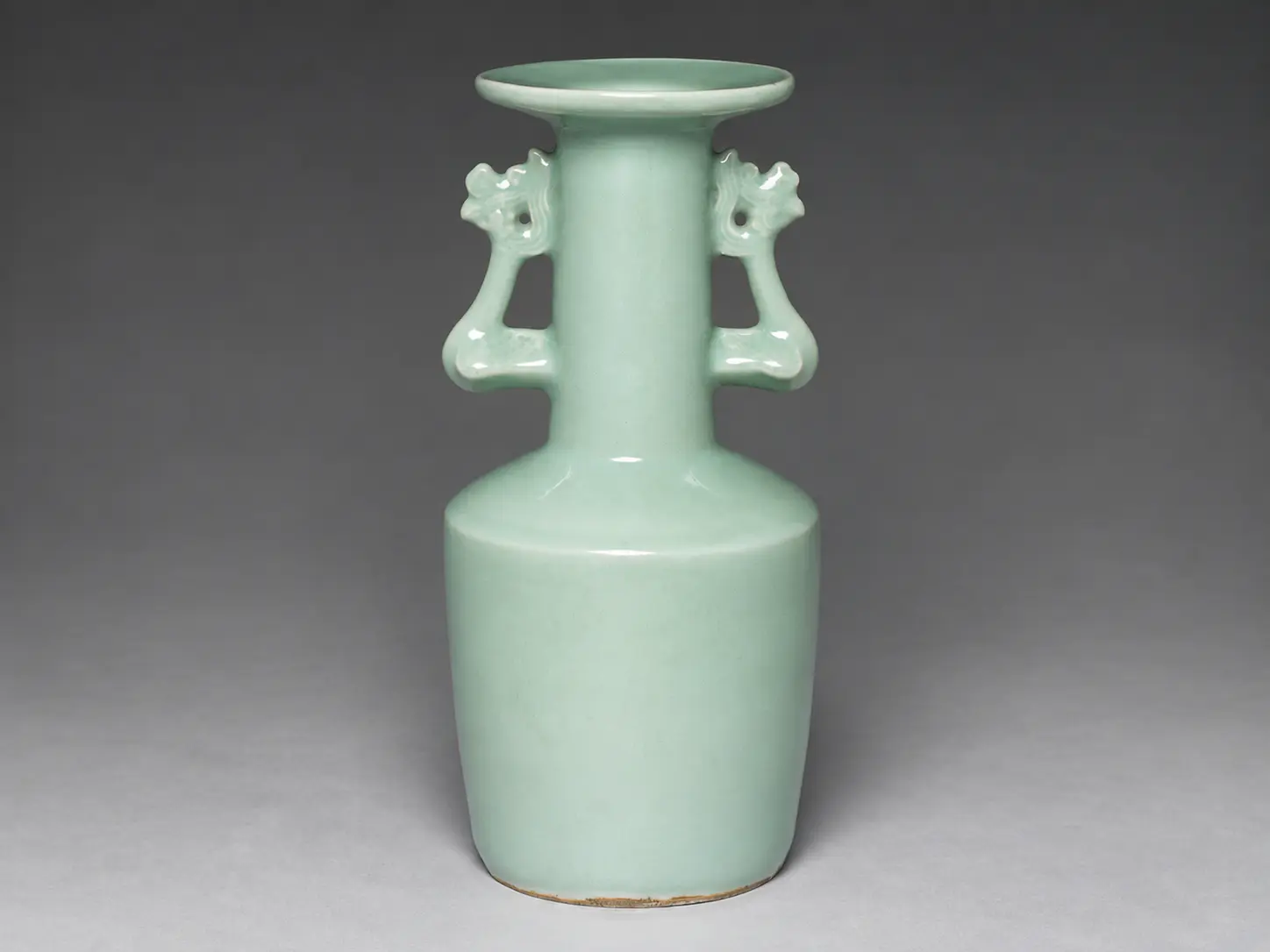
*Longquan celadon bottle vase, Southern Song dynasty, 13th century. The Metropolitan Museum of Art, Public Domain.*
Celadon, white ware and qingbai
Three families help travelers read Song labels without turning this page into a types monograph.
Celadon is high-fired ware with a greenish glaze produced through iron-bearing glazes and controlled firing. Longquan is the Song tradition that most clearly shows why the history of Chinese porcelain cannot be reduced to blue-and-white decoration.
White wares include traditions such as Ding, where pale ceramic bodies and restrained decoration were central.
*Qingbai* refers to bluish-white glazed wares strongly associated with Jingdezhen and surrounding production. *Qingbai* is part of Jingdezhen’s earlier history: a pale, glazed porcelain tradition already in place before Yuan cobalt painting became the globally famous Jingdezhen product.
Ceramics become major trade goods
Song maritime commerce made ceramics major trade goods. Ports such as Guangzhou, Quanzhou, Hangzhou and Ningbo handled ceramic export as a significant commercial activity. Wares circulated across East and Southeast Asia and beyond. British Museum research notes large-scale ceramic exports during the Song period and government support for maritime commerce. Market demand—not only court taste—already shaped what kilns made. That commercial geography is the setup for the Yuan transformation: when Jingdezhen combined porcelain-stone resources, specialist labor and long-distance markets, it did so on top of an existing Song export system, not in an empty southern landscape.
Yuan and Ming: Jingdezhen and the Rise of Blue-and-White
The shift toward Jingdezhen
During the Yuan dynasty (1271–1368), Jingdezhen in Jiangxi Province became increasingly dominant in Chinese porcelain production. The British Museum describes major changes around the early 14th century as regional stoneware centers declined in relative importance and Jingdezhen emerged as the world's leading porcelain manufacturing center. Jingdezhen is in Jiangxi Province: an industrial location defined by porcelain stone, kaolin, kiln infrastructure and specialist labor.
Jingdezhen worked as a system: access to porcelain stone; use of kaolin; skilled specialist labor; kiln infrastructure; division of production tasks; and connections to domestic and international markets. Materials, kiln technology and industrial concentration explain the shift better than a dynasty label alone. Jingdezhen did not replace every other Chinese kiln. Other ceramic centers continued operating. What changed was relative dominance: porcelain production increasingly concentrated where resources, labor and distribution could operate at extraordinary scale. In 2026, UNESCO inscribed the Jingdezhen Handicraft Porcelain Industry Sites on the World Heritage List, recognizing a porcelain-production system shaped by raw materials, kiln technology, specialized labor, workshop organization and trade from the 10th to the 19th century. Jingdezhen became one of China’s most influential historic porcelain centers because materials, labor, kilns and markets aligned there.
Yuan blue-and-white porcelain
Yuan blue-and-white porcelain uses cobalt pigment painted on the ceramic body, a transparent glaze applied over the decoration, and high-temperature firing. Mature Jingdezhen blue-and-white production developed in the 14th century. Earlier blue-and-white precedents existed, but mature Jingdezhen blue-and-white porcelain developed during the Yuan dynasty. The V&A states that Tang blue-and-white precedents existed, but Jingdezhen potters substantially refined the technology during the Yuan dynasty. The Met identifies the 14th-century flowering of Jingdezhen cobalt-blue porcelain as one of the major developments in ceramic history. The history is gradual: cobalt, glaze, Jingdezhen workshop organization and trade networks came together.
Those trade networks connected China and the Islamic world. Cobalt and other materials moved into China; Chinese ceramics moved abroad; foreign forms and decorative ideas returned into production. Many large Yuan blue-and-white objects were produced for international markets. Court, domestic and export buyers already shaped forms and decoration. The plate below is the visual for that transition: Jingdezhen porcelain, cobalt under a transparent glaze, mid-14th century.
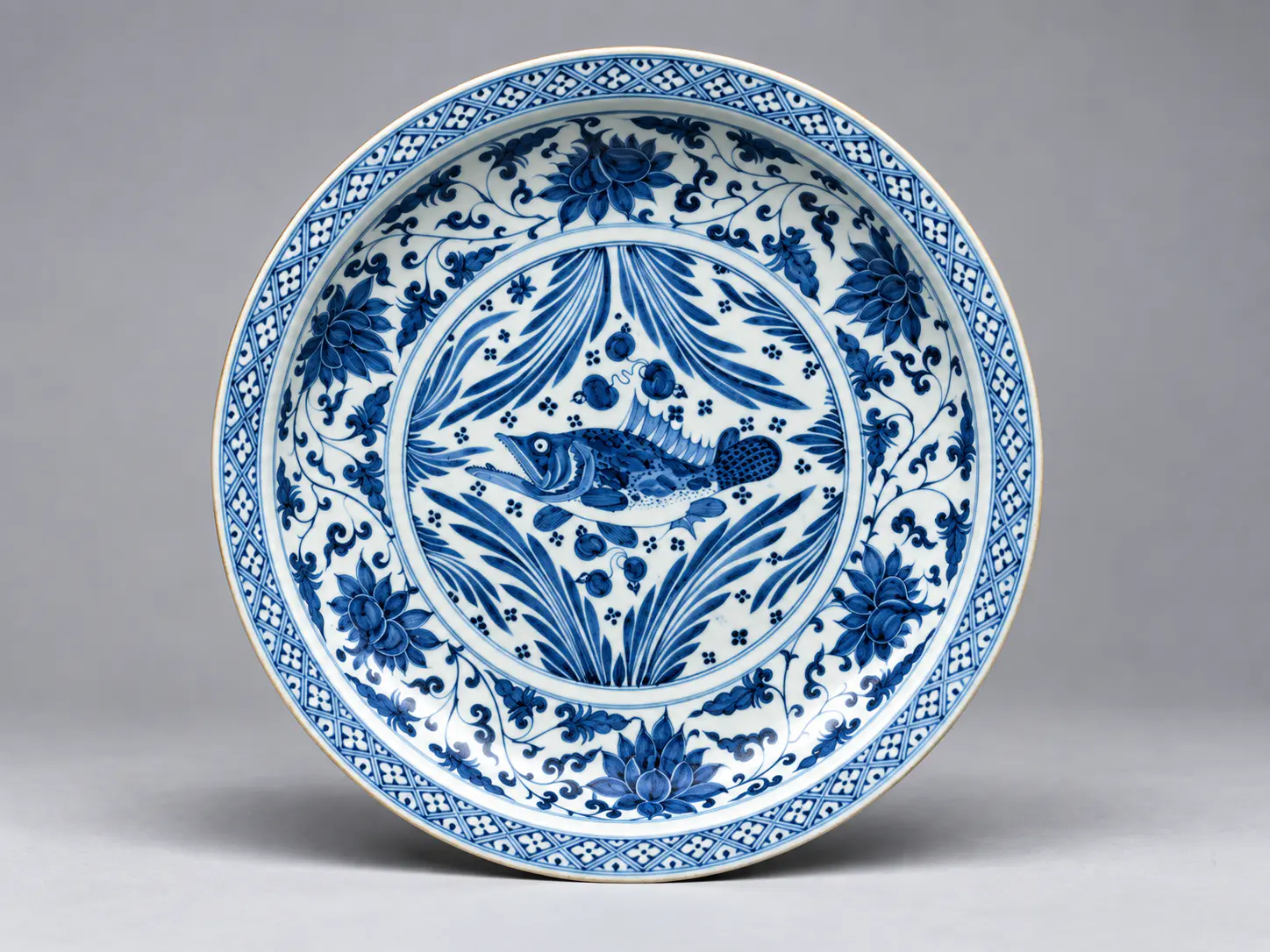
*Blue-and-white porcelain plate with fish, Jingdezhen, Yuan dynasty, mid-14th century. The Metropolitan Museum of Art, Public Domain.*
Ming imperial kilns and court patronage
The Ming dynasty was founded in 1368. Jingdezhen production moved into a closer relationship with the imperial court. Imperial orders and quality control tied porcelain more tightly to political patronage. Reign-specific styles developed. Blue-and-white remained a major medium, while workshops continued experimentation with copper red, monochrome glazes, *doucai* and enamel decoration. Early Ming reigns often cited in museum labels include Yongle, Xuande and Chenghua. Those names mark production periods and quality campaigns, not biographies of emperors. Ming imperial patronage tied Jingdezhen porcelain production more closely to court demand without making court demand the only market.
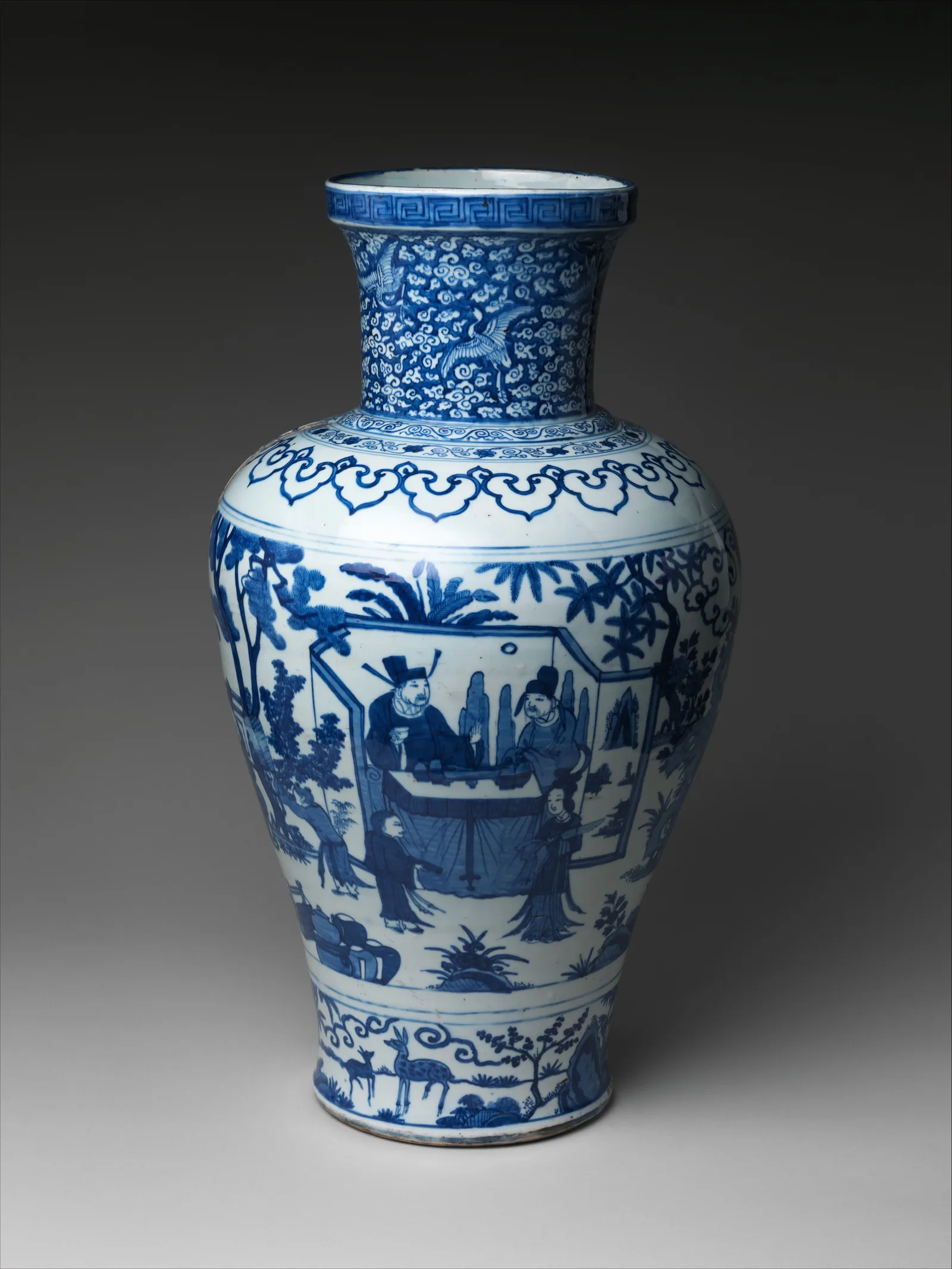
*Blue-and-white porcelain vase with the scholar Zhou Dunyi, Jingdezhen, Ming dynasty, 1587. The Metropolitan Museum of Art, Public Domain.*
The Wanli-marked vase of 1587 shows where the system had arrived by the later Ming: porcelain plus Jingdezhen plus imperial culture plus painted narrative plus blue-and-white production, all in one object. It is a developed industry, not an origin myth.
Ming porcelain becomes a global commodity
Ming Jingdezhen porcelain became a global commodity through overlapping trade systems: Southeast Asian trade, Japanese demand, Middle Eastern markets, Portuguese maritime trade, and later Dutch and other European trading networks. Forms and decorative schemes were sometimes adapted for foreign buyers. The V&A documents widespread export of Chinese blue-and-white to Japan, Korea, Southeast Asia, Africa, the Middle East and Europe. Trade carried Chinese ceramics abroad and brought foreign demand back into Jingdezhen workshops. That scale is why Ming porcelain is famous beyond China.
Qing Dynasty: Imperial Porcelain, New Enamels and Global Trade
Rebuilding production after the Ming–Qing transition
Political disruption affected Jingdezhen production during the 17th-century Ming–Qing transition. Production subsequently recovered. Qing rulers restored and developed imperial ceramic manufacture. Jingdezhen remained central. That is a production history, not a political history of the Qing conquest. The causal thread is patronage plus industrial concentration: when court orders and workshop infrastructure returned, Jingdezhen could again supply imperial, domestic and export markets.
Kangxi, Yongzheng and Qianlong imperial porcelain
Kangxi, Yongzheng and Qianlong deserve attention because they represent a major period of imperial ceramic production. They do not define all Qing porcelain. Minimal monochrome wares and restrained designs also existed.
Kangxi period
The Kangxi period is associated with technically strong blue-and-white, *famille verte* palettes, monochrome glazes and renewed large-scale production after the transition. Workshop recovery and court demand together explain the volume.
Yongzheng period
Yongzheng production is often discussed for refined vessel forms, sophisticated glazes and highly controlled imperial production. *Famille rose* / *fencai* developed in the late Kangxi period and reached a high level of refinement under Yongzheng and Qianlong, making a broader palette of opaque colors possible. Control—of form, glaze and enamel—is the historical emphasis, not a claim that every Yongzheng object is *famille rose*.
Qianlong period
Qianlong commissions include technical virtuosity, elaborate decoration, imitation of other materials, and complex combinations of glaze and enamel techniques. Imperial commissions pushed workshops toward display of skill. At the same time, commercial Jingdezhen production continued for domestic buyers and export. Virtuosity at court and volume for markets are not contradictions in an industrial porcelain city.
Famille verte and famille rose
*Famille verte* is a Western collecting term referring to palettes in which green enamels are particularly prominent.
*Famille rose* is a Western collecting term for porcelain using a palette strongly associated with opaque pink and related enamel colors.
These are European/Western classification terms, not original Chinese dynasty names for all such wares. They help museum visitors name overglaze enamel families. They do not mean *famille rose* was purely a European invention, and they do not mean Qing porcelain equals only pink enamel. Cross-cultural pigment and enamel influences should be stated cautiously: the technology developed in Jingdezhen imperial and commercial workshops, and the French collector labels arrived later as a way to group what Western collections already held.
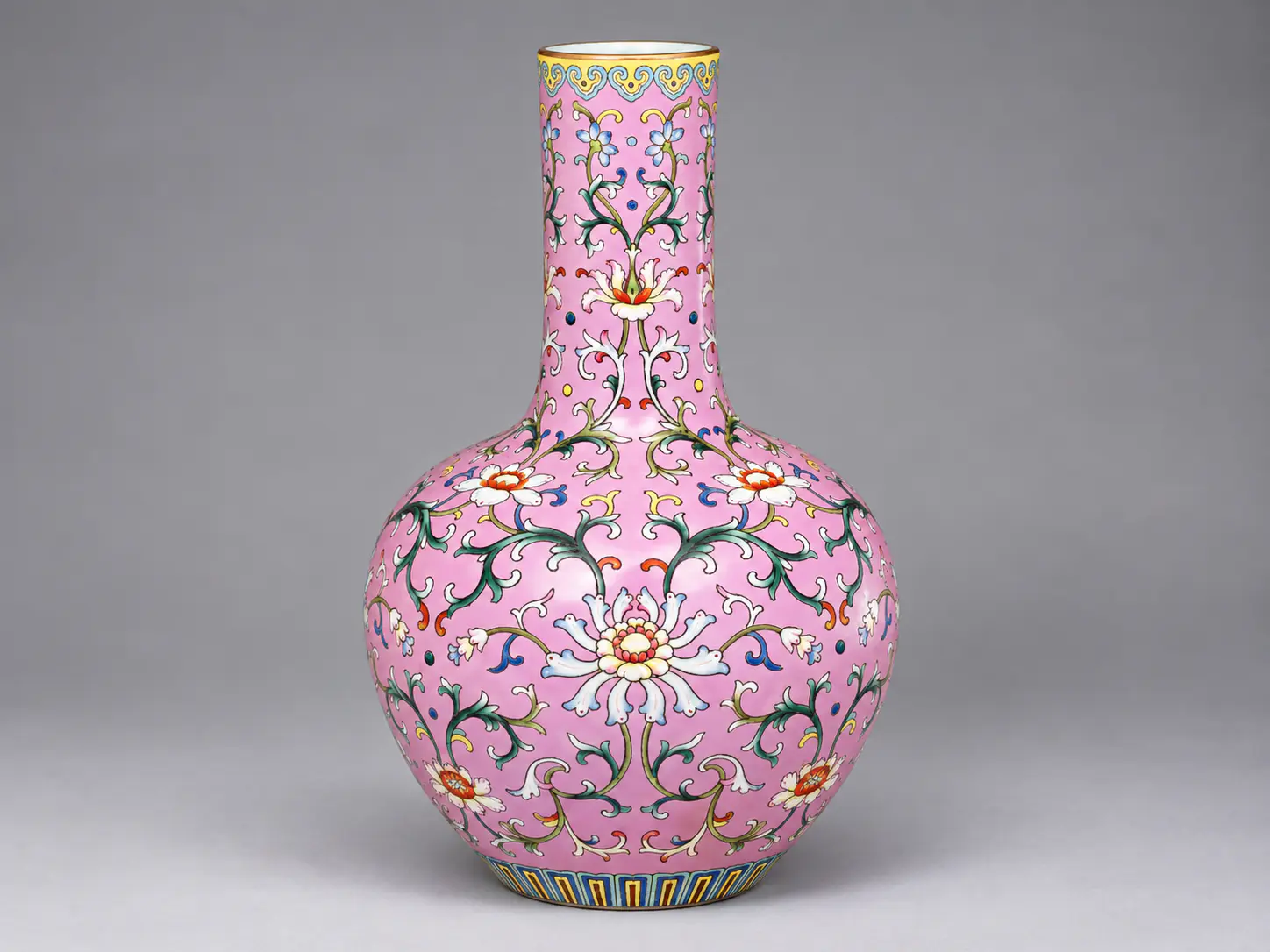
*Jingdezhen porcelain jar with colored overglaze enamels, Qing dynasty, Qianlong period, 18th century. The Metropolitan Museum of Art, Public Domain.*
Porcelain for the court, domestic buyers and export
Qing porcelain was not produced solely for emperors. Imperial wares, domestic commercial production and overseas export coexisted. European commissions adapted foreign forms and decorative motifs; influence also ran the other way as Chinese and European ceramic industries watched each other. The Met notes that Qing ceramics ranged from objects produced primarily for imperial use to porcelain exported in very large quantities. The V&A documents the growing European porcelain trade and Chinese production adapted for overseas buyers. Court, domestic and export markets all mattered. Materials, kiln schedules, enamel firings and buyer specifications explain why a Qianlong jar for the palace and a dinner service for a European trading company can share Jingdezhen origins without sharing the same brief.
The end of the imperial ceramic system
The Qing dynasty ends in 1911. Jingdezhen and other Chinese ceramic centers continued production after the end of imperial rule in 1911, developing modern and contemporary traditions beyond the chronology covered here.
See Chinese Porcelain in Beijing
Many of the historical developments described above can be explored through imperial ceramics in Beijing, especially Ming and Qing porcelain in the Palace Museum. See Forbidden City porcelain and Palace Museum ceramics. Visitors who want help with timing and route choices can also look at the Forbidden City private tour.
Continue with Chinese porcelain
- Chinese Porcelain & Ceramics guide
- Chinese Arts & Crafts
- Forbidden City porcelain and Palace Museum ceramics
Sources & Further Reading
- British Museum — Chinese ceramics; porcelain dated to around AD 600; Jingdezhen; imperial, domestic and export production
- The Metropolitan Museum of Art — Neolithic traditions, Shang high-fired ceramics, Song celadon, Yuan blue-and-white and Qing enamel wares; Open Access object photography
- Victoria and Albert Museum — Chinese blue-and-white ceramics, Yuan refinement and global circulation
- UNESCO World Heritage Centre — Jingdezhen handicraft porcelain industry sites