
Chinese Mythology at a Glance
| Topic | Orientation |
|---|---|
| Gods & divine figures | Gods |
| Creatures | Mythological creatures |
| Legends | Chinese legends |
| Folklore | Chinese folklore |
| Folktales / wonder tales | Chinese folktales |
| Urban legends | Chinese urban legends — modern rumor narratives |
| Religion link | Chinese Religion, folk religion |
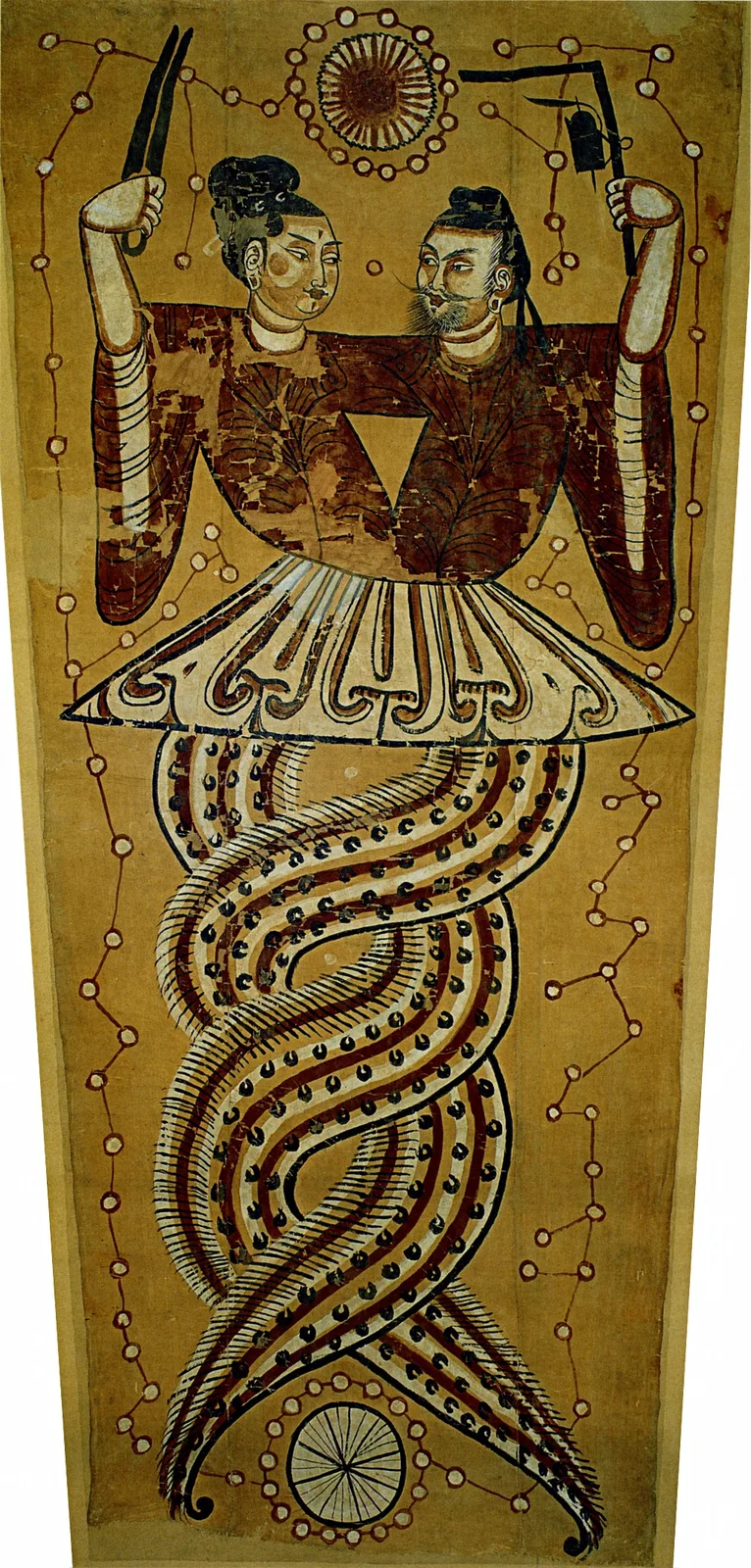
*Anonymous painting of Fuxi and Nüwa. Public domain via Wikimedia Commons. Conservative resize; later art interpreting origin/culture-hero traditions.*
Myth vs Legend vs Folklore vs Folktale
| Term | Working sense |
|---|---|
| Myth | Gods, cosmogony, sacred origins, culture heroes |
| Legend | Named heroic/romantic narratives with place/time coloring (e.g. White Snake) |
| Folklore | Living customary belief/practice motifs (door gods, festival lore) |
| Folktale | Story transmission—including wonder tales sometimes labeled “fairy tales” in English |
| Urban legend | Modern rumor narratives; distinct from classical ghost literature |
These categories overlap, and individual stories can move between religious, literary and oral traditions over time.
Major Gods and Divine Figures
Jade Emperor, popular pantheon figures, local gods and culture heroes—treated carefully as not one fixed hierarchy for all periods. Details: Gods.
Mythological Creatures
Dragons, qilin, fenghuang and others with Chinese symbolic histories—not Western fantasy clones. Mythological creatures.
Creation and Origin Narratives
- Pangu cosmogonic separation motifs in later tellings
- Nüwa repairing/creating humanity traditions
- Fuxi culture-hero associations (trigrams, civilization gifts) often paired with Nüwa in art
These circulate in multiple versions as narrative traditions rather than one single authorized scripture.
Famous Legends
White Snake, Butterfly Lovers and related story cycles—often known via opera and film. Chinese legends.
Folklore and Popular Belief
Door gods, festival beings, protective prints—bridge to folk religion. Chinese folklore.
Folktales and Story Transmission
Oral and written tale traditions, including wonder tales sometimes called “Chinese fairy tales” in English. Chinese folktales.
Literature vs Mythology
*Journey to the West* and other novels reuse mythic/religious material as literature. They are not simply “ancient myths transcribed.” Opera and novels are major traveler contact points—see also Chinese Performing Arts.
Relationship with Chinese Religion
Temple images and festival narratives move between mythology and religion. Daoist religious pantheons relate to Daoism without collapsing philosophy into myth lists.
How Travelers Encounter Mythology
Temple iconography; jade and sculpture motifs; festival stories (e.g. Weaver Girl / Qixi); opera; museum painting.
Common Misconceptions
- No single official pantheon chart for all Chinese history.
- Dragon ≠ Western dragon stereotype.
- Novels ≠ primary ancient myth texts.
- Urban legends ≠ classical zhiguai tales.
Explore Chinese Mythology
Chinese Mythology FAQ
What is Chinese mythology?
Gods, origin narratives, creatures and sacred story traditions across religion and literature—plural, not one book.
Who created the world in Chinese myth?
Multiple origin traditions (Pangu, Nüwa and others) exist in different tellings—no single universal Genesis chapter.
Is Journey to the West mythology?
It is a literary novel that uses mythic and religious figures.
Where do mythology and folk religion meet?
Temple images, festival tales and local gods—see folk religion and folklore pages.
Sources
- Metropolitan Museum of Art — collection essays and object materials on Chinese divine and legendary figures in art.