
Chinese Religion at a Glance
| Topic | Orientation |
|---|---|
| Main question travelers ask | “What is the main religion in China?” |
| Better framing | Plural traditions + overlapping practice |
| Folk religion | Local gods, ancestors, community temples — no single hierarchy |
| Buddhism | Major imported tradition that became deeply Chinese |
| Daoism | Philosophical texts and organized religious communities (related, not identical) |
| Confucianism | Ethical-ritual tradition; sometimes treated as religion, often as philosophy/culture |
| Ancient foundations | Ancestor ritual, divination, Shang–Zhou state cult |
| Traveler surfaces | Temples, caves, Confucian temples, festivals, museums |
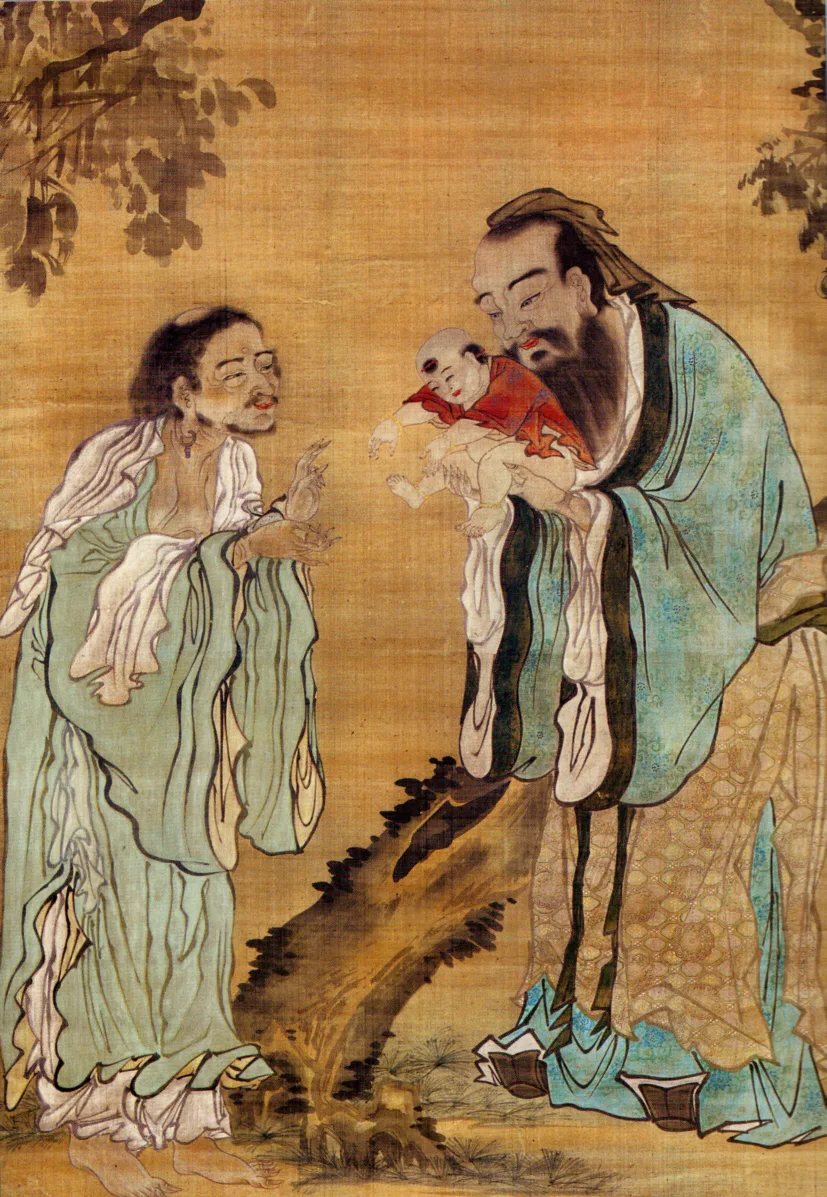
*Historical “Three Teachings” image showing Confucius, Laozi and the Buddha. Public domain historical artwork via Wikimedia Commons. Conservative resize only; the painting is a later interpretive framing, not a photograph of one temple.*
Is There One Main Religion in China?
No single answer fits every region, family or century. Measurement is hard because many people participate in ritual practice (offerings, temple visits, festival rites, ancestor remembrance) without identifying as members of one exclusive denomination. Official and survey categories also change over time. Asking for one “main religion” can be misleading because affiliation and ritual practice overlap and vary by region, family and period.
Chinese Folk Religion
Chinese folk religion is the everyday matrix of local deities (*shen*), ancestor veneration, City God and Mazu temples, household altars and festival offerings. It is not one centralized church with a single scripture or clergy. Practices vary by place and lineage. Many travelers first encounter Chinese religious life here—incense, offerings, temple fairs—even when the building is labeled Buddhist or Daoist.
Buddhism in China
Buddhism in China reached China through multiple overland and maritime transmission routes during the early centuries CE and developed Chinese schools, translation cultures, monasteries, pagodas and cave temples. Chan and Pure Land are among the best-known Chinese Buddhist traditions within a broader Mahayana context; they are not the only forms. Heritage sites from Yungang and Longmen to Leshan and Giant Wild Goose Pagoda show how Buddhism became a major visual and institutional presence.
Daoism and Confucianism: Overlapping Categories
English labels force a clean split between “religion” and “philosophy” that Chinese history does not always share.
- Daoism (Taoism) includes early texts such as the *Daodejing* and *Zhuangzi* and later organized Daoist religious communities, temples and ritual specialists. For its philosophical traditions and major texts, see the DragonTrail guide to Daoism. Religious practice also appears in the folk and temple landscape.
- Confucianism centers ethics, ritual (*li*), family roles and classical learning; Confucian temples and state ritual traditions give it religious dimensions for some observers. For its ethical, philosophical and intellectual history, see the DragonTrail guide to Confucianism. Scholars and institutions differ over whether and in what contexts Confucianism should be classified as a religion.
The historical “Three Teachings” (*sanjiao*, 儒释道) frame—Confucian, Buddhist, Daoist—describes long coexistence and mutual borrowing, not a single merged faith.
Islam and Christianity in China
Islam and Christianity also have long histories in China. Muslim communities developed across trade routes and many regions over centuries, while several Christian traditions established communities through different historical periods. Their regional histories are distinct from Buddhism, Daoism and Chinese folk religion, but they are part of China’s wider religious landscape.
Chinese government material describing major religions practiced in China often lists Buddhism, Taoism, Islam, Catholicism and Protestantism. That administrative classification does not mean folk religion or Confucian ritual culture are absent from lived practice.
Ancient Chinese Religious Traditions
Ancient Chinese religion covers Shang–Zhou ancestral ritual, oracle-bone divination, bronze sacrificial vessels, and changing language for high powers (*Shangdi*, *Tian*) through the Mandate of Heaven. Later imperial ritual at places such as the Temple of Heaven is a Ming–Qing imperial ritual complex—useful for thinking about Heaven and ritual kingship, but not unchanged Shang practice.
How Traditions Overlap in Practice
A single neighborhood may host Buddhist, Daoist and City God temples; a family may observe ancestor rites, visit a Buddhist monastery on a festival day and use Confucian idioms about filial duty. Mythic and literary figures—see Chinese Mythology—circulate through religion, opera and festival culture without belonging to one exclusive shelf.
Where Travelers Encounter Religious Traditions
- Community and City God temples; Mazu temples in coastal regions
- Buddhist monasteries, pagodas and cave temples
- Daoist temples and mountain hermitage sites
- Confucian temples and academy spaces
- Museums with oracle bones, bronzes and ritual jades
- Festival processions and household ritual days
Related reading: Chinese Festivals, Chinese Philosophy, Chinese Mythology.
Common Misconceptions
- China does not have one official “main religion” that describes every household.
- Folk religion is not a failed version of Buddhism or Daoism.
- Confucianism is not simply “not a religion” or simply “a religion”—classification depends on definition and context.
- Daoism as philosophy and Daoism as organized religion are related but not identical.
- Temple of Heaven imperial ritual ≠ Shang ancestral cult.
Explore Chinese Religion
Chinese Religion FAQ
What is the main religion in China?
There is no single main religion that covers all Chinese communities and regions. Folk religious practice, Buddhism, Daoist religion, Confucian ritual culture and other communities coexist; many people participate in ritual without exclusive denominational identity.
What are the major religions in China?
Commonly discussed traditions include Chinese folk religion, Buddhism, Daoism, Islam and Christianity, alongside Confucian ritual culture. Relative visibility varies by place and period.
Is China a Buddhist country?
Buddhism is historically and culturally influential in China, but China is not “only Buddhist.” Folk religion and other traditions remain highly visible.
Is Confucianism a religion or philosophy?
Both framings appear in scholarship and public speech. Confucianism is an ethical-ritual tradition with classical texts; Confucian temples and state ritual give it religious dimensions in some contexts. See Confucianism.
Is Taoism/Daoism a religion or philosophy?
Daoism includes philosophical texts and organized religious practice. Taoism is a common English spelling of the same Chinese term in this context. See Daoism.
What is Chinese folk religion?
Local and household religious life centered on gods, ancestors and community temples without one centralized church. See Chinese Folk Religion.
Sources
- Pew Research Center, *Measuring Religion in China* — affiliation vs practice; folk religion, Buddhism, Taoism and Confucianism in survey context.
- Metropolitan Museum of Art — Chinese Buddhist Sculpture (and related Met collection essays) for Buddhism’s material culture in China.
- Metropolitan Museum of Art — Shang bronze and oracle-bone collection materials for early ritual evidence.
- Chinese government / State Administration for Religious Affairs framing of major religions practiced in China (Buddhism, Taoism, Islam, Catholicism, Protestantism) as an administrative classification, not a complete map of lived ritual life.
Reviewed September 2026.