
Chinese Folktales at a Glance
| Topic | Orientation |
|---|---|
| English “fairy tales” | Common broad English label for these traditional stories |
| Example narrative | Weaver Girl / Cowherd (also festival-linked) |
| Vs legends | Folktales = broader tale types; legends = famous named cycles |
| Festival bridge | Qixi Festival |
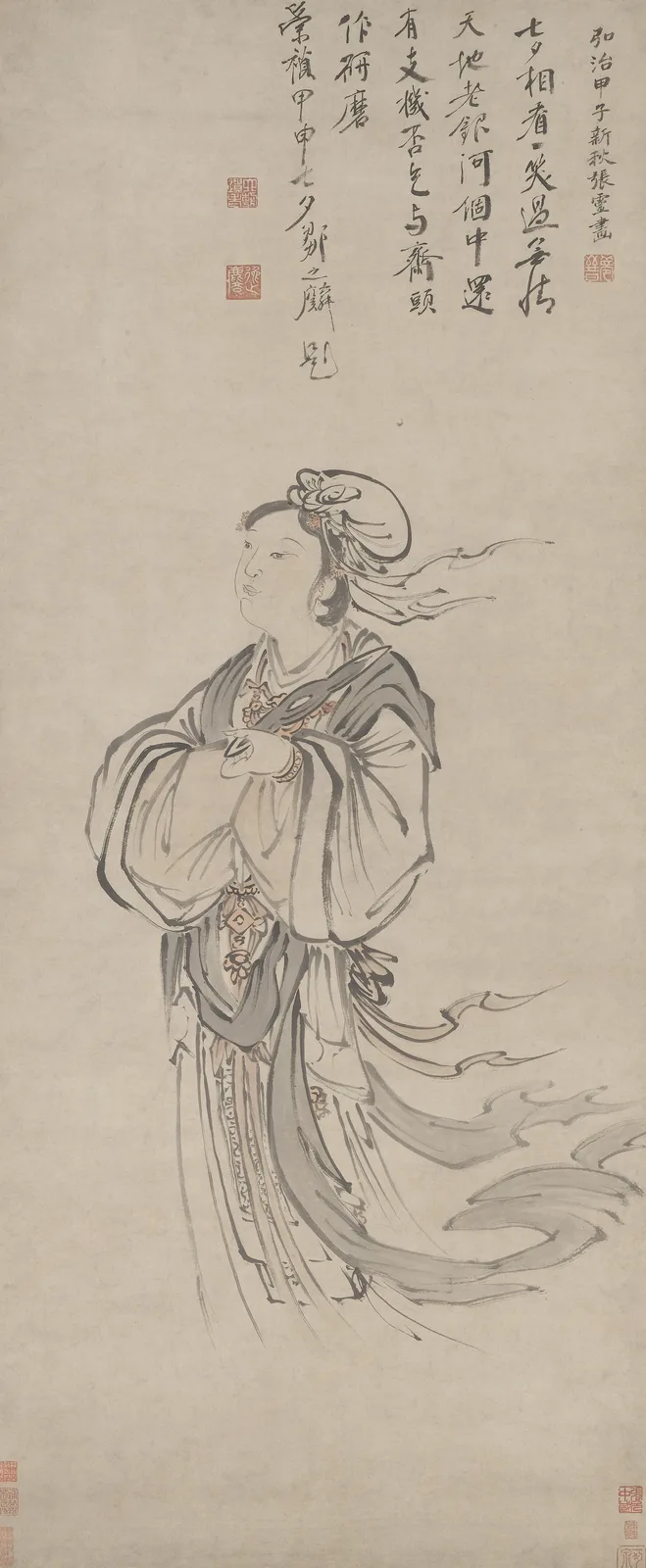
*The Weaver Girl, by Zhang Ling. Public domain via Wikimedia Commons. Conservative resize. Narrative art for a major tale/festival tradition.*
Folktale vs Fairy Tale Terminology
“Fairy tale” implies European fairies and a specific literary history. Folktale or wonder tale is usually clearer for Chinese materials, even when English books use “fairy tales” as a broad label.
Weaver Girl and Cowherd
A major tale of separated lovers linked to the Qixi festival—story + calendar ritual. See Qixi.
Story Transmission
Oral telling, storybooks, children’s editions, animation and school texts all rewrite tales. There is rarely one “the original.”
Boundaries with Legends and Myth
Origin myths stay on the mythology hub. Famous opera legends: Chinese legends. Custom motifs: folklore.
Common Misconceptions
- Chinese tales ≠ Grimm with chopsticks.
- Children’s book versions ≠ ethnographic field texts.
- One motif can appear in myth, festival and children’s tale differently.
Chinese Folktales FAQ
What are Chinese fairy tales?
English-language books and websites sometimes use that phrase as a broad label for these traditional stories; this guide treats them as Chinese folktales/wonder tales rather than European fairy lore.
What is the Weaver Girl story?
A traditional narrative of the Weaver Girl and the Cowherd, linked to Qixi.
Are folktales the same as legends?
Overlapping storytelling world. Famous named story cycles such as White Snake are treated separately as legends in this guide; broader tale transmission is covered here.
Related Pages
Sources
- Festival context for Weaver Girl / Cowherd narratives: Qixi Festival.
- Related named cycles: Chinese legends.